Qubbet el-Hawa: The Rock-Cut Governors’ Necropolis at Aswan
Site at a Glance
- Rating
- 4.7
- Popularity
- Low
- Country
- Egypt
- Primary era
- Bronze Age
- External website
- Open
- Eras represented
- Bronze Age, Medieval
- Civilizations
- Byzantine, Egyptian, Fatimid
- Site type
- Burial
- Remains
- Necropolis
On this page23 sections
History
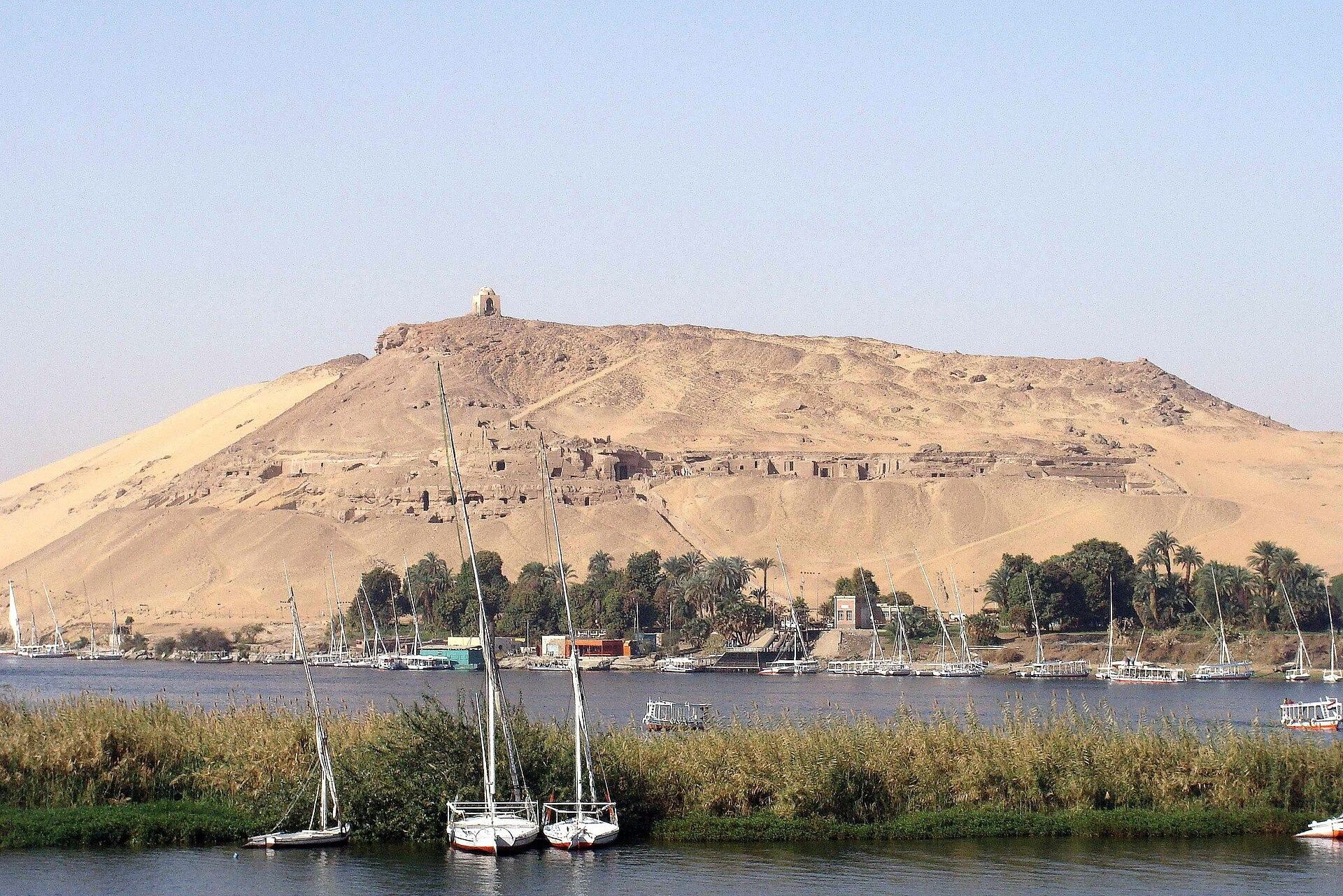
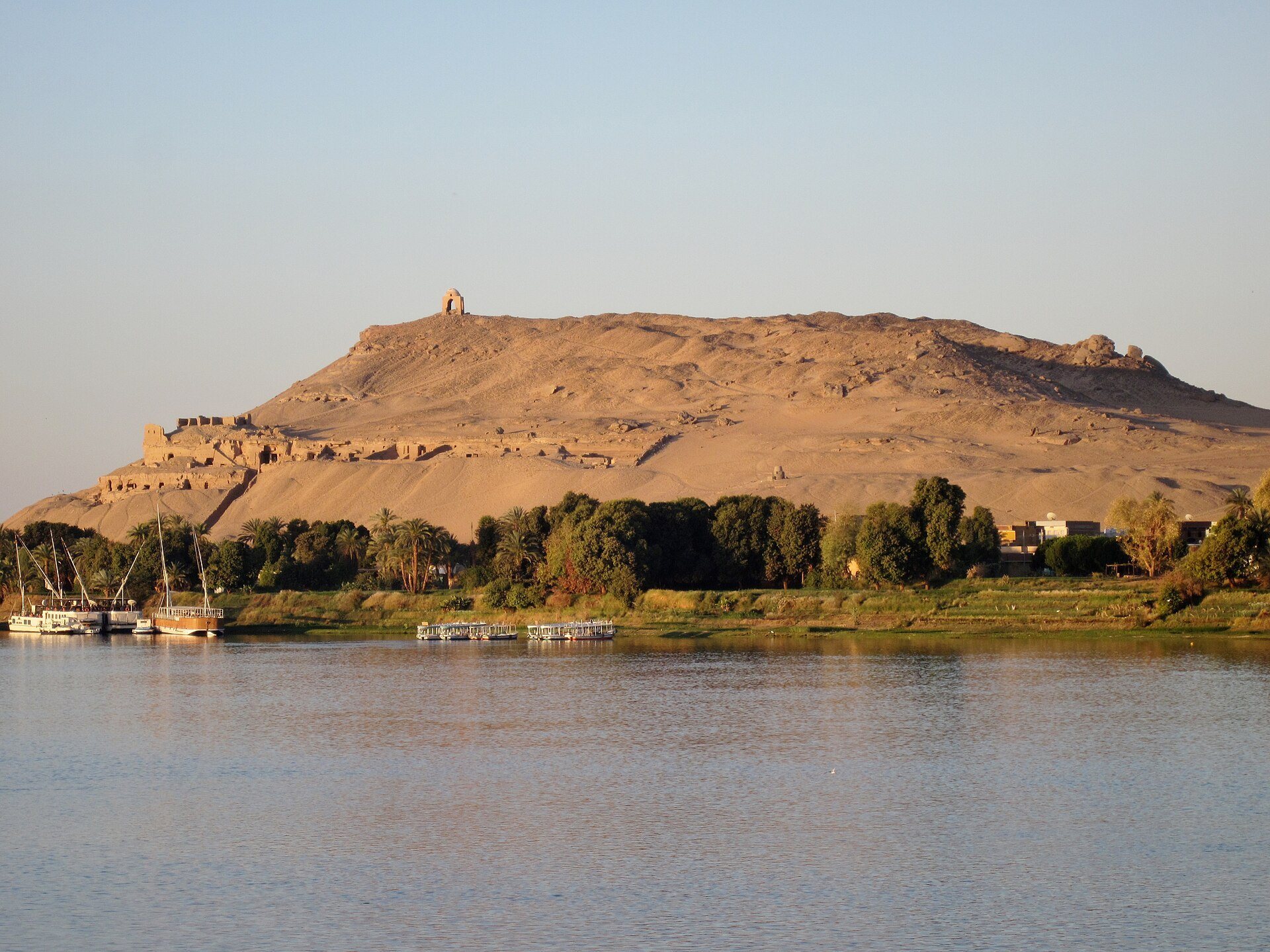
Qubbet el-Hawa is a rock-cut necropolis on the western bank of the Nile opposite Aswan in Egypt, built and used by ancient Egyptian communities from the later Old Kingdom through later historical periods. The cemetery stands slightly more than 1 km north of Elephantine, the capital of Upper Egypt’s First Nome, an administrative province whose center served as Egypt’s southern frontier, military base, and gateway to Nubia and lands farther south. Its tombs preserve the careers of governors, military leaders, priests, and administrators whose duties joined provincial government with diplomacy, trade, and royal expeditions.
Origins and Old Kingdom governors
Burial at Qubbet el-Hawa began by at least the later Old Kingdom, with evidence extending from the Fifth or Sixth Dynasty to the Roman period. One proposed early phase belongs to the reign of Djedkare Isesi in the Fifth Dynasty. A later group is associated with Mekhu, Sabni, and Harkhuf, whose careers reveal the responsibilities carried by Elephantine’s governors and officials.
Mekhu and his son Sabni served as governors during the Sixth Dynasty. Mekhu died while taking part in an expedition to Wawat. Sabni arranged for his father’s body to be recovered and was rewarded by Pepi II with provisions, ointments, and the services of royal embalmers. Their tombs preserve the connection between provincial authority, military expeditions, and the court.
Harkhuf, whose tomb is QH34n, led expeditions with his father during the reign of Merenre to Yam and Libya. The expeditions returned with aromatic oil, ivory, grain, and animals. An inscription preserves a letter from Pepi II asking Harkhuf to bring a small foreign performer to the royal court. These texts provide direct insight into the movement of people and goods between Egypt, Nubia, inner Africa, and the royal administration.
First Intermediate Period and Middle Kingdom
The First Intermediate Period, a phase of political fragmentation between the Old and Middle Kingdoms, is represented at the necropolis by the tomb of Setka, also called Setikai, QH110. Its scenes include Nubian mercenaries associated with the conflicts of that age. The cemetery continued to develop during the Middle Kingdom, when Elephantine’s governors received larger funerary complexes built between the reigns of Senusret II and Amenemhat III.
Sarenput I was appointed governor of Elephantine by Senusret I. His tomb describes his advancement through the provincial administration and his logistical role in organizing the king’s Nubian campaign. Other Middle Kingdom complexes belonged to officials connected with the Heqaib tradition, including Heqaib son of Penidebu and Heqaib son of Sithathor. Sarenput II, son of Khema, was active between the reigns of Senusret II and Senusret III, while Heqaib-Ankh, also called Heqaib III, belongs to the period between Senusret II and Amenemhat III.
The inscriptions from this period show that the governors of Elephantine were more than local administrators. A governor of a nome could oversee taxation and local government while also commanding troops, arranging transport, conducting diplomacy, and organizing expeditions for the king. The tombs therefore preserve both personal biographies and evidence for the workings of Egypt’s southern frontier.
Reuse and later ancient occupation
Several tombs were reused as burial places after their original construction. QH34h, belonging to Khunes, was later incorporated into the area occupied by a Coptic church. The tomb of Kakm, which originated in the Middle Kingdom, was reused in the New Kingdom by Kakm, a high priest of Khnum and overseer of the priests of Elephantine. Khnum was the local god associated with Elephantine and the life-giving waters of the Nile, making Kakm’s office an important religious position in the region.
New Kingdom activity included the complex of User at Qubbet el-Hawa North, dated to the middle of the Eighteenth Dynasty under Amenhotep III. Another tomb belonged to Amenhotep, an Elephantine official active under Hatshepsut and Thutmose III. Other burials were connected with User Wadjat and officials serving the administration of Elephantine. Older tombs continued to receive secondary burials, apparently into the Twenty-Sixth Dynasty.
The cemetery was probably abandoned around the end of the fifth century BCE, although occupation of the hill continued through the Byzantine and medieval periods. From the sixth century CE, Coptic monks adapted some ancient tombs for a monastic complex and church. Coptic refers to the Christian tradition of Egypt, whose monastic communities frequently reused earlier sacred and funerary structures.
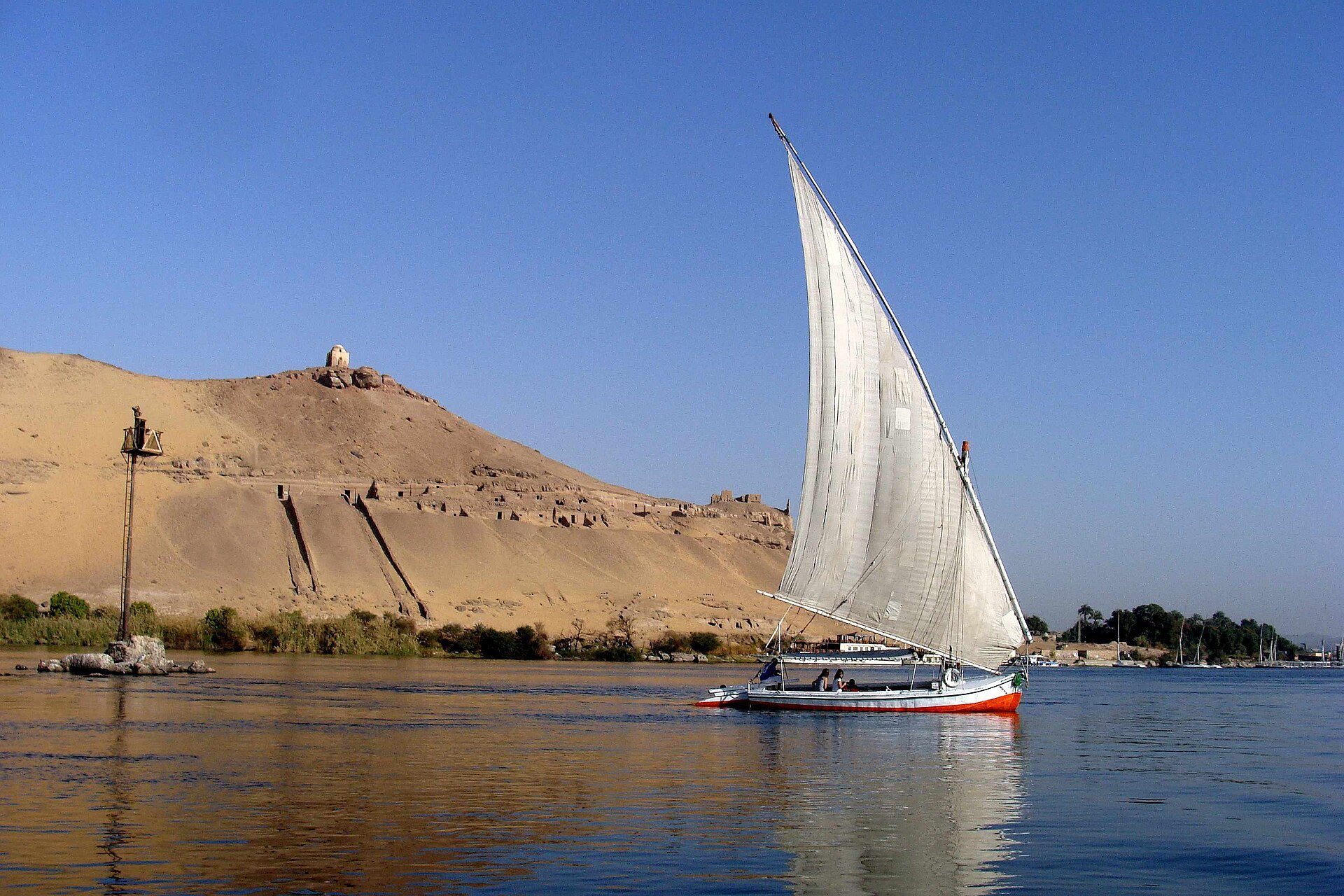
The modern name Qubbet el-Hawa means “Dome of the Wind.” It comes from the domed mausoleum of the Muslim sheikh Sidi Ali Abu el-Hawa on the summit. A study published in 2024 associated him with the Fatimid period and stated that his followers later erected the dome over his grave. In archaeological usage, Qubbet el-Hawa generally refers to the terraces and rock-cut tombs below the mausoleum as well as the hilltop structure.
Exploration, excavation, and continuing research
The scientific commission accompanying Napoleon Bonaparte’s Egyptian expedition first documented the site in 1799. Johann Ludwig Burckhardt later described tombs and other structures in notes published in Travels in Nubia in 1819. Excavation began in 1885 under the British general Francis Grenfell after antiquities from the hill appeared on the Aswan market. Wallis Budge took part in work connected with the 1886 campaign, which exposed more than twenty tombs and inscriptions associated with governors of the Sixth and Twelfth Dynasties.
Ernesto Schiaparelli began work in 1892 and discovered Harkhuf’s tomb. During the 1890s, Jacques de Morgan catalogued and published additional tombs and inscriptions relating to Sabni, Pepinakht, Sarenput I, and Harkhuf. Lady William Cecil, supported by Howard Carter, excavated at the necropolis from 1902 to 1904.
Labib Habachi worked at Qubbet el-Hawa from 1946 to 1951, excavating a large group of burials around the hypogeum associated with Heqaib and investigating the tomb of Setka. Elmar Edel resumed systematic research in 1957 and continued almost annually until 1984, searching for new tombs and recording earlier discoveries in greater detail. Italian investigations resumed in 2003, followed by the University of Jaen’s archaeological project from 2008. Ten campaigns between 2008 and 2018 used photogrammetry, terrestrial laser scanning, and three-dimensional recording to examine the necropolis and its underground tombs. Later work involved the University of Birmingham, the Egypt Exploration Society, and Egyptian and international teams.
Recent discoveries have expanded knowledge of the cemetery’s burial population. In 2016, excavators found wooden inner and outer coffins belonging to Sattjeni, a daughter of Sarenput II. The following year, the tomb of Shemai, Sarenput II’s brother, yielded inner and outer wooden coffins, funerary equipment, a mask, a necklace, and a mummified body covered with cartonnage, a stiff decorated material formed from layers of textile or papyrus coated with plaster.
In 2019, an undisturbed deposit contained ten crocodile mummies. Five were relatively complete bodies and five were heads in varying states of preservation. They represented Crocodylus niloticus and Crocodylus suchus, with lengths of approximately 1.8 to 3.5 m. The same period of research revealed six mastaba tombs, two shaft tombs, and a rock-cut tomb containing multiple burials. These discoveries date to the Old Kingdom, and one tomb had been entered by looters through its rear wall in antiquity.
In June 2025, three further Old Kingdom tombs were announced. They date to the late Sixth Dynasty and contain vertical shafts, small courtyards, false doors, offering tables, pottery vessels, and human remains. Evidence of later reuse during the Middle Kingdom shows that the cemetery continued to be adapted long after the original burials.
In 1979, the Old and Middle Kingdom tombs were included in the UNESCO World Heritage property “Nubian Monuments from Abu Simbel to Philae.” Egyptian authorities announced restoration and preparation work in 2022 to make additional tombs accessible for public viewing.
Remains
Qubbet el-Hawa occupies a sandstone hill on the western bank of the Nile opposite northern Aswan. The principal archaeological zone covers approximately 1.2 hectares, and the hill rises to about 130 m. The main governor’s tombs are cut into artificial terraces at elevations of roughly 130 to 135 m, below the summit and the Islamic mausoleum. More than 100 underground tomb complexes, or hypogea, have been identified, arranged at several levels and often in three superimposed rows.
Old Kingdom tombs
Mekhu and Sabni
The connected tombs QH25 and QH26 belonged to Mekhu and his son Sabni at the southern end of the necropolis. They have separate entrances and two long ramps, with the southern access leading to Mekhu’s chapel and the northern access leading to Sabni’s chapel. QH25 covers approximately 150 sq m and has three rows of six columns. Its principal false door stands behind a cult niche, with a granite offering table in front, while four additional false doors occupy the western and southern parts of the complex. Traces of the original stucco coating survive on the exterior.
QH26 covers about 120 sq m, and its ceiling is supported by fourteen pillars arranged in two rows. A wall painting shows Sabni hunting birds and fish with his daughters and remains especially well preserved.
Sobekhotep and Heqaib son of Sithathor
Tomb QH29, belonging to Sobekhotep, covers approximately 15 sq m. A central pillar supports the ceiling, and two additional shafts descend from the main chamber. Inscriptions on 55 excavated vessels helped identify the owner after the tomb’s wall inscriptions had been damaged.
QH30 belonged to Heqaib son of Sithathor and covers approximately 78 sq m. Six pillars stand in two rows, while the cult niche and false door are positioned opposite the entrance, about 30 cm above the main chamber. Painted stucco covered the niche, and two further burial shafts open from the chamber. Nearby QH30b, belonging to Anch-nef-itef, covers about 10 sq m and contains one supporting pillar, a burial shaft, and a burial chamber. A small opening links the main chamber with a subsidiary room probably used for storage. Fifteen vessels helped establish the owner and date of the tomb.
Harkhuf and Pepinakht
QH34n, the tomb of Harkhuf, has a main chamber of approximately 25 sq m supported by three pillars. Its facade preserves autobiographical inscriptions and the letter from Pepi II concerning Harkhuf’s expedition. The texts connect the physical tomb with the official’s journeys to Yam and Libya and with the exchange of goods and people between the southern regions and the Egyptian court.
QH35d belonged to Pepinakht Heqaib. The tomb was probably begun and then abandoned because of its small size. A cult hall below it, excavated by Habachi in 1947, contains well-preserved wall paintings, and numerous small contemporary tombs surround the structure. QH35e, belonging to Sabni II, lies in the forecourt of QH35d. It covers approximately 60 sq m and has four supporting pillars. Its paintings show Sabni with a staff and sceptre, while an inscription records his organization of the production and transport of two obelisks.
Middle Kingdom governor complexes
Sarenput I
QH36 belonged to Sarenput I and is among the earliest Middle Kingdom tombs at Qubbet el-Hawa. Its inscription describes his advancement in the provincial administration and his role in organizing Senusret I’s Nubian campaign. The tomb forms part of the group of governor’s complexes whose inscriptions connect funerary commemoration with royal service.
Khema, Sarenput II, and Heqaib-Ankh
The QH31 to QH33 group comprises three adjacent Middle Kingdom rock-cut complexes. QH32 belonged to Khema, QH31 to his son Sarenput II, and QH33 to Heqaib-Ankh, also called Heqaib III. QH32 was built before QH31. Together, the complexes contain chambers, corridors, chapels, vertical shafts, and burial chambers arranged through complex internal plans. QH33 has been studied in relation to solar and cardinal orientation, including alignment toward the winter solstice. QH31 is one of the major tombs of the necropolis because of its architecture and decoration.
Khunes
QH34h belonged to Khunes and his wife. It covers approximately 85 sq m and contains several passages and chambers supported by eight pillars. Their joint burial forms part of the varied family arrangements represented in the necropolis, where the tombs preserve the connections between governors, relatives, and officials.
Other funerary complexes and later reuse
Henebaba and Sobekhotep
QH88, the tomb of Henebaba, has a small, nearly square main chamber supported by four pillars. Four passages lead to burial chambers that contained 434 vessels, together with small objects, jewelry, beads, and vases. QH89, belonging to Sobekhotep, covers approximately 80 sq m, with a ceiling supported by thirteen pillars. The 185 vessels found there date the tomb to the reign of Pepi II. Skeletal evidence indicates that Sobekhotep came from outside the local population, and several of his descendants were also buried at Qubbet el-Hawa.
Ishemai and Setka
QH98 belonged to Ishemai. Its cult chamber measures approximately 6.67 by 3.48 by 7.91 m and is supported by three pillars. Four rectangular decorated fields contain reliefs and paintings of Ishemai with priests, subordinates bringing cattle, and offering bearers. The pigments remain well preserved.
QH110, the tomb of Setka, covers approximately 70 sq m and has two rows of eight pillars. Two cult niches with false doors stand opposite the entrance, and an offering table formerly placed before the right niche now rests against the wall. A later opening through the exterior wall reflects the tomb’s reuse within the Coptic monastery. Its inscriptions and paintings survive in a partly damaged condition.
Monastic and Islamic remains
The Coptic church
The Coptic church stands on the hillside above the principal pharaonic tombs, approximately 100 m above the Nile, and covers about 270 sq m. It reused earlier funerary structures, particularly the area around QH34h. Coptic wall paintings and other architectural remains survive within the complex, showing how the ancient necropolis was adapted for Christian monastic use from the sixth century CE.
The summit mausoleum
The summit contains the domed mausoleum of Sidi Ali Abu el-Hawa, a conspicuous white pavilion. Its dome gave the hill its modern Arabic name, while the terraces below retain the principal concentration of rock-cut tombs.
Recent discoveries
Coffins and crocodile mummies
The wooden coffins of Sattjeni and Shemai add richly furnished Middle Kingdom burials to the material remains of the governor’s cemetery. The crocodile deposit found in 2019 contained bodies and heads whose resin had not survived and whose linen bandages had largely deteriorated through insect activity. Their condition allowed detailed morphological and skeletal measurement of the two crocodile species.
Old Kingdom tombs
The Old Kingdom discoveries made in 2019 and 2020 included mastabas, shaft tombs, and rock-cut chambers with multiple burials. Their entrances included vertical shafts and mudbrick blocking, and some chambers measured approximately 190 by 285 cm while others measured about 352 by 635 cm. The three late Sixth Dynasty tombs announced in 2025 contain the characteristic combination of vertical shafts, small courtyards, false doors, offering tables, and pottery vessels, together with human remains and evidence of Middle Kingdom reuse.