Caughnawaga Indian Village Site: A Seventeenth-Century Mohawk Village
Site at a Glance
- Rating
- 4.8
- Popularity
- Very Low
- Country
- United States
- Primary era
- Early Modern
- External website
- Open
- Eras represented
- Early Modern
- Civilizations
- Unclassified
- Site type
- Military
- Remains
- Fortified Town
On this page7 sections
History
Caughnawaga Indian Village Site is a seventeenth-century Mohawk village site west of present-day Fonda in New York, United States. The Mohawk, one of the original Five Nations of the Haudenosaunee, occupied the settlement from at least 1666 to 1693. Its precise construction date is uncertain, since both 1666 and 1679 are associated with the village’s establishment at its present location.
Settlement and mission
Historians believe the community was first located upstream at the Fox Farm site and moved to Caughnawaga in 1679. The village housed approximately 300 people, according to an estimate by archaeologist Dean Snow, making it smaller than the earlier Fox Farm settlement. By that time, some Mohawk Catholics had moved to Kahnawake, a Mohawk community south of Montreal along the St. Lawrence River.
French Jesuits, members of a Catholic religious order active in missionary and educational work, established a mission at Caughnawaga in 1668. It continued until 1679, providing Christian instruction and teaching some Mohawk residents to read and write in French. The Mohawk also maintained trading relationships with French colonists from Quebec, Dutch settlers based in Albany, and the English who later took control of Dutch territory. French pressure in the late seventeenth century contributed to the movement of some Mohawk, including Catholic converts, toward mission communities near Montreal and along the St. Lawrence River.
Discovery and recognition
Reverend Thomas Grassmann discovered the site in 1950. It became the only Mohawk village site in the United States to be completely excavated for archaeological study. Caughnawaga was added to the U.S. National Register of Historic Places, the federal register of places important in American history, archaeology, architecture, engineering, or culture, on August 28, 1973. The listed area covers 135 acres, or 55 hectares.
The archaeological site is associated with the Saint Kateri Tekakwitha National Shrine and Historic Site, which is dedicated to Kateri Tekakwitha, a seventeenth-century Mohawk woman who converted to Catholicism and was canonized in 2012 as the first Native North American saint in the Roman Catholic Church. The grounds also include the Mohawk-Caughnawaga Museum, where artifacts recovered during excavations at the village are held.
Remains
Village layout and defenses
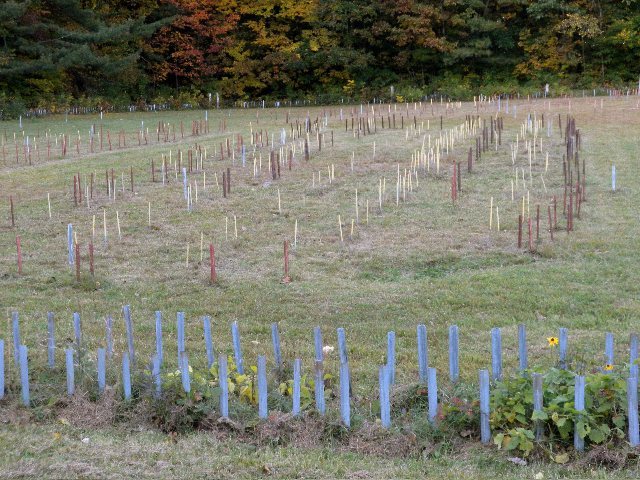
The settlement occupied a hill on the north side of the Mohawk River near a natural spring. A defensive palisade once enclosed the village, and stakes now mark the outlines of twelve longhouses and the stockade. Longhouses were large communal dwellings used by many Indigenous peoples of the northeastern woodlands. Together, these marked outlines indicate the former residential arrangement and fortified boundary of the settlement.
Museum and shrine grounds
The memorial and archaeological site lie within the grounds of the Saint Kateri Tekakwitha National Shrine and Historic Site, near the Mohawk-Caughnawaga Museum and shrine chapel. Artifacts recovered during excavation are included in the museum’s collections, connecting the surviving village layout with material remains from the settlement.
Name and place
The name Caughnawaga derives from the Mohawk word kahnawà꞉ke, meaning “place of the rapids,” a reference to nearby rapids in the Mohawk River. Historical records also used the forms Gandaouage and Kachnawage, with the latter glossed as “Indian Castle” or “fortified place.”