Broughty Castle: A Fortified Stronghold on the River Tay


Site at a Glance
- Rating
- 4.5
- Popularity
- Medium
- Country
- United Kingdom
- Primary era
- Medieval
- External website
- Open
- Eras represented
- Medieval, Early Modern, Modern
- Civilizations
- British, English, Kingdom of Scotland
- Site type
- Military
- Remains
- Castle
On this page11 sections
History
Broughty Castle is a Scottish medieval fortress in the United Kingdom, standing at Broughty Ferry near Dundee at the mouth of the River Tay. Royal permission to fortify the site was granted in 1454 to George Douglas, 4th Earl of Angus, and the central tower house was built around 1495 by Andrew Gray, 2nd Lord Gray. Its position gave the castle control over access to the Tay and made it an important defensive site for Dundee, Perth, and other settlements along the river.
Foundation and Gray family ownership
George Douglas’s son, Archibald Douglas, 5th Earl of Angus, was later compelled to surrender the castle to the Crown. Andrew Gray received it in 1490, and the Gray family retained possession until selling the property after 1666. The tower house created under Andrew Gray remained the central element of the castle through its later military transformations.
The War of the Rough Wooing
Broughty Castle became a contested military position during the War of the Rough Wooing, the Anglo-Scottish conflict in which England sought to force the marriage of the infant Mary, Queen of Scots, to Henry VIII’s son Edward. After the Scottish defeat at Pinkie in September 1547, Patrick Gray, 4th Lord Gray of Foulis, sold the castle to the English. Its messenger, Ninian Cockburn, negotiated with Edward Seymour, 1st Duke of Somerset, and received a reward of £4. The Scottish keeper, Henry Durham, accepted an English pension, fishing income, and an import-export licence, and later lent the English commander £138.
The English strengthened the position soon after taking it. Edward Clinton began the work on the advice of the Italian engineer Giovanni di Rossetti and left a garrison of 100 men supported by three ships. Sir Andrew Dudley first commanded the garrison, which included Italian and Spanish soldiers. Dudley also hoped to promote the Tyndale Bible in Dundee.
On 27 October 1547, Dundee agreed to support the English garrison and resist the Scottish regent, James Hamilton, 2nd Earl of Arran. The agreement was signed by Dundee’s constable, John Scrimgeour, with the town’s baillies and council, under pressure from Dudley’s two gunships. The Earl of Argyll attacked the castle unsuccessfully on 22 November 1547 and again in January 1548, when Duncan Dundas led 150 men. In December 1547, Thomas Wyndham brought two more ships, and his forces burned Balmerino Abbey on Christmas Day.
The English continued to improve the defences. Berwick supplied 100 matchlock guns and associated equipment on 12 January 1548. Sir Thomas Palmer and Giovanni di Rossetti identified a nearby hill as a weakness because it overlooked the castle. One hundred workmen and further arms were sent from Berwick in February to strengthen the hill. The English also considered building a citadel at Dundee, a plan that would have required the demolition of the town church and tolbooth.
Siege, recapture, and surrender
John Luttrell, formerly commander of Inchcolm, succeeded Andrew Dudley. In 1548 he was warned that supplies might be reduced because of an expected French fleet, that Scottish assassins threatened the garrison, and that German mercenaries under his command were to be dismissed. He was also ordered to build a new fortification on adjacent ground. Luttrell reported that its turf ramparts were unstable and could not be reinforced.
Pedro de Negro and Spanish soldiers reinforced Luttrell in February 1549, although Luttrell later complained that the men lacked pay and clothing. Thomas Wyndham and Luttrell were investigated in November 1549 over the legality of a ship they had seized. Meanwhile, Mary of Guise convened a conference at Stirling Castle on Christmas Day 1549. The meeting agreed to bring additional French guns against Broughty.
Twelve English ships arrived to support the defenders, but Scottish and French forces recaptured the castle in February 1550 under the command of Paul de Thermes. Two hundred and forty men were injured and 50 were killed. The garrison surrendered at midnight, six days after the successful assault. James Dog of Dunrobin claimed Luttrell as his prisoner, and Luttrell’s papers were captured. On 16 May 1550, a ransom of £1,000 Scots was raised in exchange for English-held prisoners, including the sons of George Douglas of Pittendreich and the Master of Semple. Luttrell was later arrested over debts to the Dundee merchant Robert Craig, but Regent Arran paid the debt in September and Luttrell was permitted to return home.
Seventeenth-century decline
General George Monck and the Parliamentary army attacked Broughty Castle in 1651 during the Wars of the Three Kingdoms, a series of civil and related conflicts in England, Scotland, and Ireland. The Royalist defenders fled without fighting. After the Gray family sold the castle after 1666, it gradually became more ruinous.
Railway harbour and military rebuilding
The Edinburgh and Northern Railway Company bought the castle in 1846 to build an adjacent harbour for its railway ferry. The War Office acquired it in 1855 to defend the harbour against a possible Russian attack. Renewed fears of a French invasion led to rebuilding and refortification from 1860. The work followed designs by Robert Rowand Anderson and transformed the medieval stronghold into part of a larger coastal military complex.
The castle remained in military use until 1932 and returned to service from 1939 to 1949. During the twentieth century it served as the headquarters of the Tay Division Submarine Miners, Royal Engineers (Volunteers), and accommodated related military buildings and magazines. Submarine miners were military personnel responsible for laying controlled underwater mines to obstruct or attack enemy shipping.
The final defence-related alteration came during the Second World War, when a defence post was installed at the top of the main tower. After military operations ended in 1949, the battery observation post and related fortifications were decommissioned. Parts of the outer battery were demolished in 1967 to make way for recreational facilities.
Museum conversion and protection
In 1969, Broughty Castle was converted into a public museum, first operated by Dundee City Council and later by Leisure and Culture Dundee. The 1970s and 1980s brought maritime and whaling galleries, including the Local and Whaling History displays introduced around 1970 and the Seashore Gallery installed in 1976. The Military Gallery was updated in 1994, while further redevelopment in 2001 and 2002 received council and Heritage Lottery support. Trenches for floodlighting were laid across Castle Green and inside the courtyard in 1993.
The castle was placed under scheduled-monument protection in 1981. A scheduled monument is an archaeological or historic site protected by heritage legislation because of its national importance. Proposed closures in 2024 and 2025 led to public opposition, consultation, and discussions involving Dundee City Council, Historic Environment Scotland, Leisure and Culture Dundee, the Broughty Ferry Trader Association, and the Friends of Broughty Castle.
Remains
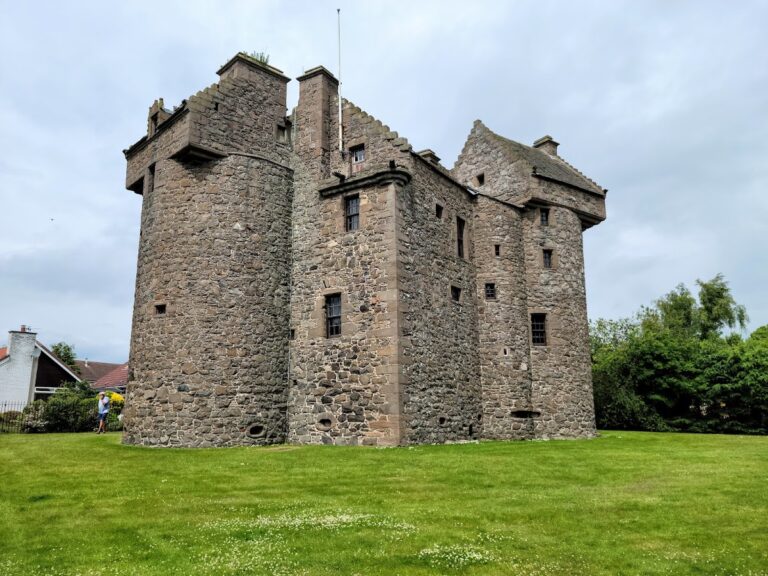
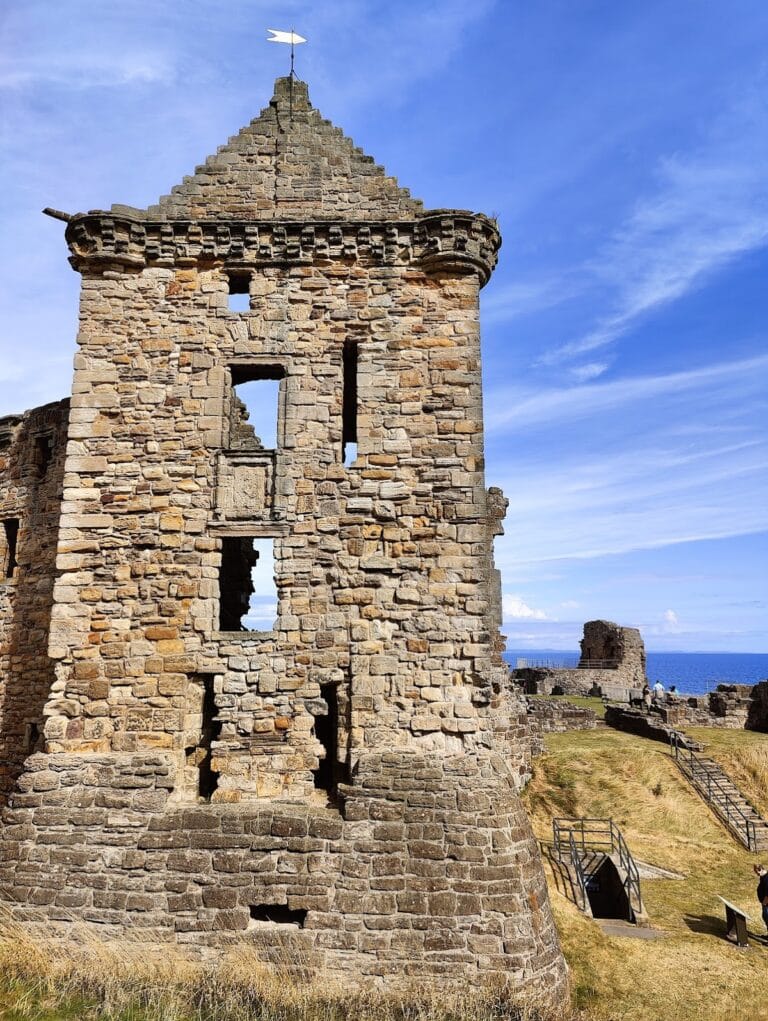
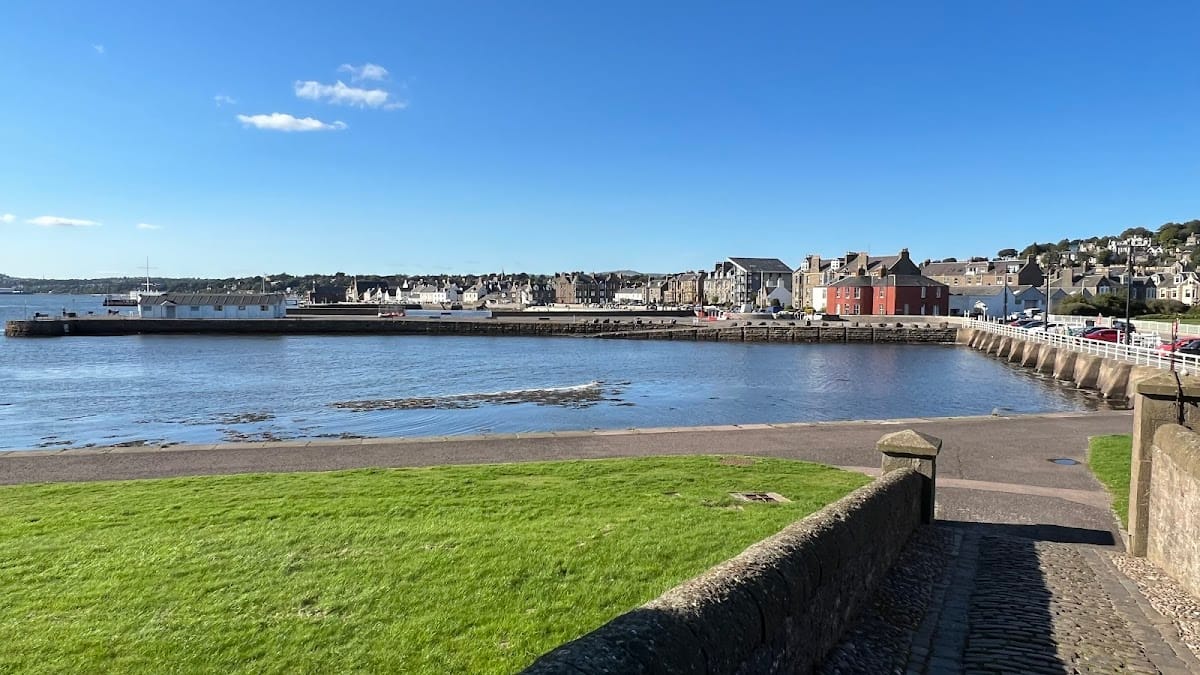
Broughty Castle occupies a promontory beside the River Tay near its mouth. The stone-built site combines a four-storey medieval tower house with courtyard walls, later wings, gun positions, batteries, magazines, and associated military buildings. The landward side was defended by a ditch, while the swift river current was considered to make naval bombardment impractical. A nearby hill overlooked the castle and was consequently treated as a vulnerable point in the sixteenth-century defences.
Medieval tower and sixteenth-century defences
The four-storey central tower house, built around 1495 for Andrew Gray, forms the core of the castle. It was later incorporated into successive defensive arrangements. During the English occupation, a ditch was cut across the landward side of the promontory. The garrison also attempted to strengthen the nearby hill and began an additional fortification on adjacent ground, although its turf ramparts proved unstable.
Nineteenth-century military complex
The nineteenth-century rebuilding altered the arrangement around the tower. The main courtyard walls were rebuilt, new wings and courtyards were added, and a caponier was constructed along the south-eastern side. A caponier is a covered defensive structure projecting into a ditch so that defenders can fire along or across it. Emplacements for nine large guns were installed, and a small enclosure was added on the western side of the courtyard.
From 1886 to 1887, a range east of the castle was built for submarine miners who would have laid mines in the Tay Estuary during an emergency. A magazine was constructed inside the western enclosure between 1889 and 1891, prompting major remodelling of the gun emplacements. The wider military complex included outer batteries, magazines, and other associated buildings. During the First World War, the battery mounted two 4.7-inch quick-firing guns.
Second World War and museum spaces
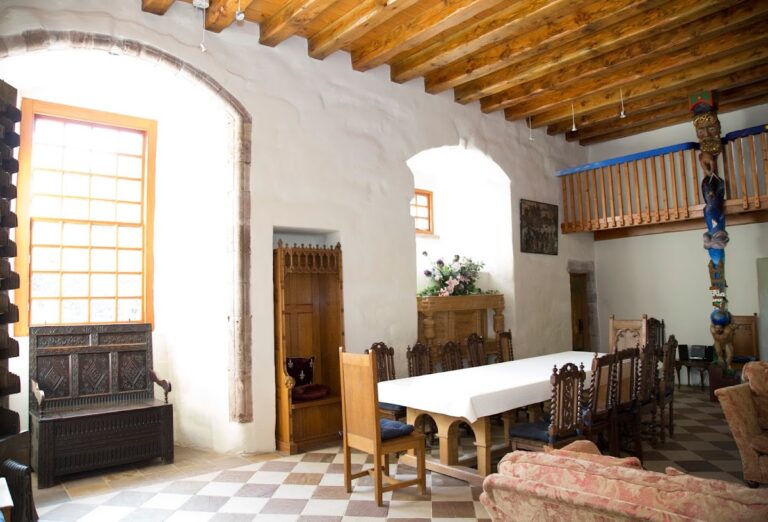
A defence post was installed on top of the main tower during the Second World War. The castle itself was adapted for museum use from 1969, and its physical visitor installations include galleries on local and whaling history, a Seashore Gallery, and a Military Gallery. Floodlighting infrastructure was added through trenches across Castle Green and within the courtyard in 1993. The surviving castle and its military remains are formally protected as the scheduled monument known as Broughty Castle.