Mains Castle: A Sixteenth-Century Tower House in Dundee


Site at a Glance
- Rating
- 4.3
- Popularity
- Very Low
- Country
- United Kingdom
- Primary era
- Early Modern
- Eras represented
- Early Modern
- Civilizations
- Kingdom of Scotland
- Site type
- Military
- Remains
- Castle
On this page10 sections
History
Mains Castle is a sixteenth-century Scottish castle in Dundee, Scotland, United Kingdom, built as a fortified noble residence in the tower-house tradition. Also known as Fintry Castle and Claverhouse Castle, it was probably commissioned in 1562 by Sir David Graham, nephew of Cardinal Beaton, the leading Scottish churchman and last pre-Reformation archbishop of St Andrews.
Douglas and Graham ownership
An earlier castle on the estate belonged to the Douglas earls of Angus from the fourteenth century until 1530. The earls were senior Scottish nobles from the powerful Douglas family. In 1530, the property passed to the Grahams, who developed the present castle during the following decades.
Evidence connects the building’s foundation with 1562, while a beam above an eastern courtyard doorway carries the date 1582, possibly marking the completion of the work. Mains Castle remained the seat of the Grahams of Fintry until the nineteenth century. Robert Graham of Fintry later sold the lands to David Erskine on the condition that his family could retain the territorial name “Graham of Fintry” and that the estate would return to one of the older names, Lumlathen or Linlathen.
Public ownership and later conservation
Shipley Gordon Stuart Erskine subsequently sold the estate to James Key Caird, a Scottish industrialist and philanthropist known for supporting civic and cultural projects. In 1913, Caird gave the castle and its lands to Dundee’s town council for use as a public park. Caird Park opened in 1923, with the ceremony conducted by his half-sister, Mrs Marryat.
By the 1980s, many of the buildings had become roofless. The castle was renovated during that decade through a government employment scheme for unemployed people. Since December 2015, it has belonged to Dean Duncan of Kirkton, and extensive work in 2016 renovated the forecourt and interior facilities. Historic Environment Scotland lists Mains Castle as a Category A historic building, a designation that provides Scotland’s highest level of statutory protection for buildings of special architectural or historic interest. The castle and its grounds also inspired The Castle of Mains, a poem by Dundee poet William McGonagall.
Remains
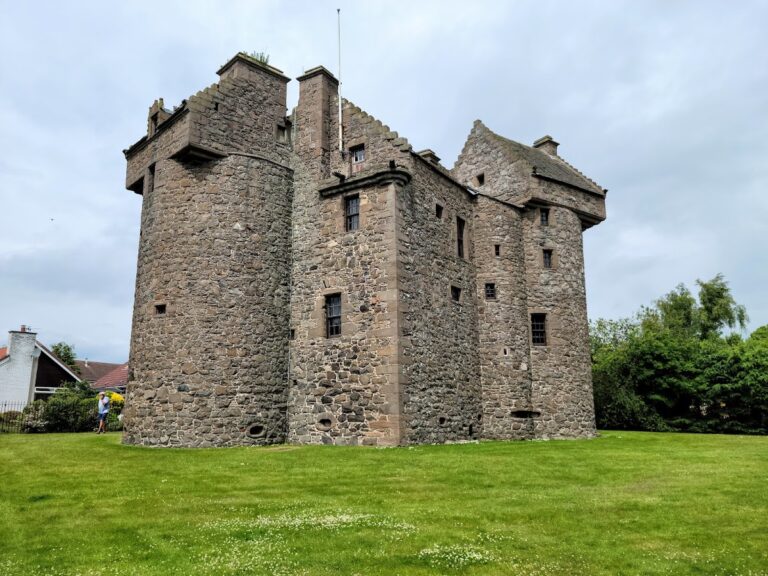
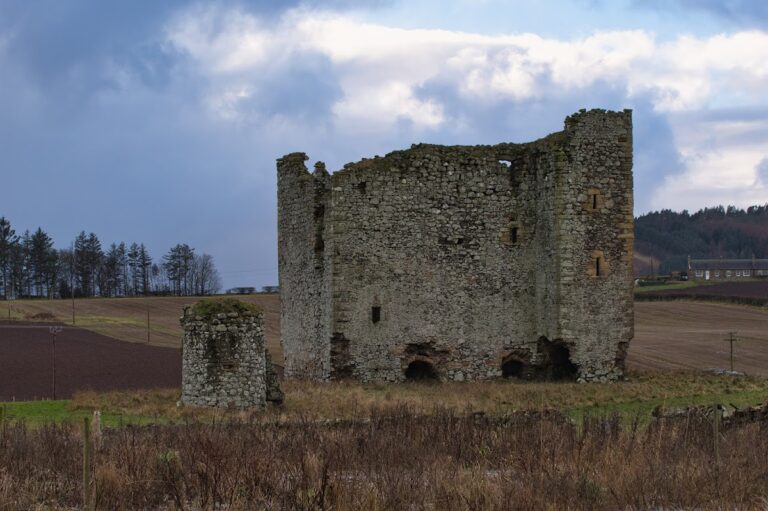
Mains Castle consists of several rubble-masonry buildings arranged around a courtyard. A large square tower house, a fortified residence organized around a tall residential tower, forms part of the complex. The surviving buildings reflect a division between the family’s accommodation in the northern and eastern ranges and servants’ quarters in the southern range. Much of the original western range has not survived.
Principal buildings
Square tower house
The principal tower is six storeys high and square in plan. Its dressed cornerstones, carefully finished stones forming the angles of the building, are characteristic of sixteenth-century construction. The tower stands within the wider courtyard complex rather than as an isolated structure, preserving the castle’s combined residential and defensive arrangement.
Courtyard ranges
The northern and eastern ranges formed the family’s part of the castle, while the southern range housed servants. These buildings were arranged around the courtyard and constructed in rubble masonry. Their condition was affected by the loss of roofs before the twentieth-century renovation, after which the castle was described as being in good condition.
Entrances and landscape setting
Western gateway and eastern doorway
The western gateway retains a keystone bearing the date 1562 and the initials “DG” and “DMO.” The initials represent David Graham and Dame Margaret Ogilvy, linking the entrance to the castle’s construction. A horizontal beam above one of the eastern courtyard doors bears the date 1582, which may relate to the completion of the building.
Caird Park and Gelly Burn
The castle stands in Caird Park north of Dundee city centre, overlooking the Dichty valley and beside Gelly Burn, a small stream. Across the burn are the Graham family mausoleum and Main’s cemetery, which occupies the former site of the district kirk. These associated features form part of the historic landscape around the castle.
Nearby sites