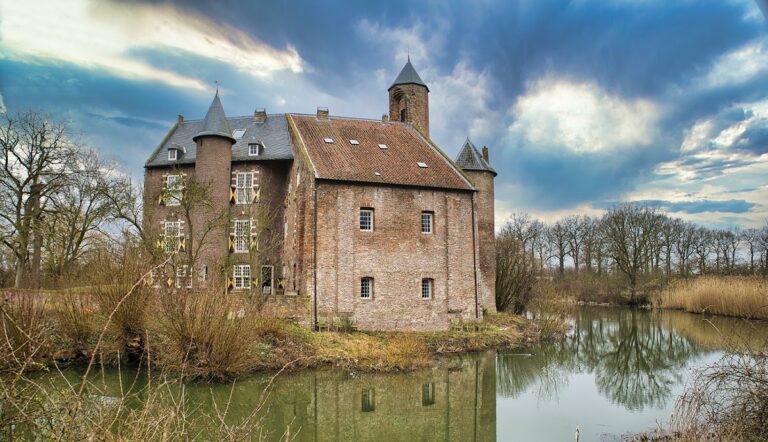
Ammersoyen Castle: A Medieval Water Castle in the Netherlands

Site at a Glance
- Rating
- 4.5
- Popularity
- Medium
- Country
- Netherlands
- Primary era
- Medieval
- External website
- Open
- Eras represented
- Medieval, Early Modern, Modern
- Civilizations
- Dutch, Holy Roman Empire
- Site type
- Military
- Remains
- Castle
On this page13 sections
History
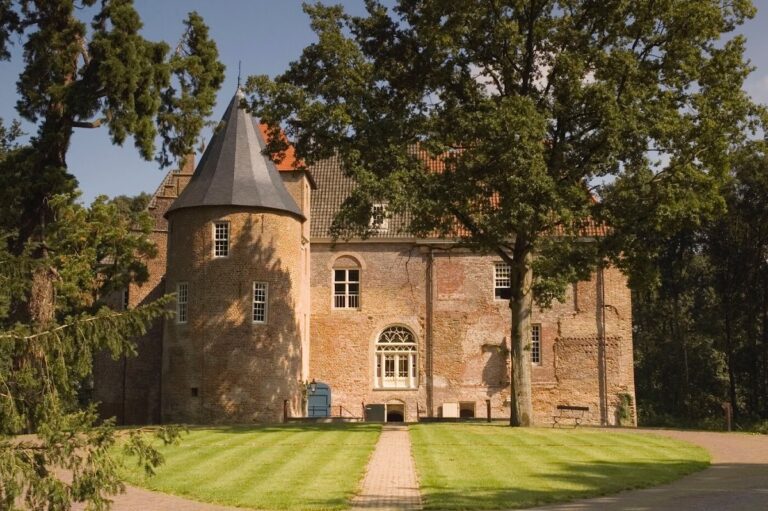
Ammersoyen Castle is a medieval water castle in Ammerzoden, Netherlands, generally dated to the 1350s. Its origins lie in a local seigneurial estate mentioned in a charter of 1026, while the settlement appeared as Ambershoye in 1196. A surviving foundation has been dated to around 1300, but the stone castle is associated with the building campaign ordered by Dirk van Herlaer in the first half of the fourteenth century.
The Van Herlaer and Hoeman Lords
Dirk van Herlaer belonged to the influential Van Herlaer family. After his death in 1354, Ammersoyen passed first to his eldest son, Gerhard, and then to his brother Arent. In 1384, control passed to Arent Hoeman, during whose tenure the Van Herlaers permanently lost the castle.
Hoeman became involved in the conflict between Gelderland and Brabant, a struggle over territorial control that was intensified by Burgundian expansion. Although he had previously been close to Duke William of Gelderland and Jülich, Hoeman supported Johanna, Duchess of Brabant. William treated this allegiance as treason, invaded Ammerzoden, captured Hoeman, and took the castle under ducal authority in 1386.
Expansion, War, and Restoration
In 1405, Duke William transferred Ammersoyen to his illegitimate son. Johan van Broeckhuysen, lord of Waardenburg, purchased it in 1424, strengthened the fortifications, and added a chapel. Through marriage and inheritance, the castle reached Otto van Arkel in the 1490s. The wealthy Van Arkel family then held it for several generations.
Ammersoyen experienced repeated military occupation during the sixteenth century. Habsburg troops briefly held it during the Gelderland Wars in 1513, and Burgundian troops under Count Henrick van Nassau occupied it for a short time in the middle of the century. Sieges and occupations caused serious damage and the loss of personal possessions, although the Van Arkels had sufficient wealth to repair the castle.
Spanish forces occupied Ammersoyen in 1572 during the Eighty Years’ War, the long revolt of the Dutch provinces against Spanish Habsburg rule. Troops commanded by Prince Willem of Orange expelled them. The castle sustained little damage during this episode and had been fully repaired by 1590. That same year, however, a major fire destroyed its interior. Joris van Arkel, then lord of Ammersoyen, suffered severe burns and died from them. His son, Otto van Arkel, began a partial restoration, but the family’s financial difficulties prevented a complete rebuilding.
Between 1648 and 1667, Thomas Walraven van Arkel undertook a comprehensive restoration. He deliberately renewed the exterior in a medieval manner rather than adopting the Renaissance style fashionable at the time, while making the interior more comfortable according to seventeenth-century standards. During the French invasion of the Dutch Republic in 1672, known as the Year of Disaster, the castle was threatened with destruction or looting. Thomas van Arkel paid the French commanding officer 7,000 guilders to secure its safety. The payment left the family heavily indebted and stopped the planned completion of the interior decoration.
Later Owners and New Uses
The Van Arkel line ended in 1693. Ammersoyen subsequently passed through the families of Lichtervelde, Van Vilsteren, De Ribaucourt, and De Woelmont Ammersoyen. Because these owners generally lived elsewhere, maintenance declined and the castle deteriorated.
Arthur, Baron de Woelmont, acquired the castle in 1856. He repaired it and remodeled its interiors in the Gothic Revival style. Financial problems led him to sell Ammersoyen and the remaining seigneurial possessions to the Roman Catholic parish of Ammerzoden on 31 January 1873.
In 1876, the castle became the second Poor Clare convent in the Netherlands. The Poor Clares, also called Clarisses, are a Catholic contemplative order founded in the Franciscan tradition. Around 1893, the nuns filled in the surrounding moats so that a chapel could be built west of the castle. The sediments of the filled moats preserved objects deposited there since the fourteenth century.
Ammersoyen suffered extensive war damage, including bombing, in 1944 and 1945. After the war, the nuns left and moved to Hoogcruts. The building later served for a time as a washing-machine factory.
The Friends of Gelderland Castles Foundation acquired Ammersoyen in 1957. Restoration began in 1959 and continued for 16 years. The work recovered medieval forms, reversed many later alterations, and restored the castle and grounds by 1976. Excavation of the former moats produced a large collection of objects from several centuries, and a permanent exhibition was installed inside the castle.
Until the municipality of Ammerzoden was dissolved in 1999, part of the castle served as the municipal town hall and as a meeting place. Since the beginning of the twenty-first century, Ammersoyen has functioned as a museum and cultural venue. It is a protected Rijksmonument, a Dutch building or site with national cultural and historical importance, registered as monument number 8104. The Friends of Gelderland Castles Foundation owns the castle and its grounds.
Remains
Fortified Layout and Water Defences
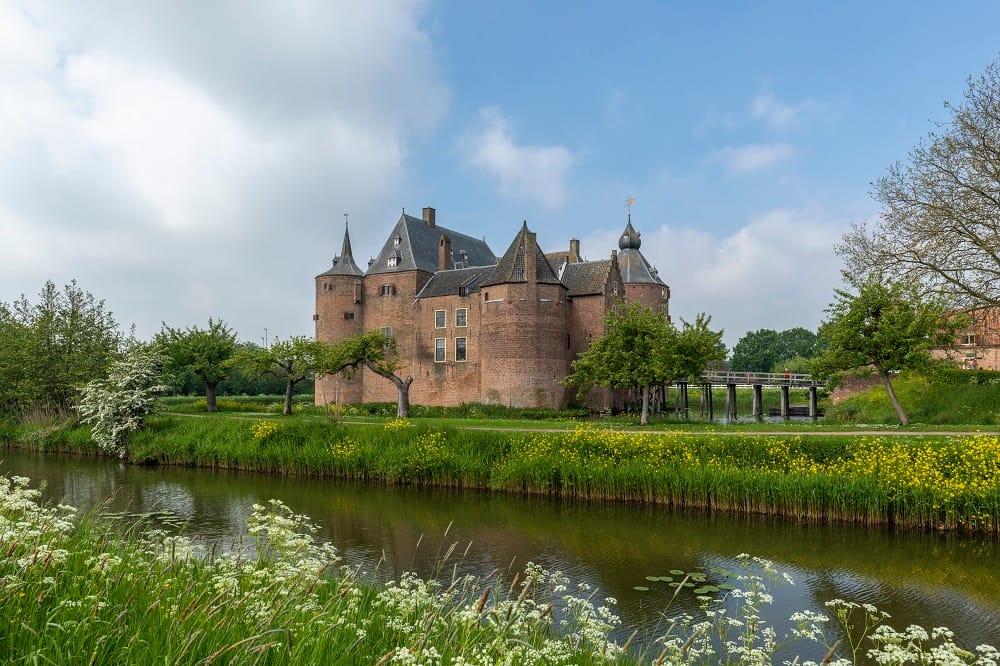
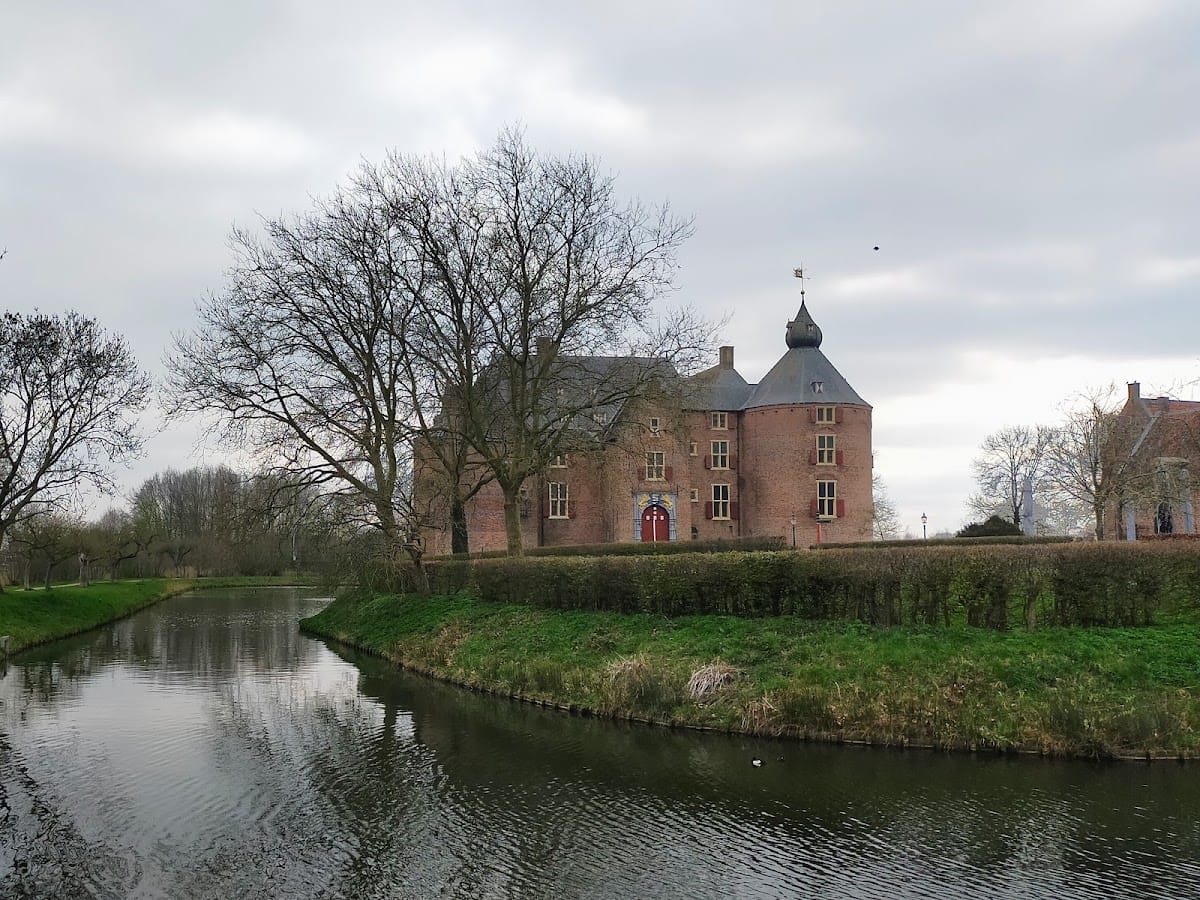
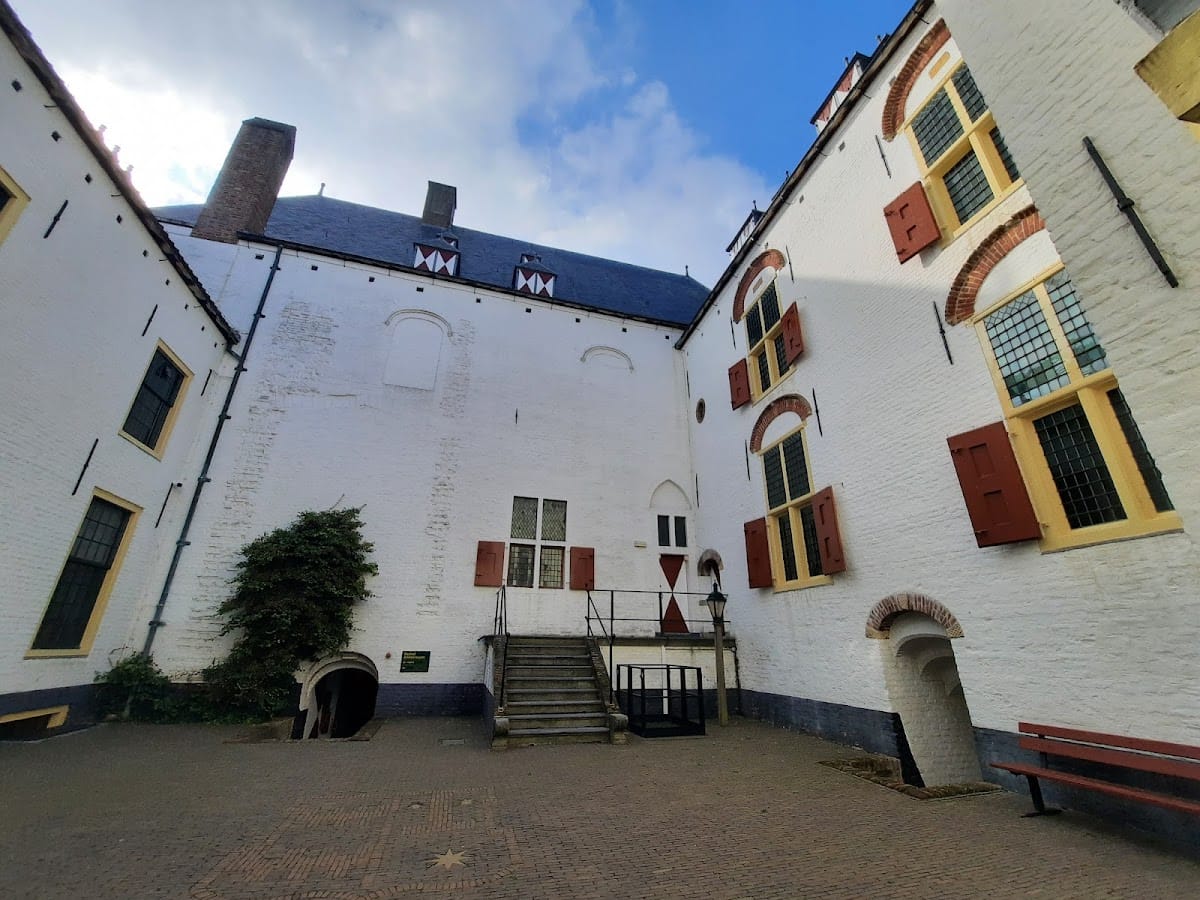
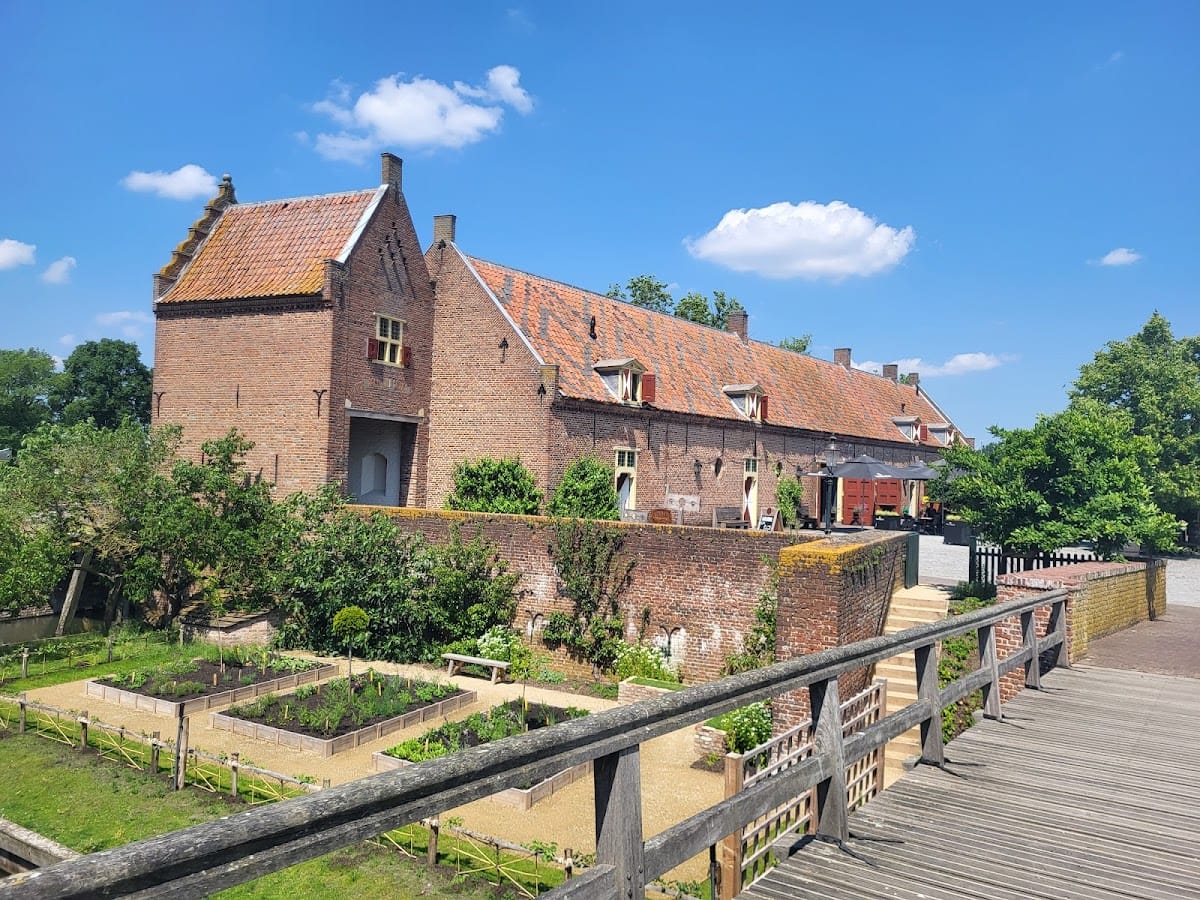
Ammersoyen has a square plan organized around a central open courtyard. Four substantial corner towers are joined by four wings, forming a unified design rather than a castle expanded through successive medieval building campaigns. Built of stone and brick, it belongs to a defensive arrangement associated with Count Floris V of Holland. All four sides were fortified, concentrating access through the defended entrance.
The castle was originally built beside a branch of the Maas. The river was rerouted soon afterward, reportedly in 1354, and canals were created to keep the surrounding water-filled ditches supplied. The principal castle and outer bailey, a defended enclosure outside the main castle, were enclosed by moats. A single drawbridge from the north led to the main entrance. A second artificial island, about three times larger than the castle island, held the outer fortifications and was linked to the mainland by one drawbridge on its western side.
The moats were filled in around 1893 and were excavated and restored during the postwar restoration. The double-moat arrangement now surrounds the castle and its associated buildings, reinstating the principal water defences of the site.
Medieval Interior
Rooms and Circulation
Restoration uncovered medieval stairways within the thick walls, blocked loopholes, lamp niches, fireplaces, beam sockets, shooting openings, a well, and numerous concealed or sanitary spaces. These elements allowed the building to be restored toward its medieval appearance. The Knights’ Hall and the women’s chamber, or kemenade, were returned to their original height, and fireplaces were reconstructed in both rooms.
Fireplaces and Furnishings
A seventeenth-century staircase from the Knights’ Hall was moved to the west wing. In the room of the northwestern corner tower, a seventeenth-century fireplace was restored with an earlier fireplace formerly associated with the descendants of Arthur, Baron de Woelmont. Large medieval rooms and high ceilings were recovered, while fireplaces, chimneys, and staircases were reconstructed or repositioned. Most Gothic Revival decoration introduced by De Woelmont was removed, although one element remains where the northwestern wing connects with the entrance portal.
A portrait dated 1651 by Theodoor van Thulden, a seventeenth-century painter, was returned to the fireplace of the northwestern corner-tower room after an absence of 123 years. The painting may depict Anna van Renesse, a noblewoman of the period. Other family portraits, including works lent by the Brantsen family through the Zyp Foundation, help recreate the character of an inhabited historic residence.
Archaeological Collection
Excavation of the former moat yielded hundreds of objects preserved in its sediments. The finds include pottery and other ceramics, stoneware, glass, silver, bronze, tin, clothing, footwear, weapons, religious items, lighting and heating equipment, food-related objects, and children’s toys. Complete objects and pottery fragments are displayed on the upper floor and in the attic. Together, they illuminate food preparation, eating and drinking, lighting, heating, clothing, warfare, religion, and play at the castle.
Grounds and Chapel
Garden and Approach
A small French-style garden occupies the northern island near the retaining wall opposite the castle. Created in 1975 to a design by M. E. Canneman-Philipse, it contains clipped box-edged beds planted with heliotrope, silver-leaved plants, lavender, daisies, and pink begonias. Espaliered mulberry, quince, fig, and pear trees grow within the garden. Additional kitchen and ornamental gardens once lay east of the fortress, while lawns now occupy the area between the inner and outer moats and extend along the approach.
Medlar Tree and Chapel
A medlar tree stands near the stationary bridge leading to the castle. Its fruit becomes edible after several months of ripening, and the tree is associated with the heraldic imagery of the counts of Gelderland. The chapel built west of the castle during the Clarisse occupation also remains on the grounds.