Altena Castle: A Historic Hilltop Castle in Germany

Site at a Glance
- Rating
- 4.6
- Popularity
- Medium
- Country
- Germany
- Primary era
- Medieval
- External website
- Open
- Eras represented
- Medieval, Modern
- Civilizations
- German, Holy Roman Empire
- Site type
- Military
- Remains
- Castle
On this page9 sections
History
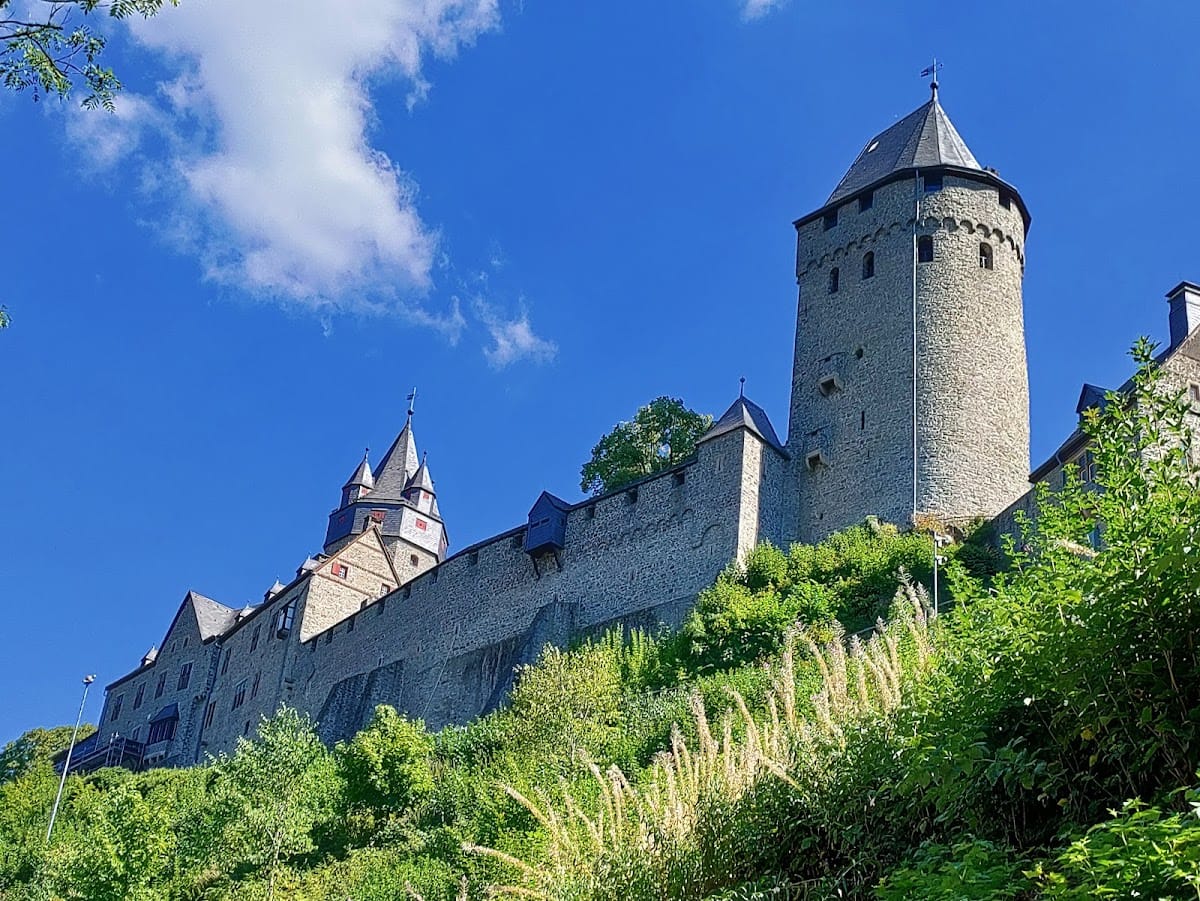
Altena Castle is a hilltop castle in Altena, Germany, whose origins are traditionally placed in the early twelfth century on the Klusenberg. Tradition attributes its construction around 1108 to the brothers Adolf and Everhard of Berg, who were said to have received land in the Sauerland from Emperor Henry V for loyal service. They supposedly built a stone castle on Wulfseck, first called Wulfeshagen and later Altena, but this foundation story has not been confirmed by surviving documents. The castle may also have helped protect and exploit the region’s important iron industry.
Seat of the Counts of Altena
Eberhard I of Berg-Altena is recorded as a Count of Altena in 1161, and the castle served as the seat of the county. Between 1170 and 1198, Friedrich of Berg-Altena acquired the lordship of Mark near Hamm. Around 1202, his son Adolf I moved the family’s permanent residence to Mark Castle. The territory then became known as the County of Altena-Mark and later simply as the County of Mark, a medieval and early-modern lordship in Westphalia.
After the comital residence moved, Altena Castle was occupied mainly by drosts, local administrative officials, and members of collateral comital lines. It later served chiefly as the residence of an Amtmann, a territorial official who represented a count or another ruler. The settlement below the mountain received important privileges on 20 December 1367, when Count Engelbert III of the Mark granted it self-government and freedom from customs duties. These rights supported the development of the town of Altena.
Fire, garrison, and charitable uses
A major fire damaged or destroyed the castle in 1455. The subsequent rebuilding was partial and inadequate, leaving the complex vulnerable to further deterioration. During the Jülich-Cleves succession dispute in 1609, a Brandenburg garrison moved into the castle. An institution for invalids was established there in 1670, while parts of the buildings housed the criminal court and prison of the County of Mark from 1766 to 1811.
The castle was demilitarized in 1771, when the garrison was dissolved. The town acquired the vacant sections and used them as a poorhouse and orphanage until 1840. In 1797, the needle manufacturer and mayor Johann Caspar Rumpe received permission to take stone from the castle for his house. The buildings then deteriorated severely. A reconstruction planned in 1835 by building inspector Friedrich August Ritter, in a Romantic neo-Gothic Tudor style, never began because of financial difficulties. Tudor architecture uses a picturesque late medieval and early modern English vocabulary, including flattened pointed arches and prominent gables.
Preservation and reconstruction
In 1842, the town donated its shares in the castle to King Friedrich Wilhelm IV of Prussia, who intended to preserve it as a historical monument. The following year he ordered the surrounding area to become a public park. Garden architect Maximilian Friedrich Weyhe directed the work, which his son Joseph Clemens Weyhe continued after his death and completed in 1852.
The castle was later entrusted to the Order of St. John, a Christian religious and hospitaller order associated with hospitals and charitable institutions in Europe. Under Arnold Ludwig von Holtzbrinck, the order established a hospital in the buildings in 1856. It remained in operation until 1906.
That year, County Administrator Fritz Thomée proposed rebuilding Altena Castle as part of the regional castle renaissance and in preparation for the 300th anniversary of the County of Mark’s affiliation with Brandenburg-Prussia. The Märkische Burgverein was founded partly to raise donations, and architecture professor Georg Frenzen prepared the plans. Karl Ernst Osthaus and historian Hermann Ehrenberg opposed the project, arguing that the proposed transformation of the medieval and early-modern fabric threatened the castle’s historical authenticity. They favored conserving the ruin instead.
Emperor Wilhelm II reviewed the plans at an audience in Münster on 29 August 1907, approved them, and called the project an “artistic-patriotic great achievement.” Reconstruction proceeded, with most work completed by 1914 and further work continuing until 1918. The Museum of the County of Mark opened in the rebuilt castle in 1915. Altena Castle became the property of the former Altena district in 1943; the Märkischer Kreis is now its owner and continues conservation and maintenance.
Youth hostel and museum complex
In 1914, teacher Richard Schirrmann established the world’s first permanent youth hostel at the castle and helped found the German Youth Hostel Association. The institution, known in German as a Jugendherberge, provided the model for a permanent youth-hostel system. The original hostel rooms are now museum spaces, while buildings in the lower courtyard dating from 1934 continued the youth-hostel tradition.
The castle now contains several museums and exhibition institutions, including the Museum of the County of Mark, the World Youth Hostel Museum, the Märkisches Blacksmith Museum, and the German Hiking Museum. Parts of the complex are also used as a restaurant. The museums were expanded and revised repeatedly, and the permanent exhibition in use was conceived in 2000. In 2007, the Federal Government Commissioner for Culture and Media classified Altena Castle as a monument of national importance.
An elevator project completed in April 2014 improved access from the town while adding a historical interpretation route. The elevator began operating on 26 April 2014 and presents 900 years of castle history at six stations. Altena Castle remains a landmark of Altena and a place where the history of the County of Mark, regional crafts, hiking, and the youth-hostel movement is presented together.
Remains
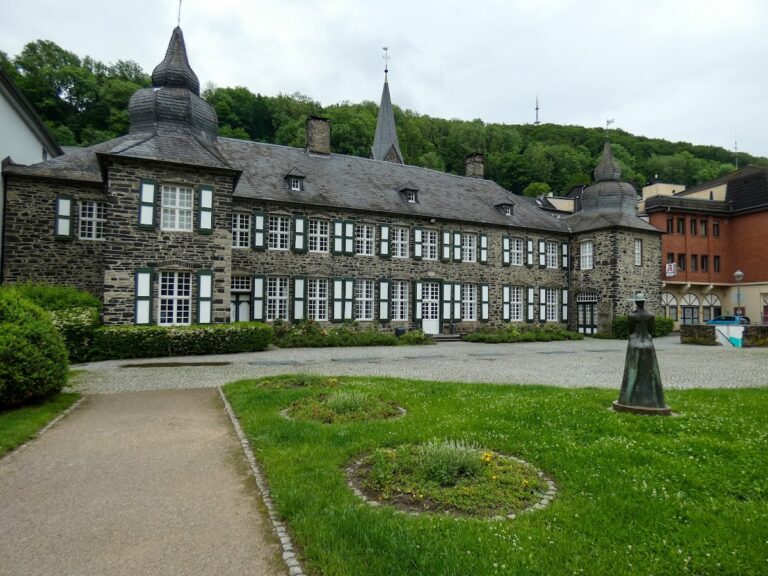
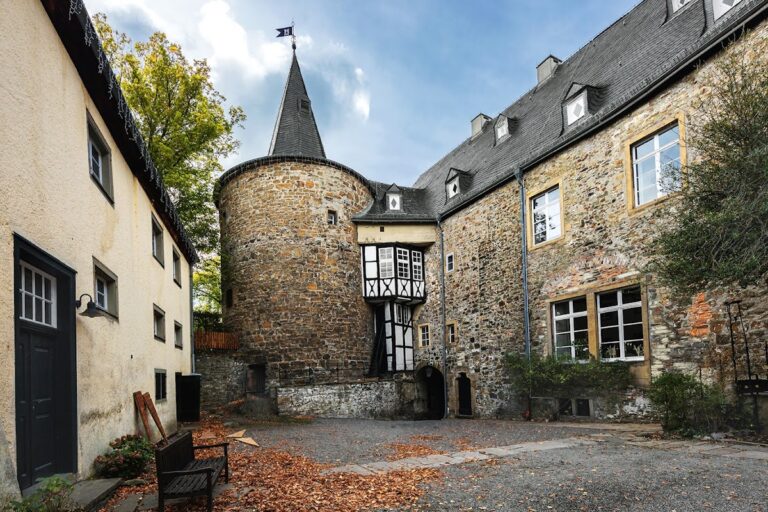
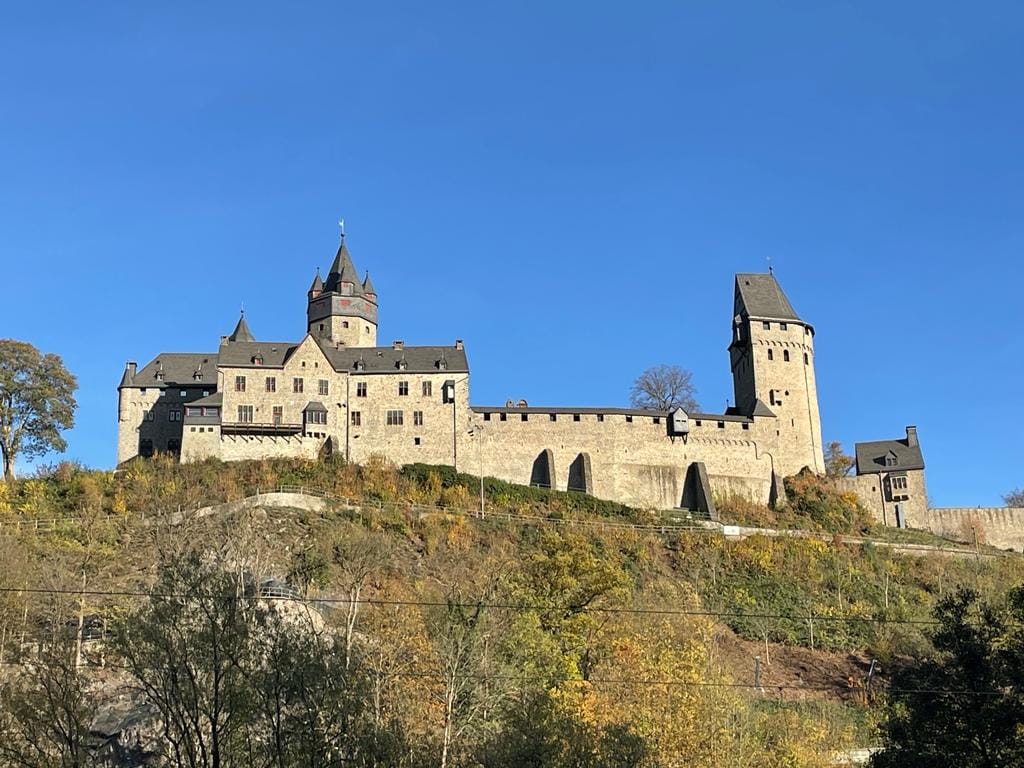
Altena Castle occupies a mountain spur of the Klusenberg above Altena, between the Lenne and its tributary, the Nette. It is a stone-built hill castle whose surviving fabric has been restored. The medieval complex extended beyond the principal upper buildings to include an outer bailey and structures in the lower part of the castle. These outer and lower sections were not fully restored during the reconstruction completed around 1914, and parts remain unrestored.
Medieval and reconstructed fabric
The castle’s present appearance reflects several building phases. The 1455 fire was followed by provisional and partial rebuilding, while the later decline prompted the unrealized nineteenth-century Tudor-style scheme. The reconstruction carried out between 1907 and 1918 substantially reshaped surviving medieval and early-modern fabric by imposing new historical forms on older remains. The west wall was among the reconstructed elements, making the visible complex a combination of preserved material and historicist rebuilding.
Gates and courtyard access
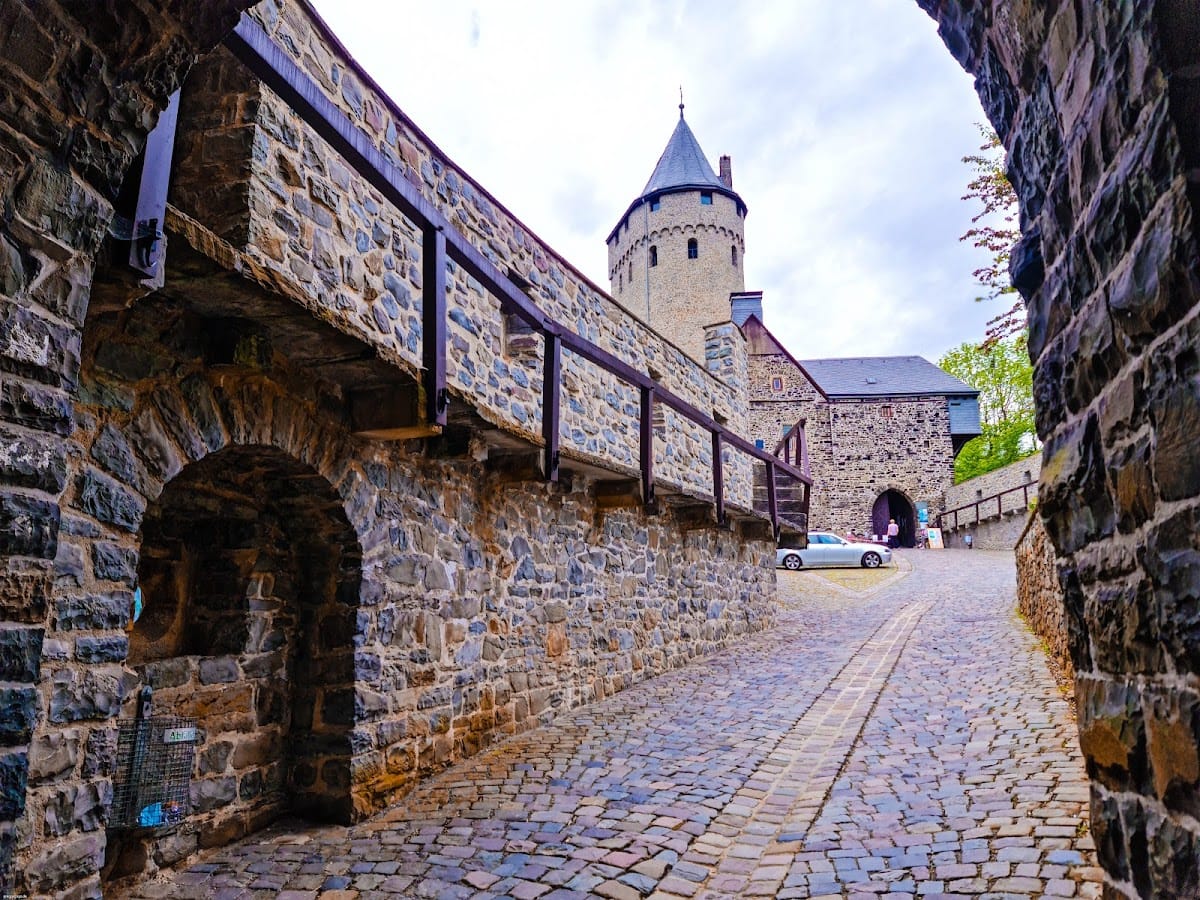
The castle gates underwent extensive restoration between 2016 and 2018. Their restored condition was recognized with the Westphalian Monument of the Month award in December 2018. An elevator begins at the foot of the Klusenberg after an approximately 95-meter interpretive route from Lennestraße and rises 60 meters through the rock to the castle courtyard. Along the route, a time tunnel with six stations explains the history of the castle.
Interior spaces and displays
The buildings contain numerous museum and exhibition rooms. The former youth-hostel rooms survive as museum spaces, and a large wall painting by Joachim Böhmer in the ceremonial hall draws on medieval models from several periods of chivalric culture. The wider complex houses the Museum of the County of Mark, the World Youth Hostel Museum, the Märkisches Blacksmith Museum, and the German Hiking Museum, alongside a restaurant.