Tuna el-Gebel: The Necropolis of Hermopolis Magna in Egypt
Site at a Glance
- Rating
- 5
- Popularity
- Very Low
- Country
- Egypt
- Primary era
- Classical
- Eras represented
- Bronze Age, Iron Age, Classical
- Civilizations
- Egyptian, Ptolemaic, Roman
- Site type
- Burial
- Remains
- Necropolis
On this page16 sections
History
Tuna el-Gebel is an ancient Egyptian necropolis near Mallawi in Minya Governorate, Egypt, developed by the people of Hermopolis Magna from the New Kingdom through Late Antiquity. The cemetery extended for about 7 km along the desert edge and served the city whose chief deity was Thoth, a god associated with writing, knowledge, measurement, and judgment. Its surviving monuments represent Egyptian, Greek, and Roman religious and funerary traditions, and the site is the largest known Greco-Roman necropolis in Egypt.
From the New Kingdom to the Late Period
The cemetery gradually moved southward during the Third Intermediate Period. New Kingdom tombs once occupied the area north of the later Ptolemaic and Roman cemetery, although their above-ground structures have disappeared. Objects and surviving elements from this early phase are now dispersed among several museums. A rock-cut boundary stela of Akhenaten, also known as Amenhotep IV, once marked the northwestern limit of Akhetaten, the royal capital he founded at nearby Tell el-Amarna during the Amarna period.
From the Twenty-Sixth Dynasty, Tuna el-Gebel became a major animal necropolis, a cemetery devoted to mummified sacred animals. Its underground galleries held ibises, baboons, and other birds connected with Thoth. Between the sixth and fourth centuries BC, the cemetery was Egypt’s only burial place for sacred ibises. Demotic papyri, written in a later cursive script used for everyday, legal, administrative, and scholarly texts, indicate that ibises were brought there from across Egypt.
The galleries expanded around 380 BC under Nectanebo I and again around 310 and 250 BC during the early Ptolemaic period. Sacred animal burials continued until the first century BC. The animals were raised at an adjacent breeding installation, or Ibiotropheion, beside a lake that existed in antiquity. The burial complex itself is known as an Ibiotapheion.
The Ptolemaic and Roman Necropolis
A separate human cemetery developed south of the animal galleries from the late fourth century BC. It remained in use until the end of the third century AD. The earliest large tombs were built for priests of Thoth and included the tomb of Petosiris, two tombs probably belonging to his father and brother, and the tomb of Padjkam. These early structures were limestone buildings shaped like small temples and are therefore called temple tombs.
The tomb of Petosiris became a pilgrimage destination during the third and second centuries BC. Visitors left numerous Greek inscriptions there, although the tomb was later reused for additional burials. During the late Ptolemaic and early Roman periods, the cemetery expanded substantially. Mud-brick tomb houses were cheaper to build than stone monuments, allowing a much larger community to establish family burial places.
Most people buried at Tuna el-Gebel during the Roman period were Egyptian by origin, while their funerary customs were predominantly Greek and became increasingly Hellenized. Burial practices changed from concealing mummies in underground galleries to placing them on floors and eventually displaying them openly. Mummification nevertheless remained widespread. Some tomb buildings were later reused for secular purposes.
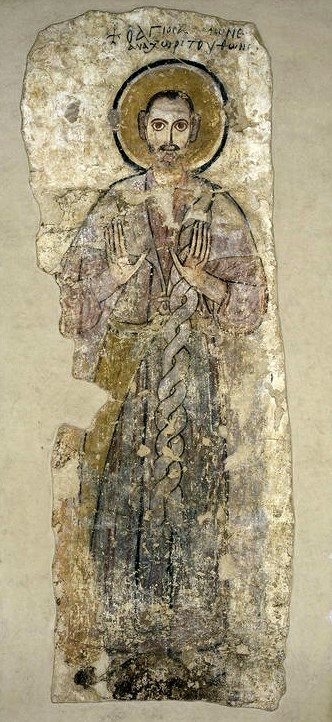
The tomb and cult of Isadora belong to the Roman period, during the reign of Antoninus Pius. Isadora drowned while trying to cross the Nile. Her father had her body mummified and built an elaborate memorial tomb, around which a cult developed. A Christian monastery, Deir Nazlet Tuna, was later established north of the necropolis.
Excavation and Continuing Research
André Gombert carried out the first excavations at Tuna el-Gebel in 1902 and 1903. Walter Honroth briefly investigated Roman-period tomb buildings near Akhenaten’s boundary stelae in January 1913. The Egyptian Service of Antiquities learned of the tomb of Petosiris in late 1919, and Gustave Lefebvre excavated it in 1920.
From 1931 to 1952, Cairo University, directed by Sami Gabra, excavated the central Ptolemaic and Roman cemetery around the tomb of Petosiris and investigated the underground animal galleries. After 1949, Alexander Badawy continued work at the temple with the well and in the southeastern cemetery, where he excavated the Graffiti Chapel.
German and Egyptian teams have worked at Tuna el-Gebel since the 1970s. Research has examined the animal galleries, northern surface structures, stone tombs, mud-brick buildings, painted decoration, and the southern human cemetery. Since 1989, a joint mission of Ludwig Maximilian University of Munich and Cairo University has investigated the galleries and their associated cult and administrative buildings. Later work under the Lower Saxony State Museum Hannover continued research in the animal cemetery and, since 2018, in the southern Petosiris cemetery, focusing on spatial organization and burial practices.
Geophysical surveys and archaeological investigations indicate that only about 10 percent of the Petosiris cemetery has been excavated. The unexplored area covers approximately 20 hectares, making Tuna el-Gebel the largest known Ptolemaic and Roman necropolis in Egypt. Egyptian archaeologists found fifty Ptolemaic mummy burials in February 2019. In January 2020, another excavation reported sixteen tombs containing twenty sarcophagi and coffins, including five limestone anthropoid sarcophagi with hieroglyphic texts and five well-preserved wooden coffins. The burials included senior officials and high-ranking clergy associated with Thoth.
Remains
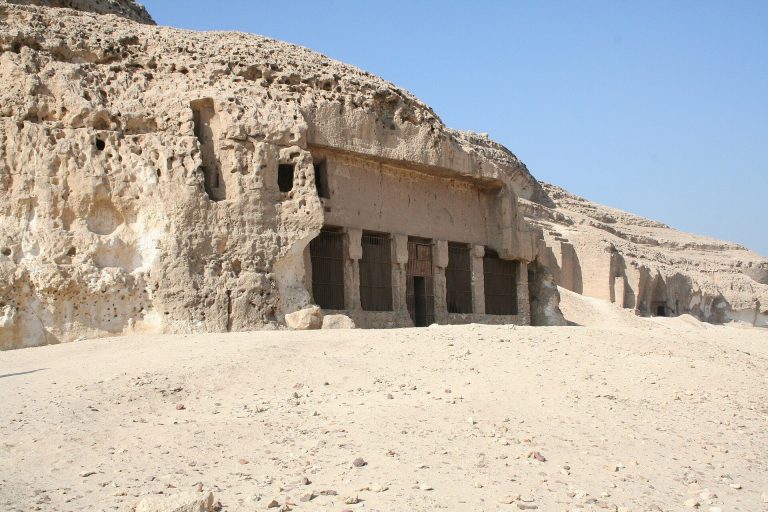
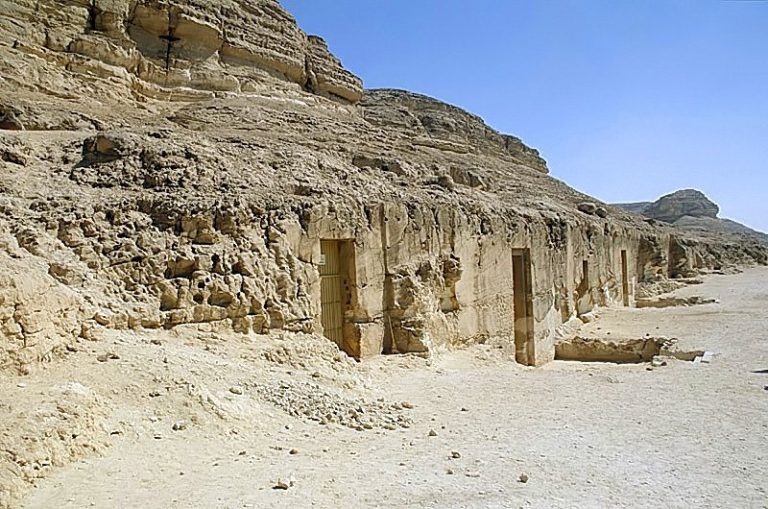
Tuna el-Gebel consists of a northern animal cemetery, a large southern human cemetery, temples, processional routes, priestly and administrative buildings, and later Christian remains. The Ptolemaic and Roman cemetery lies about 3.5 km south of the New Kingdom tombs. Its structures combine limestone construction, underground galleries, mud-brick tomb houses, painted decoration, and burial chambers cut into the western escarpment.
The Animal Necropolis and Cult Buildings
Underground Galleries
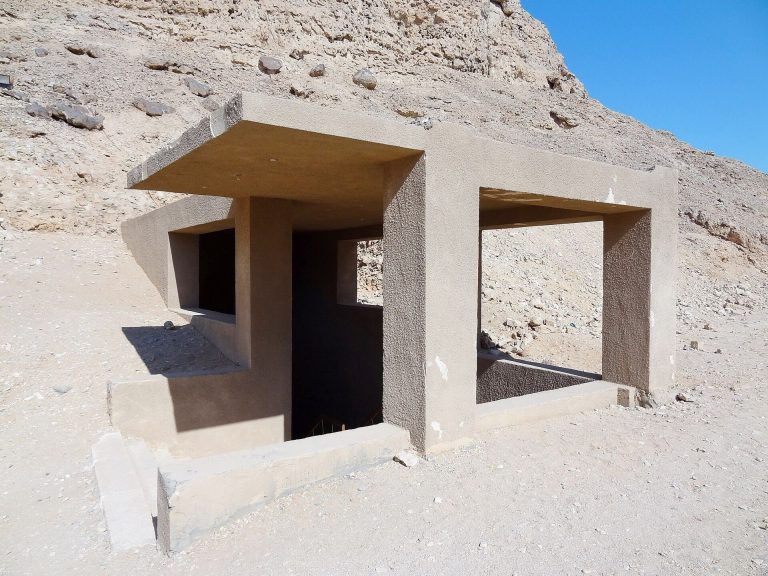
The animal galleries were cut into the western escarpment. Ibises were first placed in pottery vessels and later in coffins and sarcophagi, while baboon mummies were set into niches closed with stone slabs. Around 380 BC, niches for ibis sarcophagi were added in Galleries C and D. From the Ptolemaic period, animal coffins and sarcophagi increasingly carried Demotic inscriptions.
Under Ptolemy I, around 310 BC, Galleries C-C and C-A were greatly enlarged and received decorated cult chambers. Under Ptolemy II, around 250 BC, Gallery B and a stone northern entrance building with a horn altar were constructed. A further entrance, Gallery A, was added in the first century BC. Gallery C-D contained a painted wooden box for a baboon mummy bearing the cartouche of Darius I, together with Aramaic private letters from the late sixth or early fifth century BC that had been placed in a pottery vessel.
Temple of the Primordial Thoth
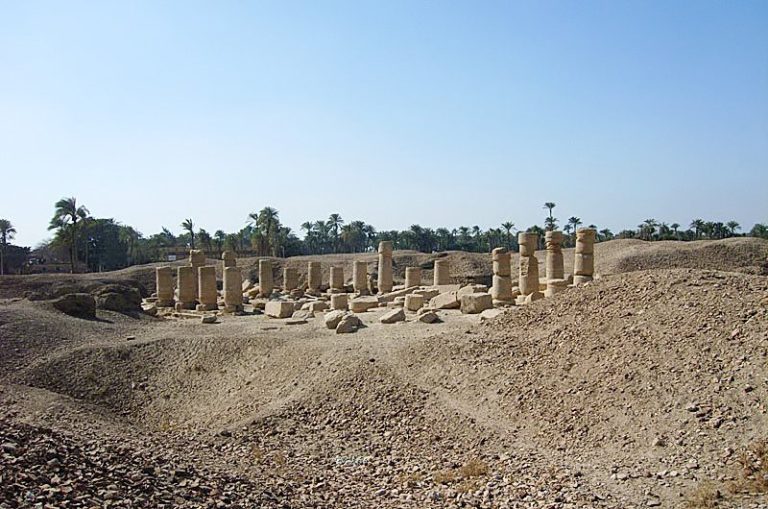
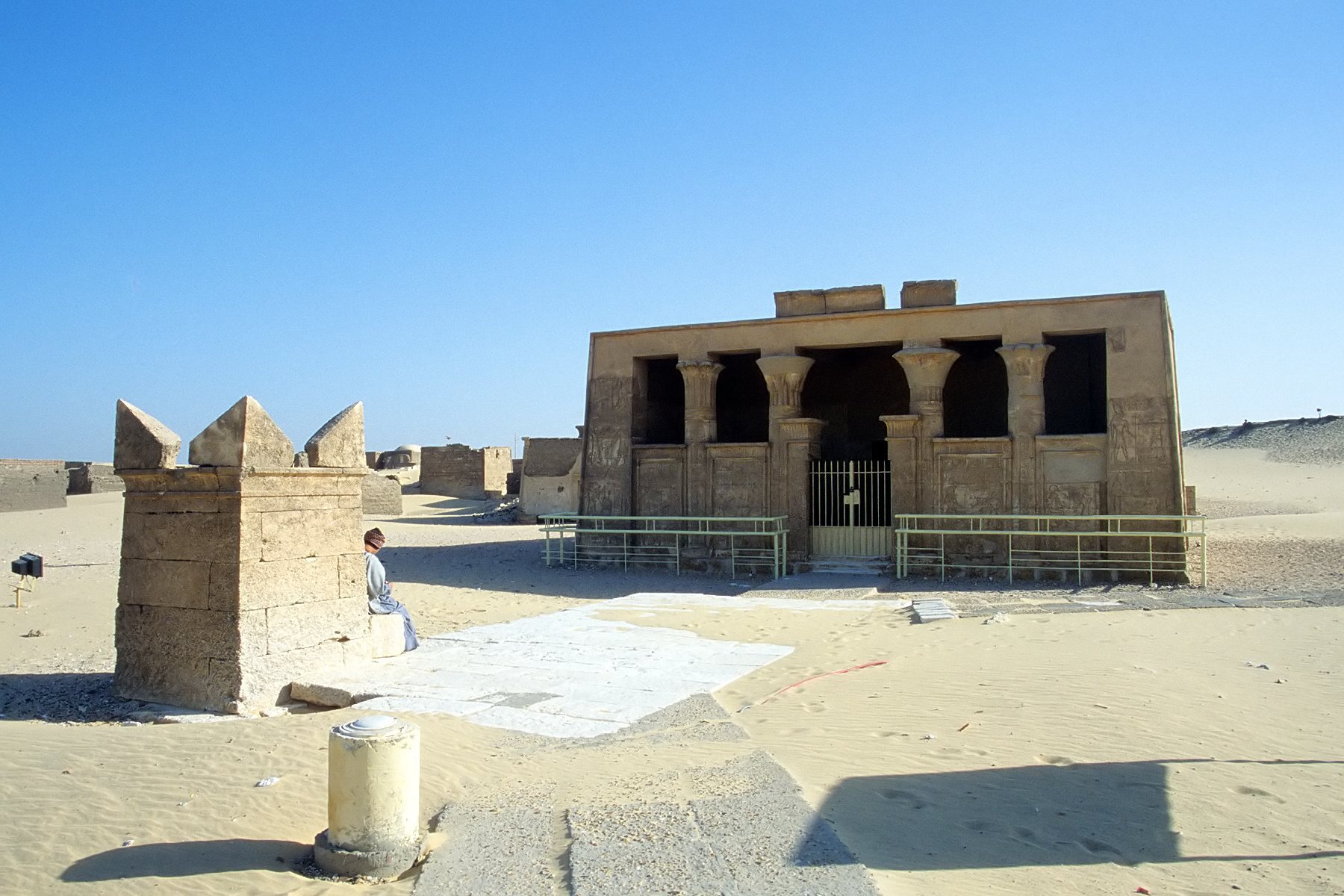
West of the Ptolemaic and Roman cemetery are the remains of the Temple of the Primordial Thoth, built on raised ground south of the animal galleries and west of the human cemetery. The surviving Roman-period remains probably incorporate an older sanctuary. An early temple at Tuna el-Gebel has also been dated to the reign of Amenhotep III, although its dedication is uncertain.
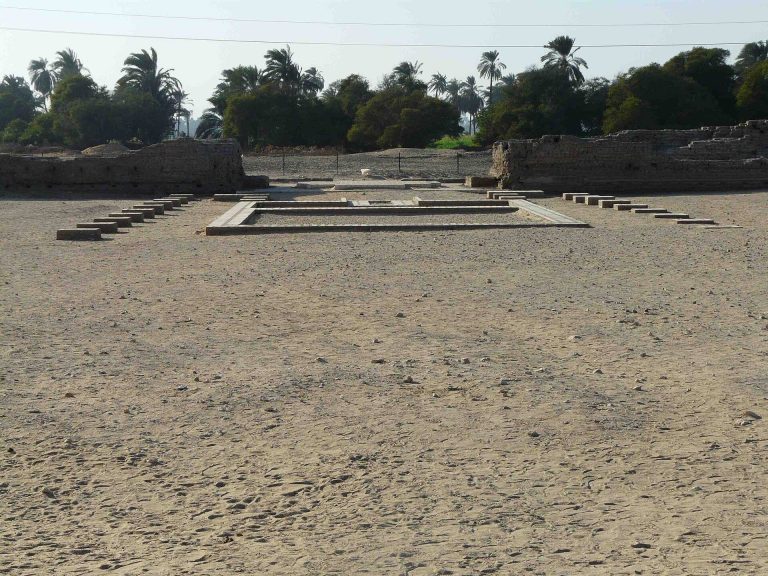
The temple had a courtyard surrounded by a colonnade and a rear garden, probably used for keeping sacred animals. A well 35 m deep, called the es-Saqqiya, stood at the center of the complex. Much of what remains belongs to a Serapeion, a sanctuary for Serapis, a Hellenistic deity whose cult combined Egyptian and Greek traditions. This sanctuary was created when the temple was converted, and a Serapeion had already been attached to the original temple under Ptolemy I.
Temple of Osiris-Baboon
The limestone Temple of Osiris-Baboon was built around 310 BC under Ptolemy I, then serving as satrap, in the name of Alexander IV. It stood beside the new entrance to Gallery C. Festive rites for Osiris connected the forms of Osiris-Baboon and Osiris-Ibis, while Demotic papyri indicate that people probably consulted an oracle at the temple. Only fragmentary remains survive. Sami Gabra first excavated the building, which was investigated again between 1989 and 1992.
Priest’s House and Archive
South of the Temple of Osiris-Baboon is a badly ruined, elongated mud-brick priest’s house, or pastophorion, built around 170 BC. It contained a room for the cult image of Osiris-Baboon, an assembly and writing room, a kitchen area, and an archive. The building was re-excavated in 1993 and 1994.
The Demotic Codex Hermopolis was found outside the building in 1938 and 1939. The papyrus contains mathematical calculations and what is described as the oldest known collection of Egyptian legal cases.
Routes, Boundaries, and Other Structures
A processional road ran from the Temple of Osiris-Baboon toward the ancient settlement, passing limestone and mud-brick tombs. East of the temple, a broad wall approximately 261 m long extended north to south between the Great Temple and the entrance to Gallery A. A second late-period stone temple stood on a rock plateau above the animal galleries, with Roman-period mud-brick buildings nearby. A naos, or shrine for a cult image, from the reign of Nectanebo II is now in the forecourt of the Mallawi Antiquities Museum.
The Human Necropolis
Stone Temple Tombs
The earliest preserved human tomb buildings date from around 300 BC. Built of limestone, they had forecourts and principal chambers and resembled small temples. The tomb of Petosiris contains high-quality painted reliefs that combine Egyptian and Greek imagery, underground burial chambers reached by deep shafts, and several secondary burials. Its decoration uses red, yellow, black, blue, and green pigments, sometimes mixed to create additional colors. Greek inscriptions left by pilgrims are associated with the monument.
Later stone tombs used smaller blocks and deliberately rough surfaces. Some early examples had T-shaped plans, although most were rectangular. Stone tombs generally represented more expensive and socially elevated burials than mud-brick structures. During the Roman period, some were converted into collective graves, reused for new mummies, or enlarged by adding further stories.
Mud-Brick House Tombs
From the late Ptolemaic or early Roman period, mud-brick tomb houses became increasingly common. They followed the form of ordinary houses, sometimes reaching four stories built in successive stages. Plastered outer and inner walls were often decorated with paintings. Their imagery was initially Egyptian in character and increasingly adopted classical forms from the second century AD.
These buildings probably served families and could hold several burials. The dead were often laid on klinai, couches used for reclining or placing bodies, while small altars for burnt offerings usually stood before the entrances. The cemetery developed into a dense, town-like settlement of tomb buildings divided by broad streets and narrow lanes. Some cheaper later tombs used several stories to accommodate multiple people, while other structures consisted only of stone or mud-brick pillars with spaces or niches for urns.
Tomb of Isadora
The tomb of Isadora is an elaborate mausoleum containing a ten-line poem in Greek elegiac couplets. Her mummified remains are preserved inside the mausoleum in a glass case. The monument belongs to the Roman-period cemetery and preserves the memorial associated with the cult that developed after her death.
Later Burials
The Petosiris cemetery has yielded Ptolemaic burials wrapped in linen, stone coffins, and wooden sarcophagi. Of the fifty burials discovered in 2019, twelve belonged to children. They lay in four burial chambers about 9 m deep, including one burial with a partially exposed skull still wrapped in linen. Excavations in 2020 produced limestone anthropoid sarcophagi carved with hieroglyphic texts, wooden coffins, and additional tombs of varied forms and sizes.