Teocaltitán Archaeological Site: A Pre-Hispanic Ceremonial and Civic Center in Mexico
Site at a Glance
- Rating
- 4.6
- Popularity
- Very Low
- Country
- Mexico
- Primary era
- Medieval
- Eras represented
- Classical, Medieval
- Civilizations
- Unclassified
- Site type
- Religious
- Remains
- Sanctuary
On this page9 sections
History
Teocaltitán Archaeological Site is a pre-Hispanic ceremonial and civic center in Teocaltitán de Guadalupe, Jalisco, Mexico, built and used by communities of western Mesoamerica. Its principal occupation lasted approximately from AD 450 to 900, during the Late Classic and Epiclassic periods, when it served religious, residential, and administrative purposes. Architecturally, it belonged to the Grillo Tradition, an archaeological and building tradition associated with western Mexico during these periods.
Late Classic and Epiclassic prominence
During its main period of prominence, Teocaltitán developed as a large center with monumental buildings, sunken patios, platforms, and spaces for civic and religious activity. It may have participated in commercial exchange with Teotihuacán, the major ancient urban and ceremonial center of central Mexico whose peak occurred during the Classic period. This proposed relationship indicates a possible long-distance interaction, not a confirmed political affiliation.
Reoccupation and abandonment
After the main occupation ended, the center was abandoned toward the close of the Epiclassic. Groups originating in northern Mexico reoccupied the area during the Early Postclassic, approximately from AD 900 to 1100. Teocaltitán was definitively abandoned around AD 1350, well before the arrival of Spanish conquerors.
Archaeological investigation
The site remained known locally, while formal delimitation, topographic recording, and rescue work began in 2007 through an agreement between Mexico’s National Institute of Anthropology and History, the federal institution responsible for archaeological research and heritage protection, and the Jalisco state cultural authority. Formal excavations began in 2011 and continue under the coordination of archaeologist Marisol del Carmen Montejano Esquivias. The name Teocaltitán derives from Nahuatl and is commonly translated as “place of the house of God” or “in the temples.”
Remains
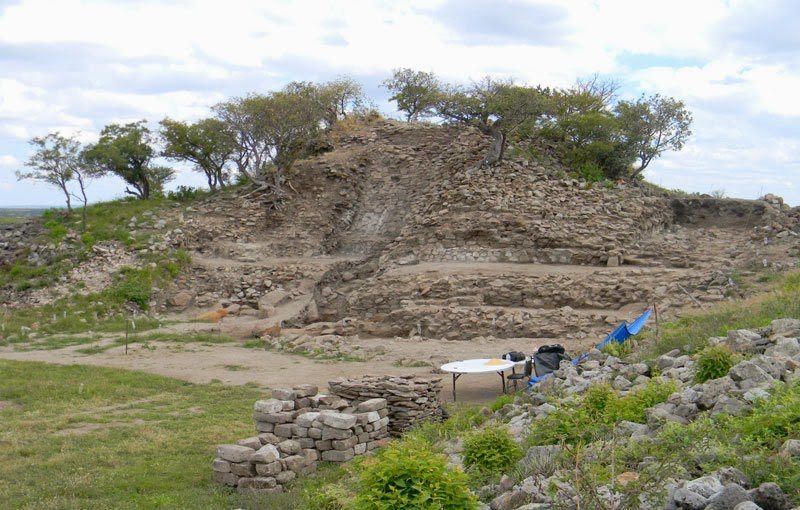
Teocaltitán covers almost 60 hectares on the upper part of Teocaltitán Hill. At least 24 monumental structures have been identified, many still covered or only partly exposed. The complex is organized around platforms and sunken patios, deliberately lowered open courts that helped define civic and religious spaces. Its principal buildings include a large pyramid, a central altar, and a ballcourt.
Monumental core
Principal Pyramid
The Principal Pyramid has a rectangular base and rises approximately 10 meters. Its profile was formed with a talud system, in which sloping battered walls create the main face of the monument. The structure belongs to the monumental architectural group that defined the center of the complex.
Central Altar
The Central Altar stands in a sunken patio in front of the Principal Pyramid. Excavation in the central-altar area revealed several pre-Hispanic burials, including an adult accompanied by a vessel dating to the Late Classic and a complete infant burial from the Postclassic. The infant burial was protected beneath a stone slab. Together, these remains provide evidence for funerary practices and for different construction and occupation phases at the ceremonial center.
Ballcourt and open courts
The complex contains a ballcourt approximately 60 meters long, a purpose-built space associated with the Mesoamerican ball game. Excavation in the ballcourt area also revealed pre-Hispanic burials, including the Late Classic adult burial and the complete Postclassic infant burial associated with the central-altar investigations. Sunken patios and platforms complete the documented spatial organization of the site, separating and defining its civic and religious areas.