Beni Hasan: An Ancient Egyptian Rock-Cut Necropolis
Site at a Glance
- Rating
- 4.4
- Popularity
- Low
- Country
- Egypt
- Primary era
- Bronze Age
- Eras represented
- Bronze Age, Iron Age, Classical
- Civilizations
- Egyptian, Ptolemaic
- Site type
- Burial
- Remains
- Necropolis
On this page20 sections
History
Beni Hasan is an ancient Egyptian rock-cut necropolis on the eastern bank of the Nile in Egypt, about 20 kilometers south of Minya. Cut into the limestone cliffs of Middle Egypt, it was used from the late Old Kingdom through the Middle Kingdom and into the Late Period, with its principal monumental phase in the Middle Kingdom. The cemetery is associated with the ancient place-name Menat Khufu, although the settlement itself has not been securely located.
From the Old Kingdom to the Middle Kingdom
The earliest burials at Beni Hasan date to the Sixth Dynasty, while the latest belong to the Thirtieth Dynasty. The cemetery’s main period of use was the Middle Kingdom, a phase of ancient Egyptian history that broadly spans the early second millennium BC to the seventeenth century BC. An interruption occurred during the New Kingdom. Two decorated rock-cut tombs in the lower cemetery belonged to Old Kingdom individuals named Ipi Heryib and Bebi.
During the Middle Kingdom, the monumental upper cemetery was used chiefly by governors and high officials of the Oryx Nome, one of the administrative districts of Upper Egypt, traditionally identified as the Sixteenth Nome. In the late First Intermediate Period and early Middle Kingdom, provincial governors were often drawn from hereditary local families. During the Twelfth Dynasty, royal authority increasingly controlled or confirmed their appointments. Beni Hasan therefore preserves evidence for changing relationships between provincial officeholders and the Egyptian court.
The upper cemetery contains 39 monumental tombs, mainly dating from the Eleventh and Twelfth Dynasties. Twelve retain inscriptions and painted decoration. Their owners included governors, princes, a prince’s son, and a royal scribe. The southern group is generally regarded as earlier and is associated mainly with the Eleventh Dynasty, while several northern tombs belong more securely to the Twelfth Dynasty. The sequence remains partly uncertain.
Governors and provincial authority
The tombs of Khety, Baqet III, Khnumhotep I, Khnumhotep II, Amenemhat, also called Ameny, Nakht, Netjernakht, Ramushenti, Baqet I, Baqet II, and Khnumhotep IV preserve the names and careers of important local officials. Khety held the titles “administrator of the Eastern Desert” and “commander of the warriors in all difficult places.” Nakht and Netjernakht also served as “Overseer of the Eastern Desert,” an office connected with administration beyond the Nile Valley.
Khnumhotep I’s autobiographical inscription presents him as a governor and high priest under Amenemhat I, who redefined the boundaries of the Oryx Nome. The text also refers to a naval battle, although its wider significance is uncertain. Baqet III, the son of Ramushenti, was a governor of the Oryx Nome whose tomb belongs to the earlier southern group. Khety was also governor of the Sixteenth Nome and is associated with a tomb dated approximately to 2055–1956 BC.
Khnumhotep II served as Overseer of the Eastern Desert under Amenemhat II and Senusret II. His tomb records the arrival of an Asiatic delegation in the sixth year of Senusret II, while a group of Libyans appears in the tomb of Khnumhotep I. These inscriptions and images place local officials within the administrative, military, and diplomatic activity of the Egyptian state.
Amenemhat was the last governor of the Oryx Nome known from Beni Hasan. He held office for approximately 25 years during the reign of Senusret I. His son, Khnumhotep III, entered the central administration and was buried at Dahshur rather than at Beni Hasan. The apparent decline of large provincial funerary complexes after the reign of Senusret III may reflect changes in political power, expressions of authority, or funerary practice, but the precise explanation remains uncertain.
Later use and modern investigation
The lower cemetery served mainly officials, courtiers, lesser officials, and their families. John Garstang excavated 888 burials there in 1902–1904, within a cemetery estimated at about 900 graves. The site also retained later religious and funerary activity. A Greco-Roman rock-cut chapel bears a royal cartouche naming Ptolemy Alexander II. South of the cemetery, Hatshepsut and her successor Thutmose III constructed an underground temple for Pakhet, a local lioness goddess associated with hunting and warfare. Greek identification of Pakhet with Artemis, their hunting goddess, gave the sanctuary its later name, the Cave of Artemis, or Speos Artemidos.
Later Coptic Christian hermit activity is represented by a tomb associated with a figure called “ruler of the desert.” Its wall painting of an alphabet suggests that it may have served as a school, while another tomb was converted into a church.
European study began in the late eighteenth and early nineteenth centuries. Edme François Jomard examined tombs BH15 and BH17 in 1798, James Burton visited in 1825, and Jean-François Champollion, Ippolito Rosellini, Robert Hay, John Gardner Wilkinson, and Karl Richard Lepsius copied or described the tombs, inscriptions, and paintings.
Percy E. Newberry directed Archaeological Survey of Egypt campaigns from 1890–1891 to 1894. George Willoughby Fraser prepared plans, sections, and measurements, while the team recorded the architecture, inscriptions, and painted scenes. The results appeared in four parts between 1893 and 1900. Garstang later excavated the lower cemetery for the University of Liverpool in 1902–1903 and 1903–1904, and objects from the work were dispersed among museums and other institutions.
Since 2010, a research programme directed by Naguib Kanawati has used photography, drawings, architectural plans, inscription copies, and studies of surviving decoration to examine decorated tombs and selected undecorated burials. The programme has also traced more than 2,000 dispersed objects in 114 institutions and reconnected many with their original tomb numbers.
Remains
Upper cemetery
Layout and construction
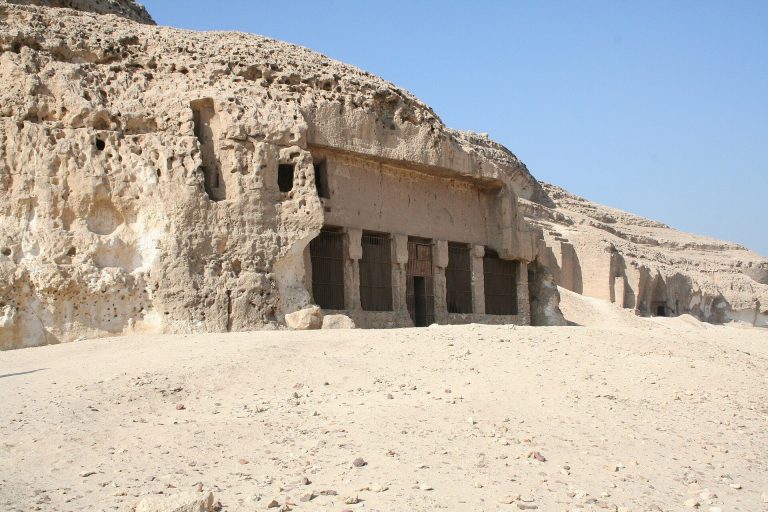
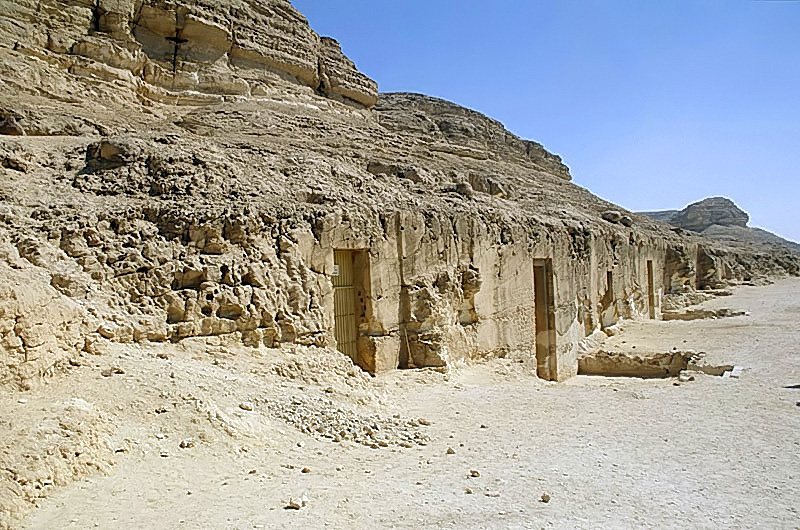
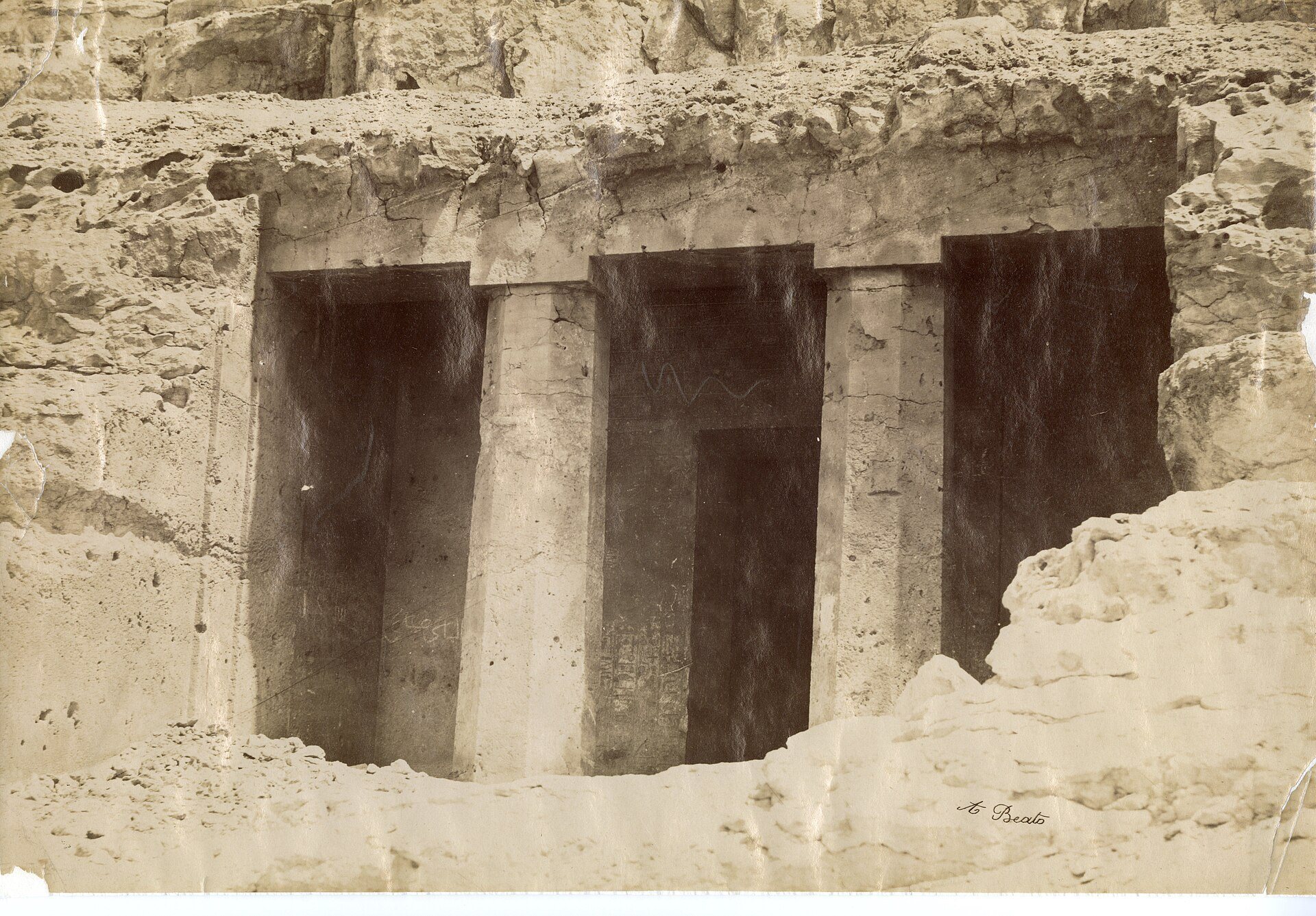
The monumental tombs are cut into the limestone cliffs forming the eastern edge of the Nile Valley. They occupy a natural terrace approximately halfway up the cliff, while the lower cemetery extends farther down the slope. The 39 upper tombs follow a generally north–south axis. A slight natural break in the cliff separates a northern group of 13 tombs from a southern group of 26.
Most upper tombs had a rock-cut chapel preceded by an open court. Later examples could include columned porticoes. A shaft, or occasionally a sloping corridor, descended from the chapel to an underground burial chamber. Chapel plans included small square rooms, larger rectangular halls with flat ceilings supported by rows of lotus-form columns, and more elaborate arrangements combining an open court, a vaulted portico, a square main chamber, paired columns, and a small statue shrine.
In the most elaborate chapels, the main chamber used sixteen-sided columns and the portico used octagonal columns with shallow longitudinal fluting. Square abaci, the slabs at the tops of capitals, supported the architraves. Since the time of Champollion, this column form has been called proto-Doric because later observers considered it an early analogue of the classical Doric order. Some chapels also contained shrines with statues of the deceased and family members.
Amenemhat’s chapel
A causeway led to the chapel of Amenemhat, which was preceded by a court with a two-columned portico. A shrine in the eastern wall held a statue group showing Amenemhat with his wife Hetepet and his mother Henu. The ceiling imitated beams and matting through multicolored geometric patterns.
Khnumhotep II’s chapel
The chapel of Khnumhotep II consisted of a court, a portico with two fluted columns, two burial shafts, and a hall that originally had four columns. The hall led to a statue shrine. An inscription extending over 222 columns records his life and career.
Khety’s chapel
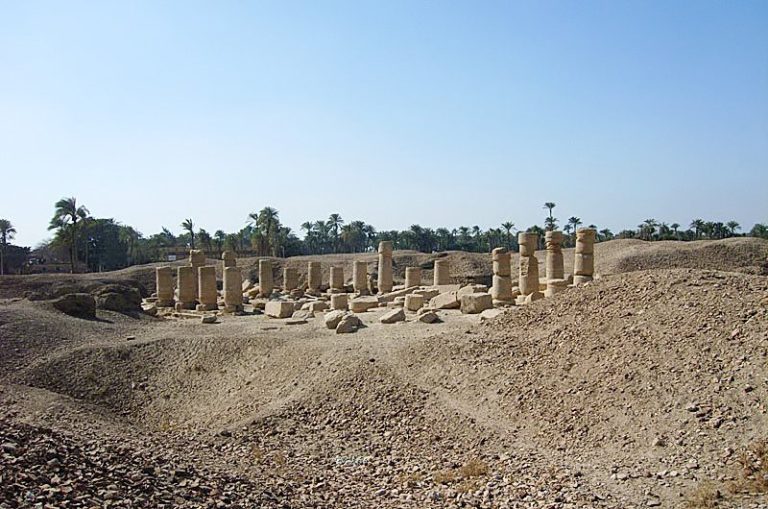
Khety’s chapel originally contained two rows of three columns with lotus-flower capitals. One column in each row survives intact. The unfinished chapel attributed probably to Khnumhotep IV belongs to the northern group and may date to the reign of Senusret II, Senusret III, or a slightly later period.
Baqet I and Baqet II
Baqet I’s large chapel was cut entirely into the rock and had no columns. Burial shafts opened through its floor. Baqet II’s simpler columnless chapel stood above a burial apartment whose chamber preserves extensive funerary texts.
Painted decoration and inscriptions
Twelve upper-cemetery tombs retain painted wall scenes. Artists applied the decoration over a smoothing layer of lime plaster. The subjects include hunting, fishing, agriculture, crafts, athletic contests, games, warfare, funerary offerings, and the afterlife. Autobiographical texts name tomb owners, give their titles and careers, and describe their position within provincial society.
Baqet III’s scenes
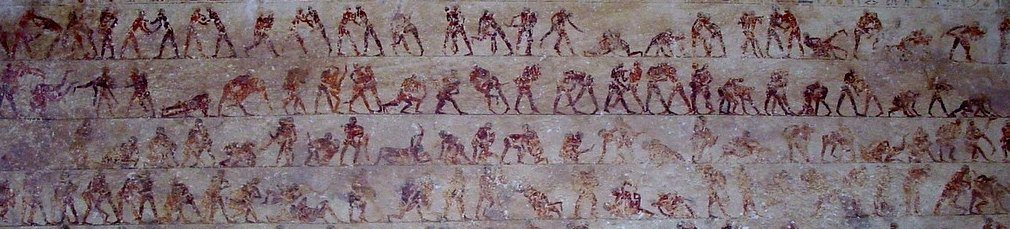
The tomb of Baqet III contains images of craftsmen at work, tax collection, hunting, fishing, animals, warfare, and the siege of a fortress. Its wrestling cycle includes 220 pairs of wrestlers. The two figures in each pair were painted red and dark brown so that their movements could be distinguished.
Khety’s scenes
The tomb of Khety depicts military training and an assault on fortified structures, together with 122 pairs of wrestlers. Other scenes show desert hunting, woodworking, spinning, weaving, board games, acrobatics, wine production, music, and additional sports.
Khnumhotep II’s scenes
The tomb of Khnumhotep II shows fifteen Asiatic figures, while its accompanying inscription gives a total of 37 and connects their arrival with an eye-paint substance. The painted programme also includes antelope feeding, fishing in marshland, fowling, and the gathering of figs.
Baqet II’s funerary texts
The burial chamber of Baqet II preserves hieratic and cursive-hieroglyphic funerary texts along the lower parts of all four walls. They include an abridged liturgy related to the Pyramid Texts, Pyramid Text spells PT 221 and PT 222, and Coffin Text spell CT 225.
Many paintings, including those in the tomb of Khnumhotep I, have been damaged by age, human intervention, exposure, and salt encrustation. Some details have been lost. Nineteenth-century expeditions produced facsimiles, drawings, color plates, and transcriptions that preserve records of parts of the decoration.
Lower cemetery
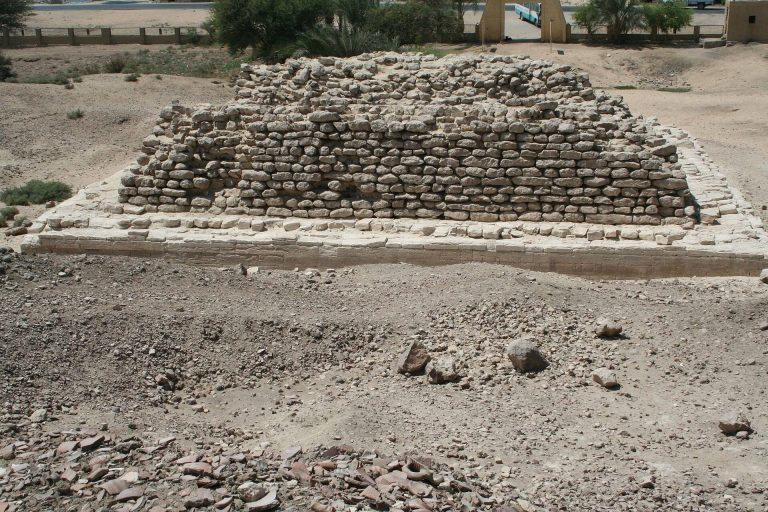
The lower cemetery contains approximately 900 mainly shaft tombs. About 800 followed a recurring plan consisting of a generally quadrangular vertical shaft and a small chamber or recess opening on the south side at its base. Shafts were usually 5–7 meters deep, while other examples reached about 3 meters and the deepest approximately 10 meters.
The small burial chambers held coffins and funerary equipment, including food, drink, furniture, and other offerings. An excavated undisturbed burial contained a coffin and several jar stands. Associated finds included pottery vessels, fragments of wooden figures, an offering table, and part of a bronze battle-axe blade.
Later structures
Temple of Pakhet
The underground temple of Pakhet lies south of the cemetery in a wadi opening east of the modern village. Hatshepsut and Thutmose III cut the sanctuary into the rock. Its later association with Artemis produced the name Speos Artemidos, meaning Cave of Artemis.
Greco-Roman and Coptic features
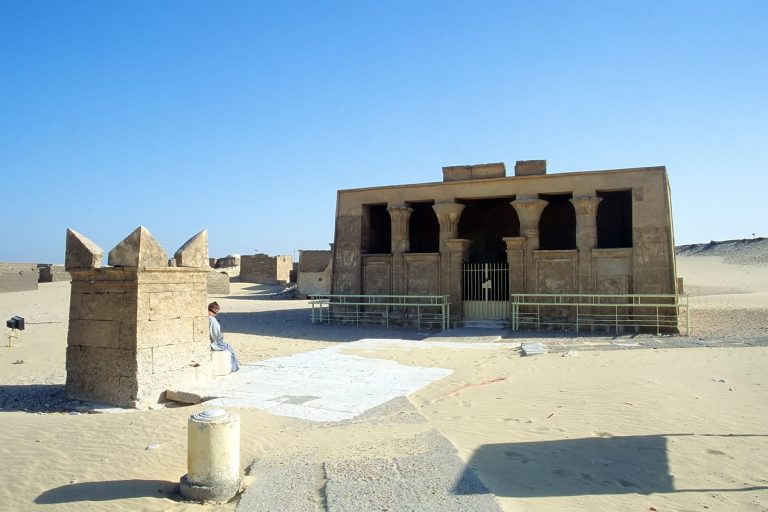
The Greco-Roman rock-cut chapel has a cornice bearing the cartouche of Ptolemy Alexander II. A cartouche is an elongated ring enclosing a royal name in Egyptian hieroglyphic writing. A tomb used as a possible Coptic school preserves an alphabetic wall painting, while another tomb was adapted as a church.