Saseongam: A Buddhist Hermitage on Mount Osan, South Korea
Site at a Glance
- Rating
- 4.6
- Popularity
- Low
- Country
- South Korea
- Primary era
- Medieval
- External website
- Open
- Eras represented
- Medieval
- Civilizations
- Goryeo
- Site type
- Religious
- Remains
- Monastery
On this page10 sections
History
Saseongam is a Buddhist hermitage on Mount Osan in Gurye County, South Korea. Tradition places its foundation in 544, during the reign of King Seong of Baekje, one of the three major kingdoms of ancient Korea, and attributes its construction to the Buddhist priest Yeongi Josa. This foundation date remains a traditional account rather than a confirmed historical event. Yeongi Josa is also associated with the establishment of nearby Hwaeomsa and Yeongoksa.
From Osanam to Saseongam
The hermitage was first known as Osanam, a name connected with its position near the 531-metre summit of Mount Osan. It later became Saseongam, meaning “Hermitage of Four Saints.” The name refers to Uisang, Wonhyo, Doseon, and Jingak, four prominent Buddhist figures traditionally linked with the site. Uisang was a major monk of the Hwaeom tradition, while Wonhyo was a leading Buddhist thinker. Doseon was associated with geomantic ideas, and Jingak was a Goryeo-period Buddhist master.
Wonhyo and Doseon are specifically associated with retreat and Buddhist practice on the cliffs. Tradition places the ascetic practices of these high priests at Saseongam from the closing period of Unified Silla, the era after Silla unified most of the Korean Peninsula, through the Goryeo period. The hermitage buildings were later reconstructed under the supervision of Jingak, who lived from 1178 to 1234.
Reconstruction and heritage status
The Main Hall was reconstructed during the 1980s. In 1984, Saseongam became Jeollanamdo Cultural Property Material No. 33. That designation was withdrawn in 2014 when the wider Mount Osan-Saseongam area was elevated to Scenic Site No. 111 of South Korea. The scenic designation covers 71,129 square metres and recognizes the relationship between the hermitage, the granite formations, and the surrounding landscape.
Mount Osan provides wide views toward the winding Seomjin River, Gurye town, seven administrative townships, and the mountain ranges of Jirisan. An 1800 record compared the mountain’s distinctive rocks with those of Geumgangsan and called the area “Small Geumgangsan.”
Remains
Cliffside layout
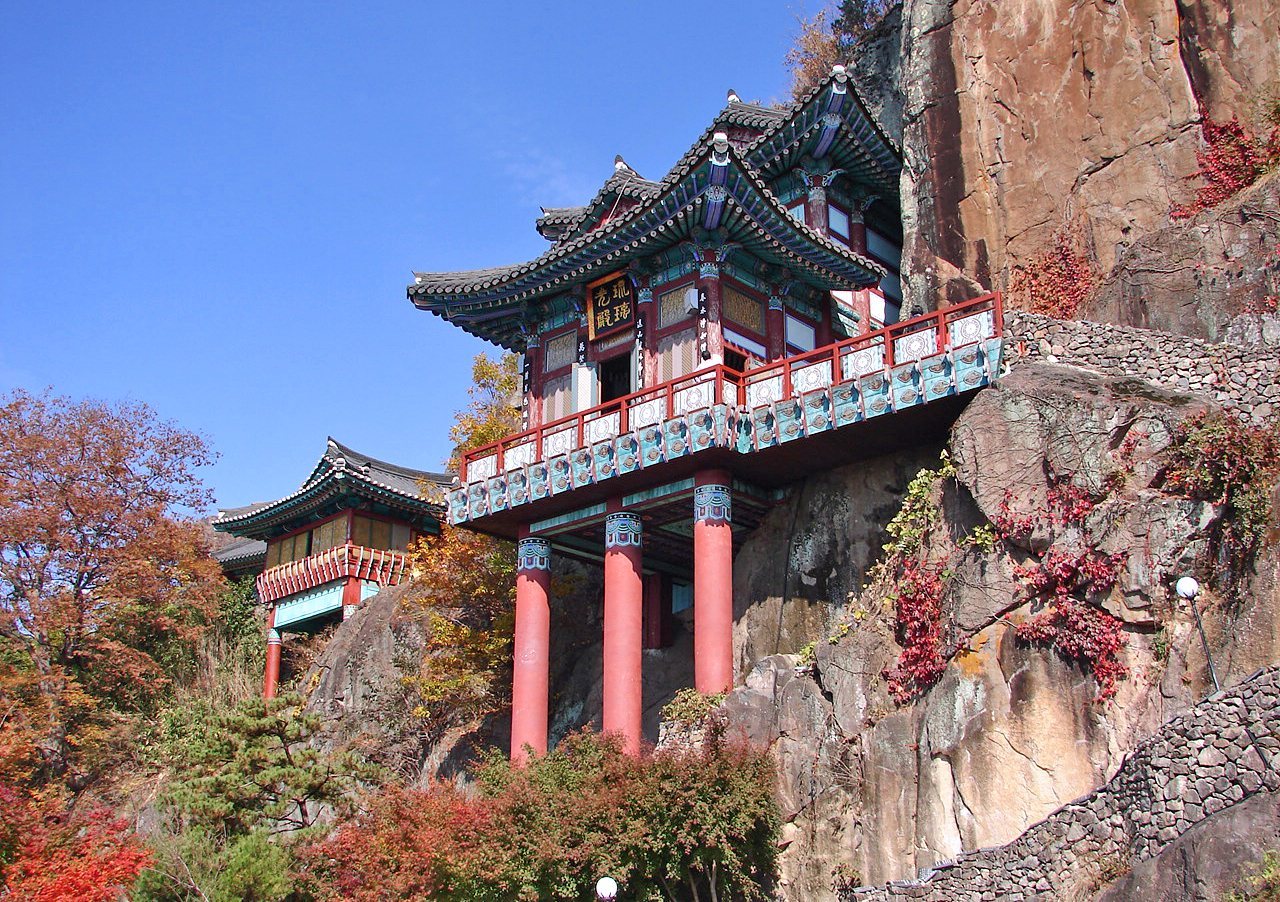
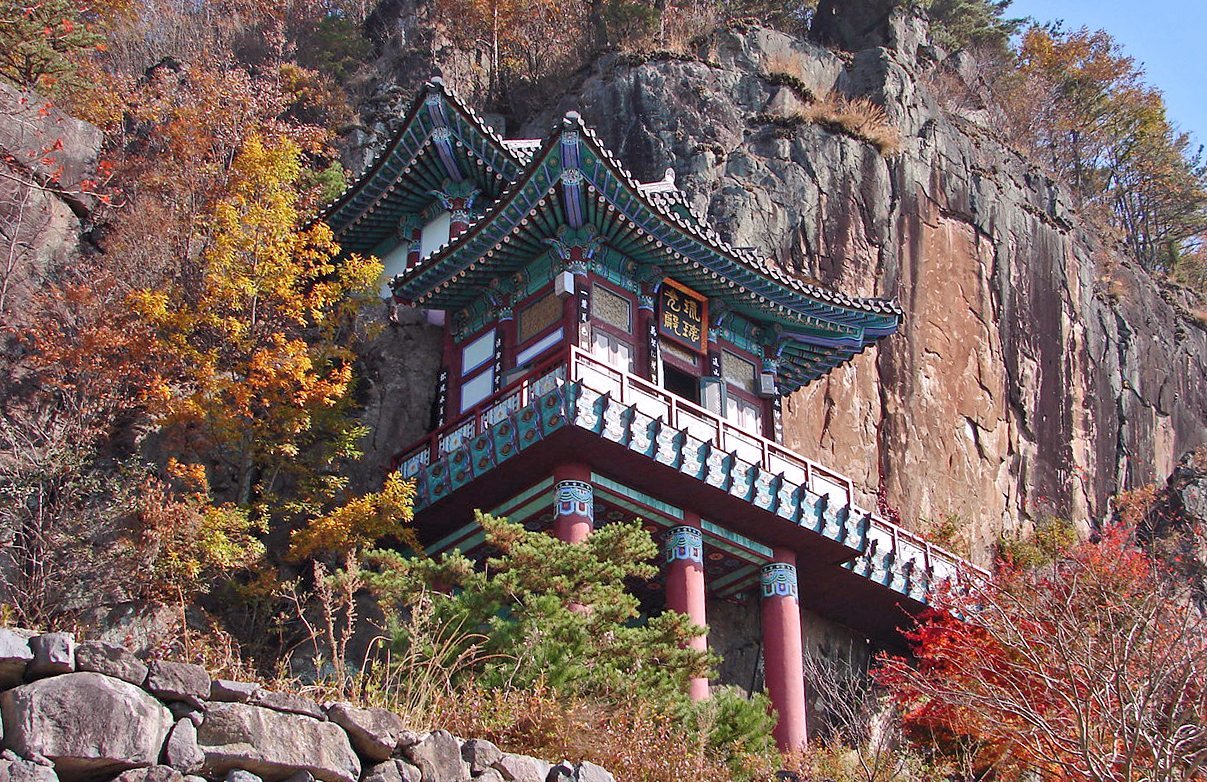
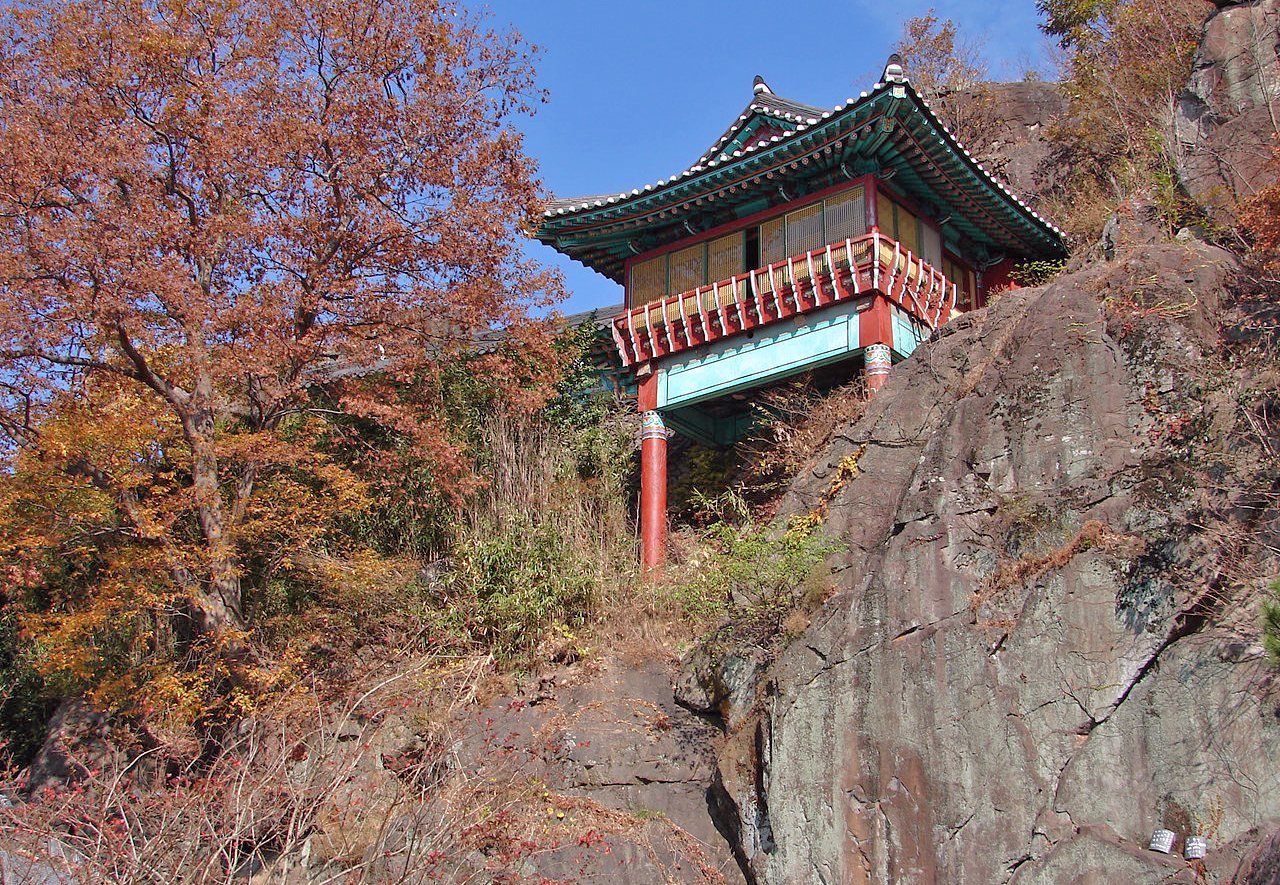
Saseongam occupies steep granite cliffs near the summit of Mount Osan. Two halls at the front are supported by large painted pillars set against the cliff, while two further halls stand on a crest west of the Main Hall. A steep stone stairway rises to a bridge crossing toward the Main Hall, linking the buildings across the sharply sloping site.
Main Hall and rock-carved Buddha
The Main Hall is carried on three massive red-wood pillars positioned before a standing Buddha carved into the rock face. Known as Maaeyeoraeipsang, the image is visible through a large glass window that forms most of the hall’s rear wall. Cultural authorities date the carving to the early Goryeo period. The arrangement places the hall directly in relation to the cliff and the image cut into it.
Jijangjeon
Jijangjeon is reached by a second set of stone stairways west of the Main Hall. The building is dedicated to Jijang, or Ksitigarbha, a Mahayana Buddhist bodhisattva associated with relieving suffering and aiding beings in the realms of death and hell. Jijangjeon stands behind a smaller hall perched on two large red-wood pillars.
Shrines and cliff passages
Sanshingak
Sanshingak is a small Mountain-Spirit Shrine behind Jijangjeon. It is dedicated to Sanshin, a Korean mountain spirit traditionally shown as an elderly man accompanied by a tiger.
Doseongul
Doseongul is a passage between enormous cliff boulders beside Sanshingak. Tradition holds that Wonhyo meditated there. About two centuries later, Doseon is said to have lived briefly in the passage while developing Pungsu-jiri-seol, Korea’s adaptation of feng shui, a geomantic tradition concerned with the relationship between human settlements and landscape forms.
Unusually shaped rocks surround Mount Osan, and one bears an engraving of a standing Buddha. Together with the halls, stairways, carved image, shrines, and narrow rock passage, these features form a hermitage closely fitted to the mountain’s granite terrain.