Gwangju Wolgye-dong Janggobun: Sixth-Century Keyhole Tombs in South Korea
Site at a Glance
- Rating
- 4
- Popularity
- Low
- Country
- South Korea
- Primary era
- Medieval
- External website
- Open
- Eras represented
- Medieval
- Civilizations
- Baekje
- Site type
- Burial
- Remains
- Necropolis
On this page11 sections
History
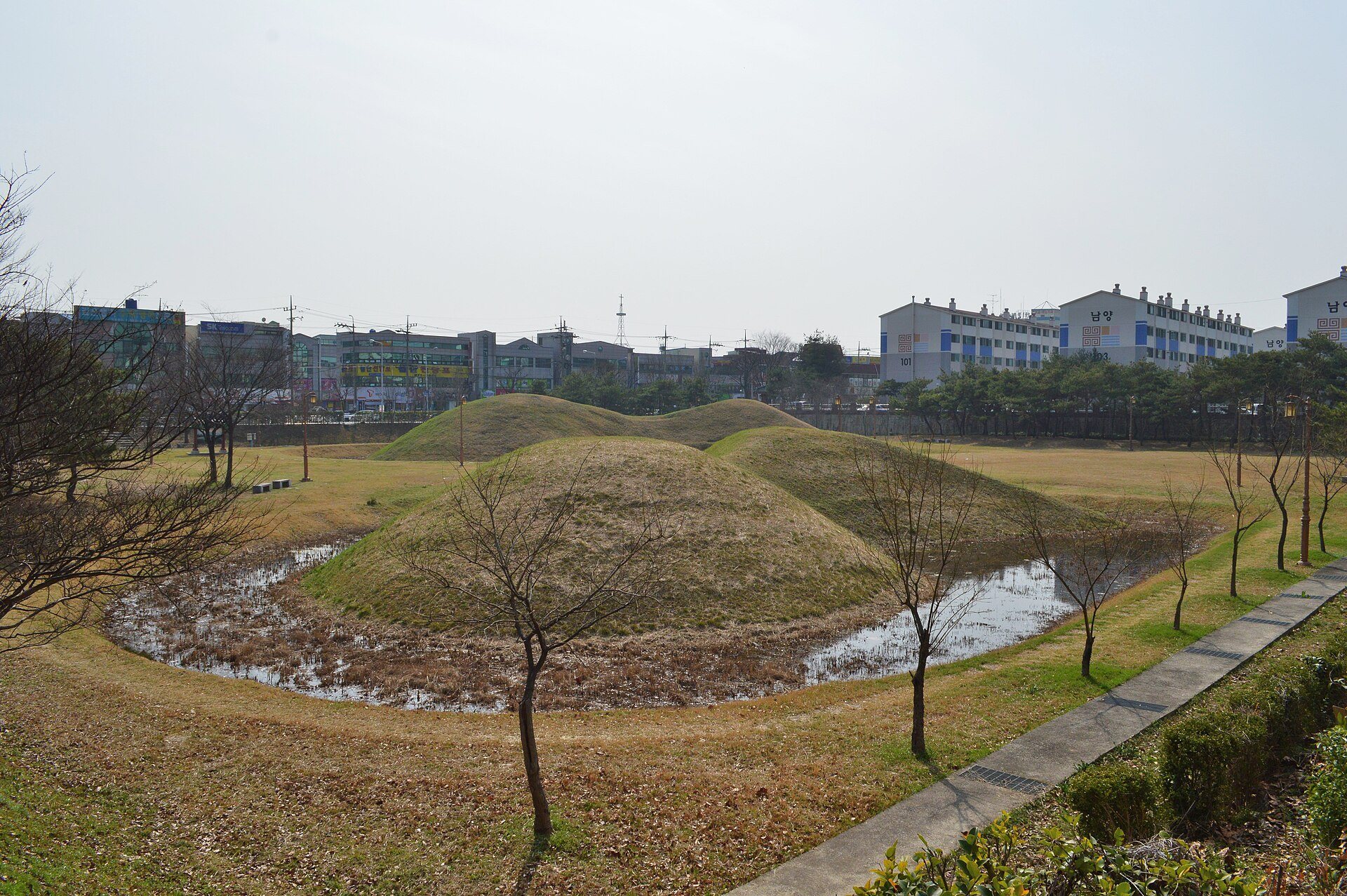
Gwangju Wolgye-dong Janggobun is a group of two sixth-century keyhole-shaped tombs in Wolgye-dong, Gwangsan District, Gwangju, South Korea, built during the Three Kingdoms period. This period was marked by competition among Goguryeo, Baekje, and Silla from approximately the fourth through the seventh centuries. A keyhole-shaped tomb has a square front joined to a rounded rear mound, a form also called a janggobun in Korea because it resembles an hourglass-shaped drum. The two tombs were constructed on low hills beside the alluvial plain of the upper Yeongsan River, probably during the first half of the sixth century.
A paired tomb group in the Three Kingdoms period
The tombs stand about 50 meters apart and form the only known group in the southern Korean Peninsula in which multiple keyhole-shaped tombs were built together. Most of the roughly ten or more comparable tombs around the Yeongsan River occur singly. Their external forms contain strong elements associated with Wa, the name used in early East Asian sources for the polity or peoples of the Japanese archipelago. Their coffins and grave goods, however, show strong connections with Baekje, one of the Three Kingdoms whose influence extended across southwestern Korea.
No local tomb tradition is known in the immediate area, and the group appears to have emerged there abruptly. The combination of external features associated with Wa and burial equipment linked to Baekje has made the tombs important for examining ancient burial practices and relations between the Korean Peninsula and Japan. Interpretations have differed. One has connected the tombs with a proposed Yamato-period Japanese colonial rule in southern Korea, while another has regarded them as the graves of Japanese merchants who traded iron with Mahan. These remain historical interpretations rather than established facts.
Investigation, damage, and preservation
Chonnam National University investigated the site in 1993 and 1995. The first investigation established the extent of the tombs and set aside a preservation area before development of the Gwangju Advanced Science and Industrial Complex. The second investigation fully excavated the surrounding ditches. Both tombs had stone burial chambers covered by earthen mounds and enclosed by ditches.
Looting during the Japanese colonial period destroyed or removed much of the tomb contents and damaged parts of the burial facilities. The site was restored to its present form in 1997. On February 18, 1994, it became Gwangju Metropolitan City Monument No. 20 under the designation Wolgye-dong Janggobun. The protected area covers 13,850 square meters and includes both tombs.
Remains
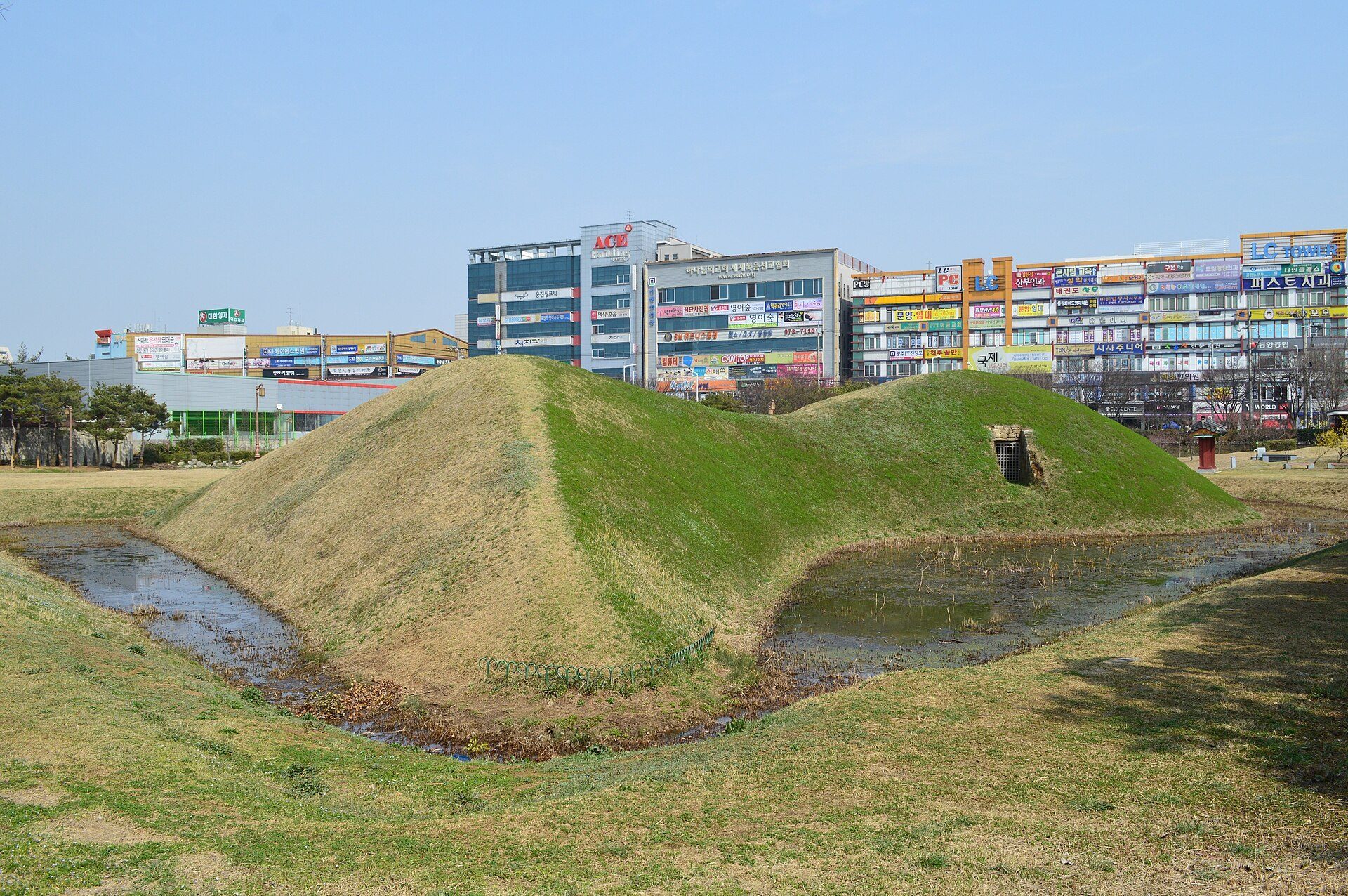
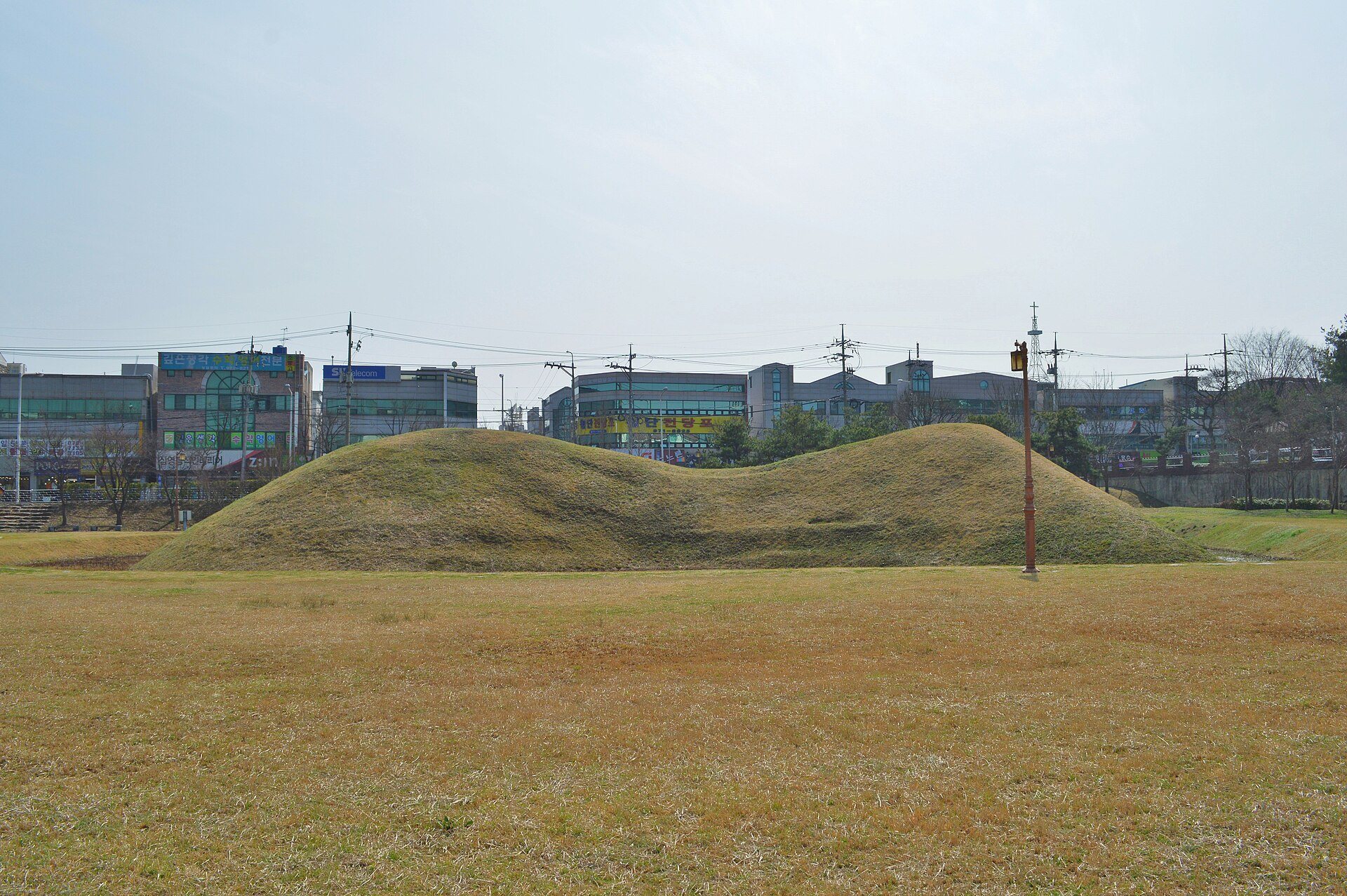
The surviving site consists of two earthen mounds shaped with square front sections and rounded rear sections. Their square fronts point generally westward and widen into fan-shaped areas. Shield-shaped ditches surround both mounds. The tombs have no documented stone facing, stepped construction, or projecting platforms on their mound surfaces. Their burial chambers were made from roughly split stones laid in courses resembling brickwork.
Earthen mounds and surrounding ditches
Tomb 1
Tomb 1 lies about 50 meters southwest of Tomb 2 and is oriented west-northwest. Its surviving mound measures 36.6 meters in length, while its reconstructed length is estimated at 45.3 meters. The rear circular section is about 16 meters across and 4.8 to 4.9 meters high; reconstruction gives an estimated diameter of 25.8 meters and height of 6.1 meters. The narrowed middle section is 10.45 meters wide and 3.3 meters high, with estimated reconstructed dimensions of 14.5 meters and 3.8 meters. The front section is 27 meters wide and 4.9 meters high, with reconstructed dimensions of 31.4 meters and 5.2 meters. The rear section has suffered heavy damage, and a shield-shaped ditch approximately 1.5 meters deep surrounds the mound.
Tomb 2
Tomb 2 stands about 50 meters northeast of Tomb 1 and faces west. Its mound is 28 meters long, with an estimated reconstructed length of 34.5 meters. The surviving rear circular section measures 13.9 meters in diameter and 2.9 meters high; its reconstructed dimensions are approximately 20.5 meters and 3.5 meters. The narrowed section is 7.9 meters wide and 0.7 meters high, with estimated reconstructed dimensions of 14.5 meters and 1.5 meters. The front section is 11.9 meters wide and 2 meters high, with reconstructed dimensions of 22 meters and 3 meters. A shield-shaped ditch about 1 meter deep encircles the mound.
Burial chambers and excavated objects
Tomb 1 chamber and finds
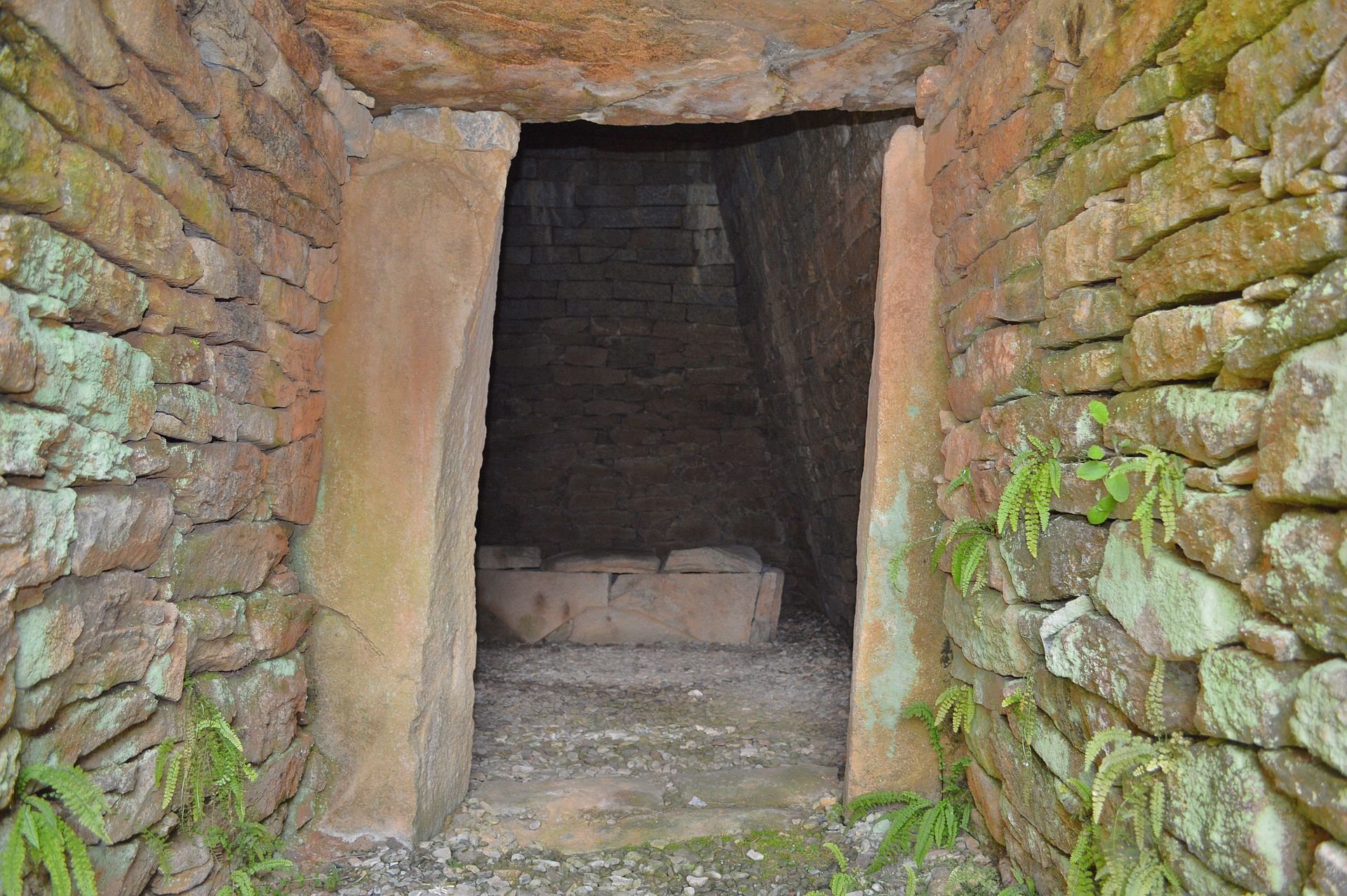
Tomb 1 contains a double-sleeved stone burial chamber, meaning that lateral projections flank the junction between the main chamber and its entrance passage. The chamber was built toward the southern side of the rear mound and is entered from the southwestern side of the narrowed section. It measures about 4.5 meters long, 2.7 to 2.8 meters wide, and at least 2.4 meters high. Its corridor is approximately 2.8 meters long, 1.4 meters wide, and 1.6 meters high. The chamber was severely damaged by looting, and its construction includes features associated with stone chambers in Kyushu.
Objects from Tomb 1 include a gold earring, iron arrowheads, pottery fragments, silver-clad nails, and fittings from a ring seat. A Japanese-imported Sue ware flask of the MT15 type was also found. Sue ware was a high-fired Japanese ceramic tradition of the Kofun period, and its presence can indicate contact or movement between the Korean Peninsula and the Japanese archipelago. The nails and fittings suggest that the burial once contained a decorated wooden coffin in the Baekje style.
The ditch around Tomb 1 produced cylindrical and morning-glory-shaped haniwa-like earthen objects, along with numerous wooden pieces. These included umbrella-shaped objects and Iwami-type shield-shaped pieces. Haniwa are clay funerary objects especially associated with Japanese kofun tombs, although the Wolgye-dong objects are described as haniwa-like rather than automatically identified as imports from Japan. Their manufacture has been associated with Baekje ceramic ware.
Tomb 2 chamber and finds
Tomb 2 has a double-sleeved stone chamber built toward the northern side of its rear mound. Its entrance passage opens toward the northwestern side of the narrowed section and is now closed. The chamber was damaged by looting and incorporates features associated with Kyushu stone chambers. It measures approximately 3.8 meters long and 2.4 to 2.5 meters wide, while the corridor is about 1.2 meters long and 1.5 meters wide.
Excavated material from Tomb 2 includes fragments of an iron knife, pottery, glass beads, and other objects connected with Baekje. As in Tomb 1, the burial arrangement is inferred to have included a decorated wooden coffin in the Baekje style.
Comparative forms and surviving collections
The shapes of the mounds have been compared with several tombs in Japan. Tomb 1 has been compared with Ichinoyama Tomb in Fujiidera, Osaka, and Katsuragawa Tenjinyama Tomb in Keisen, Fukuoka. Tomb 2 has been compared with Oka-Misanzai Tomb in Fujiidera and Ueyama Tomb in Kitakyushu. These comparisons concern the forms of the mounds and do not directly identify the people buried at Wolgye-dong.
Other recovered materials include perforated wide-mouthed jars, reddish-brown cylindrical pottery, wooden objects, and additional pottery fragments. Excavated objects from the tombs are held in collections including those of the National Gwangju Museum and Chonnam National University Museum.