Songgwangsa: A Historic Seon Monastery in South Korea
Site at a Glance
- Rating
- 4.5
- Popularity
- Medium
- Country
- South Korea
- Primary era
- Medieval
- External website
- Open
- Eras represented
- Medieval, Modern
- Civilizations
- Joseon
- Site type
- Religious
- Remains
- Monastery
On this page18 sections
History
Songgwangsa is a Buddhist monastery on Jogyesan in Suncheon, South Korea, whose origins lie in the late Silla period and are also dated to 867. It belongs to the Jogye Order, Korea’s principal Buddhist order, and is regarded as the temple representing the Sangha, the Buddhist monastic community, in Korea’s Three Jewels Temples. Tongdosa represents the Buddha and Haeinsa represents the Dharma, or Buddhist teaching.
From Gilsangsa to a Goryeo centre
The monastery began as the small temple of Gilsangsa. Tradition attributes its foundation to the Seon master Hyerin, who built a hermitage on the mountain and lived there. The original establishment measured about 37 square metres and housed roughly 30 to 40 monks. After more than fifty years of abandonment, it fell into ruin.
During the reign of King Injong of Goryeo, the mountain monk Seokjo began preparing a major expansion, but he died before the work was finished. A decisive change came in 1190, when the Seon master Jinul moved his Samadhi and Prajna Community, also called the Jeonghye Association, to the ruined site. This community joined meditation with the cultivation of wisdom and made the monastery a centre for religious practice.
Rebuilding and expansion began in 1197 under Jinul’s disciples Suu, Cheonjin, and Gwakcho, and were completed in 1207. King Huijong of Goryeo, who supported Jinul, renamed the monastery Suseonsa, meaning the monastery of the Seon-practising community. The meditation hall has retained this name. The mountain later became known as Jogyesan, while the monastery eventually took the name Songgwangsa. The date of that final change is uncertain.
Several traditions explain the name Songgwangsa. One interprets it as referring to a temple from which eighteen great monks would spread the Buddha’s teaching. Another connects the name with a wooden kite released by Jinul that landed on the mountain. A third relates it to the pine trees that once covered the slopes.
Medieval religious importance
Under Jinul and his successors, Songgwangsa developed into a major centre of Korean Buddhism. It brought together masters of the five traditional doctrinal schools and the nine mountain Seon schools, the Korean tradition of meditation-centred Buddhism. The monastery produced sixteen national preceptors, the highest religious distinction granted to a monk by the Goryeo state. They included Jinul and his successor, Hyesim Chingak.
More than 500 practitioners were associated with Jinul’s period. Later, several thousand students were linked with the national master Wŏngam Chungji, both at the main complex and in surrounding temples and hermitages. In the mid-fourteenth century, King Gongmin proclaimed Songgwangsa “the best monastery of the East.”
Financial support ended late in the Goryeo period, and the monastery declined. Kobong Pŏpchang, described as the sixteenth and last national teacher, began repairing its damaged buildings after arriving in 1395. His successors completed the restoration in 1427.
War, fire, and repeated rebuilding
During the Japanese invasion of 1597 to 1598, four monastery buildings were burned and most of the monks were forced to leave. Reconstruction began under the monk Ŭngsŏn. The monastery revived under Punhyu Sŏnsu, who arrived in 1614 with more than 400 monks and gave lectures attended by more than 600 listeners. Songgwangsa was rebuilt again during the seventeenth century as Buddhism regained importance.
On 2 March 1842, a fire destroyed every building over two days and consumed almost all the monastery’s sculptures, paintings, and other religious objects. The main hall’s Buddhist triad survived, along with a statue of Ksitigarbha, the large bell, and wooden blocks bearing the Avatamsaka Sutra, a major Mahayana Buddhist scripture associated in Korea with the Hwaeom tradition. Monks and laypeople rebuilt the monastery over fourteen years under the supervision of Kibong and Yongun.
Between 1924 and 1928, the monk Yurma built or completely renovated nineteen buildings. The monastery was then affected by the Korean War and the surrounding conflict. In 1948, attacks and United Nations bombing destroyed the forest around Songgwangsa. Communist forces entered the complex after younger monks had left to avoid forced recruitment, and communist guerrillas killed the remaining monks in February 1951. A counterattack in May destroyed the central complex, including the main hall, library, and most monastic quarters.
After the war, the monk Ch’wibong and the abbot Kŭmdank began a 1,000-day retreat of sutra and dharani recitation to raise funds for reconstruction. Between 1955 and 1961, the main hall, four other temples, the bell tower, and a museum were rebuilt or newly constructed.
Modern monastic institution
A conflict between married, Japan-influenced monks occupying the monastery and traditional monks led by Kusan was finally resolved on 2 September 1967. On 15 April 1969, Songgwangsa entered the chongnim system, an institutional arrangement combining meditation, education, and monastic administration within a major monastery. Kusan then directed extensive reconstruction, restoring Songgwangsa’s importance within Korean Buddhism.
Songgwangsa now functions under the Jogye Order while retaining institutional autonomy. It is the head temple of the order’s twenty-first district and administers a network of branch temples. It remains an active Seon practice centre and includes an international Seon centre for foreign practitioners. The monastery is one of Korea’s oldest active Seon temples and has been repeatedly rebuilt and restored. A field of stupas, Buddhist monuments associated with relics and memorialization, preserves the remains of approximately thirty Seon masters and eminent monks.
South Korea designated Songgwangsa Historic Site No. 506 on 21 December 2009. The wider Jogyesan and Songgwangsa landscape is also Scenic Site No. 65. The monastery continues to observe two traditional three-month meditation seasons, one in winter and one in summer. About 120 monks usually attend during these periods, compared with about 70 in the off-season. Meditation can occupy twelve hours a day and may include periods of continuous practice lasting twenty-four hours.
Buddha’s Birthday is marked with lanterns, candle-lit lamps around the shrines and central courtyard, food offerings, lectures, and an evening lighting ceremony. Songgwangsa also observes a three-day Korean New Year festival beginning on New Year’s Eve. These festivals and meditation seasons express the continuing religious identity of Songgwangsa as an active Seon monastery.
Remains
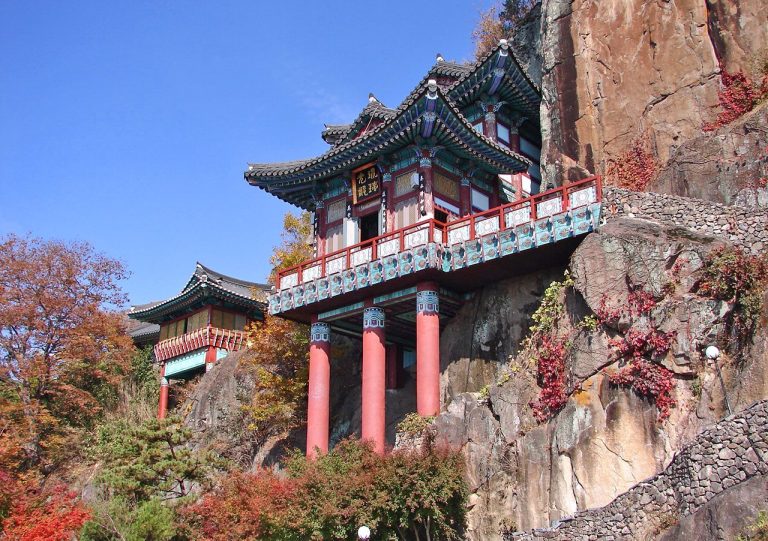
Songgwangsa lies within Jogyesan Provincial Park, where the approach passes through large pine trees and crosses a valley bridge with a round resting pavilion called Cheongnyanggak. A stream runs at the entrance, crossed by two bridges, one of which has an unusual architectural arch. The complex covers approximately 44,297 square metres and contains about eighty predominantly wooden buildings, together with stupas, stele, and monuments.
Layout and entrance buildings
The monastery’s overall arrangement follows the Hwaeom “ocean-seal” or Dharma-wheel chart, a diagram associated with the Buddhist idea of the Dharma realm. A large central courtyard forms part of the complex, while auxiliary buildings and work-and-living units are set around it. The main entrance is the ilchumun, a Korean temple gate with a single line of supporting pillars. Beyond it stands an entrance building associated with the Four Heavenly Kings, Buddhist protectors.
Bridges and detached entrance buildings
Two small detached buildings stand near the entrance bridges. One tradition identifies them as temporary storehouses for human remains, while another identifies them as dressing rooms used by members of the royal family after bathing before marriage ceremonies.
Drum and Bell Tower
The Drum and Bell Tower, or Chonggo-ru, stands beyond the entrance area and contains implements historically used in monastic life. Its position links the entrance zone with the central buildings of the monastery.
Central halls
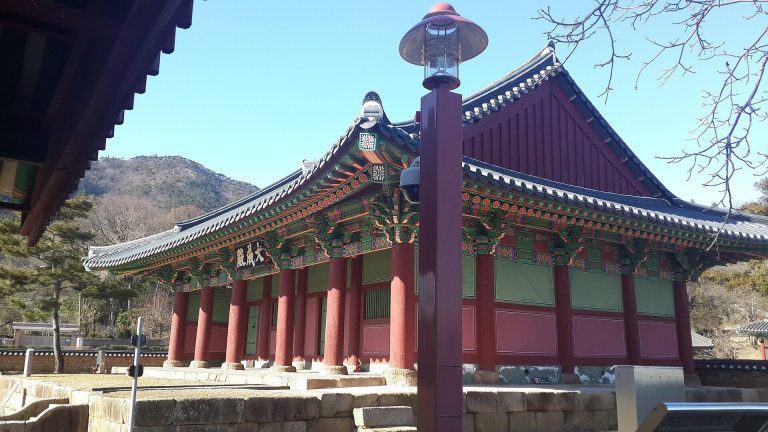
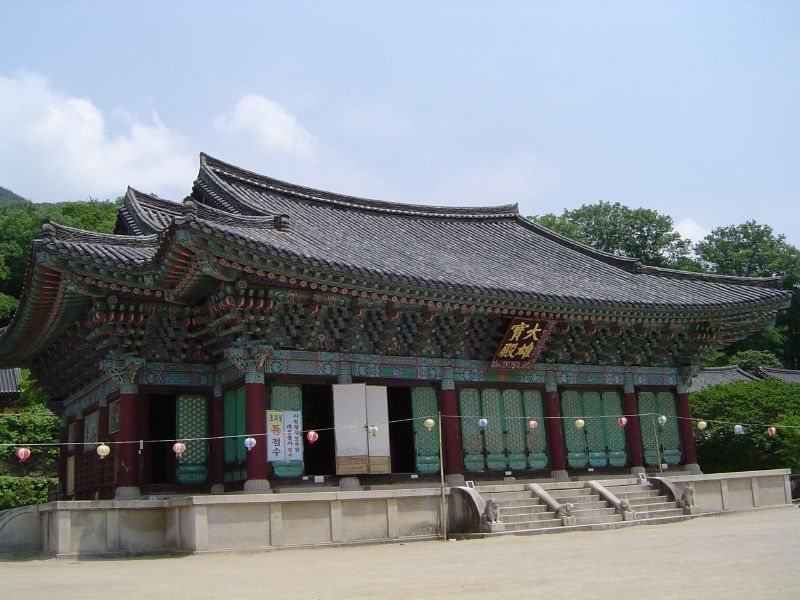
The Great Hero Hall, also rendered as Daeungbojeon or Taeung-chon, is the architectural and ideological centre of Songgwangsa. It is a wooden post-and-beam building with a double-roofed appearance, reinforced brackets, carefully fitted joints, and no structural nails. The spaces between the supporting columns are filled with dried clay mixed with grass.
Great Hero Hall
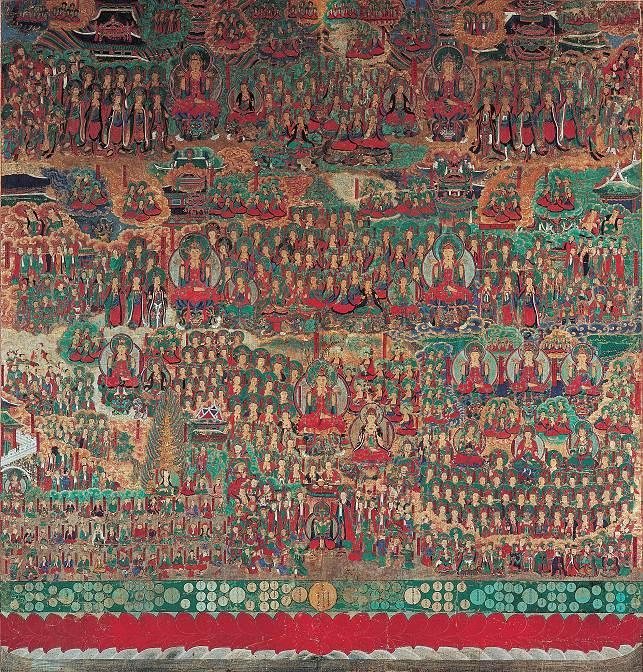
The hall contains a shrine to Vairocana, the cosmic Buddha associated with the Buddha’s universal body, and the three Buddhas of past, present, and future, Dipankara, Gautama, and Maitreya. The principal wooden altar is approximately 7 to 7.6 metres high and stands far enough from the front wall to allow circumambulation. Behind it hangs a large, brightly coloured taenghwa, a Buddhist scroll painting depicting a pantheon. A depiction of the guardian general Wita appears on a side wall. Burgundy columns, yellow walls, and eaves decorated in cinnabar and pale green frame patterns in red, green, blue, and yellow.
Seungbojeon and Jijangjeon
The Seungbojeon stands beside the Great Hero Hall and expresses Songgwangsa’s identity as the temple of the Sangha, the Buddhist monastic community. The Jijangjeon, also beside the main hall, contains a statue of Ksitigarbha, a bodhisattva associated with protection of the dead. Together with the Great Hero Hall, these buildings form the central group of halls.
Teaching and meditation buildings
The Teaching Hall, Masters’ Portrait Hall, and residence of the Seon spiritual leader stand at a higher elevation than the Great Hero Hall. A small building with a conventional chimney near the spiritual leader’s residence is traditionally associated with his deputy and is regarded as one of Korea’s oldest living quarters. It dates to the fifteenth century.
Meditation hall
The meditation hall is positioned above and beyond the Great Hero Hall, emphasizing the central place of monastic practice. The hall has retained the name Suseonsa, given to the monastery by King Huijong during the Goryeo period. On a small hill above the main hall, the meditation and teaching buildings and the Seon master’s residence are somewhat isolated from the central group to preserve the privacy of meditation practice.
Residential units
Monastic residential units are separated from one another and from public areas by walls of clay and stone. Each has a central courtyard and a principal room called the keunbang, or large room. Its heated ondol floor can accommodate approximately thirty monks, and the room can serve successively as a classroom, refectory, dormitory, or meditation hall.
The keunbang contains regularly spaced pairs of sliding paper doors. An external furnace heats both the floor and water in a large boiler, while a granite tank receives spring water brought through channels. A network of water channels beneath the monastery supplies the main complex and outlying quarters. Drainage channels carry roof water away, as the buildings have no conventional gutters.
Supporting buildings and memorial features
Songgwangsa contains separate kitchens, offices, libraries, auxiliary buildings, and small shrines dedicated to bodhisattvas, Seon patriarchs, and deceased masters. Hermitages in the surrounding mountains form part of the wider monastic institution. The upper areas contain stone stelae, generally about 2.4 metres high, that record the monastery’s history. An ancient hitching post near the stelae was formerly used by government officials and other eminent visitors.
Stupas and relics
Numerous stelae and pagodas contain the ashes or relics of monks and national teachers. A nearby stupa field preserves the relics of approximately thirty Seon masters and eminent monks, extending the monastery’s memorial landscape beyond its principal halls.
Three celebrated treasures
The monastery’s three celebrated treasures are the Bisari Gusi, the Ssanghyangsu, and the Neunggyeonnansa. The Bisari Gusi is a large rice container made from two Chinese juniper trees and can hold enough rice for 4,000 monks. The Ssanghyangsu consists of two very large Chinese juniper trees, Juniperus chinensis, and is recognized as a natural monument. The Neunggyeonnansa is an intricately designed plate.
The buildings have been repeatedly repaired and reconstructed, with damaged wooden elements replaced by carefully made copies. Very little timber from the earliest phases survives, but the rebuilt complex retains its traditional architectural identity. The surviving arrangement includes the principal halls, teaching and portrait buildings, meditation structures, residences, kitchens, offices, shrines, hermitages, towers, and service buildings that support Songgwangsa’s continuing monastic life.