Terrace of the Leper King: A Royal Terrace at Angkor Thom
Site at a Glance
- Rating
- 4.7
- Popularity
- Low
- Country
- Cambodia
- Primary era
- Medieval
- Eras represented
- Medieval
- Civilizations
- Khmer
- Site type
- Civic
- Remains
- Monument
On this page10 sections
History
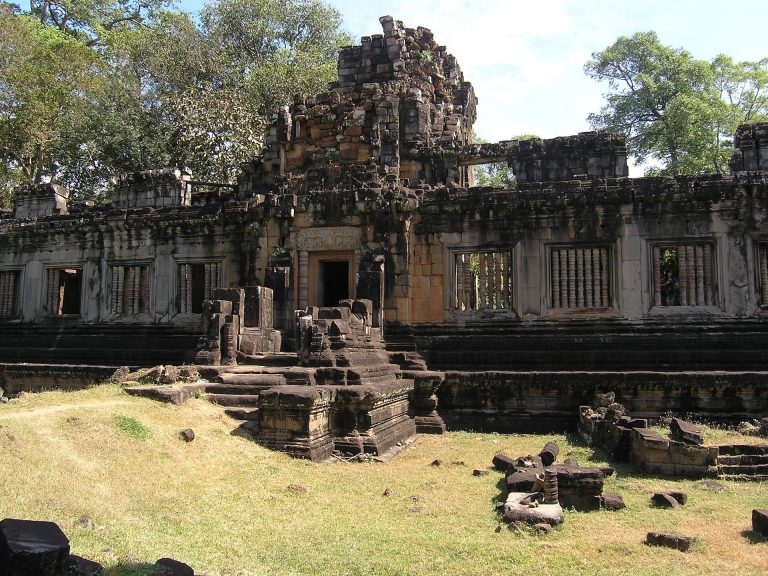
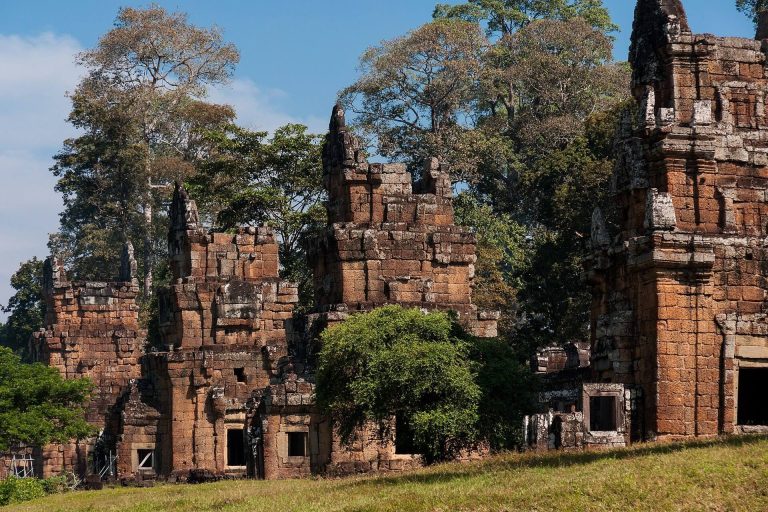
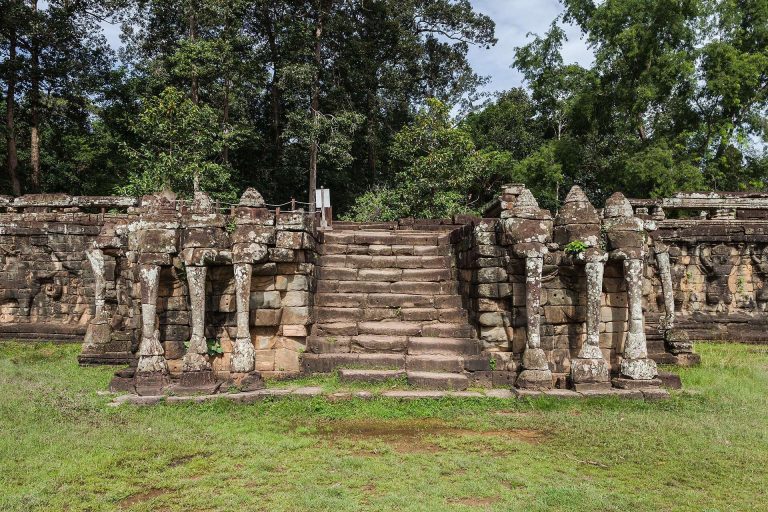
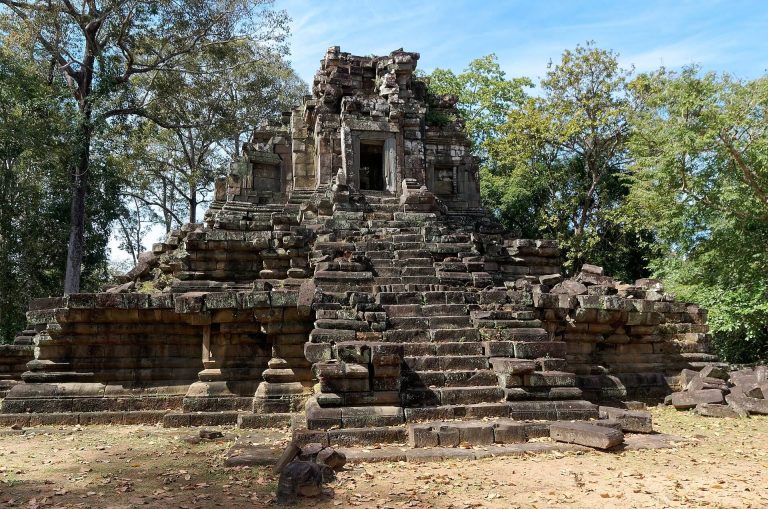
The Terrace of the Leper King is a late-twelfth-century Khmer royal terrace in Angkor Thom, Cambodia, built under King Jayavarman VII in the Bayon style. It stands immediately north of the Terrace of the Elephants at the northwest side of the Royal Square, east of the former Royal Palace. The terrace faced the central square, the Prasat Suor Prat towers, and the North and South Kleangs, forming part of the royal-palace complex.
Royal and Religious Functions
The terrace has been interpreted as a place where royal justice was administered. Another interpretation identifies it as a royal cremation site, partly because of the statue associated with Yama, the Hindu deity of death, judgment, and the realm of the dead. Its history therefore combines royal authority with funerary and religious meanings, although the precise original function remains uncertain.
Excavation of the terrace fill revealed the bases of enormous wooden posts, each about 1.10 metres in diameter at the base. These remains allowed a virtual reconstruction of a pavilion with large openings. The pavilion stood too close to the original wall and may have contributed to its collapse. The terrace was subsequently enlarged, burying the earlier decorated wall beneath the outer enclosure.
Later Alterations and Destruction
At the beginning of the fourteenth century, the construction of a Buddhist monastery radically changed the surroundings. The monastery enclosure caused the near-destruction of the terrace’s northern stairway, while a stupa built in the same area was also almost completely destroyed. The destruction of the stupa and nearby structures may correspond to the Thai sack of Angkor in 1330.
A later construction was destroyed during the sack of 1430. After this attack, the terrace was abandoned. These events left the monument with a layered history of enlargement, Buddhist reuse, destruction, and burial rather than a single unchanged building phase.
The Statue and the Name
The sculpture that gave the monument its modern name probably dates from the late eighth century. It has been attributed to the reign of Jayavarman II, the founder of Angkorian kingship, and was reportedly placed at this location by Yasovarman I when he established himself there. The proposed reuse of this earlier image has been interpreted as evidence for the continuity and antiquity of Cambodia’s sacred foundations.
A fourteenth- or fifteenth-century inscription on the statue’s base identifies it as Dharmaraja, meaning “King of Dharma,” a title associated with Yama in his role as judge of the dead. The figure has consequently been identified as Yama or Dharmaraja, as Yasovarman I, and, in another interpretation, as Kubera. The claim that Jayavarman VII suffered from leprosy is not supported by firm historical evidence.
The modern name “Leper King” arose from the statue’s missing fingers, later discoloration, and moss, which were thought to resemble symptoms of leprosy. These features became linked to legends about the leprous King Yasovarman I. Cambodian traditions tell of a ruler who contracted the disease after striking or killing a minister with a sacred sword. Other versions describe a ruler seeking a cure in a medicinal bath, whose failure led to a curse, illness, and the decline of the kingdom. The statue’s association with Yama nevertheless continued to support both the funerary and royal-justice interpretations of the terrace.
Modern Restoration
Restoration began in 1972 under Bernard-Philippe Groslier of the École française d’Extrême-Orient and later involved Jacques Dumarçay and Christophe Pottier. The work used anastylosis, a method that dismantles a monument and reassembles its original blocks with necessary repairs and structural additions. The wall was taken apart block by block and rebuilt after earlier reconstruction errors were corrected. The restored terrace was inaugurated in March 1996, while related work on the northern stairway of the Terrace of the Elephants resumed in 1992 under Christophe Pottier.
The restoration exposed the second decorated wall beneath the outer wall and made the passage between the two enclosures accessible. The original statue is preserved at the National Museum of Cambodia in Phnom Penh to prevent theft, while a copy occupies its former position at the terrace.
Remains
Terrace Walls and Layout
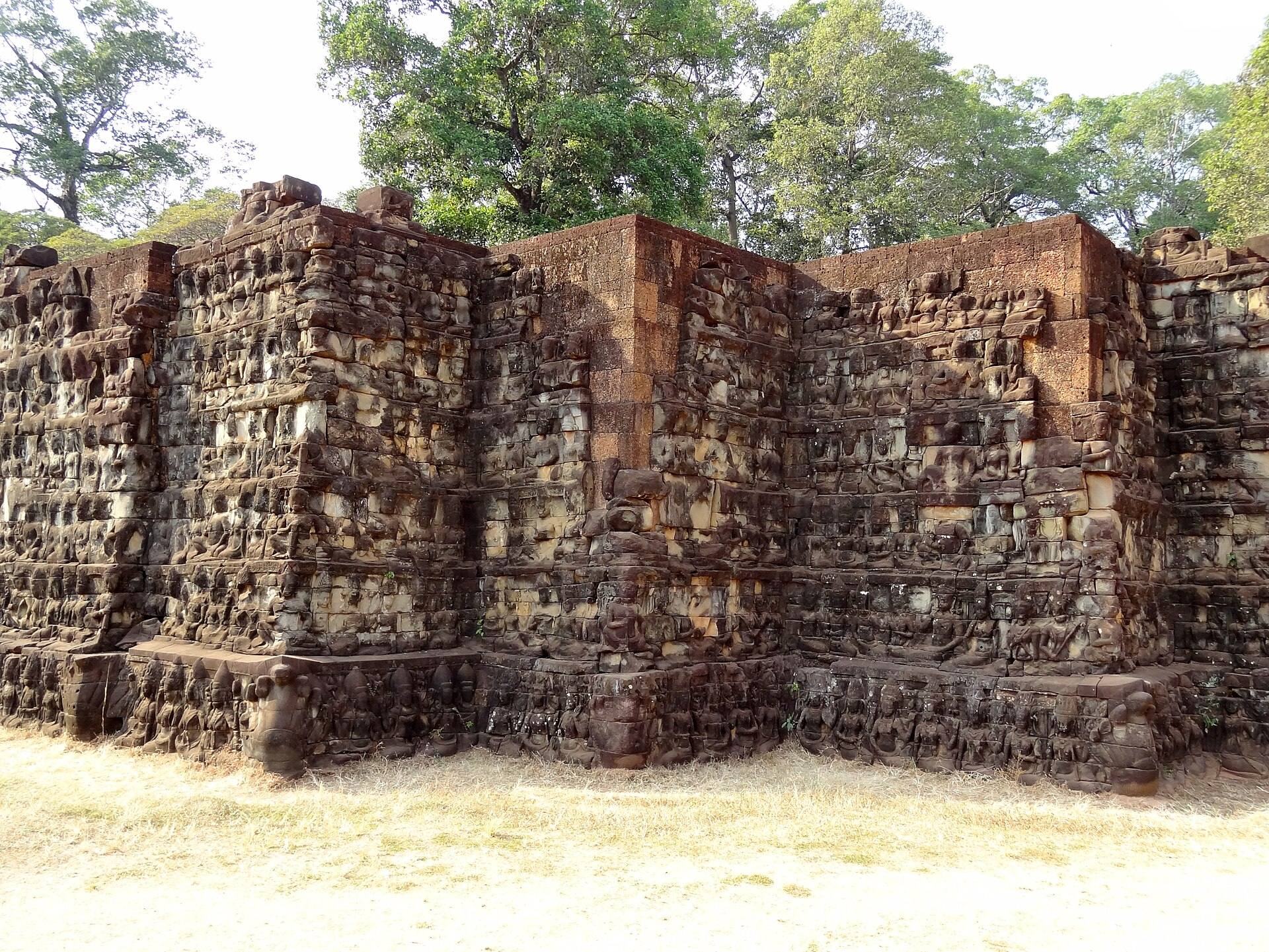
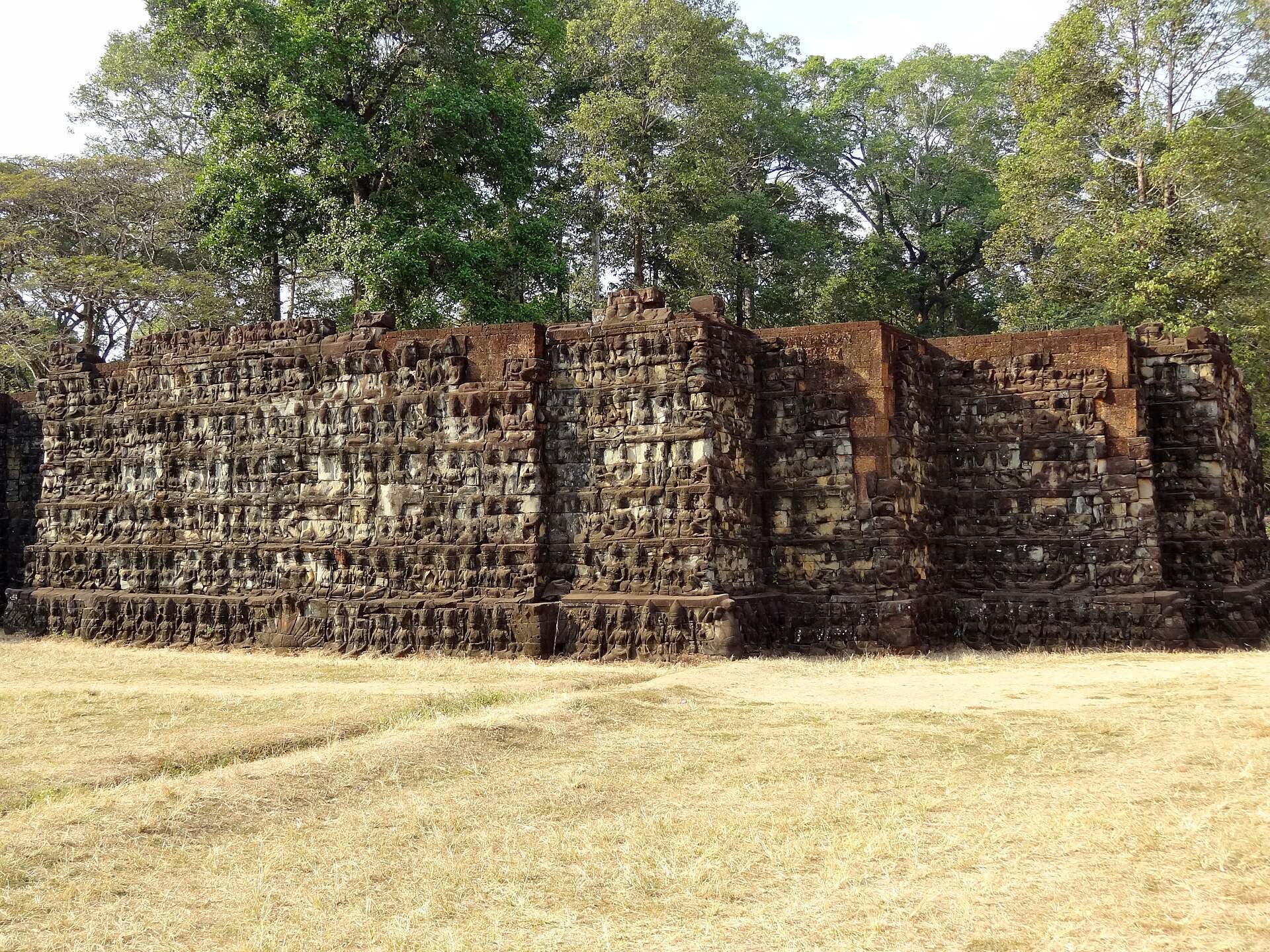
The terrace measures approximately 25 by 25 metres and rises about 6 metres high. Its enclosing wall forms a roughly U-shaped plan facing the Royal Square. Sandstone facing covers a substantial earthen fill, and both the outer and inner faces carry dense reliefs arranged in seven horizontal registers. The carved surfaces present the monument as an architectural enclosure as well as a large sculptural composition.
Outer Wall Reliefs
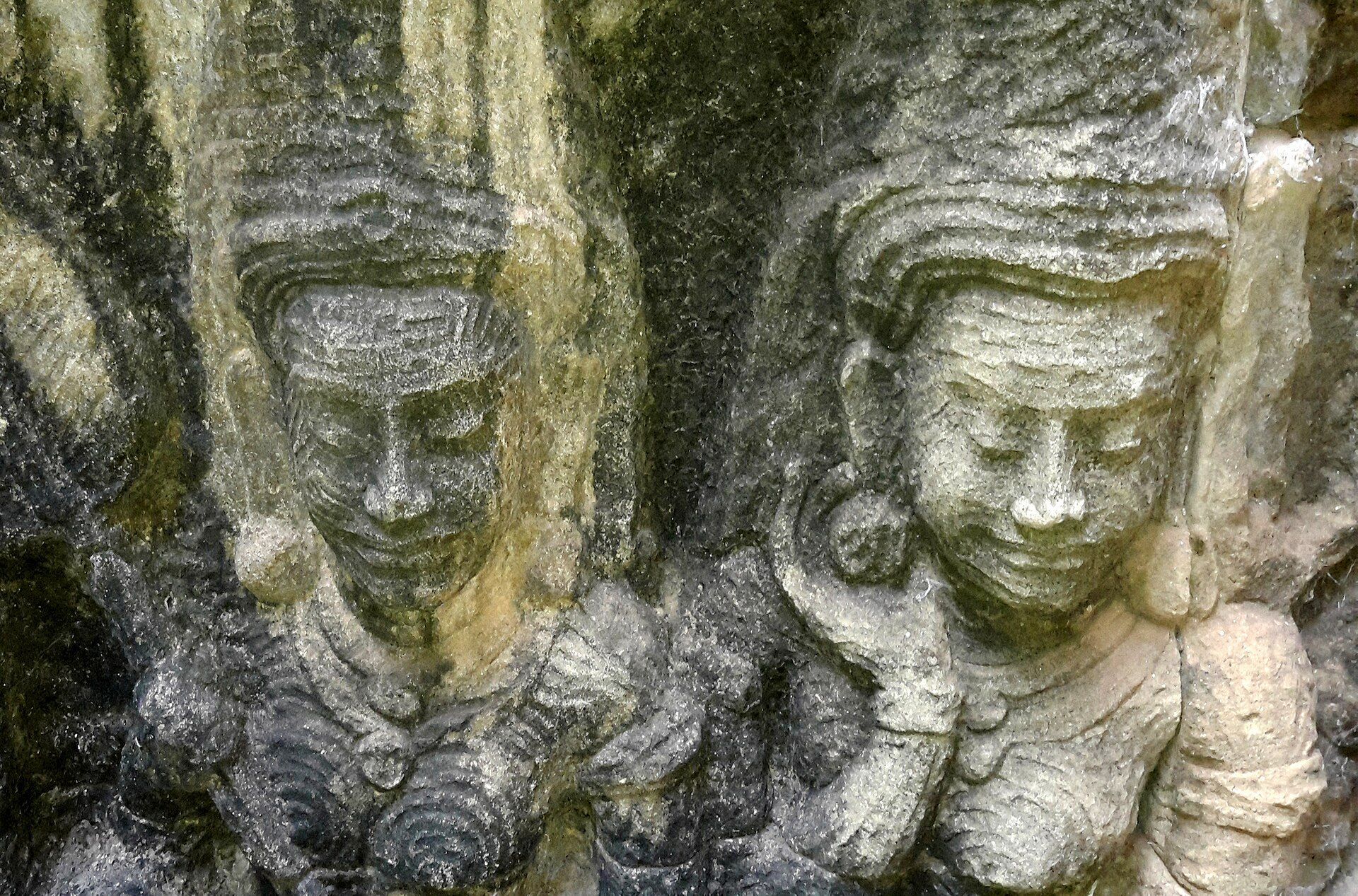
The outer wall shows Hindu deities seated in palaces with consorts and attendants. The imagery also includes five-, seven-, and nine-headed nagas, marine creatures, garudas, and multi-armed giants carrying swords and clubs. Bare-chested female figures wear flame-shaped crowns. Other deities ride aquatic animals while holding sacred objects, and fish, elephants, flowers, plants, crocodiles, a giant Siamese carp, and a crab fill the reliefs. Low pillars carry fish and elephant imagery, while one horizontal band represents a river.
The carved architecture reproduces wooden palace structures with ornamental details and Khmer tiled roofs. Some sculptures remain unfinished, and traces of the sculptors’ tools can still be seen on the reliefs. These details combine religious imagery with representations of buildings and natural forms across the sandstone surfaces.
Inner Wall and Structural Works
A second decorated wall stands about 2 metres behind the outer wall, creating a corridor between the two enclosures. Its relief decoration is equally abundant. The inner wall was buried when the outer wall was expanded to prevent the original structure from collapsing, preserving an earlier stage of the monument within the later terrace.
The restored walls incorporate reinforced-concrete slabs and curtain walls to resist the pressure of the approximately 6-metre-high fill. Drainage was directed toward a basin, and the stone surfaces that meet cement were coated with waterproofing material. The northern stairway was almost entirely destroyed when the Buddhist monastery enclosure was built, and the stupa later erected there was also almost completely destroyed.
Associated Statue
The associated statue is approximately 1 metre high and represents a nude, asexual male figure. It is shown seated with one leg raised, and its missing arm appears to have held an object. The strongly built body has an aquiline nose, high incised eyebrows, wide open eyes, full lips, and a prominent moustache rising high on the cheeks. These features have been compared with other rare eighth-century Khmer sculptures.
The inscription on the base identifies the figure as Dharmaraja, the “King of Dharma” associated with Yama. Its original surface condition, including discoloration and moss, contributed to the later popular identification of the image as a leprous king. The original sculpture is kept at the National Museum of Cambodia in Phnom Penh, and a replica stands at the terrace.