Jokhang: A Tibetan Buddhist Temple Complex in Lhasa
Site at a Glance
- Rating
- 4.7
- Popularity
- Low
- Country
- China
- Primary era
- Medieval
- Eras represented
- Medieval, Early Modern
- Civilizations
- Ming, Tibetan
- Site type
- Religious
- Remains
- Temple
On this page12 sections
History
Jokhang is a Tibetan Buddhist temple complex and Gelug school monastery in Lhasa, China. Established in the mid-seventh century under King Songtsen Gampo, it became the spiritual heart of Lhasa and is traditionally regarded as the most sacred temple in Tibet.
Foundation under Songtsen Gampo
Songtsen Gampo, the seventh-century ruler traditionally credited with consolidating Tibet and creating an early network of Buddhist temples, established Jokhang as part of a plan for twelve temples. These were arranged in three groups of four, covering central Tibet, outer regions, and frontier areas. Jokhang was eventually built in the heart of Tibet. The oldest part is dated to 652, while another tradition places the temple’s construction around 640 to 642.
The temple was intended to house the Jowo Mikyo Dorje, an image of Akshobhya Buddha brought from Nepal by Songtsen Gampo’s queen, Princess Bhrikuti. The image is now housed at Ramoche in Lhasa. Bhrikuti’s Nepalese connections helped give the early temple its Indian and Nepalese religious and artistic associations.
Songtsen Gampo’s other queen, Princess Wencheng of the Tang dynasty, brought a statue of Shakyamuni Buddha to Tibet in 640. Shakyamuni is the historical Buddha. The statue was first enshrined at Ramoche and was later moved to Jokhang, where it became known as Jowo Rinpoche and came to be regarded as the most revered statue in Tibet.
Traditions explain the choice of the site through a lake associated with Songtsen Gampo. In one version, the king threw a hat or ring into the water, after which a stupa appeared. Another tradition credits Bhrikuti with establishing the temple for the image she had brought from Nepal. The lake was filled, leaving a small pond or well connected with the foundation story.
The temple’s ancient name was Rasa Trulnang Tsuklakhang, interpreted as “House of Mysteries” or “House of Religious Science.” Jokhang means “House of the Jowo,” referring to its principal sacred image. Other recorded names include Zuglagkang, Tsuklakang, and Qoikang Monastery. Nepalese and Indian artists and craftsmen took part in the original design and construction.
Religious change and expansion
From about the fourteenth century, Jokhang was associated with the Vajrasana, the “Diamond Seat” at Bodh Gaya in India, traditionally linked with the Buddha’s enlightenment. Tibetans consequently called it the “Vajrasana of Tibet” and the “second Vajrasana.” The temple was enlarged over approximately nine centuries, with major improvements made after 1409 under the Ming dynasty. The Fifth Dalai Lama directed another major renovation in 1610.
During the reign of King Tresang Detsan, from 755 to 797, Buddhists were persecuted under the influence of the Bon-affiliated minister Marshang Zongbagyi. The Bon religion was an indigenous Tibetan tradition that existed alongside Buddhism and sometimes competed with it. The image of Akshobhya Buddha was reportedly hidden underground, while images from Jokhang and Ramoche were moved. Monks were persecuted and driven from Jokhang.
During further anti-Buddhist activity in the late ninth and early tenth centuries, Jokhang and Ramoche were reportedly converted into stables. Buddhist activity later returned. In 1049, the Bengali teacher Atisha taught at Jokhang and reportedly found the “Royal Testament of the Pillar,” attributed to Songtsen Gampo, inside one of the temple’s pillars.
After the Gorkha-Tibetan War of 1792, the Qing emperor Qianlong restricted Nepalese access to Jokhang. During a period when pilgrimage beyond Tibet was restricted, the temple consequently became an exclusively Tibetan place of worship. Its historic pilgrimage walkway was later partly destroyed during the redevelopment of Lhasa. An inner walkway was converted into a plaza, leaving a shorter route around the temple.
Persecution, restoration, and heritage status
Red Guards attacked Jokhang on August 24, 1966, during the Cultural Revolution, a political campaign in China from 1966 to 1976 during which religious institutions and cultural monuments suffered widespread attack. Worship in Tibetan monasteries ceased for about a decade, and Jokhang was reportedly boarded up until 1979. Parts of the complex were used at different times as a pigsty, slaughterhouse, army barracks, and hotel. Soldiers also burned historical Tibetan scriptures.
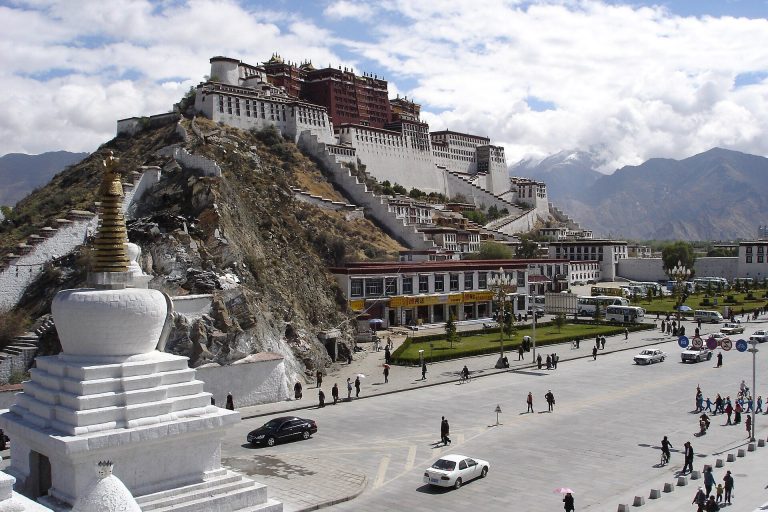
Renovation began in 1972 and was largely complete by 1980. After religious persecution ended and restoration work was carried out, Jokhang was re-consecrated and Tibetan worship resumed. The temple was added in 2000 to the UNESCO World Heritage listing of the Historic Ensemble of the Potala Palace, which had been inscribed in 1994 and extended in 2000 and 2001. The listed property covers 7.5 hectares and has a 130-hectare buffer zone. Jokhang is also included in China’s first group of nationally protected cultural relic units.
A fire broke out at Jokhang on February 17, 2018, at approximately 6:40 p.m. and continued until late that evening. It was quickly extinguished. No deaths or injuries were reported, and no damage to the temple’s relics was reported.
Jokhang remains a major pilgrimage center. Pilgrims walk around the temple, turn prayer wheels, prostrate themselves, recite Om mani padme hum, and offer ceremonial scarves or touch the knees of the principal Buddha image.
Remains
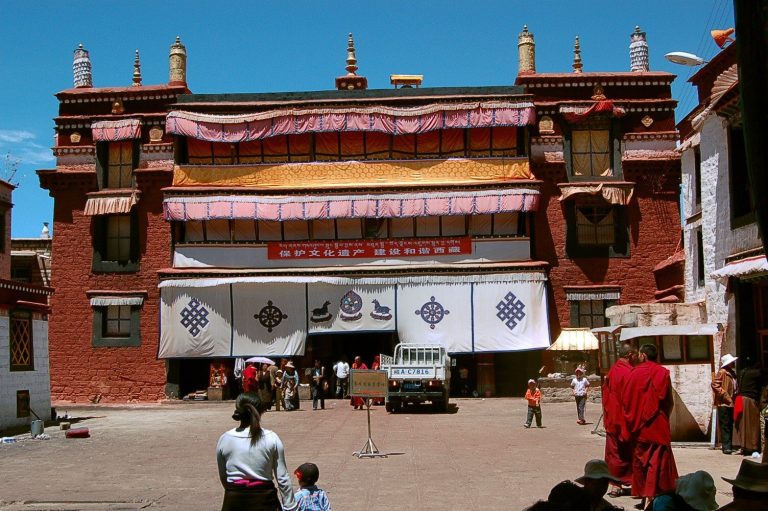
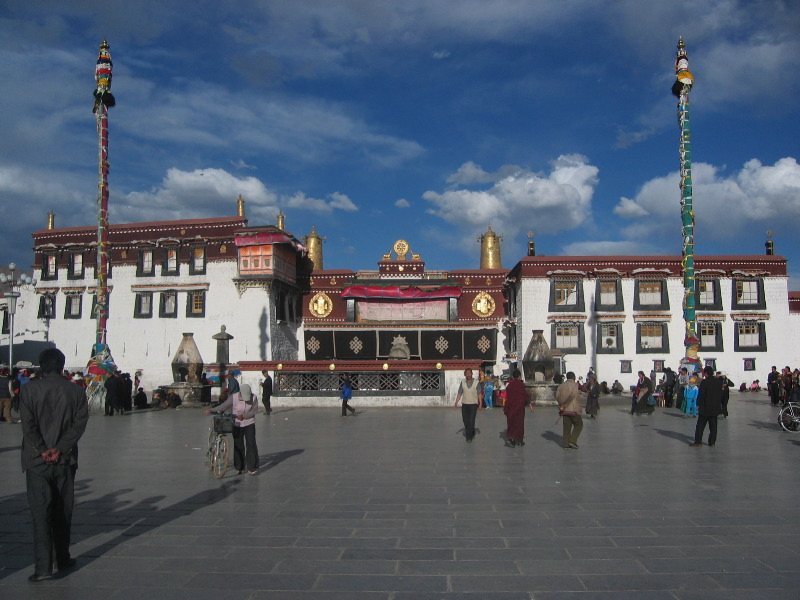
Jokhang occupies approximately 2.51 hectares and has an east-west orientation, with its main gate facing west toward Nepal in honor of Princess Bhrikuti. The complex combines Tibetan Buddhist architecture with Chinese influences, Indian monastic design, and Nepalese elements. Built of wood and stone, it is organized along an axis from an arched entrance through the Buddha Hall, an enclosed passage, cloisters, courtyards, and accommodation for lamas. Gilded bronze roof tiles, figurines, and decorated pavilions crown the principal buildings.
Temple layout and construction
Entrance and Buddha Hall
Four Guardian Kings stand inside the entrance, with two on each side. Beyond the gate, a porch leads toward a large paved courtyard and the tall, four-story Buddha Hall. The courtyard is arranged around two concentric circles containing two temples, one in the outer circle and one in the inner circle. The outer circle contains a circular pilgrimage path with large prayer wheels, which leads toward the principal shrine and its surrounding chapels and enclosed walkways.
The temple’s seventh-century form reportedly contained eight rooms on two floors for scriptures and Buddha images. Brick-lined floors, columns, wooden door frames, and carved wooden elements formed part of the early construction. Carbon dating has identified the wooden beams and rafters as original, while Newari door frames, columns, and finials dating from the seventh and eighth centuries were brought from Nepal’s Kathmandu Valley.
Principal shrine and chapels
The main shrine occupies the ground floor. The first floor contains murals, monks’ residences, and a private room for the Dalai Lama, while residences and chapels are arranged around the shrine. The second and third floors of the Buddha Hall and associated buildings were constructed in the eleventh century. Dozens of chapels, each about 20 square metres, stand on both sides of the Buddha Hall.
The principal image in the ground-floor hall is a 1.5-metre-high gilded bronze statue of Jowo Shakyamuni, representing the Buddha at the age of twelve. It wears a jeweled crown and pearl-studded garment, with a diamond on its forehead. The figure sits in lotus posture on a three-tiered lotus throne, with one hand resting on the lap and the other touching the earth.
Chapels around Jowo Shakyamuni are dedicated to deities and bodhisattvas. Avalokiteshvara, the bodhisattva of compassion and Tibet’s patron, is represented with a thousand eyes and a thousand arms. Halls beside the main hall are dedicated to Amitabha, the Buddha associated with the Western Pure Land, and Maitreya, the future Buddha. Images of Shakyamuni occupy both sides of the central axis, while a warrior guardian of the Buddha stands in the middle of the halls on the left.
Prince of Dharma chapel
The Prince of Dharma chapel is on the third floor. It contains images of Songtsen Gampo, Princess Wencheng, Princess Bhrikuti, the minister Gar Tongtsan, and Thonmi Sambhota, who is traditionally regarded as the inventor of the Tibetan script.
Murals, sculpture, and roof decoration
The surviving mural traditionally depicting Princess Wencheng’s arrival and a Buddha image is located at the rear center of the inner temple. The Buddha image was first kept at Ramoche before being moved to Jokhang. It has remained on a platform since the eighth century, except when temporarily moved for protection, and has been gilded several times. The mural shows the image with the king and his two consorts.
More than 3,000 images of Buddhas, other deities, and historical figures are held within the complex, including an image approximately 26 metres high. Religious and historical murals cover the walls. Decorative carving on the superstructure includes winged apsaras, human and animal figures, flowers, and plants. Sphinx-like figures with varied expressions appear beneath the roof.
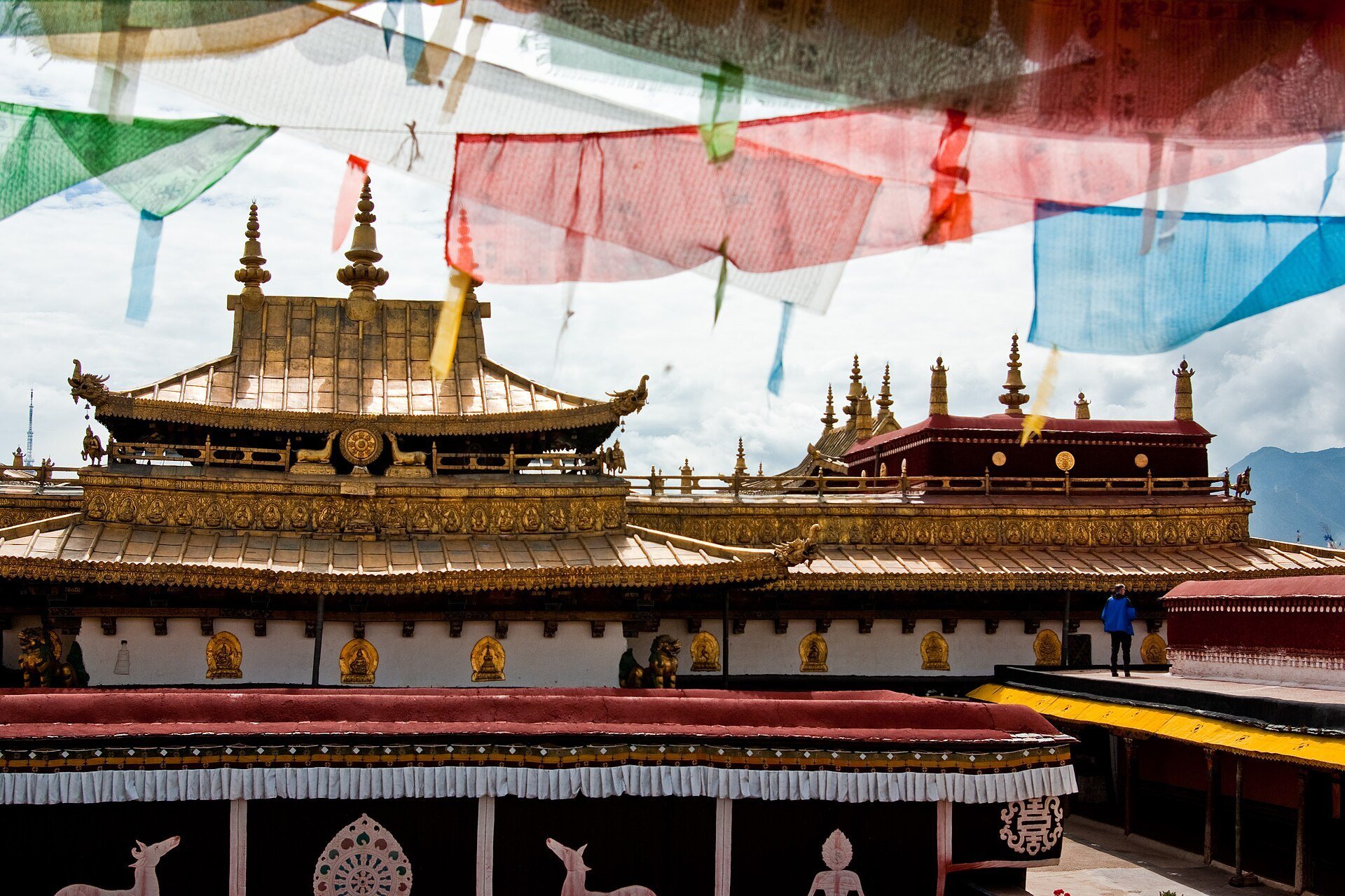
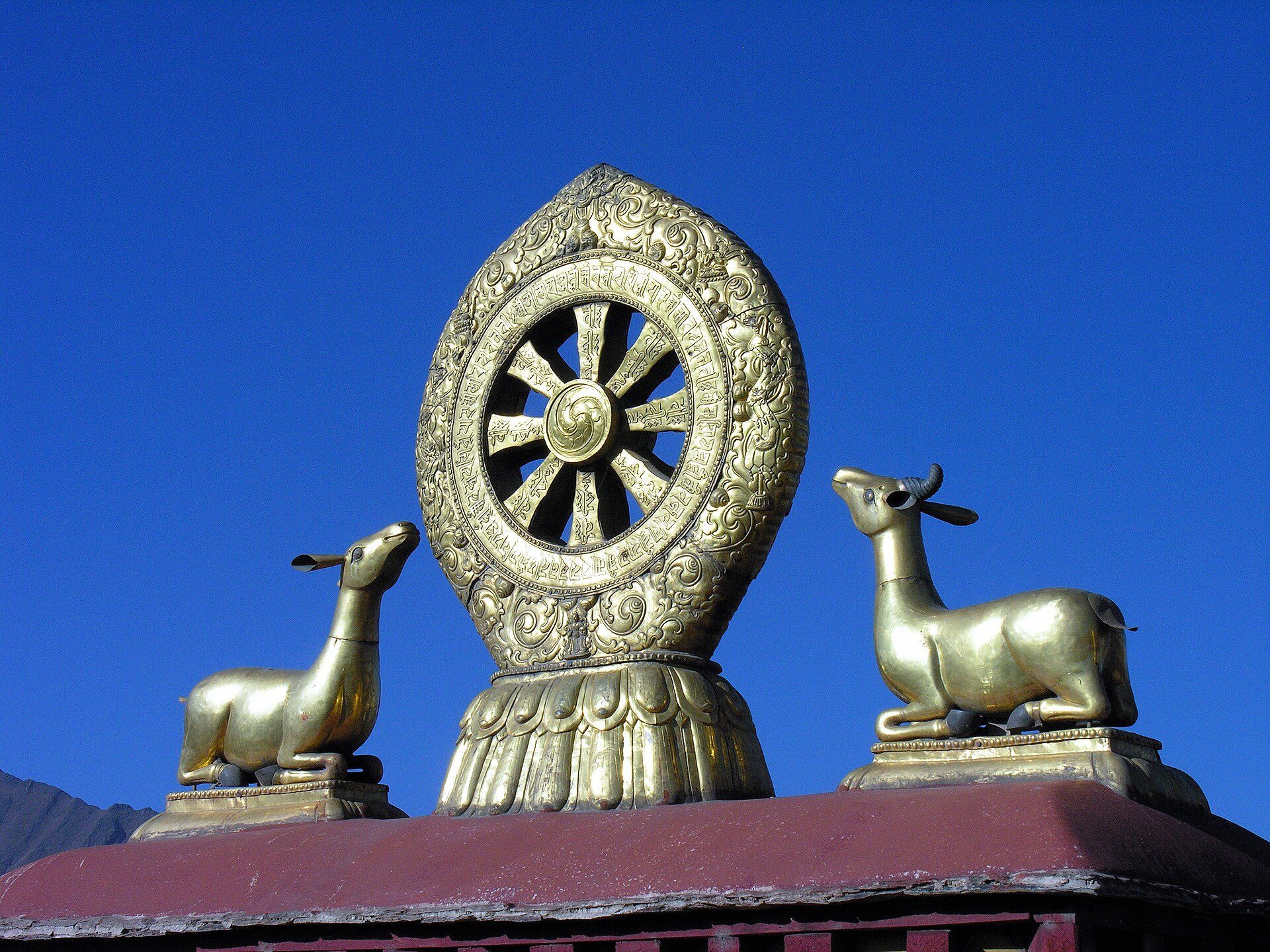
The roof and roof ridges carry golden deer flanking a Dharma wheel, victory banners, and large fish figures. Inside, the chapels form a dark, interconnected group of spaces illuminated by votive candles and filled with incense smoke.
Inscribed pillars and the Princess Willow
Two inscribed stone pillars, known as doring, stand outside the temple beside its northern and southern entrances. A doring is an inscribed stone pillar or stele, and both pillars are worshiped by Tibetans. The older pillar is about 5.5 metres high and has a palace-shaped crown. Its inscription, dated to 821 or 822, is written in Tibetan and Chinese and records a treaty between the Tibetan king Ralpacan and the Tang emperor Muzong concerning the frontier between Tibet and China.
The newer monument records a March 1794 edict concerning hygiene and the prevention of smallpox. Parts of its surface were reportedly chipped away by Tibetans who believed the stone possessed healing powers. Both pillars were enclosed by brick walls when Barkhor Square was redeveloped in 1985.
A walled enclosure in front of Jokhang, near the older treaty pillar, contains the stump of a willow known as the Tang Dynasty Willow or Princess Willow. Tradition attributes its planting to Princess Wencheng.
Religious objects and manuscripts
Jokhang contains a substantial collection of cultural objects, including Tang-dynasty bronze sculptures, Ming-dynasty figures, hundreds of thangka paintings, 54 boxes of red-printed Tripitaka texts, and 108 carved sandalwood sutra boxes. A vase presented by the Qianlong emperor was used for selecting the Dalai Lama and Panchen Lama. Two notable embroidered silk thangka paintings, depicting Chakrasamvara and Yamantaka, date to the reign of the Yongle emperor and are described as well preserved.
The complex also contains numerous manuscripts and other religious objects. A clay image of Chenrezig reportedly held a small wooden Buddha image brought from Nepal. The clay figure was said to have remained at Jokhang for about 1,300 years before being smashed during the Cultural Revolution. The smaller wooden image was later given by a Tibetan to the Dalai Lama.