Cheomseongdae: A Seventh-Century Silla Astronomical Structure
Site at a Glance
- Rating
- 4.5
- Popularity
- Very High
- Country
- South Korea
- Primary era
- Medieval
- External website
- Open
- Eras represented
- Medieval
- Civilizations
- Silla
- Site type
- Civic
On this page11 sections
History
Cheomseongdae is a seventh-century stone structure in Gyeongju, South Korea, built during the Silla period and traditionally dated to the reign of Queen Seondeok, who ruled from 632 to 647. The exact construction year is uncertain. The Samguk Yusa places it near the Silla capital, while other records give 633 or 647. It is widely regarded as the oldest surviving astronomical observatory in Asia and is possibly the oldest surviving structure of its kind in the world.
Silla use and purpose
Silla was one of Korea’s Three Kingdoms and later unified much of the Korean Peninsula, with its capital at present-day Gyeongju. Cheomseongdae stood near the capital, north of the former Wolseong palace site. It is traditionally associated with watching celestial phenomena, identifying the seasons and the 24 solar terms, and correcting the calendar. Solar terms are traditional divisions of the year based on the sun’s position. The structure may also have served as a reference for the meridian and the four cardinal directions.
The precise purpose of Cheomseongdae remains debated. Traditional interpretation describes it as an observatory for viewing the stars, while other interpretations connect it with sundial measurement, astrology, ritual, seasonal regulation, or political symbolism. The structure’s relationship to the Silla court and to the palace area has also encouraged interpretations that combine astronomical and symbolic functions.
Influence and preservation
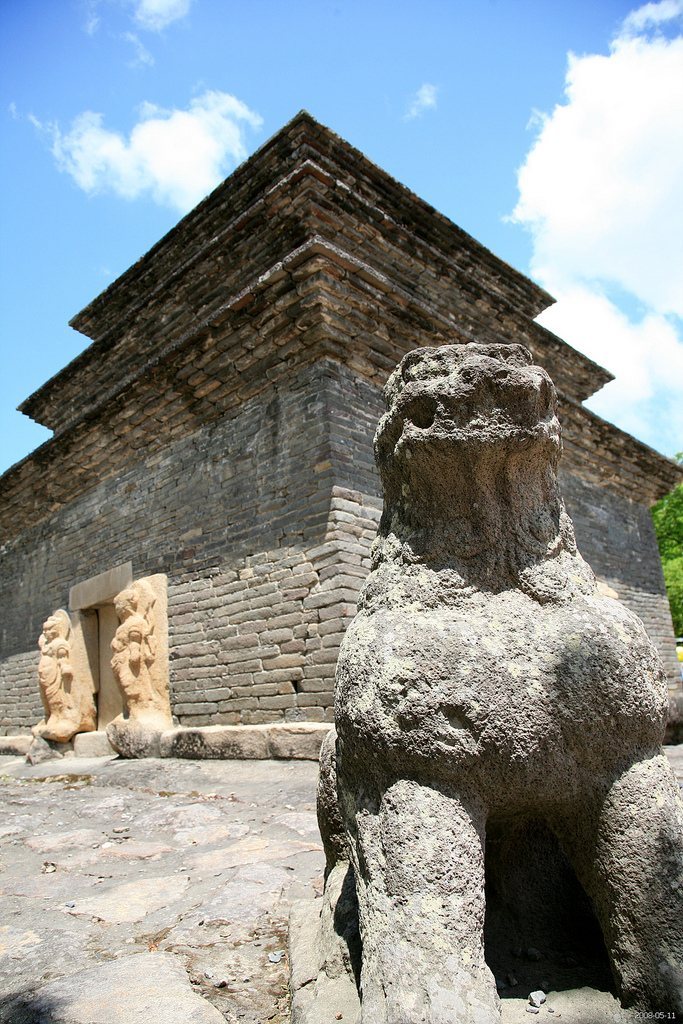
Cheomseongdae’s construction style is described as comparable to that used at Bunhwangsa, a historic Buddhist temple site in Gyeongju. Its design is also reported to have influenced an observatory built in Japan in 675 and the observatory traditionally associated with Duke Zhou in China in 723.
South Korea designated Cheomseongdae its 31st National Treasure on December 20, 1962. The structure forms part of the Gyeongju Historic Areas, which were inscribed as a UNESCO World Heritage Site in 2000. Since 1981, the National Research Institute of Cultural Heritage of Korea has conducted regular inspections. An hourly monitoring system was installed in 2007, while the Gyeongju municipal government oversees conservation and management.
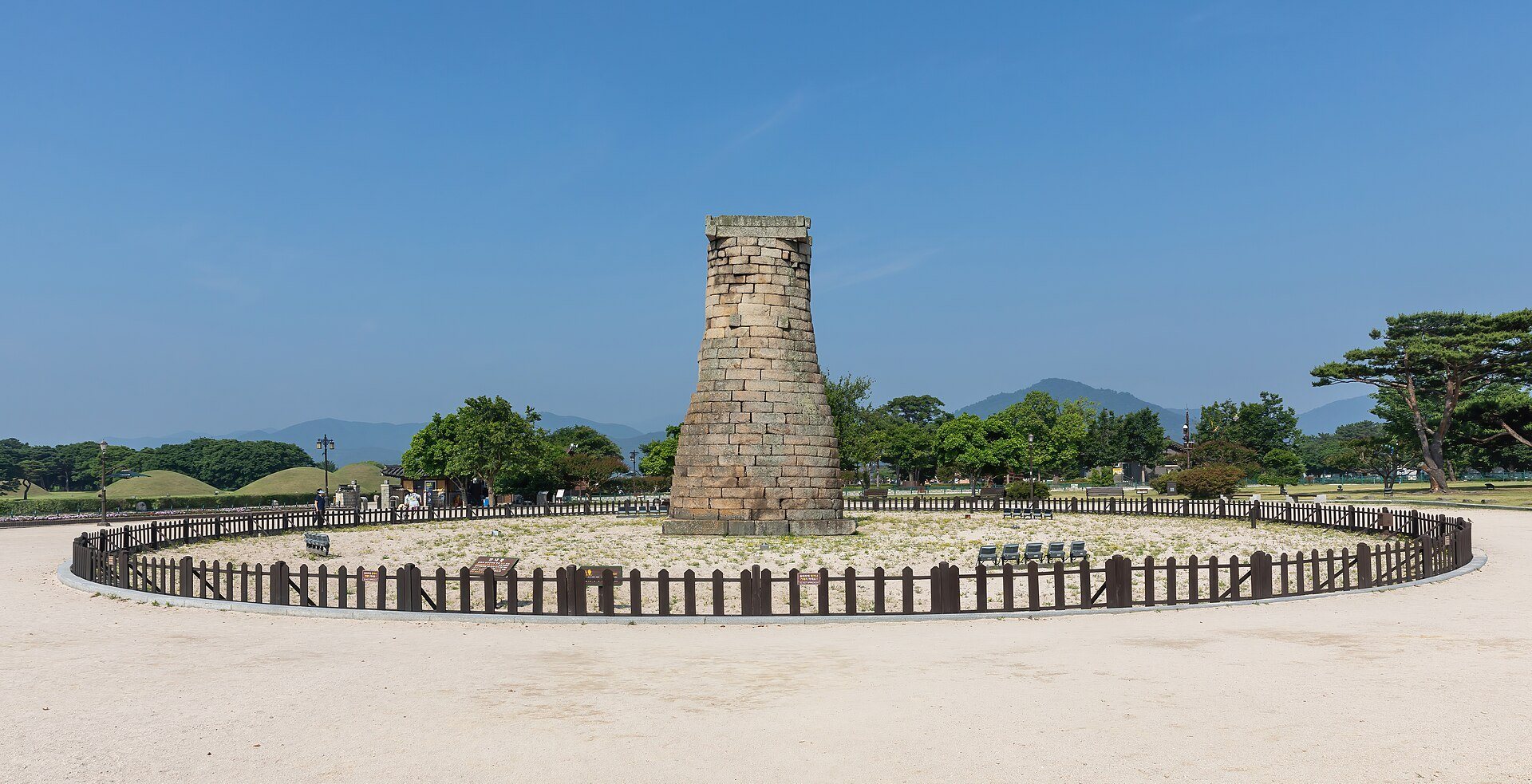
Cheomseongdae has retained its original form and appearance for more than 1,300 years, although it has developed a slight tilt toward the northeast. Measurements in 2005 recorded a displacement of about 7.2 centimetres northward and 2.4 centimetres eastward. Soft, waterlogged ground to the northeast is considered a likely cause. A local explanation links increased tilting after the Korean War to ground weakening caused by tanks using a northern road. Officials and research teams have nevertheless considered the structure stable. After the September 2016 Gyeongju earthquake, the masonry had opened by about 1.2 centimetres compared with its pre-earthquake condition, but no cracks were observed. Age, weathering, air pollution, and ground subsidence continue to affect the structure, whose exterior is regularly washed to remove moss.
Remains
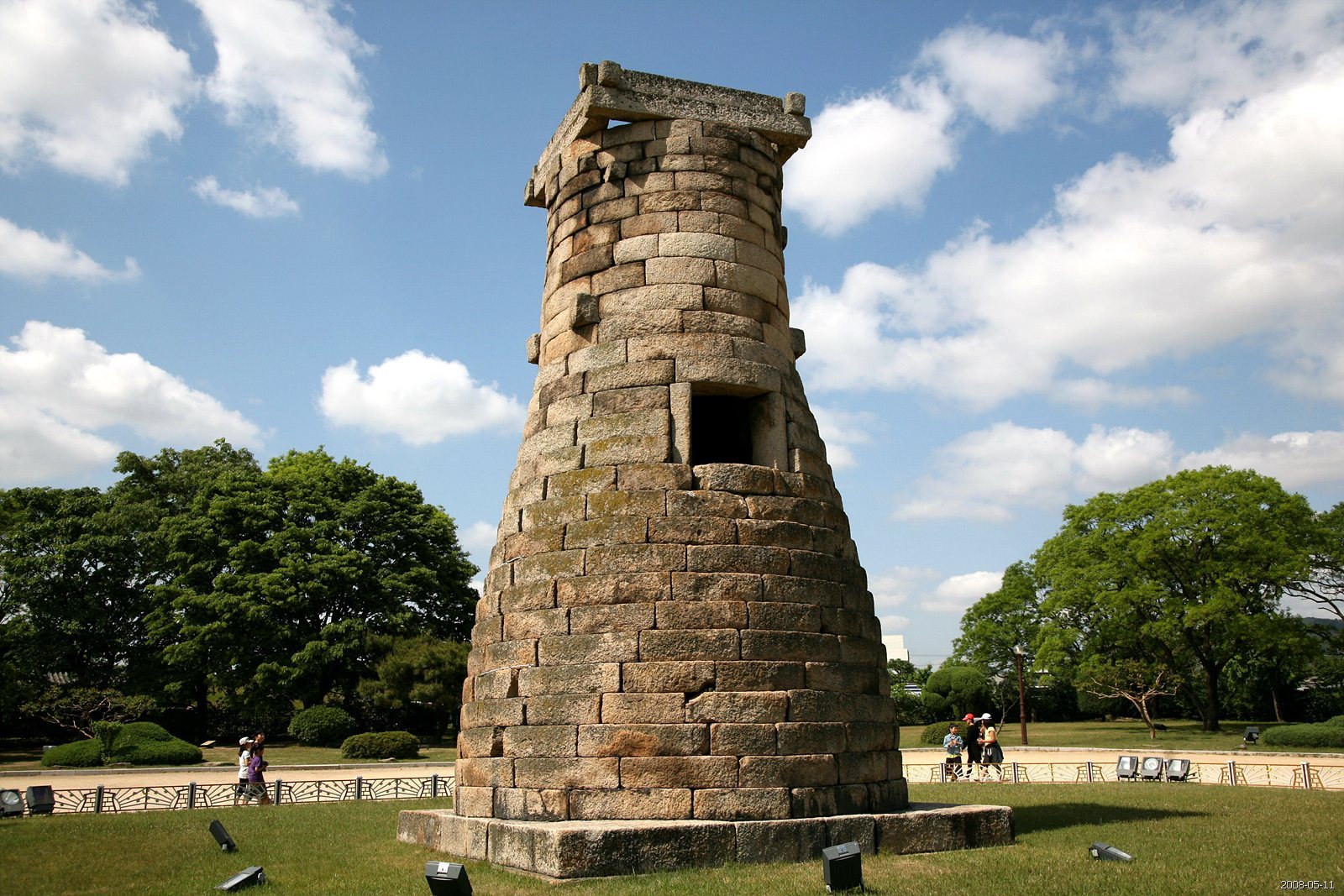
Cheomseongdae is a stone tower about 9.17 metres high. Its form combines a square supporting platform, a curved cylindrical body, and a square upper section. Seen from above, the tower resembles a well, while its exterior is uniform in appearance in every direction except at the south-facing opening.
Base and cylindrical body
Square platform
The supporting platform, or stylobate, is a base on which an upright structure is built. It is about 5.7 metres wide and consists of a single course of 12 rectangular stones. Its sides are also given as approximately 5.35 metres. The twelve stones have been interpreted as a reference to the twelve months.
Stone tower
The curved body is made from cut granite blocks shaped as annular sectors, or bent rectangular pieces. Recorded totals range from 362 to 366 blocks. The number 365 has been associated with the days of the year, while a 1962 survey by Hong Sa-jun, director of the Gyeongju National Museum, counted 366 blocks, possibly because a concealed slab inside the upper part was included.
The main body has 27 courses of stone. From its base to the window, the interior is filled with earth and rubble. Earth reaches the twelfth course, while large stones form structural elements at the nineteenth and twentieth courses and again at the twenty-fifth and twenty-sixth. These arrangements contribute to the tower’s stability and internal form.
South opening
A square opening on the south side extends across courses 13 to 15 and lies near the middle of the tower. It served as an entrance, with a ladder that could be placed across the opening to allow movement into and out of the structure. The opening and the courses around it have been interpreted as references to the twelve months and the 24 solar terms.
The opening also has a possible astronomical function. At the spring and autumn equinoxes, sunlight can pass through it to the bottom of the interior. At the winter and summer solstices, the light disappears below the opening. This alignment has been interpreted as supporting the measurement of equinoxes, solstices, and seasonal divisions.
Upper section and astronomical interpretations
Square upper tiers
The upper section consists of two tiers of square stones arranged in the form of the character jeong, meaning “well.” An observation device is presumed to have stood on the upper stone platform, although its exact arrangement and use remain uncertain. The 27 courses have been linked either to Queen Seondeok’s position as Silla’s 27th monarch or to the approximately 27-day lunar cycle.
Other numerical interpretations use different ways of counting the courses. Treating the platform as a twenty-eighth course has been connected with the 28 East Asian lunar constellations. Counting the base course, 27 circular courses, and two square upper courses produces 30 courses, which has been interpreted as the 30 days of a lunar month.
Observation and alignment
Cheomseongdae is thought to have been used for observing the sun and stars, but proposed methods differ. Observations may have taken place inside the tower, from the upper platform, or with an instrument positioned above it. Other interpretations describe the structure as a sundial or gnomon, an observation platform, or a ritual and symbolic monument connected with astrology.
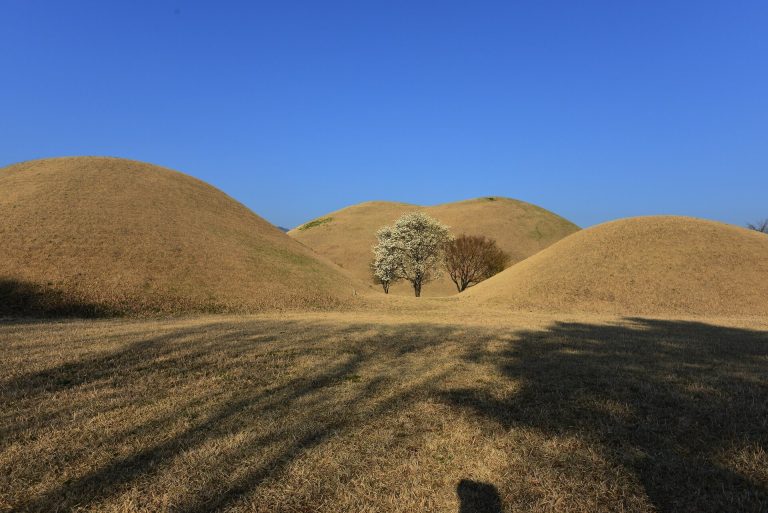
The south-facing opening provides a direct view toward palace buildings at Wolseong. One further interpretation proposes that nearby burial mounds and important monuments in Gyeongju were arranged around Cheomseongdae in a pattern resembling constellations projected onto the ground. This remains an interpretation rather than an established explanation of the site’s layout.