Gyeongju Historic Areas: Archaeological Remains of Silla’s Capital
Site at a Glance
- Rating
- 4.3
- Popularity
- Low
- Country
- South Korea
- Primary era
- Medieval
- External website
- Open
- Eras represented
- Classical, Medieval, Early Modern
- Civilizations
- Joseon, Silla
- Site type
- City
On this page20 sections
History
Gyeongju Historic Areas preserve the principal archaeological remains of Gyeongju in South Korea, the capital of the Silla kingdom from 57 BC until 935 AD. Silla rulers established palaces, public buildings, fortresses, and Buddhist temples in and around the capital, while royal burials accumulated across the surrounding landscape. The property comprises five closely spaced areas, Wolseong, the Tumuli Park, Hwangnyongsa, Mount Namsan, and Sanseong, which together cover 2,880 hectares with a 350-hectare buffer zone.
Silla’s capital and expansion
Silla was one of the Three Kingdoms of Korea. During the seventh century it expanded by defeating Baekje in 660 and conquering part of Goguryeo in 668 with assistance from Tang China. It remained the dominant power across much of the Korean Peninsula until its decline in the early tenth century. In 935, Silla was replaced by Goryeo, and the capital moved to Kaesong. Gyeongju consequently lost its political position.
Mahayana Buddhism, a Buddhist tradition that emphasizes the bodhisattva path toward enlightenment, became especially influential in Silla during the seventh century. Mount Namsan had already been regarded as sacred before Buddhism spread through the kingdom. It later became an important Buddhist landscape, containing temples, monasteries, sculptures, pagodas, and other monuments. The capital’s religious buildings and secular institutions together preserve evidence of the development of Korean Buddhist and nonreligious architecture.
Palaces, royal traditions, and observatory
Wolseong, also known as Banwolseong or the Half-Moon Fortress, contains the former royal palace. It was probably built in 101 AD during the reign of King Pasa on the site of an earlier princely compound and was repeatedly altered under later Silla rulers. After the kingdom fell in 935, the palace gradually became abandoned. At the northeastern corner of Wolseong, Donggung and Wolji was built in 674 during the reign of King Munmu as a palace for the crown prince or heir to the throne. Its pond was formerly called Anapji. Pottery inscribed with the name Wolji, excavated in 1980, led to the use of the present historical name.
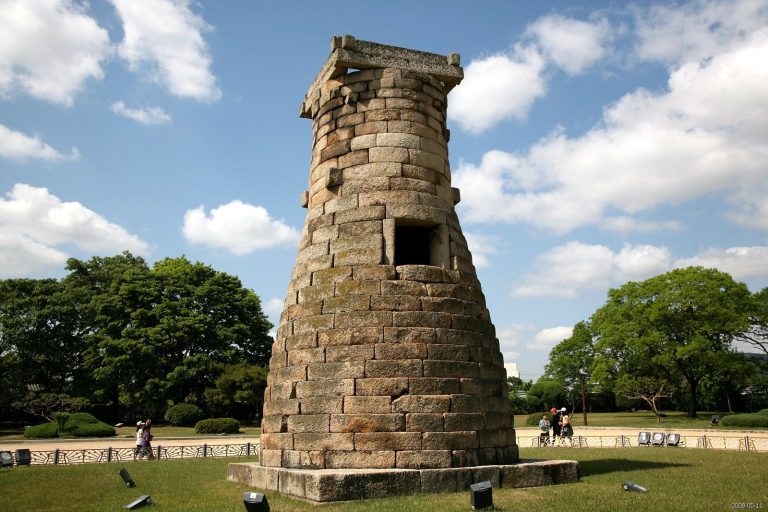
Gyerim is traditionally identified as the birthplace of Kim Alji, regarded as the ancestor of the Gyeongju Kim lineage. Nearby Naemulwangneung is identified as the tomb of King Naemul, who ruled Silla from 356 to 402. Cheomseongdae probably dates from the reign of Queen Seondeok, from 632 to 647. It is regarded as the oldest surviving astronomical observatory in East Asia, and observations of celestial phenomena were associated with divination concerning state affairs and agricultural activities.
Temples and military landscapes
King Jinheung founded Hwangnyongsa in 553, and the temple was completed in 569. A nine-story pagoda was added during Queen Seondeok’s reign in 643. The complex was completely burned in 1238 during the Mongol invasions. Bunhwangsa, immediately north of Hwangnyongsa, was probably founded in 634 during the same queen’s reign. The Silla monk Wonhyo is associated with the temple. Much of its historical material was destroyed or damaged during the Mongol invasions in the thirteenth century and the Japanese invasions of the sixteenth century.
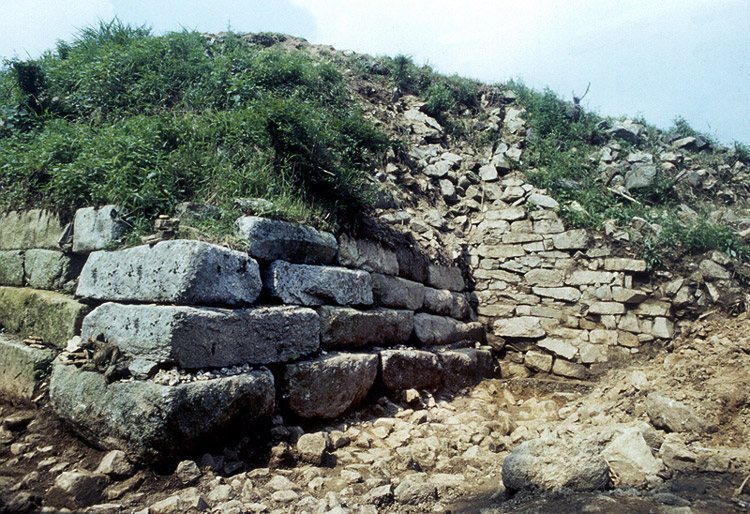
Mount Namsan was fortified from 591, with further work continuing through the seventh century. The mountain retained its historical and religious importance after Silla’s decline. Myeonghwal Fortress, in the Sanseong area, occupies the summit of Myeonghwal Mountain east of Gyeongju. A record describes an attack by Japanese pirates in 405, while a construction monument records building work in 551 during King Jinheung’s reign. The fortress was enlarged during Queen Seondeok’s reign.
Later damage and preservation
The principal buildings of Gyeongju suffered repeated damage in later periods, including during the Japanese invasions of the late sixteenth century and the Mongol invasions. Hwangnyongsa was destroyed during the Mongol war in 1238, and Myeonghwal Fortress later lost most of its walls. At Poseokjeong, King Gyeongae was captured in 927 and died there. The circumstances are described either as suicide after his capture or as his killing by Gyeon Hwon, founder of Later Baekje, a kingdom that emerged during Silla’s decline.
Archaeological investigation has made the remains of the capital more fully understood. Hwangnyongsa was surveyed in 1969 and excavated on a large scale from 1976. Families who occupied the complex during the twentieth century were removed in 1976 to allow the work to proceed. At the Tumuli Park, archaeologists excavated Cheonmachong in 1973 before attempting the larger Hwangnam Daechong. Cheonmachong yielded 11,526 artifacts, while the excavation of Hwangnam Daechong from 1973 to 1975 produced approximately 57,000 artifacts.
Gyeongju Historic Areas were inscribed as a UNESCO World Heritage cultural property in 2000, at the 24th session of the World Heritage Committee, under criteria (ii) and (iii). The designation recognizes the concentration of monuments associated with the development of Korean Buddhist and secular architecture and the exceptional evidence of Silla cultural achievement. National heritage protection also covers individual places and objects, including Wolseong, Donggung and Wolji, Gyerim, Poseokjeong, Hwangnyongsa, Myeonghwal Fortress, Cheomseongdae, the Bunhwangsa pagoda, and the Cheonmachong saddle-flap painting.
Remains
The five areas contain the remains of Silla palaces and temples, royal burial mounds, mountain fortifications, Buddhist sculpture, pagodas, stone lanterns, ponds, wells, and other archaeological features. The property is also part of Gyeongju Historic National Park. Its remains extend from the palace and administrative landscape around Wolseong to temple foundations, mountain monuments, and burial grounds distributed through and around the former capital.
Wolseong palace landscape
Wolseong and Donggung and Wolji
Wolseong has a crescent-shaped plan, which gave rise to its name. Stone and earth walls defended its eastern, western, and northern sides, while a natural cliff and a river protected the south. The walls extended for approximately 1,841 metres, and a moat lay outside them. The enclosed area covered about 19.4 hectares. Only foundation stones remain visibly above ground. Donggung and Wolji occupied the northeastern corner of the enclosure and included an artificially excavated pond. The palace complex became a ruin during the Goryeo and Joseon periods.
Gyerim and associated features
Gyerim lies west of Wolseong, with Naemulwangneung beside it. The area also includes Seokbinggo, an icehouse dating from the eighteenth century, and Samaso, a Confucian training institution for government officials. Jaemaejeong is a well in the courtyard of the former residence of the Silla general Kim Yu-sin. These features form part of the wider archaeological and historical landscape around the former palace.
Cheomseongdae
Cheomseongdae is a cylindrical, slightly tapering granite structure about 9.4 metres high, with a base diameter of approximately 5.17 metres. Its stones are arranged in about 30 courses. Tradition associates its roughly 365 granite blocks with the days of the year, while a base of 12 rectangular stones and 12 openings have been associated with the months and zodiac signs. The interior is filled with earth and stones up to the twelfth course. Above that level is an open section without a complete wall.
Royal burial grounds
Tumuli Park and Daereungwon
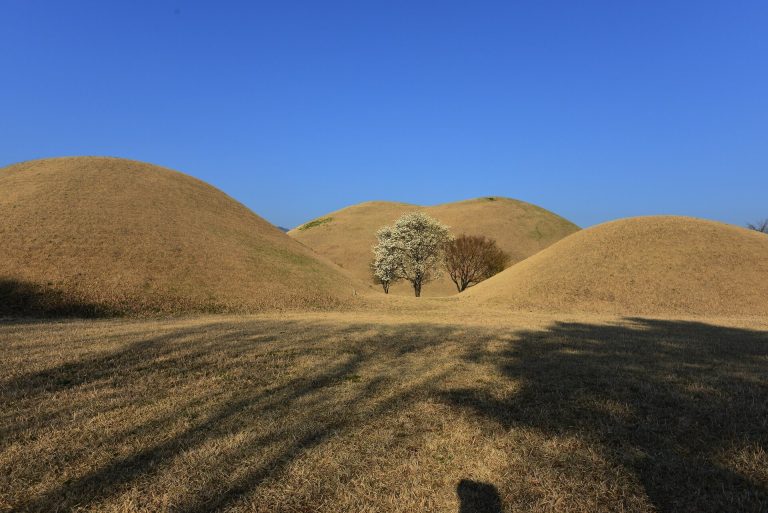
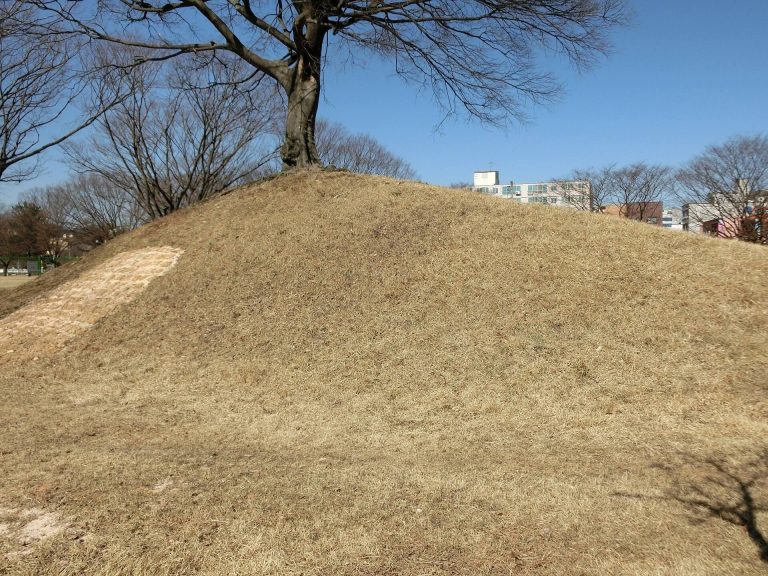
The Tumuli Park contains three main groups of royal graves, with additional groups at Noseori, Nodongri, an unnamed southern group, and Oreung. A tumulus is an artificial burial mound that often covers a chamber or coffin. Most of the mounds are domed or rounded, while others have gourd-like or half-moon forms. The royal tombs of the wider Gyeongju area date from approximately the second to the tenth century. Excavated burials contained wooden coffins covered with gravel and grave goods made of gold, glass, ceramics, and other materials.
Daereungwon covers about 12.7 hectares and contains 23 burial mounds, including Cheonmachong, Hwangnam Daechong, and the tomb attributed to King Michu. King Michu’s is the only tomb in the group whose occupant is securely identified. Hwangnam Daechong consists of two adjoining mounds resembling camel humps. The northern mound produced a gold crown, a woman’s belt, and bracelets, while the southern mound contained a male skull, leading to the interpretation that the burial may have been for a married couple.
Cheonmachong and Oreung
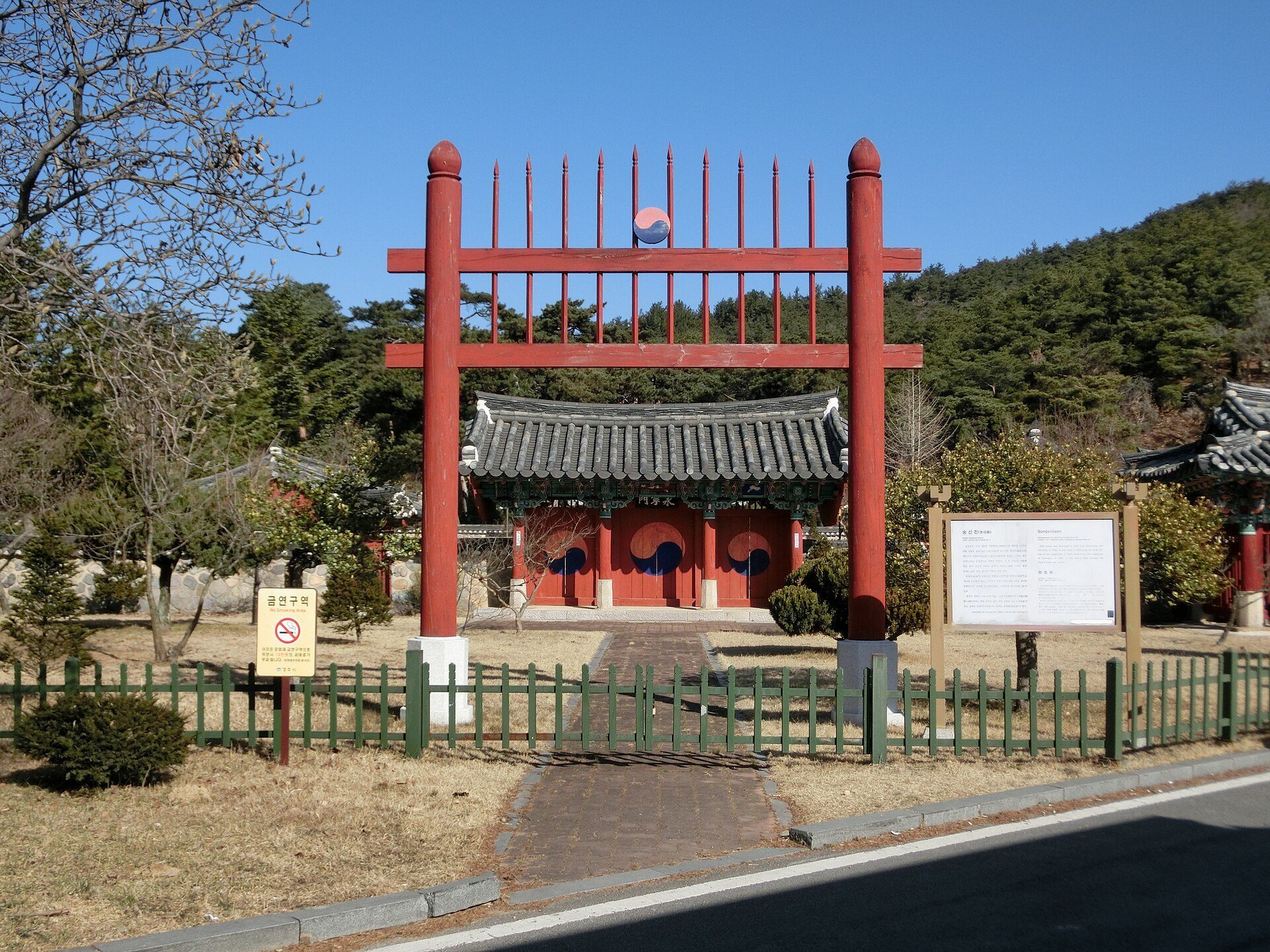
Cheonmachong is about 12.7 metres high and approximately 50 metres in basal diameter. Its occupant remains unidentified, although King Jijeung has been proposed. The mound produced 11,526 artifacts, including a birch-bark saddle flap decorated with a winged horse. The object that gave the tomb its name is preserved at the Gyeongju National Museum. Oreung includes the tomb attributed to Hyeokgeose, the traditional founder of Silla, and the Sungdeokjeon shrine.
Hwangnyongsa and Bunhwangsa
Hwangnyongsa temple foundations
The Hwangnyongsa ruins cover approximately 2.9 hectares, while the temple itself occupied about 72,500 square metres, roughly eight times the area of Bulguksa. Excavation revealed a distinctive one-pagoda-and-three-main-halls plan, a Buddhist arrangement centered on one pagoda and three principal halls. Foundations for the main hall, lecture hall, and pagoda survive, together with a substructure whose lower construction can be reconstructed. Because the upper building materials cannot be established securely, the remains have been reconstructed only to the level of foundations and platforms.
Hwangnyongsa was described as the largest Buddhist temple in Korea and, for roughly seven centuries, the largest Buddhist temple in East Asia. Its nine-story pagoda was traditionally estimated to have reached about 80 metres. The excavated complex also produced more than 40,000 artifacts, providing material evidence for the temple’s plan and use.
Bunhwangsa pagoda
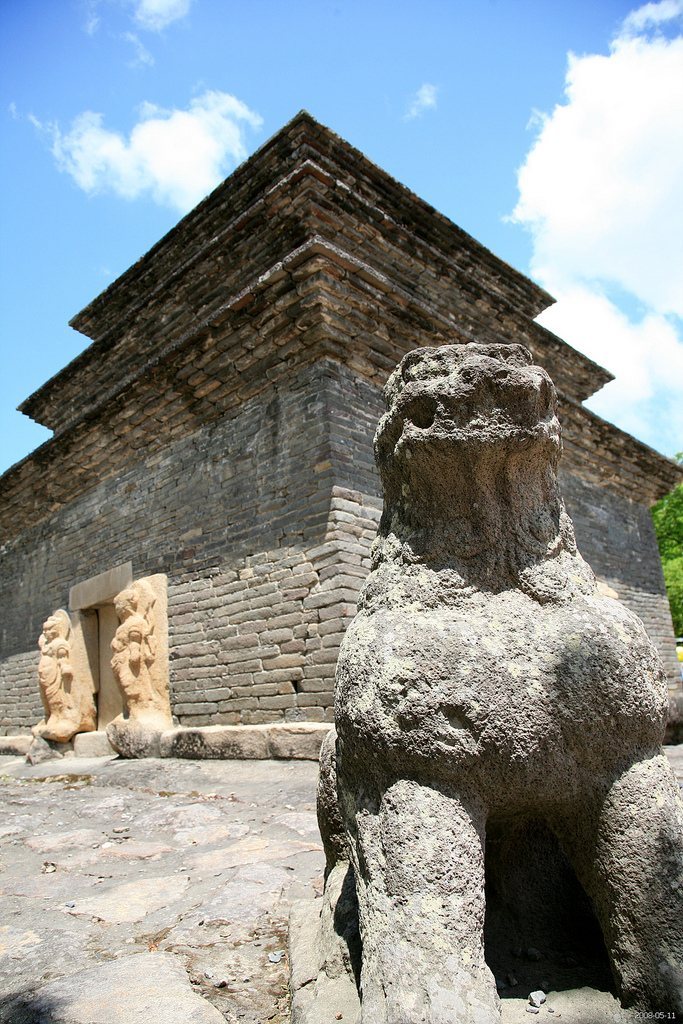
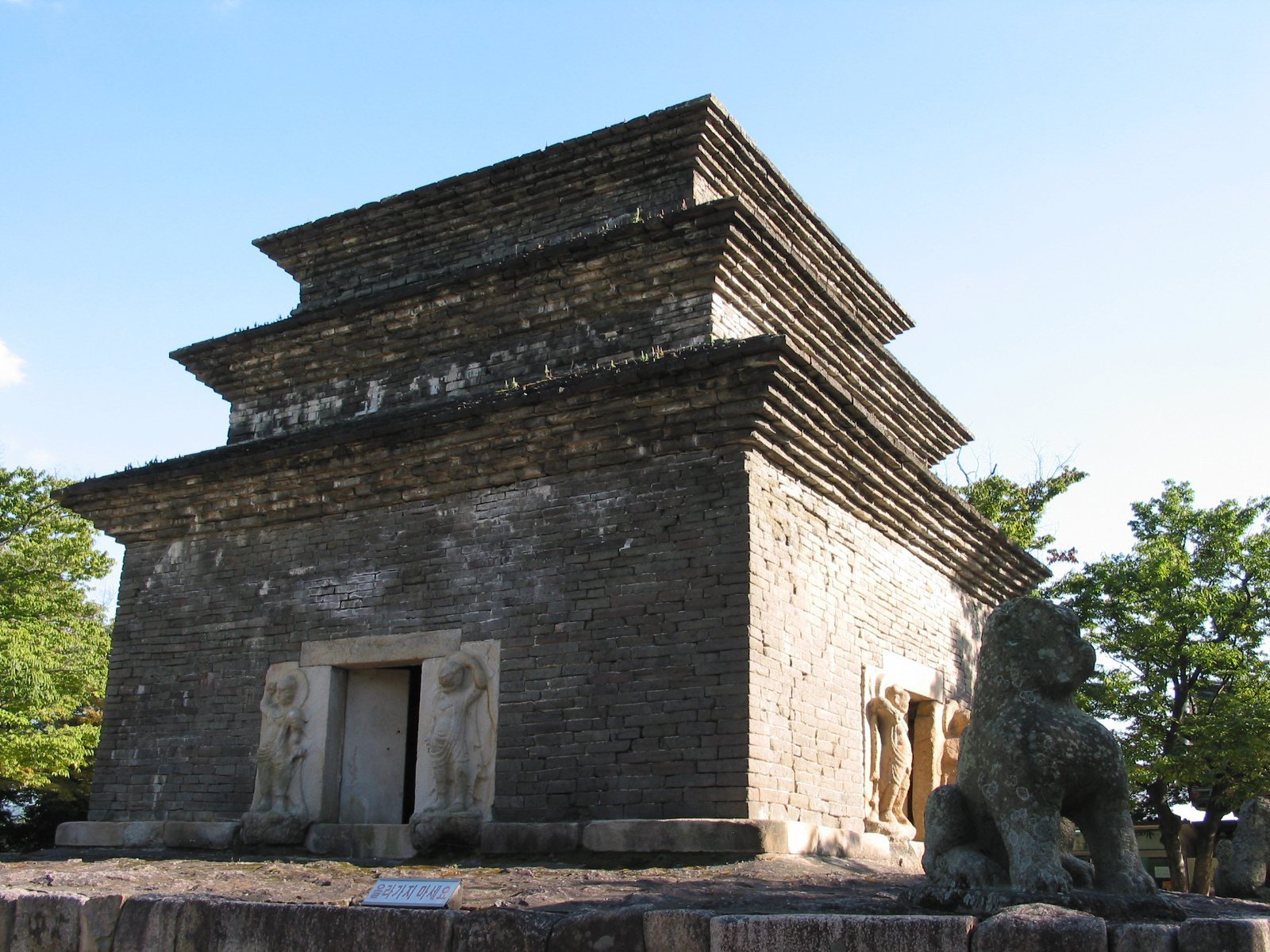
The surviving landmark of Bunhwangsa is a seventh-century stone pagoda built in a brick-pattern style. It probably originally had seven or nine stories, but only three survive. The structure stands on a square base, with a doorway on each side of its stone body. Pairs of guardian figures flank the doorways, and a granite lion stands at each corner of the base.
Pairs of sliding doors close the lower-level entrances. Reliefs above them depict warriors and kings. The pagoda’s design differs markedly from the contemporary Mireuksa stone pagoda, built in Baekje in 639. Its surviving masonry preserves one of the distinctive forms of Silla Buddhist architecture within the historic areas.
Mount Namsan and Poseokjeong
Buddhist monuments of Mount Namsan
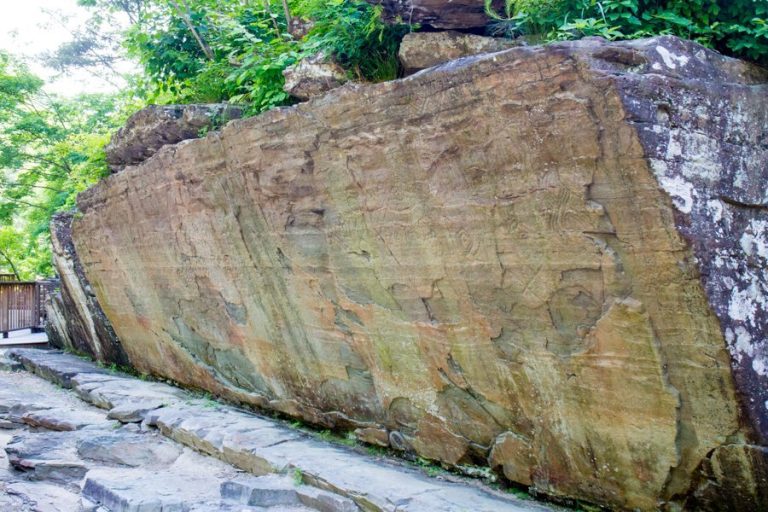
Mount Namsan contains the remains of 122 Buddhist temples, 64 stone pagodas, 53 stone statues, and 16 stone lanterns, as well as evidence of religious activity that predates Buddhism. Its open-air reliefs and carvings include numerous images of the Buddha and associated bodhisattvas, Buddhist figures who postpone final enlightenment to assist other beings. These works are representative of Silla Buddhist art. The mountain also contains royal burial mounds reinforced with large stone blocks and remains of fortifications. Some defensive embankments reached approximately two metres in height.
Poseokjeong watercourse
Poseokjeong preserves the stone watercourse for which the site is known. The channel is shaped like an abalone shell, approximately 35 centimetres wide and about 10 metres long. It was designed to carry water and floating wine cups during aristocratic drinking and poetry gatherings. The palace buildings associated with the watercourse no longer survive, leaving the carved channel as the principal physical feature of the site.
Sanseong fortifications
The Sanseong area includes Myeonghwal Fortress, whose walls once followed a circuit of approximately six kilometres around the summit of Myeonghwal Mountain. Much of the masonry has fallen, but sections of the old walls and fortress structures remain. Together with the fortifications on Mount Namsan, the surviving earthworks and masonry show how the Silla capital was defended across its mountainous surroundings.