Zaachila: A Zapotec-Mixtec City-State and Archaeological Site in Oaxaca
Site at a Glance
- Rating
- 4.3
- Popularity
- Low
- Country
- Mexico
- Primary era
- Medieval
- Eras represented
- Medieval, Early Modern
- Civilizations
- Mixtec, Zapotec
- Site type
- City
On this page7 sections
History
Zaachila is an ancient Zapotec-Mixtec city-state in Villa de Zaachila, Oaxaca, Mexico. It developed in the Central Valleys after the decline of Monte Albán, the major ancient Zapotec capital in Oaxaca, although its foundation date remains uncertain. Its principal occupation is generally placed between the eleventh or twelfth century and the arrival of the Spanish in 1521, while other proposals place its foundation in the thirteenth century or in 1399. The site belongs to the Mesoamerican Postclassic period, the final major pre-Hispanic period before the Spanish conquest.
The final Zapotec capital
Zaachila became the final Zapotec capital as Monte Albán declined. Its original name is unknown. The name Zaachila is associated with Zaachila Yoo, a Zapotec ruler traditionally placed around the late fourteenth or early fifteenth century. The city was also known by the Nahuatl name Teotzapotlan and the Mixtec name Ñuhu Tocuisi.
Before the arrival of the Spaniards, the Mixtecs controlled the capital, which remained one of the few Mixtec-Zapotec capitals still inhabited at that time. Zaachila ruled Teitipac, Macuilxochitl de Artigas Carranza, and Teotitlan del Valle, while San Baltazar Chichicapam, Tlacolula de Matamoros, Mitla, and Tlalixtac de Cabrera retained greater autonomy. The first three of those more autonomous communities were later transferred to the overlordship of Cuilapan de Guerrero. Zaachila also fought wars with Tututepec and Tlaxiaco.
In 1495, the Aztec ruler Ahuitzotl conquered Zaachila as part of the military expansion of his reign into Oaxaca. The city’s local economy included nopal fruit, products made from maguey, firewood, salt, and small quantities of cochineal, a red dye obtained from scale insects traditionally cultivated in Mesoamerica.
Excavation, preservation, and continuing traditions
Archaeological work in 1962 uncovered two tombs beneath the central mound. Excavations in 1971 revealed Tombs 3 and 4. Their offerings were simpler than those recovered during earlier work by Gallegos, but Tomb 4 was especially important because painted remains survived on its lintel, the horizontal element spanning a doorway or opening.
Since 1990, a National Autonomous University of Mexico project on pre-Hispanic mural painting has studied the site’s ancient paintings. Tree roots and rainwater infiltration have damaged the surviving designs in Tomb 4, which were interpreted as skulls and crossed bones on a red background. Population growth, official neglect, and housing construction over or near the archaeological remains have also contributed to deterioration and looting.
Zaachila remains the setting for the annual Laanii Roo Xten Daan Zaadxil, or Great Festival of the Zaachila Hill. Held on the last Monday of July, it honors Pitao Ko Shuub, a deity associated with tender maize, through dances, processions, cultural events, and food traditions. The festival combines historical and religious commemoration with living community practice.
Remains
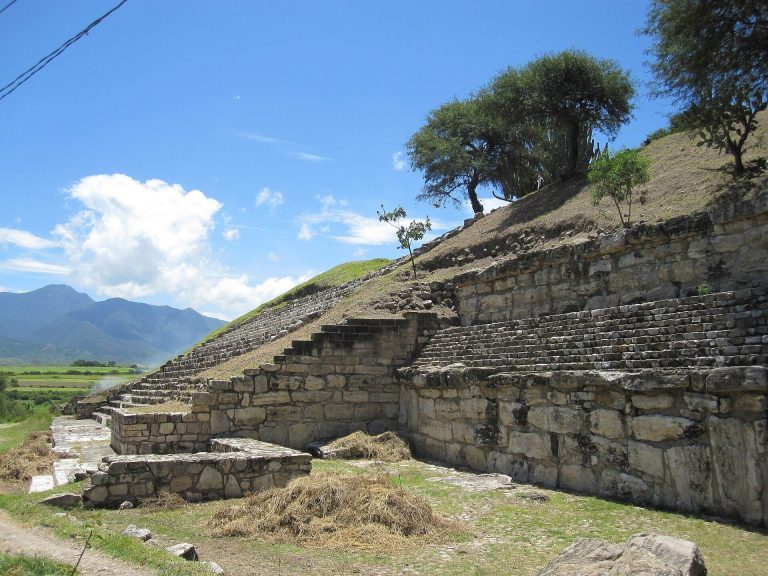
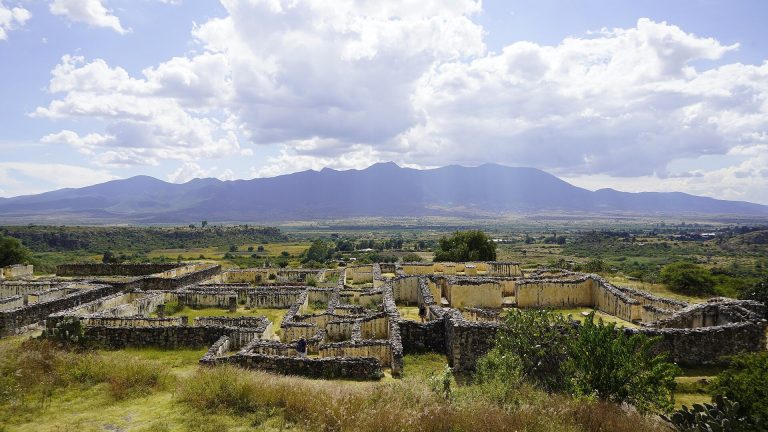
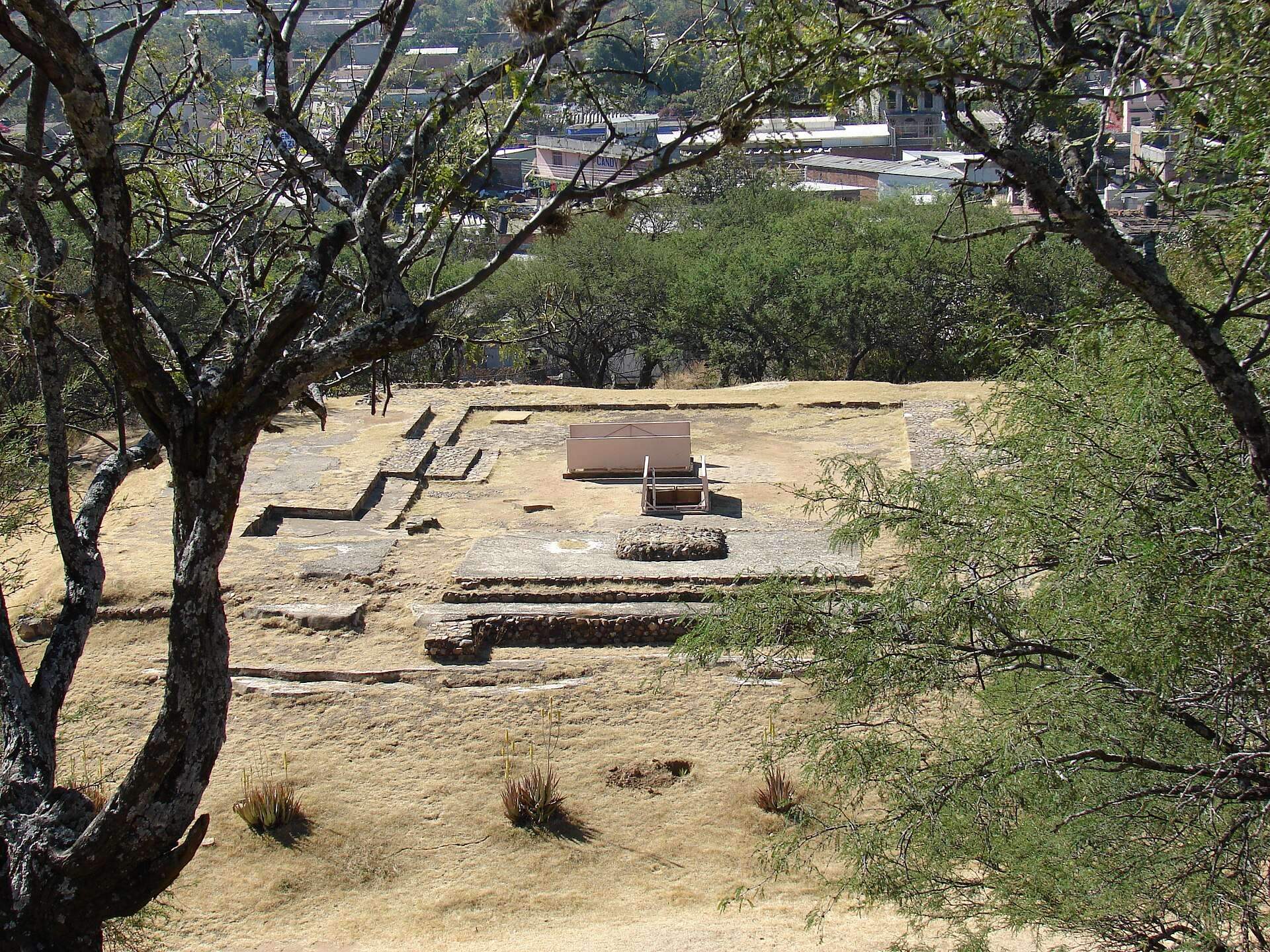
The archaeological site lies in the center of Villa de Zaachila in Oaxaca’s Central Valleys, at approximately 1,520 meters above sea level. Its ancient settlement includes numerous mounds, artificial elevations that may contain platforms, temples, palaces, tombs, or other remains. Many are occupied by modern houses, leaving the city’s full extent and architectural organization uncertain. The excavated area centers on a large pyramidal mound, a palace-like structure, and an enclosed space beneath which the principal tombs were built.
Palace and funerary complex
Tombs 1 and 2
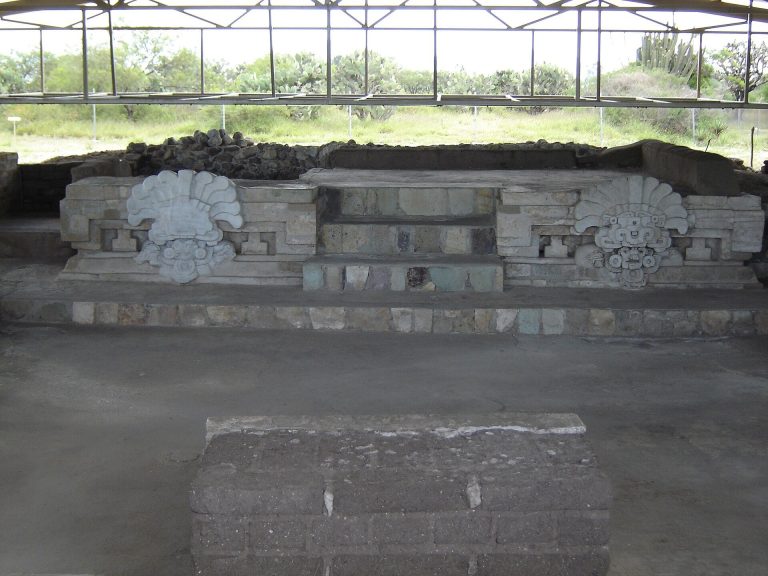
Tombs 1 and 2 lie beneath the former palace and have architectural similarities to tombs at Monte Albán. Their form belongs to the Postclassic period, and they are thought to have belonged to important Mixtec individuals. Their construction may also reflect Zapotec building traditions shaped by Mixtec influence. Stucco, a hard plaster used for surfaces and relief decoration, covers figures associated with the world of the dead in Mesoamerican mythology, including an owl.
Other reliefs show four human figures, two identified by names based on the Mesoamerican calendar system. The entrance to Tomb 1 was ornamented, and the decorative imagery included a skull-bearing figure, a figure with a turtle shell, and an owl. Excavations also recovered several pieces of pottery decorated with multiple colors. These vessels may have been made by Mixtec artisans or by Zapotec artisans working under Mixtec influence.
Tomb 4
Tomb 4 has a lintel with surviving traces of mural painting. The remaining designs, heavily damaged by tree roots and rainwater, were interpreted as skulls and crossed bones set against a red ground. The tomb forms part of the palace-and-tomb complex excavated within the central mound.
Only part of one mound and its palace-and-tomb complex has been excavated and made accessible. Other mounds remain beneath inhabited areas, so the surviving excavated remains represent only a portion of the ancient city.