San José Mogote: An Early Zapotec Center in Oaxaca
Site at a Glance
- Rating
- 4.2
- Popularity
- Low
- Country
- Mexico
- Primary era
- Iron Age
- External website
- Open
- Eras represented
- Bronze Age, Iron Age, Classical
- Civilizations
- Zapotec
- Site type
- City
On this page15 sections
History
San José Mogote is a pre-Columbian Zapotec archaeological site in Villa de Etla, Oaxaca, Mexico, in the Etla arm of the Valley of Oaxaca. It developed during the Early and Middle Formative period, approximately 1500–500 BCE, when settled agricultural communities, social hierarchies, and public architecture were emerging across Mesoamerica. Construction probably began around 1600–1400 BCE, and the settlement later became the largest and most influential community in the valley before Monte Albán rose as the principal Zapotec center.
From agricultural village to regional center
San José Mogote is regarded as the oldest permanent agricultural village in the Oaxaca Valley and probably the first local settlement to use pottery. Between approximately 1500 and 1150 BCE, it grew from a small group of houses into the largest of about 25 villages in the valley. Its early development included irrigation, specialized craft production, terracing, defensive palisades, and ceremonial construction. By the Tierras Largas phase, approximately 1400–1150 BCE, the settlement covered about 7.8 hectares and was five to eight times larger than other communities in the valley.
Agricultural production benefited from two forms of irrigation. Ditches connected to streams supplied water, while shallow wells supported a technique known as pot irrigation, in which water was drawn for use in cultivation. These systems may have helped sustain the settlement’s expansion. San José Mogote also began to exercise influence beyond its immediate surroundings, developing into a regional political and economic center after 1150 BCE.
Political hierarchy and long-distance exchange
During the San José phase, approximately 1150–850 BCE, the settlement expanded to roughly 60–70 hectares and had an estimated population of about 700. It controlled surrounding communities and received tribute, labor, or services from settlements including San Pablo Huitzo, Santa Marta Etla, Hacienda Blanca, Tomaltepec, Zaachila, Abasolo, Mitla, Tilcajete, Zegache, Santa Ana Tlapacoyan, and Tierras Largas. During the following Guadalupe phase, approximately 850–700 BCE, large public buildings with adobe-brick platforms were constructed.
Between approximately 900 and 600 BCE, about 2,000 people lived in 40 communities across the Valley of Oaxaca, with roughly half concentrated at San José Mogote. The settlement covered about 50 acres during part of this period. Between approximately 700 and 500 BCE, the valley population reached about 3,500, while San José Mogote continued to expand to approximately 60–70 hectares. Its population during the Rosario phase is estimated at about 1,300–1,400.
This growth accompanied a transformation from an autonomous and relatively egalitarian community into a chiefdom, a hierarchical society governed by concentrated chiefly authority. The scale of public construction, imported materials, control over neighboring settlements, and emergence of an elite all point to increasing social differences. Elite authority may have rested on agricultural control, alliances, coercion, reciprocal obligations, and claims to ritual power.
Exchange networks connected San José Mogote with the Gulf Coast, central Mexico, Morelos, Veracruz, and Chiapas. Local craftspeople produced magnetite mirrors that reached the Olmec Gulf Coast, about 250 miles or 400 kilometers away. Obsidian and other nonlocal materials likewise show that the settlement participated in exchange beyond the Valley of Oaxaca. The Olmec were an influential Formative-period culture centered mainly on Mexico’s Gulf Coast, and their connection with San José Mogote reflects trade and selected artistic relationships rather than a change in the site’s primary Zapotec identity.
Decline, subordination, and revival
By approximately 500 BCE, San José Mogote had lost its dominant position as Monte Albán emerged as the principal Zapotec city. The settlement probably became a lesser community under Monte Albán’s control and may have been abandoned around this time. One interpretation holds that its leaders and inhabitants participated in the establishment of Monte Albán.
San José Mogote revived as a secondary center during Monte Albán II, approximately 150 BCE–150 CE. Its central area then reached about 70 hectares and included temples, palaces, a ballcourt, and tombs. After the earlier decline, public structures on Mound 1 were rebuilt as a residence for a high-ranking family, reflecting the site’s changed political position.
Archaeological importance
Investigations carried out over roughly two decades in the late twentieth century, including work associated with Kent Flannery and Joyce Marcus, established San José Mogote as an early center of Zapotec culture. The site is associated with some of the earliest known Zapotec writing, dated to approximately 600 BCE, and with an early example of a 260-day calendar, a major Mesoamerican cycle. Its early ceremonial buildings, palisades, adobe construction, irrigation, terracing, and craft production belong among the earliest known examples of these practices in the region.
Some objects recovered at San José Mogote can be viewed in the Community Museum of San José Mogote, located in the El Cacique Hacienda.
Remains
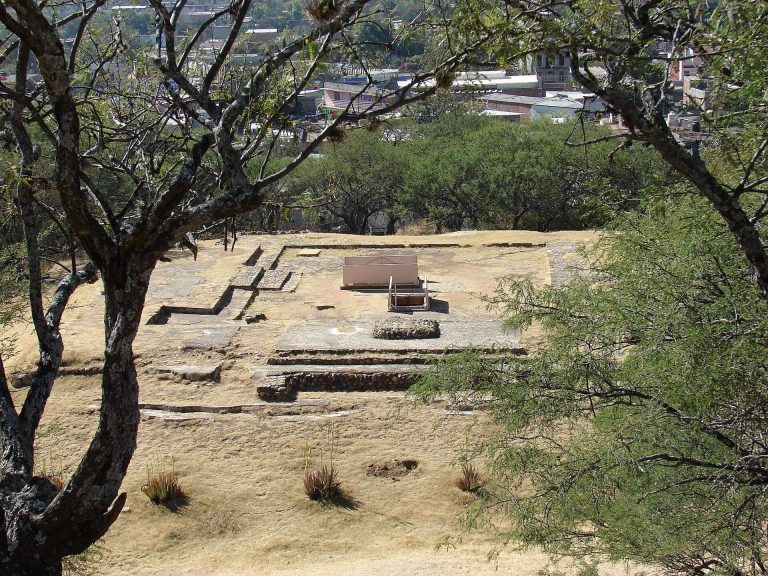
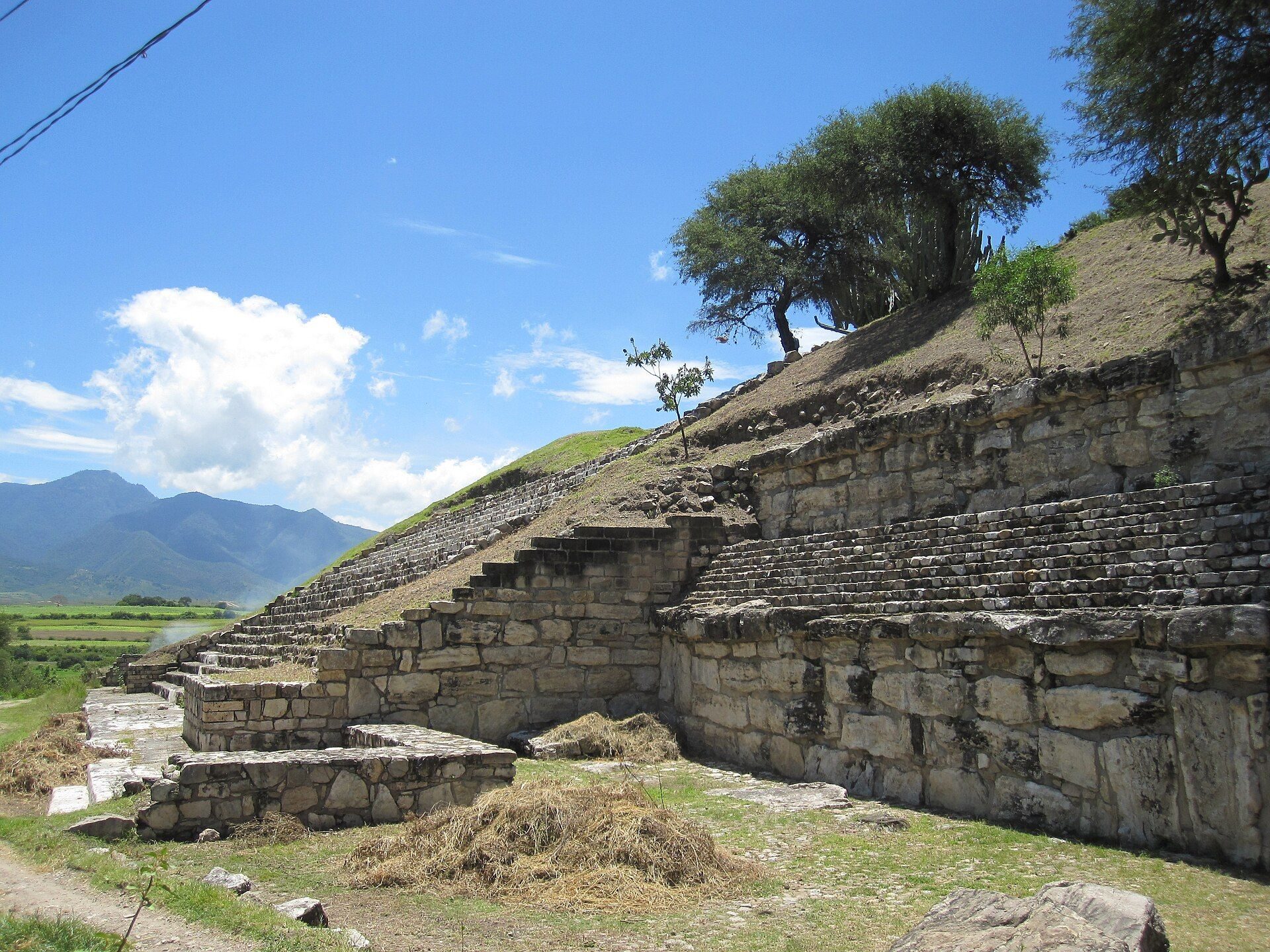
San José Mogote lies in the fertile bottomlands of the Etla arm of the Valley of Oaxaca, on the right bank of the Atoyac River, and is surrounded by the present-day village of San José Mogote, about 12 kilometers northwest of Oaxaca City. The settlement developed from household compounds into a large ceremonial and political center. Its remains include domestic structures, earthen mounds, adobe-brick platforms, stone-built structures, ritual deposits, burials, and agricultural installations distributed among several residential sectors. The site is thought to have included at least four sectors, with investigations covering parts of sectors A through C.
Households and agricultural installations
Household compounds formed the basic social units of the settlement. A typical household included braziers, earth ovens or hearths, stone manos and metates, which were grinding stones used to process food, and blackened pottery. Maize and other foodstuffs were stored in bell-shaped pits outside the houses. Later, these pits were reused for refuse and formed midden deposits. Burials and other activity areas lay beside the houses.
Small irrigation ditches connected to streams, and shallow wells supplied water for pot irrigation. These installations were associated with the settlement’s expansion and increased agricultural production. Local workshops produced polished magnetite mirrors, pearl-shell, spiny-oyster-shell, and mica ornaments, polished stone axes, pottery, and other ceremonial objects. Obsidian artifacts, turtle-shell drums, conch-shell trumpets, and stingray spines were also associated with exchange or ritual activity.
Public and ceremonial architecture
Mound 1
The principal public complex before 500 BCE was Mound 1, built on an artificially enlarged hill that reached approximately 15 meters in height. Early public buildings and later structures occupied this elevated complex. After San José Mogote lost its regional dominance, buildings on the mound were rebuilt as a residence for a high-ranking family.
The men’s home
A special community building known as the “men’s home” was rebuilt repeatedly. It probably served civic and ceremonial gathering purposes and was oriented eight degrees west of north. Its orientation resembles that of La Venta and has been interpreted as evidence of astronomical and calendrical knowledge.
Structures 1 and 2
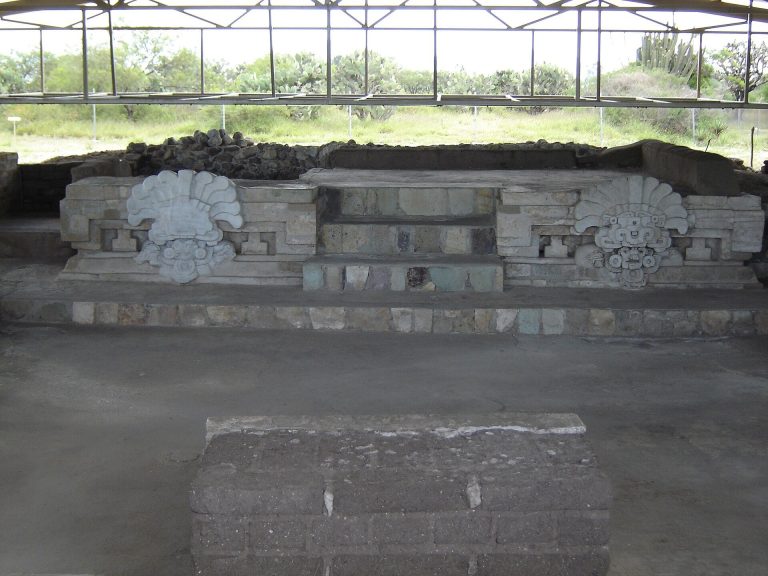
Structures 1 and 2 formed a substantial multilevel public building where a possibly ethnically diverse community may have gathered to discuss important matters. Stone carvings interpreted as jaguar and raptor heads were found beneath the stairs of Structure 2. Their forms differ from Olmec styles.
Building 6
Building 6 was an early public structure measuring approximately 5.5 by 4.5 meters. Its foundation was firmly packed with crushed stone, and its interior had plastered walls and a plastered floor. A platform interpreted as an altar stood along the south side. A central cavity filled with powdered lime may have been connected with a ritual involving tobacco.
Monument 3
Monument 3 was a flat carved stone set as a threshold at the entrance to a ceremonial structure, probably a temple. It shows a naked, vulnerable-looking man with a swollen or slit eye, a grimacing mouth, and rounded forms on the chest and abdomen interpreted as exposed internal organs. Glyphs representing blood drops accompany a possible calendar name, “1 Earthquake,” which is understood as a calendar-based personal name or day-name.
The monument is interpreted as an image of the sacrifice of a captive at the societal level. Stingray spines and similar obsidian or jade implements indicate that personal bloodletting was also practiced. The imagery formed an early precedent for the later “Dancers” reliefs at Monte Albán.
Later temple and elite remains
During the Rosario phase, approximately 700–500 BCE, an elite residence consisted of an adobe-brick house arranged around a courtyard. Adobe is sun-dried earth strengthened with organic material. Its residents were associated with jade ornaments, cranial deformation, and bloodletting carried out with sharp, dagger-shaped obsidian blades. Their remains were placed in tombs.
Later public and ritual remains included temples, palaces, a ballcourt, and tombs. Beneath the floor of one temple were jade sculptures, ceramic figurines, censers shaped as people and animals, and human and animal bones interpreted as sacrificial offerings.
Pottery, writing, and ritual evidence
Pottery from San José Mogote combined images associated with earth and sky, including earthquake and lightning motifs. During the San José phase, vessels featured designs interpreted as half-human, half-jaguar figures and fire serpents. Fire-serpent vessels came from sectors A and C, while pottery showing half-human, half-jaguar figures came from sector B. During the Guadalupe phase, incised white pottery became prevalent.
Buildings, household remains, burials, ritual deposits, and imported materials together trace the transformation of San José Mogote from a domestic agricultural village into a large ceremonial and political center. The surviving deposits also preserve evidence for early Zapotec writing, calendrical practice, craft production, social hierarchy, and connections with distant regions.