Roman Forum of Athens (Roman Agora): A Roman Public and Commercial Centre


Site at a Glance
- Rating
- 4.5
- Popularity
- High
- Country
- Greece
- Primary era
- Classical
- External website
- Open
- Eras represented
- Classical, Early Modern
- Civilizations
- Ottoman, Roman
- Site type
- Civic
- Remains
- Forum
On this page16 sections
History
The Roman Forum of Athens, also called the Roman Agora, is a Roman public and commercial complex in Athens, Greece, established between 19 and 11 BC under Roman rule. Built east of the Ancient Agora and north of the Acropolis, it provided a new place for trade, public meetings, and civic activity.
Foundation under Roman rule
The project began with Herodes of Marathon, the Athenian official responsible for the market, who sought financial support from Julius Caesar in 51 BC for public buildings at a new agora. His son Eucles later obtained support from Augustus, the first Roman emperor, and construction followed between 19 and 11 BC. The Athenians dedicated the western gateway to Athena Archegetis, a title meaning Athena the Founder or Athena the Leader, identifying her as the city’s patron deity.
The new agora was connected to the Ancient Agora by a road. After the Roman complex was completed, an Ionic stoa, a roofed colonnade used for circulation and public activity, was added along this route. The Roman Forum combined an open civic court with stoas, shops, and market facilities.
Expansion and changing civic functions
During the reign of Hadrian in the second century AD, the agora was enlarged and its court was paved with marble slabs. Hadrian was a Roman emperor known for major building projects in Athens and elsewhere. A decree placed on the Gate of Athena Archegetis regulated the tax obligations of oil merchants, linking the gateway directly with the administration of commercial activity.
After the Herulian invasion of Athens in AD 267, the city contracted within the Late Roman fortification wall. The administrative and commercial centre consequently shifted from the Ancient Agora to the Roman Agora and the nearby Library of Hadrian. As the agora lost political importance, statues and commemorative features were progressively installed in the plaza, giving it the character of a public collection of Athenian and Attic monuments.
Byzantine and Ottoman transformation
During the Byzantine and Ottoman periods, houses, workshops, churches, and other buildings gradually covered the agora. The area also functioned as a wheat market under Ottoman rule, while the Gate of Athena Archegetis became known as the Bazaar Gate.
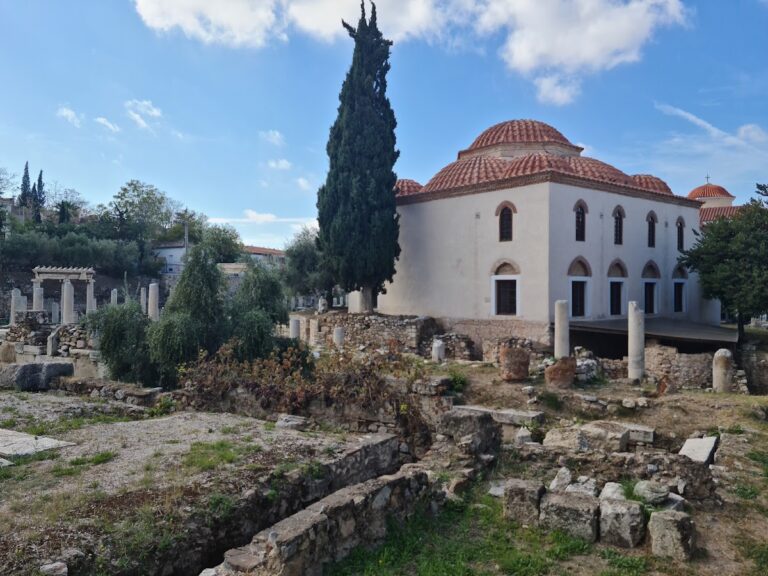
A mosque was established at the site after the Ottoman conquest of Athens in 1456. The surviving Fethiye Mosque dates from 1668 to 1670 and stands on the site of an earlier Byzantine or Early Christian basilica. It later served successively as a prison, barracks, school, and military bakery. From 1935, it was used as a storehouse for finds from the excavations and continues in that role.
Clearance and archaeological investigation
Recovering the Roman Agora required the purchase and demolition of houses and other buildings that had covered the ancient complex. The Greek Archaeological Society excavated the area in 1837 to 1845, 1890 to 1891, 1920, and 1930 to 1931. Italian archaeologists worked there from 1940 to 1942, followed by investigations led by Anastasios Orlandos and P. Lazarides in 1963 and 1964. The First Ephorate of Antiquities conducted further campaigns in 1955, 1965 to 1966, 1968, 1984 to 1985, 1989, and 1991. During the investigations of 1843, the Church of Prophet Elias, also called Panagia of the Catalans, was demolished to complete the research. The Roman Agora and the adjoining Library of Hadrian are now preserved as an archaeological area in central Athens.
Remains
The Roman Agora occupied a broad rectangular area measuring approximately 111 by 98 metres. An open court stood within an arrangement of stoas or a peristyle, meaning columns surrounding an open space. Shops and commercial buildings bordered the court, and a market formed part of the complex. The surviving remains include the principal gateways, colonnades, market-related buildings, public latrines, and other structures associated with the ancient enclosure.
Entrances and surrounding structures
Gate of Athena Archegetis
The western entrance was the Gate of Athena Archegetis, built in 11 BC. Four Doric columns stood on a base of Pentelic marble and supported a broad pediment. The Athenians dedicated the monumental gateway to Athena Archegetis, whose title expresses her role as the city’s founding or leading patron. The gate later became known as the Bazaar Gate during the Ottoman period.
Eastern propylon
The eastern entrance was an Ionic propylon, or monumental entrance structure, with four columns made from grey Hymettian marble. A nearby stoa contained sculptures of distinguished Romans, probably emperors or officials.
Fountain, basilica, and nymphaeum
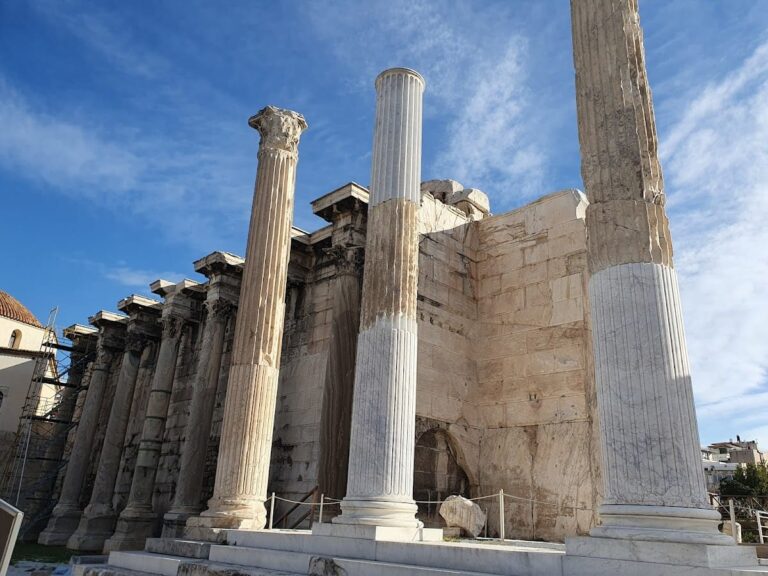
A fountain stood on the southern side of the agora. A basilica occupied its northeastern corner, while a nymphaeum, a monumental fountain structure, stood at the southeastern corner. The ruins of the Library of Hadrian extend northwest of the Roman Agora, reflecting the close relationship between the two complexes after the third-century contraction of the city.
Market and civic buildings
Agoranomion
The Agoranomion was a rectangular building on the eastern side of the agora, dating from the first century AD. Its surviving facade has three doors with arched lintels and a broad staircase. An inscription on the architrave records its dedication to the deified Augustus and Athena Archegetis.
The building’s precise function remains uncertain. It was once understood as an office for officials supervising the market, but later interpretations propose that it formed part of a cult complex for Claudius or Nero. It may have been the Sevasteion, a building dedicated to imperial worship.
Public latrines
The public latrines, known as vespasianae, occupied a rectangular building divided into an antechamber and a square room. Benches with openings ran along all four sides, with a drainage pipe beneath them. Their arrangement preserves evidence of one of the complex’s practical public facilities.
Later buildings and surviving fabric
Tower of the Winds
The Tower of the Winds stands outside the eastern boundary of the agora. Dating from the second century BC, it functioned as a public clock.
Fethiye Mosque
The Fethiye Mosque occupies the northern side of the area. Its form is associated with the earlier Byzantine or Early Christian basilica on the site. After serving several Ottoman-period purposes, the building became a storehouse for archaeological finds in 1935, a use it retains.
The buildings and colonnades of the Roman Agora were progressively covered by later urban construction before archaeological clearance exposed the remains now visible within the archaeological area.