Ursberg Abbey: A Premonstratensian Imperial Abbey in Germany
Site at a Glance
- Rating
- 4.6
- Popularity
- Very Low
- Country
- Germany
- Primary era
- Medieval
- External website
- Open
- Eras represented
- Medieval, Early Modern, Modern
- Civilizations
- Holy Roman Empire
- Site type
- Religious
- Remains
- Monastery
On this page10 sections
History
Ursberg Abbey is a former Premonstratensian monastery in Germany, founded in the mid-1120s by the nobleman Wernher of Schwabegg-Balzhausen. Dedicated to Saint Peter and Saint John the Evangelist, it was the first Premonstratensian foundation in southern Germany and probably began as a double monastery, with a separate community of women that survived until at least about 1320.
Foundation and Premonstratensian expansion
Norbert of Xanten, founder of the Premonstratensians, settled the provostry with canons from Ilbenstadt. The order combined religious life with pastoral and institutional work, and Ursberg soon became an important base for its expansion. It founded Roggenburg in 1126 and participated in establishing or taking over communities at Osterhofen, Schäftlarn, Kaisheim, and Neustift near Freising. The prior Grimo was especially associated with this activity and was later venerated as Blessed Grimo.
Ursberg received royal protection in 1143. From the thirteenth century, its bailiwick was held as an imperial fief, and in 1301 the monastery came under the Margraviate of Burgau. The provostry was raised to an abbey between 1349 and 1368. In 1418, its abbot gained the right to use pontificals, the insignia and selected liturgical privileges associated with episcopal ceremonies. The early thirteenth-century provost Burchard of Biberach also wrote the Ursberg Chronicle.
Imperial status and early modern upheavals
As an Imperial Abbey, Ursberg held its territory directly from the emperor rather than from a local prince. Its abbot therefore exercised territorial authority, and the abbey was represented in the Imperial Diet by one collective vote on the Swabian Prelates’ Bench. It belonged to the Swabian Imperial Circle. The Peasants’ War and the Schmalkaldic War brought a temporary decline during the sixteenth century, although Abbot Thomas Mang, who served from 1522 to 1569, worked to counter it.
After the Thirty Years’ War, Abbot Matthias Hochenrieder directed the rebuilding of the abbey church and monastery between 1654 and 1674. During the first half of the eighteenth century, Ursberg also became a center for the cult of a crucifix associated with the brief revival of stillborn children or infants who had died before baptism, allowing them to be baptized. More than 12,000 baptisms were attributed to the period from 1686 to 1720. Parents came from surrounding regions, the Electorate of Bavaria, Bohemia, and the Austrian lands, while their offerings provided income for the monastery.
The Roman Curia attempted to suppress the practice from 1729, but the Premonstratensians continued it for several decades. The Augustinian canon Eusebius Amort criticized it in a Latin treatise opposing the baptism of dead children before allegedly miraculous images.
Reform, secularization, and new uses
Enlightened reforms reduced Ursberg’s manorial and judicial authority during the second half of the eighteenth century. A police ordinance issued in 1777 regulated the internal order of the Imperial Abbey and the conduct of its subjects, including observance of Sundays and feast days, attendance at taverns, and a prohibition on gambling.
Bavaria dissolved the abbey on 14 December 1802 during the secularization of 1802–1803, when ecclesiastical institutions and their property were transferred to secular government. The former Imperial Abbey was incorporated into the Electorate of Bavaria. In 1792, its territory covered about 17.5 square miles and contained approximately 3,500 inhabitants. At the beginning of the nineteenth century, the former manorial territory had around 3,300 subjects. After the dissolution, the abbey church became the parish church, while the former monastic buildings housed the parish residence and Ursberg regional court. A regional court was established there in 1804.
The priest Dominikus Ringeisen acquired the former abbey buildings in February 1884. In 1897, he established a congregation of sisters to care for people with physical and mental disabilities. This work formed the basis of the present Dominikus-Ringeisen-Werk and the Franciscan St. Joseph’s Congregation of Ursberg. In 1996, the Dominikus-Ringeisen-Werk became a church foundation under public law and continued supporting people with disabilities at numerous locations in Bavaria.
Nazi persecution and the present community
During the Nazi period, more than 200 patients at Ursberg were forcibly sterilized from 1936 onward. From autumn 1940 through August 1941, almost 200 people were transported to the Hartheim killing center near Linz, a Nazi euthanasia facility where people with disabilities were murdered during the Second World War. Nearly 200 more patients died through hunger and neglect by 1945.
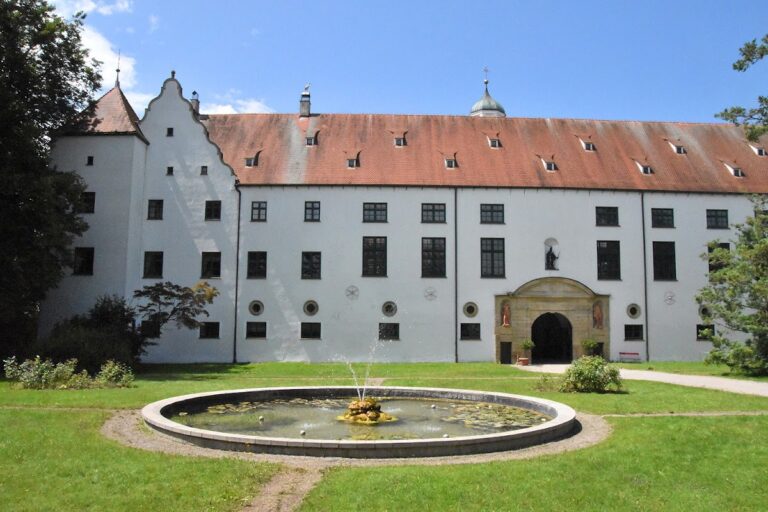
A memorial erected in the monastery courtyard in 2004 commemorates these victims and those killed in both world wars. Created by the sculptor Alfred Görig, it forms part of the site’s modern remembrance. Ursberg is now a Franciscan convent of the St. Joseph’s Congregation in the Diocese of Augsburg, occupying the former Premonstratensian monastery complex.
Remains
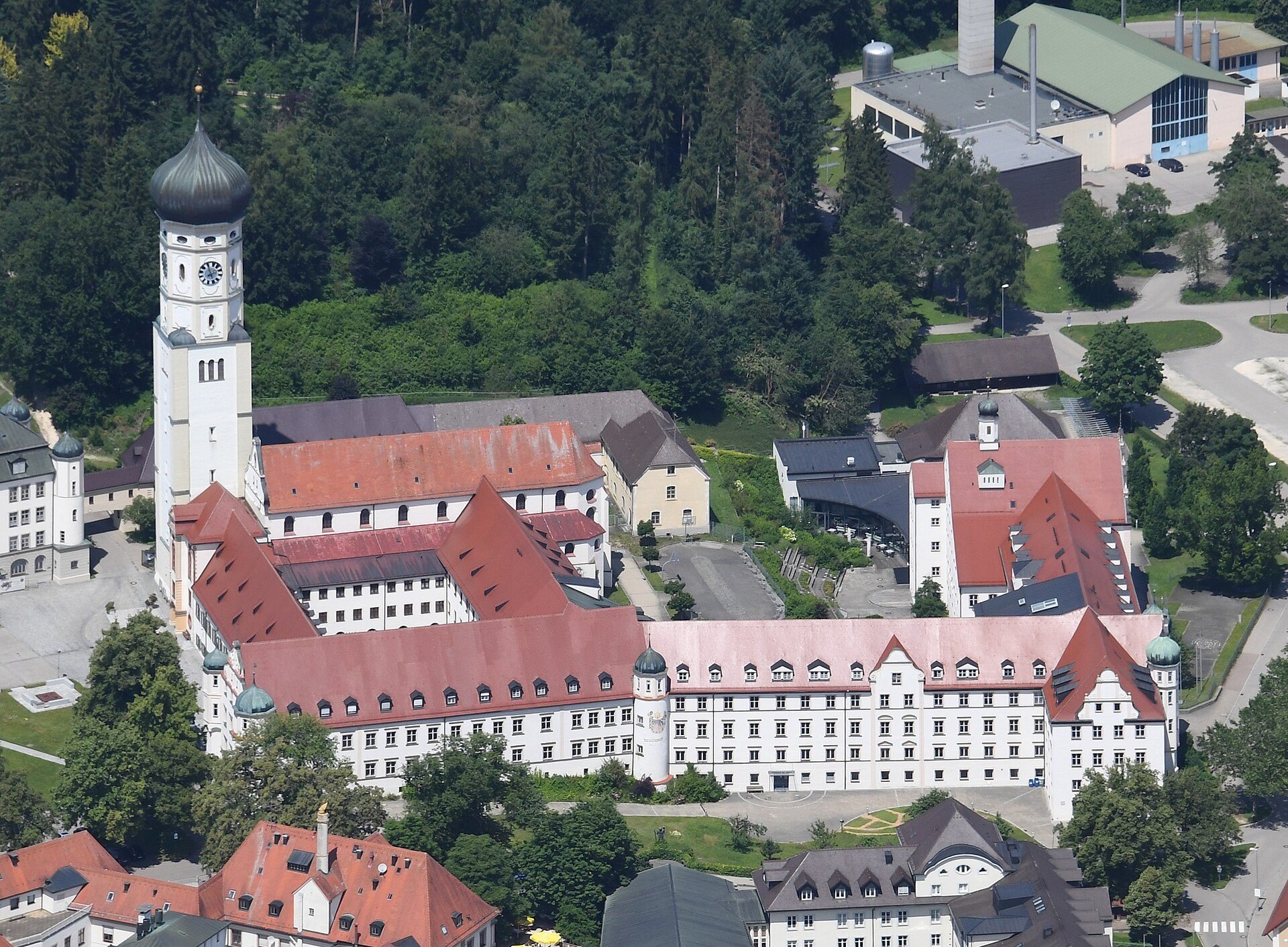
The surviving complex combines a thirteenth-century Romanesque church with eighteenth-century Baroque alterations and the former monastic buildings. The church remains in use as the parish church, while the courtyard preserves a memorial connected with the twentieth-century history of the institution.
Church and courtyard memorial
Abbey church
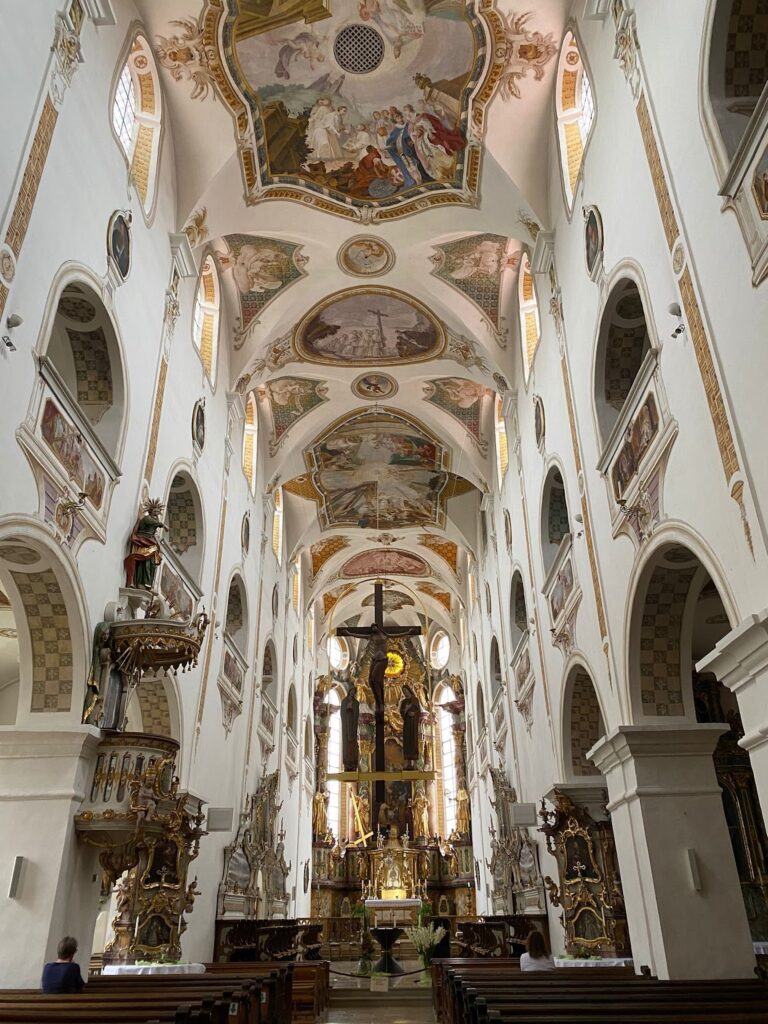
The abbey church originated as a Romanesque building constructed around 1230–1240. It was rebuilt and restored after the Thirty Years’ War, restored again in 1776–1778, and given a Baroque refurbishment during the eighteenth century. The Baroque transformation was carried out by Josef Dossenberger the Younger, master builder of Wettenhausen Abbey, while Jakob Fröschle and Konrad Huber painted the ceiling frescoes. The high altar was made by J. Pflaum, and the organ was built by Johann Nepomuk Holzhey.
Romanesque cross
The church contains a Romanesque cross accompanied by figures of the Virgin Mary and Saint John the Evangelist. It is an important example of Romanesque art and was the focus of the eighteenth-century baptismal cult. The object thus links the surviving medieval furnishings with one of the most consequential religious practices in the abbey’s later history.
Courtyard memorial
The monastery courtyard contains the memorial erected in 2004 by Alfred Görig. It commemorates patients murdered or mistreated during the Nazi period as well as those who died in both world wars.