Mother Parish of the Apostle Santiago: A Historic Parish Church in Tenerife
Site at a Glance
- Rating
- 4.5
- Popularity
- Low
- Country
- Spain
- Primary era
- Early Modern
- External website
- Open
- Eras represented
- Early Modern, Modern
- Civilizations
- Crown of Castile, Spanish
- Site type
- Religious
- Remains
- Church
On this page16 sections
History
The Mother Parish of the Apostle Santiago is a Roman Catholic church in Spain, located in Realejo Alto in the municipality of Los Realejos on Tenerife. Founded in 1496 by the Christian community established after the conquest of the island, it is dedicated to Saint James the Great, the apostle traditionally associated with the evangelization of Spain. The parish became an important ecclesiastical center in northern Tenerife and remains closely connected with the religious traditions of the region.
Foundation after the conquest
Tradition attributes the decision to establish a shrine to Santiago to Alonso Fernández de Lugo, the Castilian commander who led the conquest of Tenerife. The dedication may have expressed gratitude after the campaign and reflected the devotion to Saint James among settlers from Gáldar. The earliest building was probably a simple sacred enclosure with a thatched roof, erected around 1496. It was among the first Christian churches established on Tenerife.
On 25 July 1496, the feast of Saint James, nine Guanche rulers, including Adjona, Añaterve, and Beneharo, were baptized and received Christian names. The Guanche were leaders of Tenerife’s indigenous communities before and during the conquest. Their baptism marked their incorporation into the Christian order established by the conquerors and increased the need for a permanent place of worship. The community of Santiago del Realejo was formally recognized as a parish in 1498.
The church became the first benefice of the Taoro region. An ecclesiastical benefice was an endowed church institution that supported a cleric and could exercise administrative responsibilities. From Santiago del Realejo, jurisdiction extended over early Christian communities that later developed at Icod de los Vinos, San Pedro de Daute in Garachico, Adeje, Vilaflor, La Orotava, and Realejo de Abajo.
The parish’s earliest record book disappeared during the seventeenth century, but Bishop Diego de Muros referred to land donations made to “Santiago del Realejo de arriba” in 1542. This early reference reflects the church’s established position within the developing ecclesiastical organization of Tenerife.
Rebuilding in the seventeenth century
By the beginning of the seventeenth century, the sixteenth-century church had fallen into a dilapidated condition. In 1604, the master responsible for the 1570 stone doorway was commissioned to dismantle the structure known as the Old Church and construct a new building. Some material from the main chapel was reused, while the nave was enlarged and chapels were opened on both sides of the transept.
The north nave, also called the nave of the Gospel, was completed by 1610. Work on the south nave, or nave of the Epistle, began in 1626 under Licenciado Llanos, the beneficiary and steward of the parish. The Portuguese stonemason Manuel Penedo carried out this phase using stone from the quarries of Acentejo, while other seventeenth-century rebuilding used stone from Tigaiga. The chancel was rebuilt in 1667, completing the removal of the remaining parts of the Old Church.
The rebuilding process also transformed the church’s devotional spaces. In 1630, beneficiary Bernabé González Llanos began work on a chapel then dedicated to Our Lady of Succour, which later became the Chapel of the Nazarene. Francisco Yánez Barroso financed the Altar of Souls around 1669. The Brotherhood of Mercy built another chapel in 1767, providing it with a devotional chamber and an altarpiece for an articulated crucifix used in Good Friday Descent-from-the-Cross performances.
The Chapel of Mercy stood opposite the principal facade until it was demolished in the mid-eighteenth century to make way for the road to Icod el Alto. Its altarpiece was transferred to the former Chapel of Succour and later dismantled. By the end of the eighteenth century, the church had acquired its present general configuration.
Towers, extensions, and modern alteration
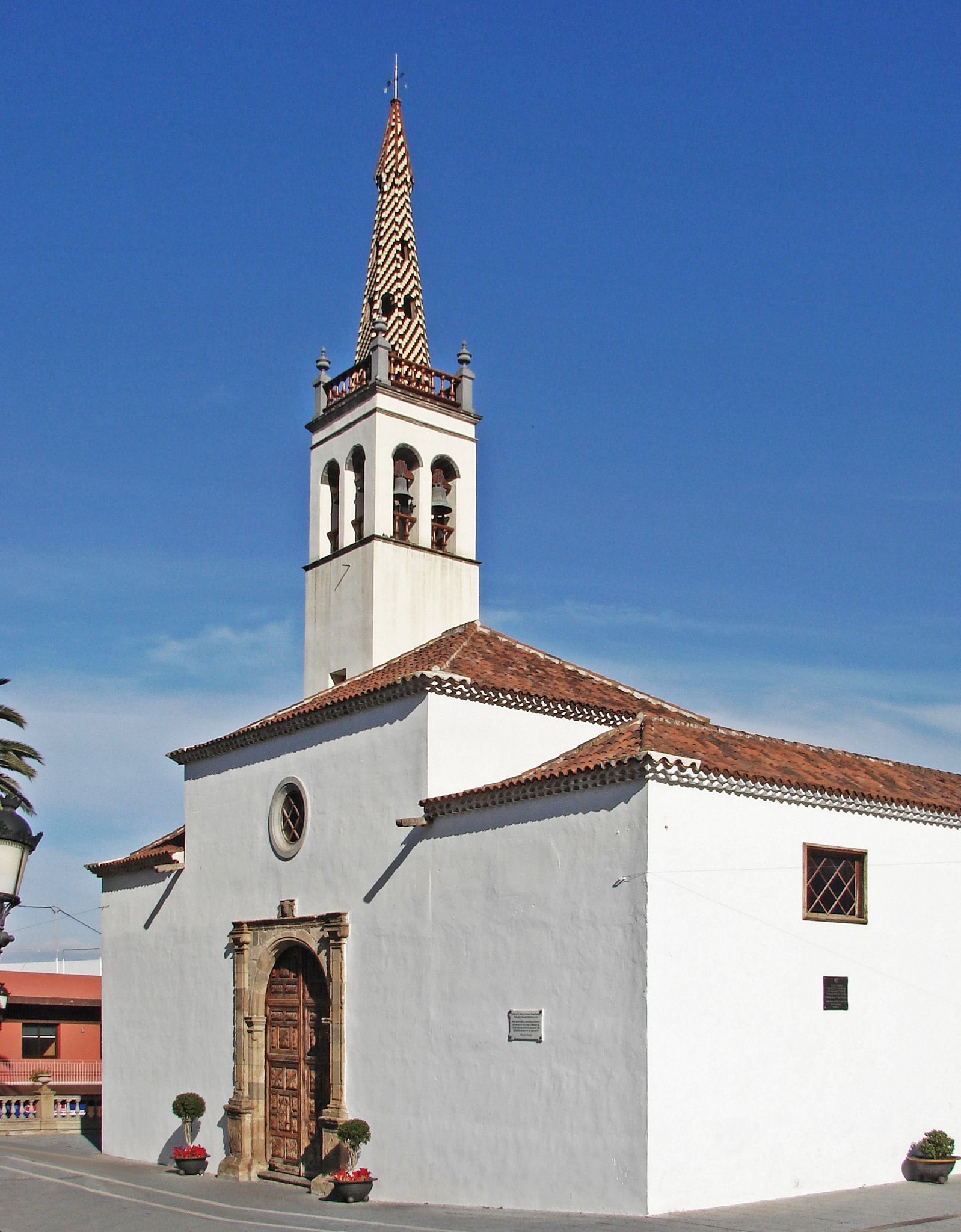
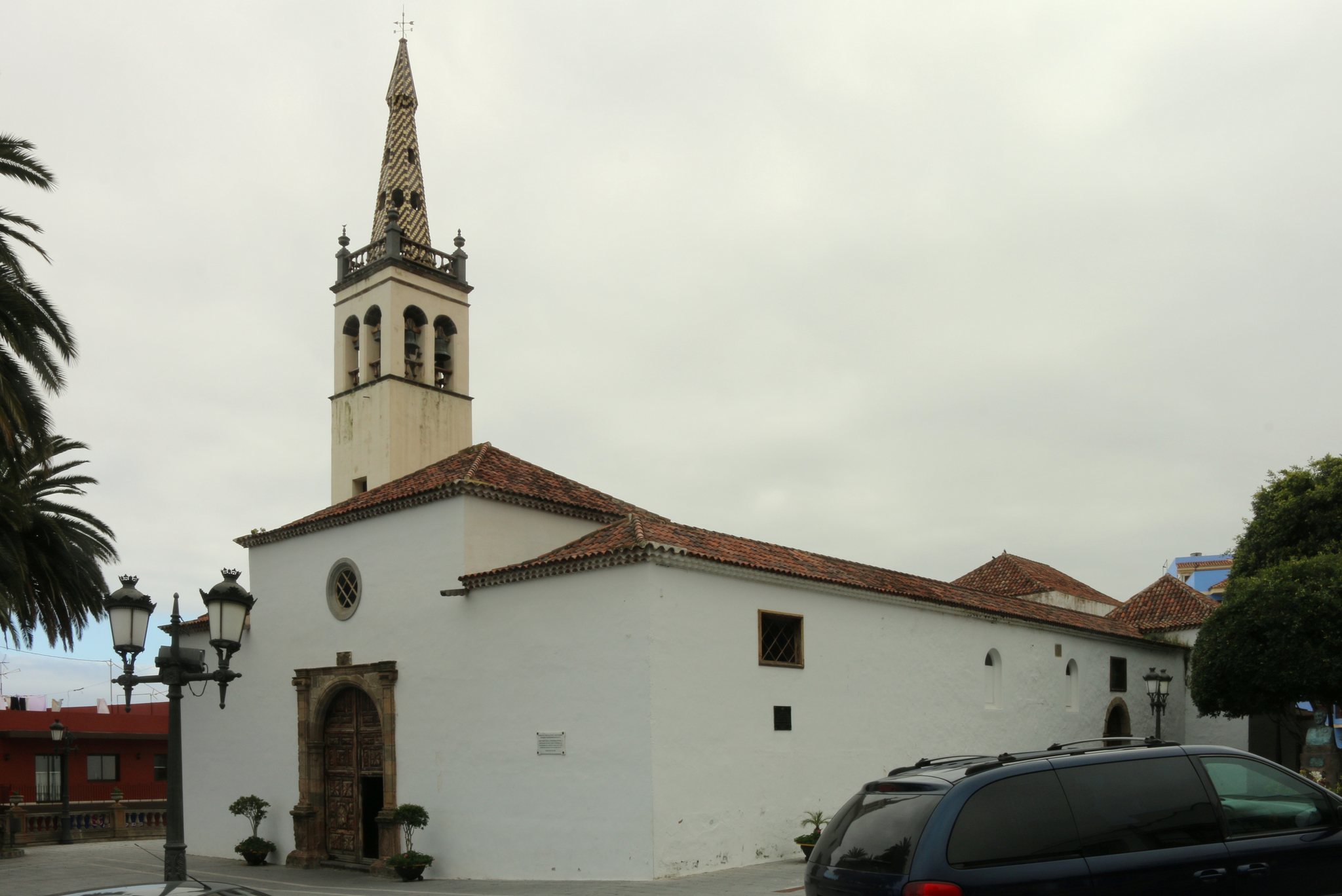
In 1774, steward Pedro González Regalado commissioned the present tower to replace the bell structure that had occupied the same position. Its spire, covered with ceramic scale tiles, became a distinctive feature of the Los Realejos landscape. A restoration carried out in 2005 and 2006 altered the tower toward its original appearance.
The building underwent substantial alteration during the twentieth century. In 1922, the original stone arches and columns were replaced with concrete because deterioration in the stone threatened the church. The replacements introduced Ionic-style capitals. During the 1960s, the western end was enlarged with three additional chapels. This work removed the wooden choir, its painted architectural decoration, the large entrance door, the barbusano-wood choir stalls, and a seventeenth-century organ.
The church was declared a National Historic-Artistic Monument by Royal Decree 598 on 2 February 1983. It is protected as a Site of Cultural Interest in the category of monument. Realejo Alto was separately declared a Site of Cultural Interest as a historic ensemble in 2014, and the church’s protection was also extended to associated movable property and its defined surroundings.
Devotional traditions and transferred images
The church’s collection developed through parish commissions, confraternities, and the transfer of works from religious institutions. A confraternity is a religious brotherhood organized around a shared devotion, charitable activity, or ritual responsibility. The parish was served by organizations including the Rosary, Mercy, Franciscan, and Holy Name brotherhoods, each of which supported particular images, chapels, ceremonies, or furnishings.
The image of Christ now associated with the Altar of Mercy came from the parish of Saint Francis of Assisi in Las Palmas de Gran Canaria after the nineteenth-century confiscation of ecclesiastical property. This process, commonly called disentailment, involved the seizure and sale or redistribution of Church possessions. At the request of Manuel Fragoso, Bishop Judas Tadeo José Romo y Gamboa arranged the transfer, and the image reached Los Realejos in 1846.
The image of the Dolorosa was transferred after the former Augustinian convent of Saint John the Baptist was confiscated. It had been deposited with José Albelo Ramírez, and beneficiaries Antonio Santos Barrios and Domingo Chávez secured its transfer to the parish in 1849. The Nazarene, commissioned in 1637 for the Franciscan Third Order at the convent church of Saint Lucy, entered the parish’s patrimony in 1856. It has had its own confraternity since 1991.
The former devotion to the Rosary declined after its confraternity ceased to exist. The image of Our Lady of Los Remedios was installed in its altarpiece in 1817. In 2007, Saint Veronica and Saint Mary Magdalene were moved from the Nazarene altarpiece to the Altar of Mercy, and two images from the Olot workshops were placed in the vacated side niches.
The parish’s dedication to Saint James and its devotional art remain linked to regional religious practice. The annual Regional Pilgrimage of Saint Isidore the Farmer takes place on the last Sunday of May in honor of the saint as protector of the agricultural workers of the comarca.
Remains
Plan and construction
The present church has three naves of equal height, each ending in a chapel. Additional side chapels open around the transept, and the western end contains three chapels added during the 1960s enlargement. Roofing timber came from Tigaiga, while roof tiles were made locally in Realejo. The combination of masonry construction, carved stone openings, and richly worked timber roofs reflects the successive building campaigns that shaped the church from the sixteenth through the eighteenth centuries.
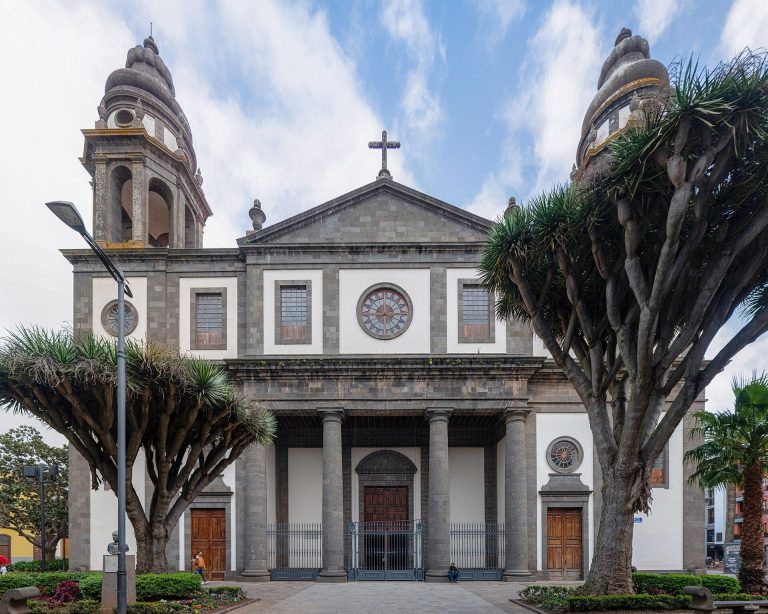
The 1570 principal doorway, carved by Juan Benítez, is now positioned in the north facade and gives access to the north nave. Known as the Jacobean Doorway, it is one of the clearest surviving elements associated with the earlier building. The present tower stands on the left side of the facade. Its ceramic-tiled spire provides a strong vertical feature, while the 2005 and 2006 restoration brought its appearance closer to the original form.
The main chapel has an elaborate wooden roof arranged in eight slopes. Latticework and an elongated central panel organize the design, with two pendants hanging from the central element. Andrés Gómez carried out the gilding and polychromy. The side-chapel roofs use a simpler version of the same conception. The nave roofs are inverted-trough constructions: the central nave has paired rafters with tie beams, while the side naves use paired rafters with a ridge beam and repeated decorative motifs on the ties.
The arches and columns now contain the concrete elements installed in 1922, when defective stone had caused serious deterioration. Their Ionic-style capitals belong to that intervention. The western extension of the 1960s added two lateral chapels equal in size to the side naves and a taller central chapel aligned with the central nave.
Altarpieces and devotional images
Main Altarpiece
The Main Altarpiece was completed in 1680 by Diego Díaz de Armas and Francisco Acosta Granadilla, using viñátigo and Canary Island pine. María de Puga, Andrés Gómez, and the Augustinian friar Miguel Lorenzo carried out its gilding and polychromy. Its present image of Saint James came from a convent in Puerto de la Cruz. It may originally have shown the apostle as a pilgrim, but remodeling in the 1920s at the Perdigón family workshops in La Orotava transformed it into a mounted figure on a white horse, holding a banner in the left hand and a silver sword in the right.
The altarpiece also contains an image of Saint Isidore the Farmer dated 1676. It is regarded as the earliest surviving representation of the saint on Tenerife. A small academic-scale image of Christ by José Luján Pérez, a prominent sculptor from Gran Canaria, was made to crown the tabernacle created for the Blessed Sacrament in the early nineteenth century. It is now kept outside liturgical use in one of the sacristies.
Altar of Our Lady of Los Remedios
The Altar of Our Lady of Los Remedios was built between 1680 and 1684 for the Rosary confraternity under the stewards Salvador Machado and Bartolomé Rodríguez. Its design belongs to the artistic orbit of Antonio Álvarez. The central niche originally held Our Lady of the Rosary, but the image of Our Lady of Los Remedios, attributed to the Canarian sculptor Fernando Estévez, was installed there in 1817. It replaced an older image recorded in 1591. That earlier image was later placed in the central niche of the Main Altarpiece.
The side niches contain nineteenth-century images of Saint Francis of Assisi and Saint Lucy, both transferred from the Convent of Saint Lucy. Paintings depicting the life of Saint James originally presided over the chancel. Part of this series survives in the Chapel of Los Remedios. Once attributed to the Antwerp school, the panels have more recently been associated with the Dutch painter known as the Master of Delft.
Altar of Souls
The Altar of Souls contains a principal canvas dating from around 1669, regarded as one of the oldest surviving works of its type in the Canary Islands. Pedro González Regalado acquired wood for its modification in 1776. The central niche holds an image of Saint Peter the Pope, made by Sebastián Fernández Méndez the Younger and paid for at 480 reales in 1757. Images of Saint Sebastian and Saint Michael the Archangel stand on either side.
Altar of Mercy
Antonio Álvarez made the Altar of Mercy in 1678. Its central niche is wider than the two side niches so that it can contain a Calvary scene. The central group now consists of Christ, Saint John the Evangelist, and the Dolorosa. Saint Veronica and Saint Mary Magdalene occupy the lateral niches. The lower section has been adapted to contain the Dead Christ in a gilded urn.
The image of Christ may originally have been an articulated crucifix used in Good Friday Descent-from-the-Cross ceremonies. The Dolorosa came from the former Augustinian convent of Saint John the Baptist. Saint Veronica may be the image of the Soledad acquired by Agustín García de Chaves in 1769, while Saint Mary Magdalene dates from the early twentieth century.
Altar of Saint Joseph
The small Altar of Saint Joseph was originally dedicated to Our Lady of the Immaculate Conception. Steward Antonio Romero financed it around 1680. Its sole niche contains an eighteenth-century image of Saint Joseph from the island’s sculptural tradition, possibly by José Rodríguez de la Oliva, who was both sculptor and painter.
Altar of Saint Barbara
Marcelo Fernández Vasconcelos financed the Altar of Saint Barbara during the second half of the eighteenth century. It is made of unpainted barbusano wood, and its central niche contains a gilded and polychromed image of Saint Barbara, recently attributed to the Sevillian sculptor Pedro Duque y Cornejo. A small image of Saint Andrew the Apostle has been attributed to Juan Bautista Vázquez the Younger. The altar also contains Saint Peter of Alcántara, a reformer of the Franciscan Order.
The former tabernacle houses an image of the Christ Child by Sebastián Fernández Méndez. The Brotherhood of the Holy Name paid 250 reales for it under the stewardship of Miguel Rodríguez de la Guardia.
Altar of the Nazarene
The Altar of the Nazarene came from the Convent of Saint Lucy, founded by the Franciscan Order in 1610. Its design belongs to the artistic orbit of Antonio Álvarez. The central niche contains the Nazarene, carved in 1637 by Martín de Andújar Cantos, a sculptor of Manchegan origin trained in Seville, for the Franciscan Third Order.
Saint Veronica and Saint Mary Magdalene formerly stood beside the central image. Their transfer to the Altar of Mercy in 2007 changed the arrangement of the altarpiece, whose lateral niches subsequently received two images from the Catalan Olot workshops.
Early inventory and surviving furnishings
An inventory from 1591 listed three principal altars. The main altar held Saint James as a pilgrim, while other principal images represented Bartholomew, Benedict, and Anthony of Padua. The inventory also mentioned Our Lady of Los Remedios, Saint Sebastian, Saint Michael the Archangel, paintings, numerous gold and silver objects, a wooden choir, an organ, and a pulpit. These references place the church’s devotional furnishings within a long process of acquisition, replacement, transfer, and adaptation that continues to shape its present interior.