Castillo de San Miguel: Coastal Defensive Tower in Garachico, Spain


Site at a Glance
- Rating
- 4.2
- Popularity
- Low
- Country
- Spain
- Primary era
- Early Modern
- Eras represented
- Early Modern
- Civilizations
- Crown of Castile, Spanish
- Site type
- Military
- Remains
- Fort
On this page7 sections
History
Castillo de San Miguel is a defensive tower on the coast of Garachico, Spain, built and enlarged during the sixteenth century to protect Tenerife’s most commercially active settlement and most used port from attacks by sea. Its position reflected Garachico’s importance as a maritime centre, where the need for coastal defence grew as fears of piracy spread through the Canary Islands.
Early defence and royal authorisation
The first bulwark of the later fortification probably existed by 1552, although the precise start of construction is unknown. In 1553, the French corsair François Le Clerc, known as “Peg Leg,” passed through Garachico before attacking Santa Cruz de la Palma. The assault looted and burned the settlement, intensifying concern about piracy and prompting renewed efforts to strengthen Garachico’s coastal protection.
After the attack, the Cabildo of Tenerife, the island’s elected governing body, petitioned the Crown to continue and enlarge the fortification. Permission for a larger and better-equipped fortress came in 1575, during the reign of Philip II, the Spanish king from 1556 to 1598. The authorisation was issued as a royal decree containing instructions prepared by Francés de Alava, the captain general of artillery.
Construction and administration
The enlargement was entrusted to Fabián Viña Negrón, a corregidor, meaning a Crown-appointed municipal official. He paid part of the costs and in return received the lifelong office of alcaide, the governor or commander of the fortress, together with hereditary rights for his successors. Disputes among his relatives over control of the office had already begun before his death.
Construction took place between 1575 and 1577. Additional work and the supply of weapons continued despite disagreements over the fortress’s administration, and the successive building works were regarded as complete in 1587, apart from minor later reforms. The tower remained in use as a military installation until 1878.
Loss of the port and later role
The fortress’s defensive purpose ended after the 1706 eruption of the Garachico volcano, known as Arenas Negras. The eruption buried part of the town and the roadstead, the sheltered coastal water where vessels could anchor. The castle itself was not damaged, but the disappearance of the port reduced Garachico’s importance and made the fortification militarily unnecessary.
Castillo de San Miguel is municipally owned and now operates as a Heritage Information Centre within the Cabildo of Tenerife’s museum network, with an exhibition function. Spain has protected it as an Asset of Cultural Interest in the monument category since 1985, and its protected surroundings were delimited in 1999.
Remains
The defensive tower
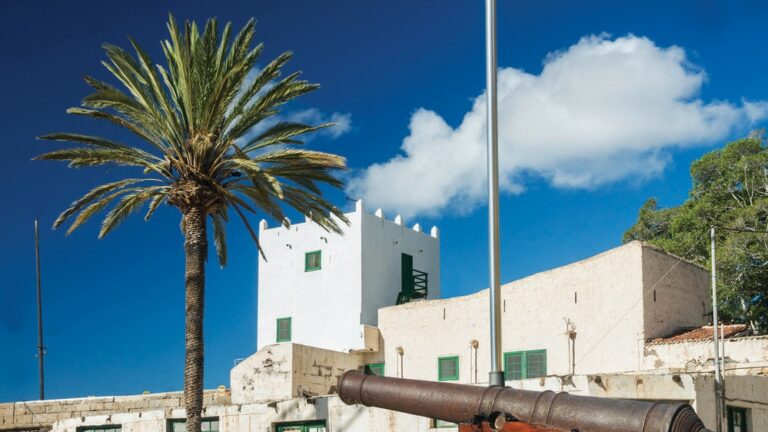
Castillo de San Miguel is a compact defensive tower with an approximately square plan, each side measuring about 50 feet. Its only entrance is on the southern side. On the opposite side, a parapet, or low protective wall along the edge of a fortification, was finished with crenellations, the alternating raised sections and openings used along such walls. The parapet ended in two garitones, small projecting defensive structures attached to a fortified wall or tower.
The interior was divided into two spacious rooms. Barrel vaults, continuous curved ceilings formed by extending an arch along the length of a room, covered most of both spaces. The first room contained the staircase to the upper platform, while the second included a kitchen and other service areas. Above the vaulted rooms, a platform served as the arms platform, where artillery was deployed during wartime.
Artillery and lower platform
The tower’s weapons increased as the fortification was enlarged. One artillery piece was recorded in 1552, while an inventory from 1589 listed seven iron artillery pieces, five cast-iron pieces, and three field cannon. These weapons equipped the upper platform for the defence of Garachico’s coastal approach.
An additional artillery platform stood at the foot of the castle. It may have been protected by minor defensive works, although the exact arrangement of this lower position is uncertain.
Nearby sites