Kosugimaruyama Site: An Early Pottery-Production Center in Japan
Site at a Glance
- Rating
- 3.8
- Popularity
- Very Low
- Country
- Japan
- Primary era
- Medieval
- External website
- Open
- Eras represented
- Medieval
- Civilizations
- Yamato
- Site type
- Economic
- Remains
- Production Complex
On this page8 sections
History
Kosugimaruyama Site in Japan is the remains of a pottery-production center established in the late seventh century during the late Asuka period. The Asuka period was an era marked by the spread of Buddhism, the growth of centralized imperial government, and the construction of new temples and administrative buildings. Kosugimaruyama is among the earliest known production centers of its type in the Hokuriku region.
Late Asuka Production
The site produced Sue ware, a high-fired Japanese stoneware, together with cylindrical and flat roof tiles. Roof tiles of this kind were used mainly for Buddhist temples and major government buildings, so their manufacture at Kosugimaruyama reflects the influence of the central imperial government and the spread of Buddhism during the Asuka period.
Nara-Period Ironworking
An ironworking workshop operated at Kosugimaruyama during the Nara period, which followed the Asuka period and saw the development of a more formally centralized state centered on the imperial capital at Nara. This later activity added iron production to the site’s earlier ceramic industry.
Excavation and Protection
The site was first excavated in 1982, after plans for an industrial park brought the remains to attention. Kosugimaruyama has been designated a National Historic Site of Japan since 1990.
Remains
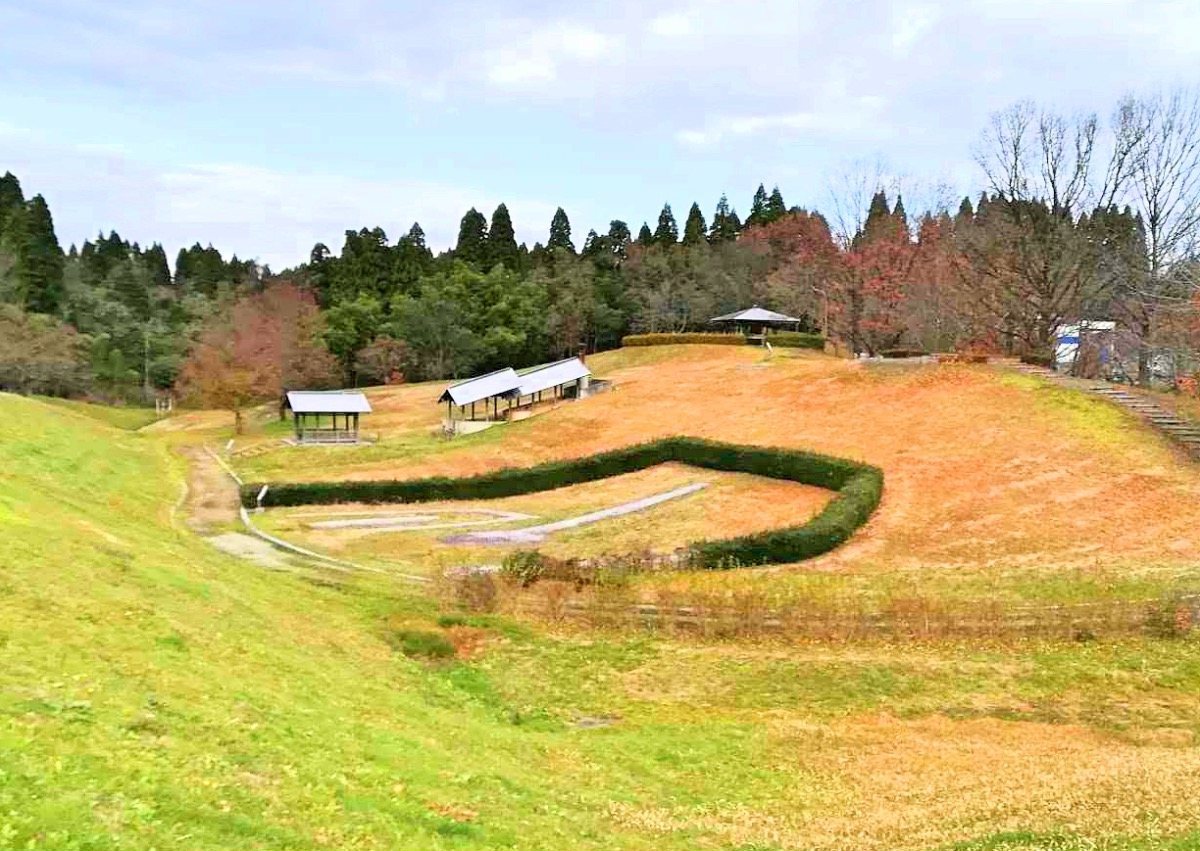
The site covers approximately 32,432 square meters in the Aoidani area of Imizu, in the southwestern part of the Imizu Hills and west of the Toyama Plain. Its surviving remains include production areas, clay-extraction ditches, firing installations, and worker housing, forming the physical setting of an early industrial settlement.
Kilns and Workshops
At least five kilns and associated workshops survive within the site. They were used to fire Sue ware pottery and cylindrical and flat roof tiles, and numerous fragments of pottery and tiles have been found across the area. Several anagama kilns, long, sloping wood-fired tunnel kilns, have been reconstructed.
Worker Housing
At least 24 semi-subterranean pit dwellings are preserved. These buildings are believed to have served as residences for workers at the production center, while nearby clay-extraction ditches supplied material for its ceramic manufacture.
Reconstructed Facilities
Several buildings have been reconstructed alongside the kilns. The site also includes the Asuka Craftsmen House, a museum connected with the remains and their craft-production history.