Masuyama Castle: A Mountain Stronghold in Toyama, Japan
Site at a Glance
- Rating
- 4.3
- Popularity
- Very Low
- Country
- Japan
- Primary era
- Medieval
- External website
- Open
- Eras represented
- Medieval
- Civilizations
- Ashikaga shogunate
- Site type
- Military
- Remains
- Castle
On this page9 sections
History
Masuyama Castle is a Japanese mountain castle in Tonami, Toyama Prefecture, built as a yamashiro during the late fourteenth century. It controlled an inland route between the Tonami and Toyama plains, near the former boundaries of Etchu Province’s Tonami, Imizu, and Nei districts. Along with Matsukura Castle and Moriyama Castle, it was regarded as one of Etchu’s three major mountain castles.
Wada Castle and the Jinbo clan
The fortress was known as Wada Castle in the Ninomiya En’a Military Service Document of 1363, a medieval record submitted by a warrior to report military service and support a later claim for reward. Its foundation is also placed broadly in the late fourteenth century and attributed to Momonoi Naotsune, the shugo, or military governor, of Etchu. The precise circumstances of this early foundation remain uncertain.
Momonoi later rebelled against the Ashikaga shogunate, the military government that ruled Japan during the Muromachi period. A shogunal army seized the castle and awarded it to the Ninomiya clan. The stronghold then appears to have fallen out of use before being rebuilt in the fifteenth century as an important Jinbo clan base. The Jinbo were retainers of the Hatakeyama clan, whose authority weakened toward the end of that century and allowed the Jinbo to expand across Etchu.
Jinbo Yoshimune attempted to cooperate with the Ikkō-ikki, leagues of armed followers associated with the Jodo Shinshu Buddhist movement and local landholding communities, in order to establish an independent position. Hatakeyama and Uesugi forces defeated him. His son, Jinbo Nagatomo, later overcame the rival Shiina clan and unified much of the province. After Toyama Castle became the Jinbo base, Masuyama continued as an important secondary center.
Conflict in the Sengoku period
The castle stood amid the sustained warfare among regional powers that characterized Japan’s Sengoku period. In 1506, Nagao Kageyoshi was killed while confronting Ikkō-ikki forces at the Battle of Seritani, also called the Battle of Hannyano. The Jinbo position later came under direct pressure from Uesugi Kenshin. After Kenshin captured Toyama Castle in 1560, Jinbo Nagatomo withdrew to Masuyama.
Kenshin’s correspondence describes Masuyama as a difficult and strongly defended position. Nagatomo surrendered to the Uesugi in 1562 after Kenshin attacked the castle again. Masuyama subsequently became the principal base of the Jinbo clan. Members opposed to Uesugi rule allied with Ikkō-ikki forces and continued the resistance. Fighting involving the Jinbo and Ikkō-ikki took place around the castle in 1568, and Ikkō-ikki forces occupied it in 1572.
Uesugi Kenshin captured Masuyama in 1576. Two years later, during the Otate Disturbance, the Uesugi succession conflict that followed Kenshin’s death, Uesugi Kagekatsu’s commander Yoshie Munenobu defended the castle. Oda forces captured and burned Masuyama and its castle town in 1581, bringing another destructive phase to the fortress’s history.
Restoration, Maeda administration, and abandonment
Sassa Narimasa subsequently restored or substantially repaired Masuyama during the 1580s. He installed senior retainers there, including Sassa Heizaemon and Sassa Genroku Katsuyuki, together with his mounted personal guards. Narimasa pacified Etchu in 1583, but Toyotomi Hideyoshi invaded the province in 1585 and forced his surrender. Masuyama then passed to the Maeda clan.
Nakagawa Mitsushige and, later, members of the Yamazaki family served as castle deputies under Maeda authority. In 1586, Uesugi Kagekatsu received hospitality from Nakagawa Mitsushige at Nakata while traveling to Kyoto. Masuyama was abandoned in the early seventeenth century, probably around 1610 to 1615, in connection with the Tokugawa shogunate’s one-castle-per-domain policy. This restriction led to the abandonment or demolition of many castles after centralized shogunal rule was established.
The ruins and roughly five hectares surrounding them opened as Masuyama Castle Ruins Park in 1976. Tonami municipal investigations included test excavations between 1997 and 2003 and a full-scale investigation of remains at Hokkebo Pass in 2002. Excavations also examined Kameyama Castle’s main enclosure and residential compounds. Masuyama was designated a National Historic Site of Japan in 2009 and selected for the Continued Top 100 Japanese Castles in 2017.
Remains
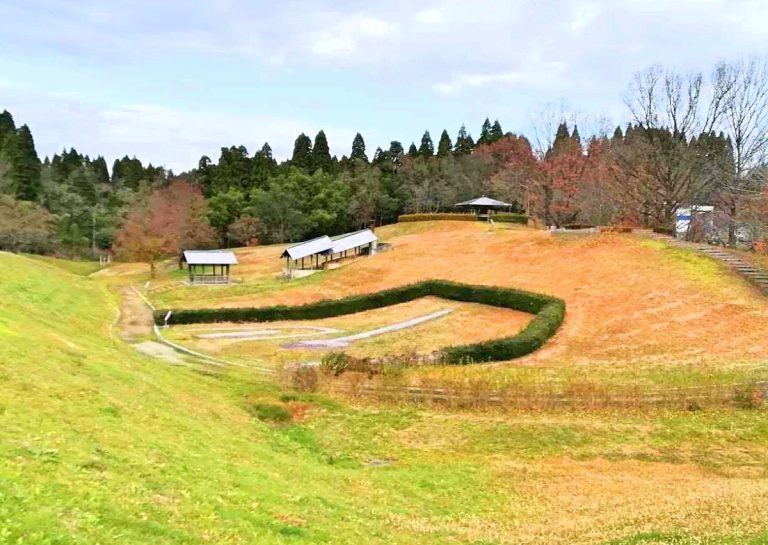
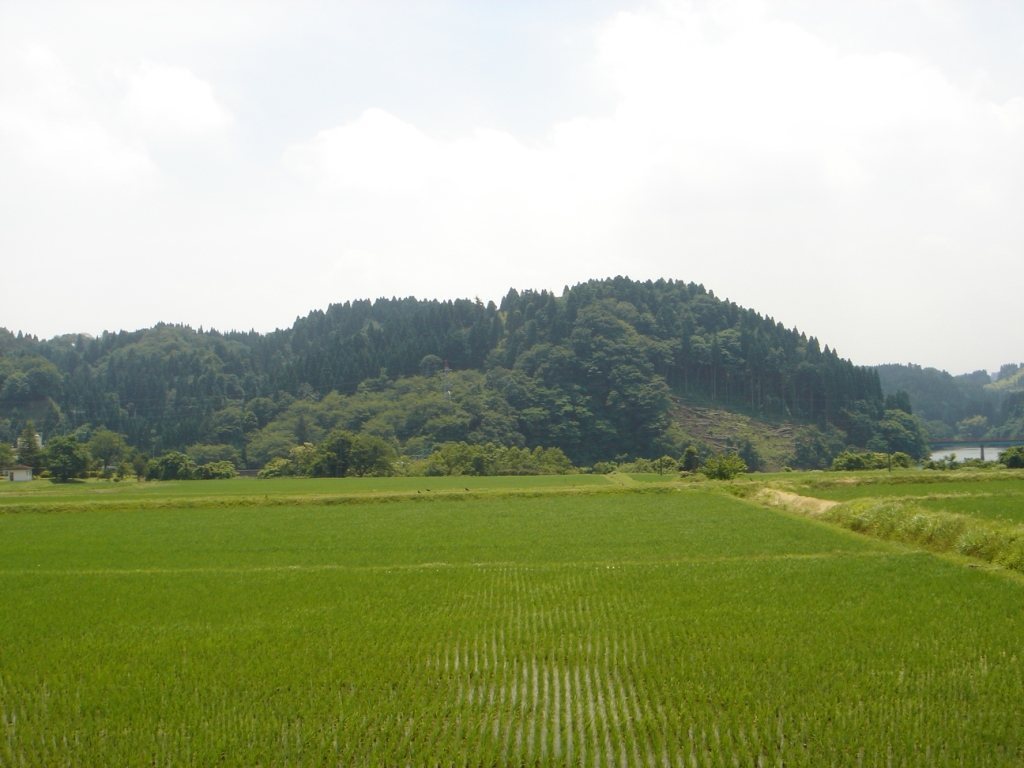
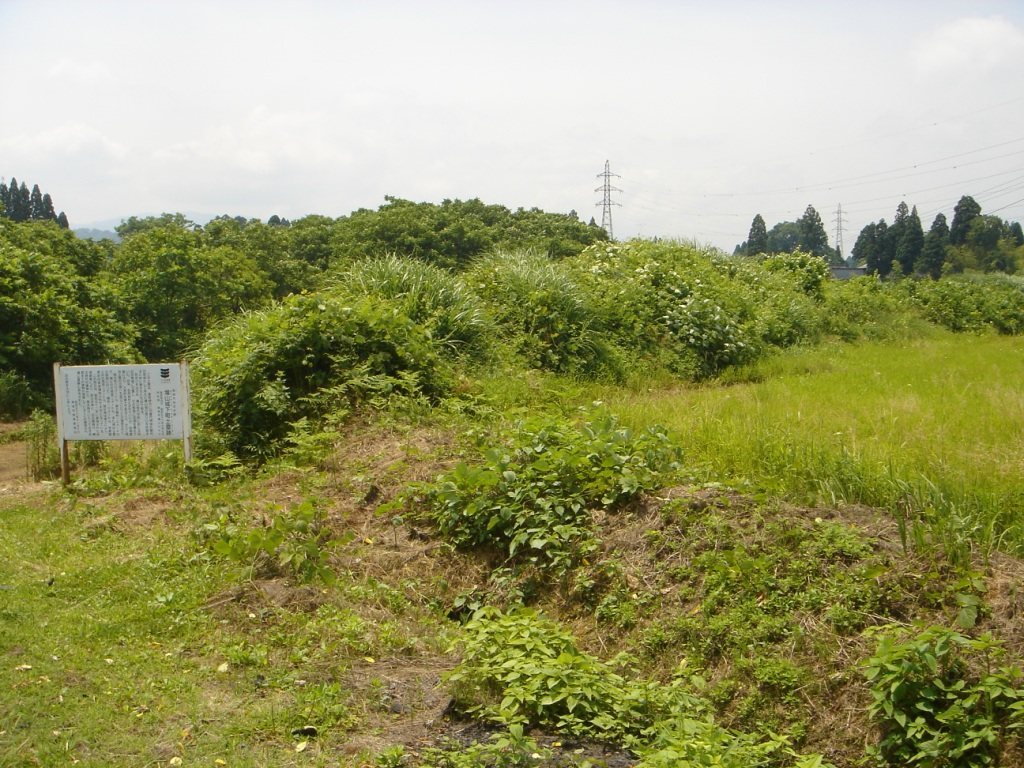
Masuyama was built on the right bank of the Wada River, on a hill rising approximately 120 meters above its surroundings. Its connected-enclosure layout extended about 1,000 meters from end to end and about 500 meters across, making it one of the largest mountain castles in the Hokuriku region. The defensive system used separated enclosures, artificially steepened slopes, vertical dry moats, cross-moats, stone walls, earthen ramparts, wells, and stone bases for flag platforms. The buildings have been lost, while sections of the dry moats and earthen rampart lines survive.
Upper fortifications
Kameyama Castle
Kameyama Castle formed part of the wider Masuyama complex and occupied its highest ground. Its main enclosure contains a triangulation point at an elevation of 133.1 meters. A tradition associates the area with the presence of a deputy of Emperor Kameyama, while an Edo-period record says that Masuyama took its name from an older Kameyama Castle. Excavations have left the relationship and relative chronology of the two fortifications uncertain.
Northern fortification
Another component of the complex occupied the northern side below adjacent Kameyama Castle. Its highest point reaches 127.8 meters. The fortification consisted mainly of eastern and western enclosure groups, with two long dry moats cut into its eastern slope.
Castle town and routes
The castle town stood across the Wada River on the western side of the fortress. A clay rampart separated the settlement from the castle, and traces of the former settlement survive together with temple mounds. Place-names preserve associations with residential areas, temples, boundaries, and the production of firearms. The lower-town area was submerged by Masuyama Lake after the Wada River Dam was built in 1967.
An internal route encircled the castle, passing through valleys, a former riding-ground area, and several enclosure zones before joining the outer route. The outer route also marked the boundary between the former Tonami and Imizu districts and extended toward the former Nei, Imizu, and Tonami areas. Together, these surviving lines and spatial features show how the mountain fortress was organized across its elevated ground and connected approaches.