Keta Shrine: An Ancient Shinto Sanctuary and Provincial Shrine in Japan
Site at a Glance
- Rating
- 4.2
- Popularity
- Low
- Country
- Japan
- Primary era
- Medieval
- External website
- Open
- Eras represented
- Medieval
- Civilizations
- Ashikaga shogunate
- Site type
- Religious
- Remains
- Sanctuary
On this page17 sections
History
Keta Shrine is a Shinto sanctuary in Takaoka, Toyama, Japan, traditionally founded in the early eighth century and centered on the kami Ōkuninushi and Nunakawa-hime-no-mikoto. Its main sanctuary preserves features of Muromachi-period shrine architecture in the nagare-zukuri style, whose gabled roof extends forward to create a covered worship space. The shrine became associated with the former Etchū Province and maintained a long-standing claim to be its ichinomiya, the highest-ranking shrine recognized within a historical province.
Foundation and provincial status
The foundation date of Keta Shrine remains uncertain. Shrine tradition places it in 717, while other traditions give 718 or around 757. The later date has been connected with the changing boundaries of Noto and Etchū. Noto was separated from Etchū in 718, incorporated into it in 741, and separated again in 757. During this process, a shrine may have been established near the provincial capital after receiving a divided spirit from Keta Taisha in Noto. The new sanctuary was reportedly called Shinketa Myōjin, meaning “New Keta Shrine.”
Several traditions offer different explanations for the shrine’s beginnings. It may have served as a nearer place of worship for Keta Taisha because that sanctuary was distant from the Etchū provincial government. Another interpretation regards it as an independent sanctuary for a local wind deity. A further tradition attributes its foundation to the Buddhist monk Gyōki in 718, although this claim has no corroborating evidence.
Keta Shrine stands near the former Etchū provincial capital, the provincial Buddhist temple known as the Etchū Kokubunji, and the traditional site of the provincial Sōja. A Sōja was a shrine or worship center for the collective veneration of a province’s principal kami. This setting supported Keta Shrine’s claim to be the Etchū ichinomiya. Imizu Shrine, Takase Shrine, and Tateyama Shrine also claimed that rank, and the rivalry between Keta Shrine and Imizu Shrine remained unresolved for centuries. Some interpretations consider Keta Shrine’s claim especially strong because the surrounding place name contains “Ichinomiya.”
Early records and religious rank
The shrine first appears in a record associated with the Engishiki in 908, when the Keta deity of Etchū received imperial offerings. The Engishiki was a tenth-century compilation of court regulations and officially recognized shrines. In the shrine register compiled in 927, Keta Shrine appears as the thirteenth and final shrine listed for Imizu District. This position has been interpreted as an indication that it was the district’s most recently founded shrine.
The shrine’s historical rank was understood in different ways. Manuscripts of the Engishiki describe it as a Myōjin-taisha, a major shrine whose deity held especially high esteem, while another manuscript identifies Imizu Shrine as the district’s major shrine. Keta Shrine was also described as the Etchū ichinomiya. Under the former modern shrine-ranking system, it became a prefectural shrine in August 1873 and was designated in March 1907 as a shrine entitled to receive state offerings of food and cloth.
A headnote connected with the Engishiki records the elevation of a Keta deity to the senior third court rank in 784. This reference is understood to concern Keta Taisha rather than Keta Shrine. The shrine’s later prominence therefore developed through its regional position, traditions, and institutional associations as well as through early court recognition.
Ōtomo no Yakamochi, the governor of Etchū while Noto was incorporated into the province, visited Keta Taisha during an official inspection in 748 and composed a poem later included in the Man’yōshū, Japan’s earliest surviving anthology of poetry. The shrine near the provincial capital is not mentioned in connection with that visit, a point used to suggest that Keta Shrine may not yet have existed at the time.
In 1080, the Jingikan ordered a purification rite at Keta Shrine after ritual pollution was believed to have brought divine retribution. The Jingikan was the classical institution responsible for state rites and shrine administration. Imperial offerings to Keta Shrine are also recorded for 940, 1081, 1141, and 1180.
Warfare and reconstruction
Religious buildings around Keta Shrine were burned during the campaigns of Kiso Yoshinaka in the late Juei era, around 1182 to 1185. Yoshinaka was a prominent warrior in the late twelfth-century Genpei War. The complex was rebuilt after the fires, but suffered further destruction during the Tenbun-era wars from 1532 to 1555. The later destruction was traditionally attributed to forces associated with Uesugi Kenshin, a powerful warlord whose armies operated across the Hokuriku region.
By the Tenbun era, the surrounding religious complex had been reduced from many Buddhist temple buildings to one shrine and one temple. The shrine was rebuilt or restored during the Eiroku and Genki eras, from 1558 to 1573. One tradition credits the work to Yuo, a monk of Keikōji, who collected donations. Another holds that the main shrine building survived the Tenbun fires and predates that reconstruction.
Buddhist institutions and the Maeda family
Keikōji formerly served as Keta Shrine’s bettōji, a Buddhist temple responsible for administering a Shinto shrine. The Kujō family may have governed the shrine through Hōjōji, a subordinate temple. The southern and northern valleys around the sanctuary once contained 49 temples and monastic buildings. Most were destroyed during the Tenbun wars. Tokushōji later joined the Ikkō sect, while Aizen-in eventually declined.
Keikōji’s abbot died in 1657, after which a caretaker administered the temple until Yugen of Aizen-in revived it in 1689. Thirteen abbots, including Yugen, subsequently served as bettō until the Meiji period. Keta Shrine also functioned as one of the scripture halls used by the Sixty-Six Provinces pilgrimage movement, a nationwide religious practice in which pilgrims carried Buddhist scriptures from province to province. Keikōji received the scriptures brought by these pilgrims.
The Maeda family, rulers of the Kaga domain, patronized both Keta Shrine and Keikōji. Maeda Toshiie reportedly ordered prayers at the sanctuary. Maeda Toshinaga donated the Miyabayashi temple estate in 1597, although a land survey in 1605 confiscated the estate and left the religious buildings seriously damaged. In 1645, Maeda Toshitsune rebuilt or repaired the shrine buildings. In 1650, he donated ten koku of rice land so that prayers could be offered for his grandson, Maeda Tsunanori.
Separation of Buddhism and Shinto
The separation of Buddhism and Shinto in 1868 ended the institutional relationship between Keta Shrine and Keikōji. Hōkai, Keikōji’s thirteenth abbot, adopted a secular name and later served at temples elsewhere. His disciple entered the Ōe family and became a Shinto priest. Keikōji was later abolished, and its former site became the shrine office and residence of the Ōe priestly family. Buddhist images associated with the shrine and Keikōji’s principal image, Dainichi Nyorai, were transferred to the Yakushidō at the former Etchū Kokubunji area. The shrine’s Buddhist associations included Manjushri, Jizo, and Bishamonten.
The Ozaki priestly family is said to have descended from the Sakurai family of Keta Taisha. During the Tenbun wars, its members took refuge at Ozaki-yama in Shimao, about four kilometers northwest of the shrine, and continued serving local shrines there. They returned to Fushiki during the Tenpō era. After the Second World War, the Ozaki family left Keta Shrine, and the Ōe family assumed the chief-priestly office.
Modern continuity and festivals
In 1937, Ugajinja, Atagojinja, Suijinja, and Shinmeijinja were merged into Keta Shrine. Their associated deities were Ōkuninushi and another deity at Ugajinja, Kagutsuchi at Atagojinja, Mizuhanome at Suijinja, and Amaterasu at Shinmeijinja. The shrine’s main sanctuary was dismantled for repairs in 1950, and its roof was reroofed with wooden shingles in 1970. Ōtomo Shrine was built within the precincts in 1985.
Keta Shrine’s main festival takes place each year on April 18. The spring celebration, locally called the Dago Festival, includes offerings of red-bean rice cakes, a procession from the shrine office to the worship hall, offerings at the main sanctuary, a portable shrine procession, and the performance known as the “Glowering Lion.” An older spring rite called Yamayuki involved going to the rear mountain to welcome the mountain deity to fields and households. It continued until the early Shōwa period.
The “Glowering Lion” moves slowly to flute and drum music. It first turns toward the outside and then toward the sanctuary, and its gaze is understood as a form of purification that drives away evil. After the shrine performance, the lion visits parishioners’ homes, especially those marking auspicious occasions, where it dances to long-bodied drums and flutes. The rite became a Takaoka municipal intangible folk cultural property in 1996. The procession of the ritual offering envoy, which had been absent for about thirty years, resumed in 2022.
Remains
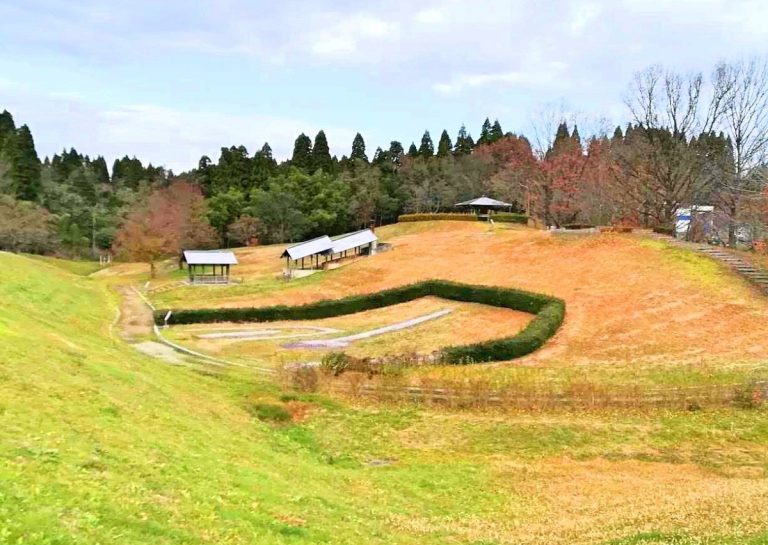
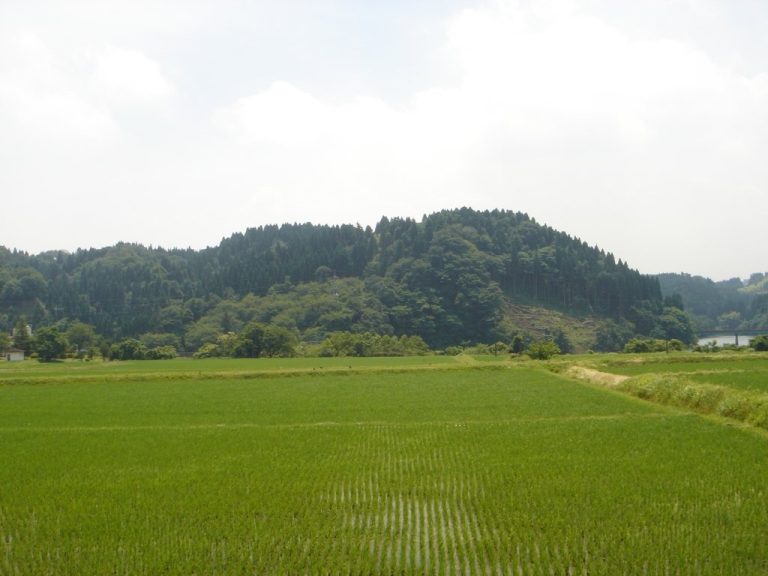
Keta Shrine occupies Ariake-no-oka, a hill about 70 meters high on Ichinomiya-yama, between the eastern hills of Mount Futagami and the plain. The precinct covers approximately 2,952 tsubo, about 9,759 square meters, and its principal buildings face southeast. The hill lies near the former centers of provincial administration and worship, with the Etchū Kokubunji area about 500 meters to the southeast and the ruins of the Etchū provincial capital about one kilometer away.
Approach and precinct
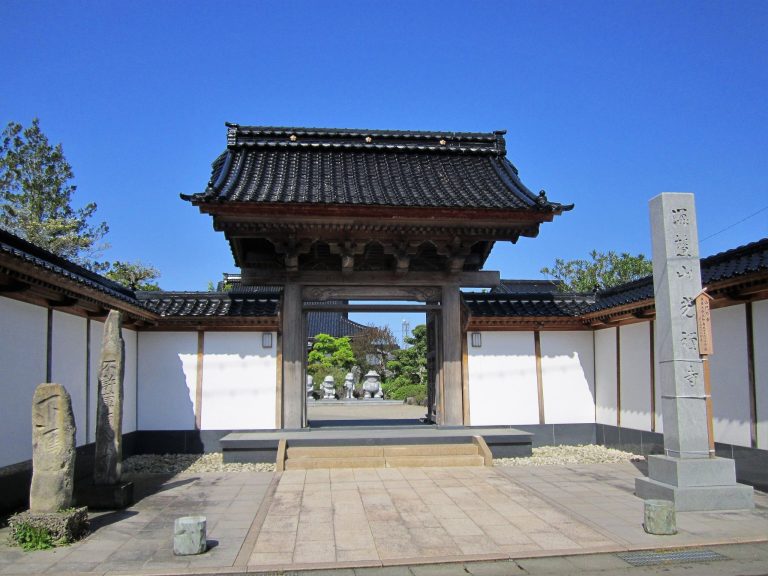
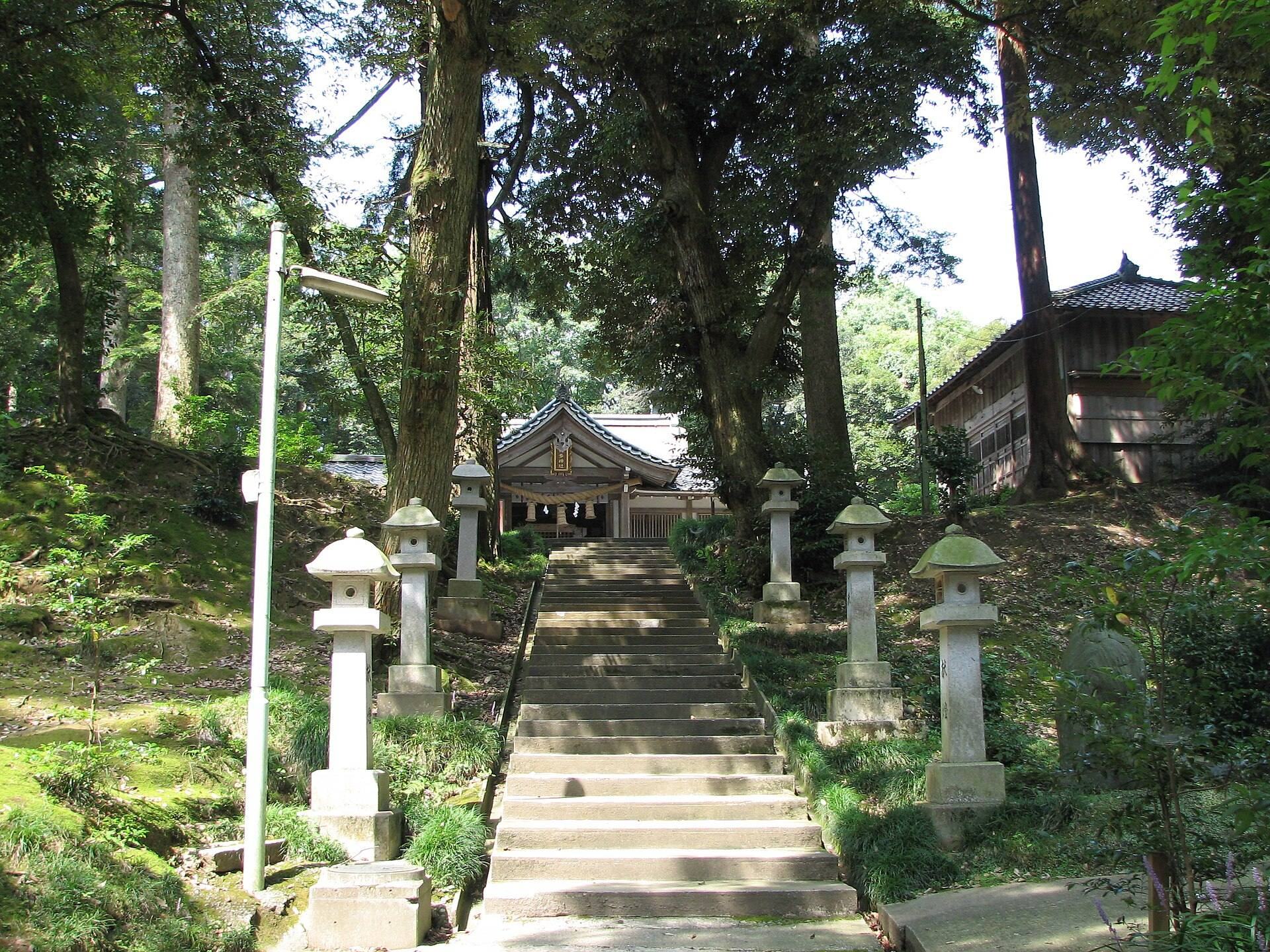
A stone marker reading “Prefectural Shrine Keta Shrine” stands at the junction of Jikken Road and Yotsuji Road. Erected in 1935, it was made by Ichijo Sanetaka. From this entrance, the approximately 700-meter approach passes through residential areas and the Etchū Kokubunji area before rising into the hills. The route includes about 70 stone steps, a stone torii gate marking the shrine approach, approximately 150 meters of further approach, and another flight of about 30 stone steps.
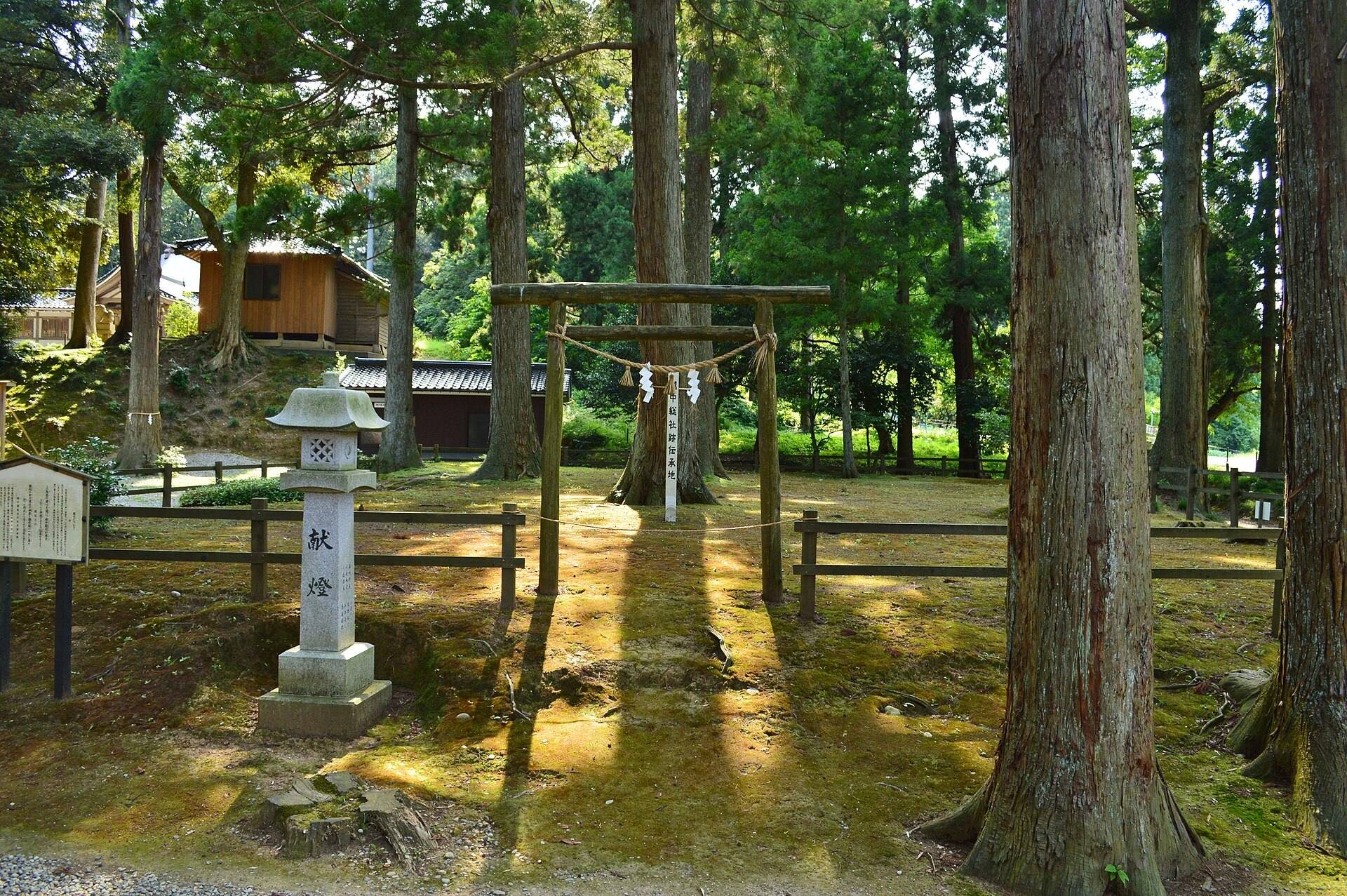
The precinct contains stone lanterns dedicated in 1890 and 1968, two smaller lanterns, and guardian dogs dedicated in 1933. It also includes the traditional site of the Etchū provincial Sōja and a stone monument to Ōtomo no Yakamochi erected in 1963. The monument stands 2.7 meters high and bears one of Yakamochi’s poems from the Man’yōshū.
Main shrine buildings
Honden
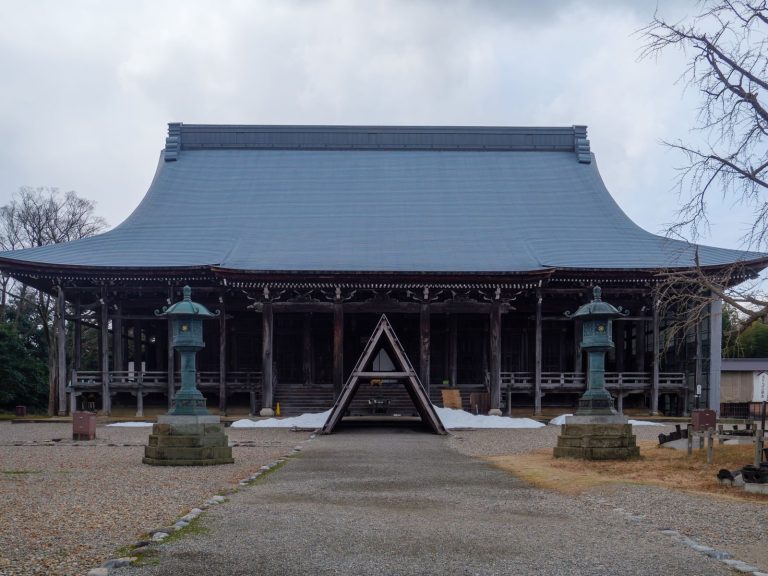
The honden, or main sanctuary where the principal kami are enshrined, is a three-bay nagare-zukuri building. It measures approximately 9.6 meters in length, 7.2 meters across the front, and 9.4 meters in height. Its roof is covered with thin wooden shingles. The building is divided into an inner sanctuary, an outer sanctuary, and a corridor, and has a single projecting front worship porch, a veranda on three sides, and high railings.
The sanctuary’s large structural proportions and its treatment of the rainbow beams, fist-shaped nose carvings, and triangular support boards retain features associated with Muromachi-period shrine architecture. It was designated a former National Treasure on January 19, 1931, and is now an Important Cultural Property. The building was dismantled for repairs in 1950, and its roof received wooden shingles in 1970.
Haiden
The haiden, or worship hall used for ritual observance, stands in front of the honden. It measures three and a half bays in length and two bays in width. Wing corridors extend from both sides, forming the principal worship space before the sanctuary.
Former worship hall and shrine office
A storehouse in the southwestern part of the precinct is the former worship hall. It was moved to its present position in 1952 and measures three bays in length and four and a half bays across its front. The shrine office stands in woodland to the left of the approach. It occupies the former site of Keikōji and also served as the residence of the Ōe priestly family.
Images and ritual remains
Guardian dogs
The honden contains a wooden pair of komainu, guardian-lion sculptures traditionally placed at Shinto shrines. The figures measure 88 and 92 centimeters in height and are traditionally attributed to the sculptor Unkei. They became Takaoka municipal tangible cultural properties in 1961.
Glowering Lion
The “Glowering Lion” is performed with a centipede-style lion dance costume. The performers who form its body wear indigo-dyed clothing, while the performer carrying the head wears traditional trousers. The form is distinctive because it does not include a tengu figure. Its slow movement, turning sequence, music, and visits to parishioners’ homes preserve a ritual centered on the lion’s evil-averting gaze.
Associated shrine
Ōtomo Shrine was constructed within the Keta Shrine precincts in 1985. It stands among the buildings and commemorative features that connect the modern sanctuary with the historical memory of Ōtomo no Yakamochi and the former Etchū provincial religious landscape.