Shōkō-ji Temple: A Honganji Jōdo Shinshū Temple in Takaoka, Japan


Site at a Glance
- Rating
- 4.3
- Popularity
- Low
- Country
- Japan
- Primary era
- Early Modern
- External website
- Open
- Eras represented
- Early Modern
- Civilizations
- Tokugawa
- Site type
- Religious
- Remains
- Monastery
On this page10 sections
History
Shōkō-ji Temple is a Buddhist temple in Takaoka, Japan, belonging to the Honganji branch of Jōdo Shinshū, a Japanese Buddhist tradition centered on reliance on Amida Buddha and rebirth in the Pure Land. It originated in 1471, when Rennyo, a major fifteenth-century leader who expanded the Honganji religious network, founded Tsuchiyama Gobō in Tsuchiyama, in the former Kanitani Estate of Etchū Province. His fourth son, Rensei, became the institution’s first religious head there.
Foundation and Relocations
In 1494, the institution moved within the former Kanitani Estate to Takakoba Gobō. After fire destroyed it, the temple was revived in 1517 under the name Shōkō-ji. That name had previously belonged to a prayer temple associated with Emperor Juntoku on Sado Island. Two years later, Shōkō-ji moved again, this time to Anyōji Village. Rensei’s second son, Jitsugen, built Anyōji Castle at the new location.
The Sengoku Period
During the Sengoku period, an era of prolonged warfare and competing regional powers conventionally dated from the fifteenth to the late sixteenth century, Shōkō-ji and Zuisen-ji became principal centers of the Etchū Ikkō uprisings. These movements involved followers of Jōdo Shinshū and allied local communities, and could exercise religious, military, and political influence. In 1581, while the temple was under its fifth head, Ishiguro Naritsuna attacked and burned Shōkō-ji.
In 1584, Sassa Narimasa donated the site of Furukokufu Castle to the Etchū Ikkō movement, and Shōkō-ji’s fifth head moved the temple there. This relocation established the site of the present temple. After Sassa Narimasa was defeated in the Toyama campaign, the surrounding region came under Maeda Toshiie. Shōkō-ji then received the protection of the Maeda family, rulers of the Kaga domain. On December 21, 1618, Maeda Toshitsune increased the temple’s estate by 25 koku, a historical measure of agricultural production and assigned revenue rather than simply land area.
Religious Life and Modern Recognition
Maeda Harunaga, the tenth lord of the Kaga domain, entered the clergy temporarily in his youth and received ordination at Shōkō-ji before succeeding to the lordship. The temple also held doctrinal discussions during its annual Hōonkō observance, a Jōdo Shinshū commemoration of the tradition’s founder that includes services and religious teaching. Priests and lay followers once questioned one another about belief and doctrine. The discussions later ended as the quality of preaching declined, and attendance fell. A large candle traditionally lit during Hōonkō continues to be maintained as a distinctive feature of the temple.
A major restoration campaign began in 1998 with government assistance and sought to return the complex toward its Edo-period appearance. Severely deteriorated sections were repaired through partial disassembly, a process in which parts of a building are taken apart, repaired, and reassembled while historic material is preserved where possible. The first phase, centered on the Main Hall, was completed in 2004, and the second phase began in 2005. Work was nearly complete by January 2020; the Main Gate was finished on July 20 of that year, and broader landscape improvements ended in March 2021.
Shōkō-ji became part of the Japan Heritage story “Takaoka, A City Where Townspeople’s Culture Related to the Maeda Family Blossoms: People, Techniques, and Spirit” in 2015. The Main Hall and the Great Hall with its Ceremonial Entrance were designated National Treasures on December 12, 2022. Ten other buildings in the complex are Important Cultural Properties, another high-level Japanese designation for significant cultural assets.
Remains
Precinct Layout
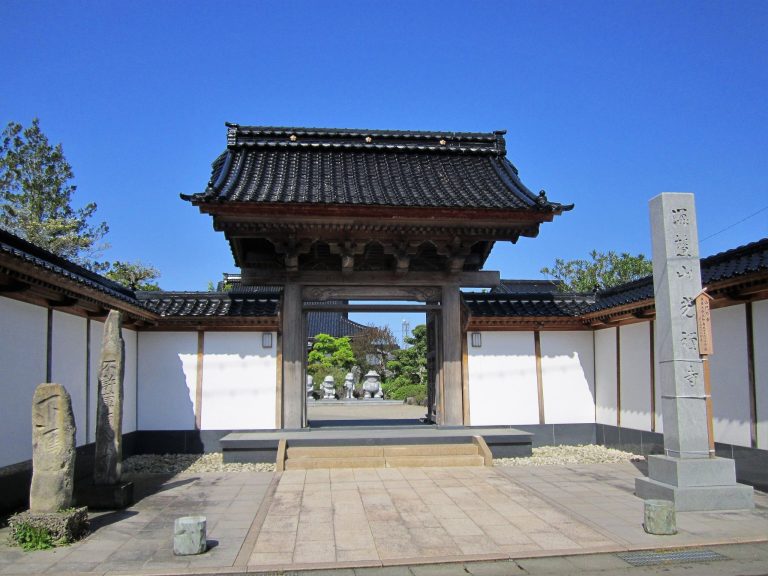
The temple precinct is enclosed by earthen ramparts and a dry moat. A local tradition identifies the grounds as the site of the former provincial capital of Etchū, an attribution preserved as tradition rather than established fact. The complex faces east. The Main Gate and the Kara Gate, a formal gate type associated with Chinese-style architectural design, provide the principal entrances, while the large Main Hall occupies the southern part of the grounds.
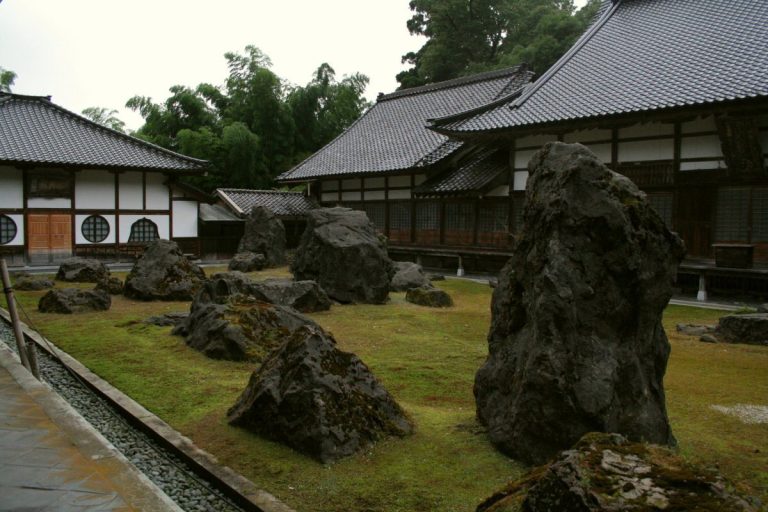
The northern area contains the Great Hall, study, kitchen, and other buildings associated with the residence and reception of the temple clergy. Together, the southern and northern groups form an organized temple precinct in which ritual, residential, and reception spaces remain identifiable.
Principal Temple Buildings
Main Hall
The Main Hall is one of the central early-modern structures in the precinct and forms part of the group of buildings that preserves the appearance of a traditional Buddhist temple complex. Its restoration was the focus of the campaign’s first phase, completed in 2004. The building is a National Treasure, designated with the Great Hall and Ceremonial Entrance in 2022.
Great Hall and Ceremonial Entrance
The Great Hall stands in the northern part of the precinct among the study, kitchen, and clergy-related buildings. Its Ceremonial Entrance forms part of the same National Treasure designation. Together, these spaces represent the formal and residential side of the temple complex, complementing the principal worship space in the southern area.
Gates, Tower, and Supporting Buildings
The Main Gate, Kara Gate, Drum Tower, and other associated buildings contribute to the substantial group of early-modern structures at Shōkō-ji. Ten additional buildings are included among the complex’s Important Cultural Properties. Physical repairs, including partial-disassembly work in the most severely damaged areas, conserved the buildings and brought much of the precinct toward its Edo-period appearance. Improvements to the surrounding landscape formed part of the same conservation effort.