St Margaret’s Church, Westminster: The Parliamentary Church beside Westminster Abbey
Site at a Glance
- Rating
- 4.3
- Popularity
- Low
- Country
- United Kingdom
- Primary era
- Medieval
- External website
- Open
- Eras represented
- Medieval, Early Modern, Modern
- Civilizations
- British, English
- Site type
- Religious
- Remains
- Church
On this page13 sections
History
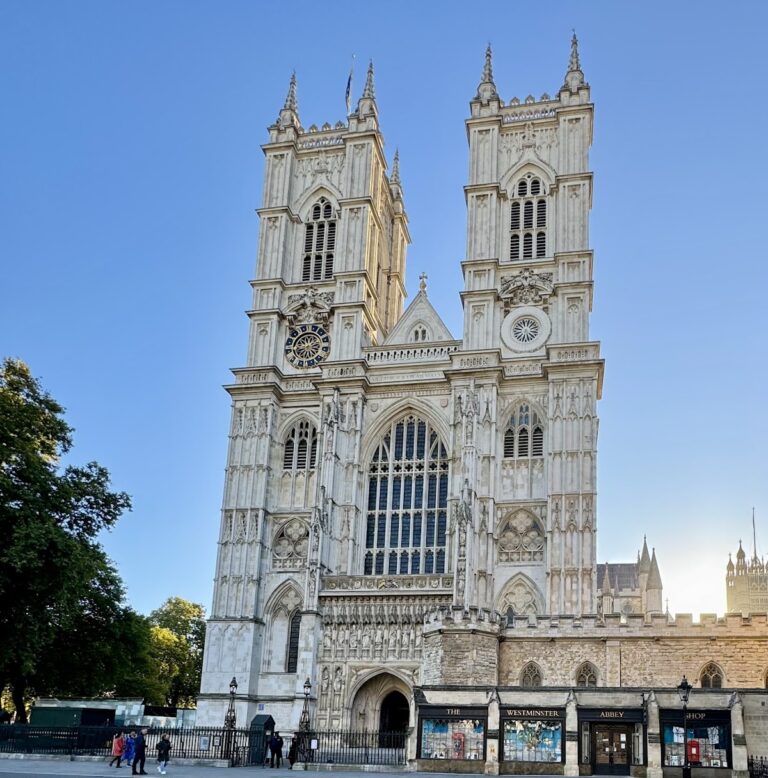
St Margaret’s Church, Westminster is an Anglican church in London, United Kingdom, built beside Westminster Abbey by Benedictine monks in the twelfth century. Its principal building is a Perpendicular Gothic church with Tudor features, rebuilt between 1486 and 1523. The church served local worshippers, supported Westminster’s parliamentary life, and became the burial place or memorial setting of figures including William Caxton, John Milton, Sir Walter Raleigh, and Admiral Robert Blake.
Foundation beside Westminster Abbey
The church was founded so that local residents could worship in a parish church without disrupting the more elaborate monastic services of Westminster Abbey. Its Benedictine founders followed the Rule of Saint Benedict, a system of communal religious life based on prayer, work, obedience, and stability within a monastery. St Margaret’s was dedicated to Margaret of Antioch, a Christian martyr and saint widely venerated in medieval Europe.
Until the Dissolution of the Monasteries in 1540, when Henry VIII’s government suppressed England’s monasteries and transferred their property, Westminster Abbey’s Benedictine monks served the growing local population through St Margaret’s. The church was historically situated in the hundred of Ossulstone, Middlesex. A medieval tradition recorded in 1914 claimed that St Margaret’s was as old as Westminster Abbey and that both churches replaced earlier buildings on the same site.
The church had an unusual ecclesiastical position. Exemptions from the authority of the Bishop of London and, later, the Archbishop of Canterbury were confirmed in 1189 and 1222, while Elizabeth I maintained the exemption in 1560. St Margaret’s and its parish became part of the Diocese of London in 1840. After the Reformation, the sixteenth-century religious transformation that separated the English church from papal authority, it belonged to the Church of England rather than the Roman Catholic Church.
Rebuilding and the Reformation
The medieval church was rebuilt at the instigation of King Henry VII between 1486 and 1523. The completed building was consecrated on 9 April 1523. It was regarded as the last church in London decorated in the Catholic tradition before the Reformation, a period that brought major changes to English worship, church decoration, and monastic institutions.
The church narrowly escaped demolition in the 1540s. Edward Seymour, Duke of Somerset, planned to take it down for building materials for Somerset House on the Strand, but armed parishioners prevented the scheme. In 1555, during the reign of Mary I, William Flower, a former Benedictine monk who had become Protestant, attacked the person administering the sacrament at St Margaret’s. He was convicted of heresy, had his hand severed, and was burned outside the church a week later.
Parliamentary church and changing jurisdiction
In 1614, Puritan parliamentarians selected St Margaret’s for parliamentary services because they considered Westminster Abbey too highly liturgical. The church then became the parish church of the Palace of Westminster and remained associated with both Houses of Parliament. A special seat for the Speaker of the House of Commons, in use from 1681, remains part of this connection.
A detached burial ground was added in 1625 at what is now Christchurch Gardens. Following the Restoration of the Monarchy, Charles II ordered the disinterment in 1661 of Parliamentarians buried in Westminster Abbey, including Admiral Robert Blake, John Pym, Stephen Marshall, and Edward Popham. They were reburied together in an unmarked pit in St Margaret’s churchyard, and a memorial to them was later set into the exterior wall beside the main west entrance.
St Margaret’s became a setting for parliamentary and public religious life as well as for family ceremonies. Marriages there included Edmund Waller and Anne Banks in 1631, Samuel Pepys and Elisabeth Marchant de St Michel in 1655, John Milton and Katherine Woodcock in 1656, Winston Churchill and Clementine Hozier in 1908, Harold Macmillan and Lady Dorothy Cavendish in 1920, Lord Louis Mountbatten and Edwina Ashley in 1922, and David Armstrong-Jones and Serena Stanhope in 1993.
Notable baptisms included Barbara Villiers in 1640, Charles Montagu in 1661, Charles FitzRoy in 1662, Thomas Pelham-Clinton in 1752, and Olaudah Equiano in 1759, under the name Gustavus Vassa. Equiano had been enslaved, bought his freedom, and later became a prominent writer and abolitionist. William Caxton was buried at St Margaret’s in 1491, while Sir Walter Raleigh was buried there in 1618 after his execution at Old Palace Yard. Other burials included John Sutton, Nicholas Ludford, John Sheppard, Blanche Parry, Thomas Churchyard, William Murray, Wenceslas Hollar, Thomas Blood, Nicholas Clagett, Elizabeth Elstob, and Ignatius Sancho.
Alterations and modern ecclesiastical life
John James rebuilt the north-west tower between 1734 and 1738 and encased the whole structure in Portland stone. The eastern and western porches were added later to designs by J. L. Pearson. George Gilbert Scott substantially restored and altered the interior in the late 1870s, creating its present appearance while retaining many Tudor features. The rectory was attached to a canonry of Westminster Abbey from 1840 to 1978, making the relevant canon rector by virtue of that office. Rectors were also often chaplains to the Speaker of the House of Commons, continuously from 1972 to 2010.
Preliminary investigations in 1863 led to the discovery of skins covering several doors. Victorian historians connected them with the punishment of William the Sacrist, who was alleged to have been involved in the theft of royal property in 1303. Later examination identified the skins as bovine rather than human.
Enemy action during the Second World War destroyed the Victorian stained glass in the eight bays of the south aisle. The windows were replaced in 1966 with designs by John Piper, made by Patrick Reyntiens, and dedicated on 15 January 1967 in memory of Canon Carnegie and others. During the First World War, Eton headmaster Edward Lyttelton preached at St Margaret’s in favour of a just rather than vindictive peace with Germany and left through a back door while demonstrators protested outside.
By the 1970s, the local population had fallen to several hundred. The Westminster Abbey and Saint Margaret Westminster Act 1972 transferred the parish’s ecclesiastical responsibility to neighbouring parishes and placed the church under the authority of the Dean and Chapter of Westminster Abbey. St Margaret’s consequently ceased to function as a parish church, although its rector has often also been a canon of Westminster Abbey. Anthony Ball has been rector since 2020.
Regular Sunday worship was announced for cessation in July 2020, and the choir was disbanded after a petition opposing the decision received more than 1,700 signatures. The former congregation had numbered approximately 60 to 120 regular worshippers. A weekly sung Eucharist had resumed on Sunday evenings by 2025. The church also hosts an annual New Year service of the Coptic Orthodox Church in Britain, held in October, and Bishop Angaelos preached there in 2016. The first performance of the UK Parliament Choir, under Simon Over, took place at St Margaret’s in 2000, and a girls’ choir was formed in 2023 to sing alongside the St Margaret’s Consort.
St Margaret’s forms part of the UNESCO World Heritage Site officially known as the Palace of Westminster, Westminster Abbey and Saint Margaret’s Church. The ensemble was inscribed in 1987 for its relationship to human creative achievement, the exchange of architectural and artistic values, and its illustration of significant stages in human history. Funeral or memorial services have also been held for Jeremy Thorpe, Antony Armstrong-Jones, and Lady Elizabeth Shakerley.
Remains
Church structure and interior
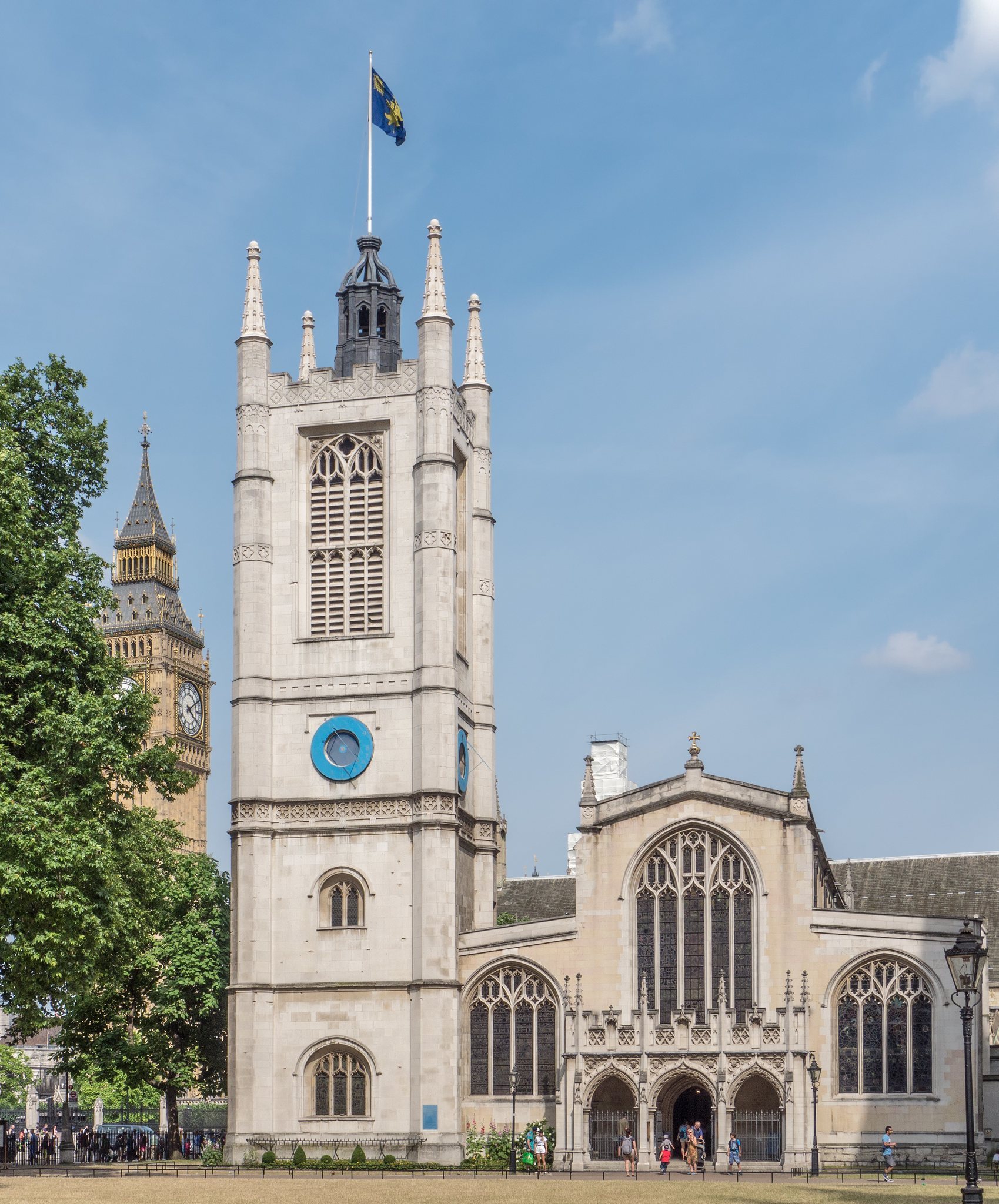
St Margaret’s is arranged as a central nave with two side aisles divided by slender rows of columns. Its principal fabric belongs to the rebuilding carried out from the late fifteenth century to 1523. The building combines Perpendicular Gothic, a late English Gothic style marked by strong vertical lines, large windows, and elaborate geometric tracery, with Tudor features associated with the reigns of Henry VII and Henry VIII.
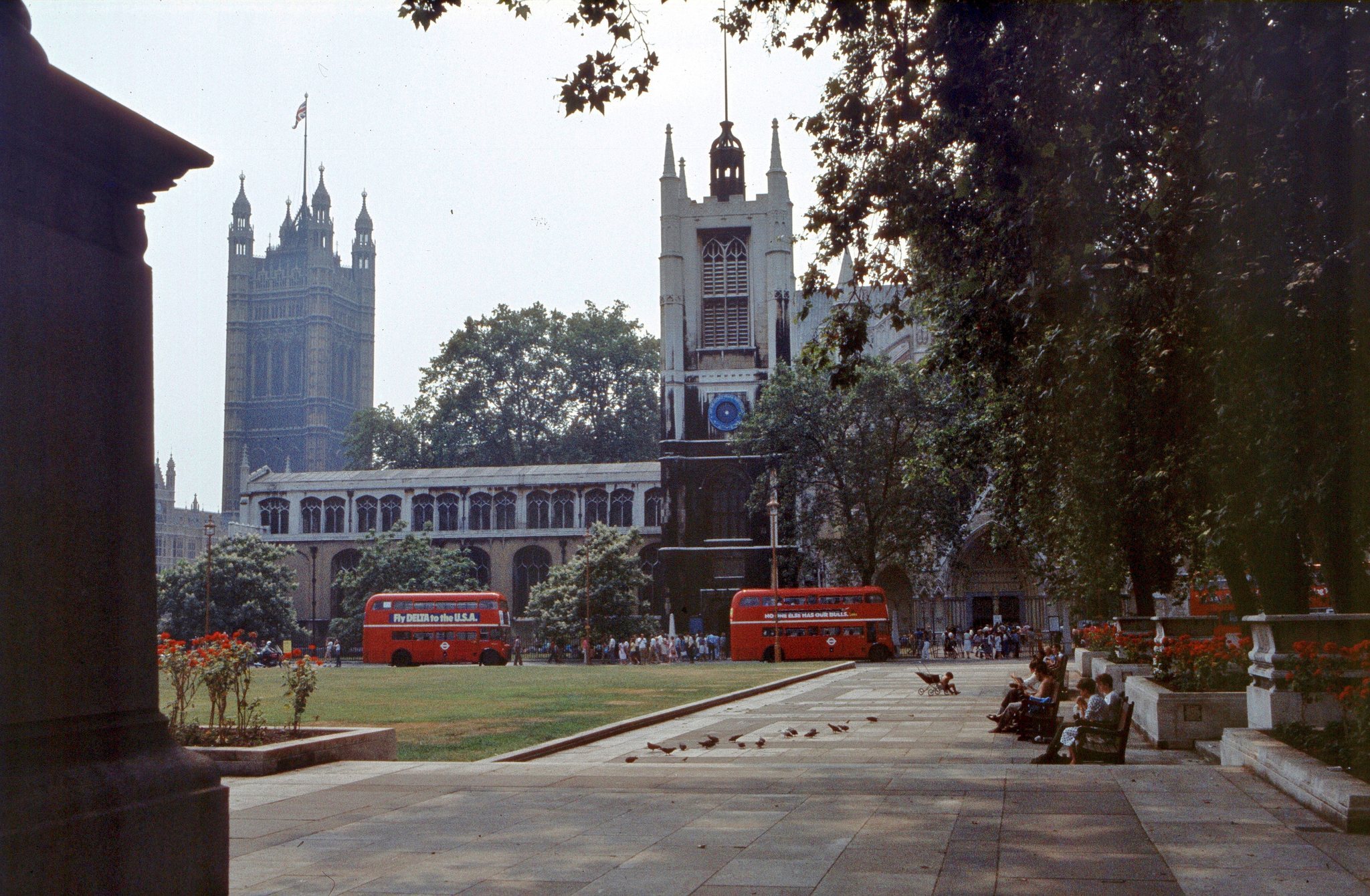
The pre-Reformation interior contained several chapels, a large rood cross, and richly painted statues of the Virgin Mary and Saint John on either side of the cross. A rood cross was a large crucifix traditionally placed at the boundary between the nave and the chancel. John James’s rebuilding of the north-west tower and Portland-stone casing altered the exterior in the eighteenth century, while J. L. Pearson’s eastern and western porches and George Gilbert Scott’s late nineteenth-century restoration shaped the present building. The tower carries a distinctive four-armed sundial, including a face on its northern side.
East window
The east window contains Flemish stained glass made in 1509 to commemorate the betrothal of Catherine of Aragon to Henry VIII. Henry VII gave the window to Waltham Abbey. Following the Dissolution of the Monasteries, it passed through New Hall and several private owners before St Margaret’s parish bought it in 1758 for 400 guineas. The purchase was funded from a parliamentary grant of £4,000 for renovating the church and rebuilding the chancel.
South aisle windows
The eight windows in the south aisle form a unified abstract scheme designed by John Piper and made by Patrick Reyntiens. They replaced Victorian stained glass destroyed during the Second World War. The predominantly silvery-grey glass includes varying areas of pale green, yellow, and blue. The windows were dedicated on 15 January 1967 in memory of Canon Carnegie and others.
Memorials and burial places
Caxton, Raleigh, Milton, and Blake memorials
Commemorative windows and memorials honour William Caxton, Sir Walter Raleigh, John Milton, and Admiral Robert Blake. Raleigh’s window and memorial relate to his burial at the church after his execution. Milton’s window depicts scenes from Paradise Lost and episodes from his life and work. Blake’s window, installed in 1888, commemorates the admiral and his reburial in the churchyard.
Parliamentarians’ memorial
A memorial plaque to the Parliamentarians reburied in 1661 is set into the exterior wall to the left of the main west entrance. The churchyard also contains the burial of John Milton’s wife, Katherine Woodcock, and their daughter. Other commemorative material concerns Wenceslas Hollar, Elizabeth Elstob, and Ignatius Sancho, figures associated with the church through burial or worship.
Parliamentary furnishings and music
The church contains a special seat for the Speaker of the House of Commons, used from 1681. Its embroidered cushions display a crowned portcullis, a vertically sliding fortified gate that became a heraldic emblem of the British Parliament and is especially connected with the House of Commons. An organ was installed by John Avery in 1806, while the present instrument was largely built by J. W. Walker and Sons.