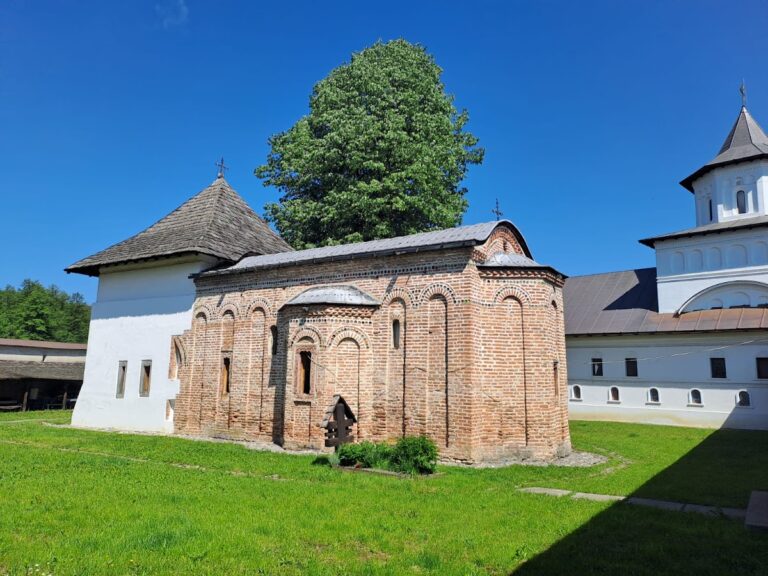
Horezu Monastery: A Brâncovenesc Monastic Ensemble in Romania
Site at a Glance
- Rating
- 4.8
- Popularity
- Medium
- Country
- Romania
- Primary era
- Early Modern
- External website
- Open
- Eras represented
- Early Modern
- Civilizations
- Principality of Wallachia
- Site type
- Religious
- Remains
- Monastery
On this page12 sections
History
Horezu Monastery is a late-seventeenth-century Romanian Orthodox monastic ensemble in Romanii de Jos, Romania, founded by Prince Constantin Brâncoveanu in the historical principality of Wallachia. Construction began in 1690, and the complex became one of the defining expressions of the Brâncovenesc style, a Wallachian tradition combining balanced architectural forms with carved stone ornament, religious painting, and donor portraits.
Foundation under Constantin Brâncoveanu
Brâncoveanu began the monastery in the second year of his reign. The main church was completed and consecrated on 8 September 1693, while the wider ensemble reached completion in autumn 1697. The monastery stood in the village then called Hurezi, in the valley of the Romanii River. A hermitage already existed nearby, although its founder and date are unknown. Local tradition connects the place-name with the calls of the huhurez, an owl found in the area.
The prince intended the monastery to contain his burial place. He was instead beheaded in Constantinople in 1714 and buried at Saint George’s Church in Bucharest. Pârvu Cantacuzino, Brâncoveanu’s first cousin, directed the building and decoration until his death in 1691. Cernica Știrbei, formerly the grand armour-bearer, then assumed responsibility for supervising the work. The principal craftsmen were Manea, master of the masons, Istrate the carpenter, and Vucașin Caragea the stoneworker.
Brâncoveanu endowed the foundation on 25 April 1695 with estates in Vâlcea, Dolj, Mehedinți, and Ilfov. His wife, Maria, founded the infirmary church in 1696, and it was completed in 1699. The Saints Apostles Skete, a smaller religious settlement linked to the monastery, was built in 1698. The Saint Stephen Skete followed in 1703 and was named after Brâncoveanu’s eldest son. A chapel dedicated to Saint Michael was also built outside the gate for the surrounding peasants.
Religious and cultural centre
Horezu developed into an important cultural centre of Wallachia. Its Library of Constantin Brâncoveanu preserved religious, historical, and literary works. A catalogue from 1791 lists 382 printed books and 46 manuscripts, including 115 books in Romanian, while by the modern period the collection was described as containing about 4,000 volumes. The holdings included works associated with Homer, Euripides, Emperor Justinian I, Anna Komnene, Laonikos Chalkokondyles, John Zonaras, and Constantine Manasses.
Ioan the Archimandrite, a senior Orthodox monastic leader and the monastery’s first abbot, copied the popular work Varlaam and Ioasaf around 1700 and compiled the monastery’s commemorative register. He later founded the Saints Apostles Skete. The scholar Rafail transcribed Halima and wrote about Peter the Great and Russian history. In 1788, Dionisie Ecclesiarch produced a work concerning Constantin Cantacuzino and circulated a three-volume edition of One Thousand and One Nights. Ioan the Archimandrite was buried in the main church.
Damage, restoration, and later use
The ensemble suffered damage during the Austro-Turkish War of 1716–1718 and the Russo-Ottoman War of 1787–1792. Buildings outside the walled enclosure were destroyed. The monastery became a nunnery in 1872, and its resident nuns continued religious and artistic work through icon painting, sculpture, and weaving.
The main church was repaired and restored in 1827, 1872, 1907–1912, and 1954–1964, with further extensive restoration during the nineteenth and twentieth centuries. Horezu was designated a historic monument and entered the UNESCO World Heritage List in 1993 under cultural criterion ii, recognising its architectural and artistic influence within the region.
Remains
Walled ensemble and circulation
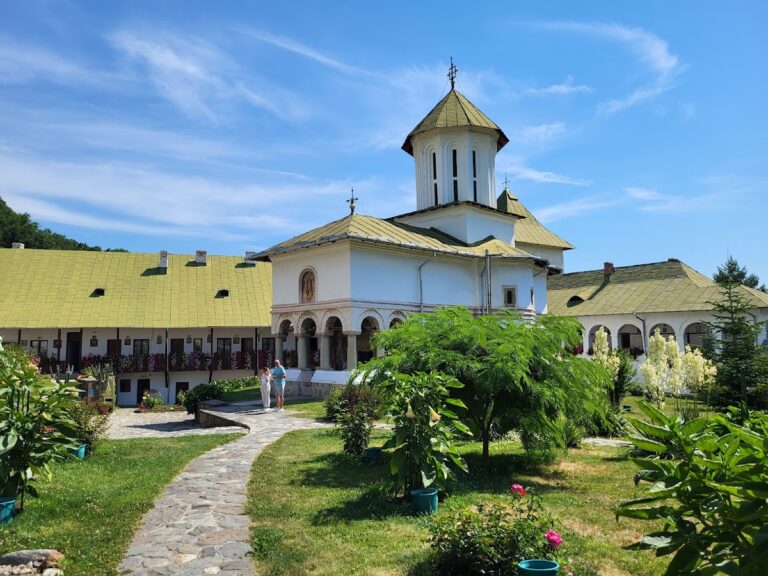
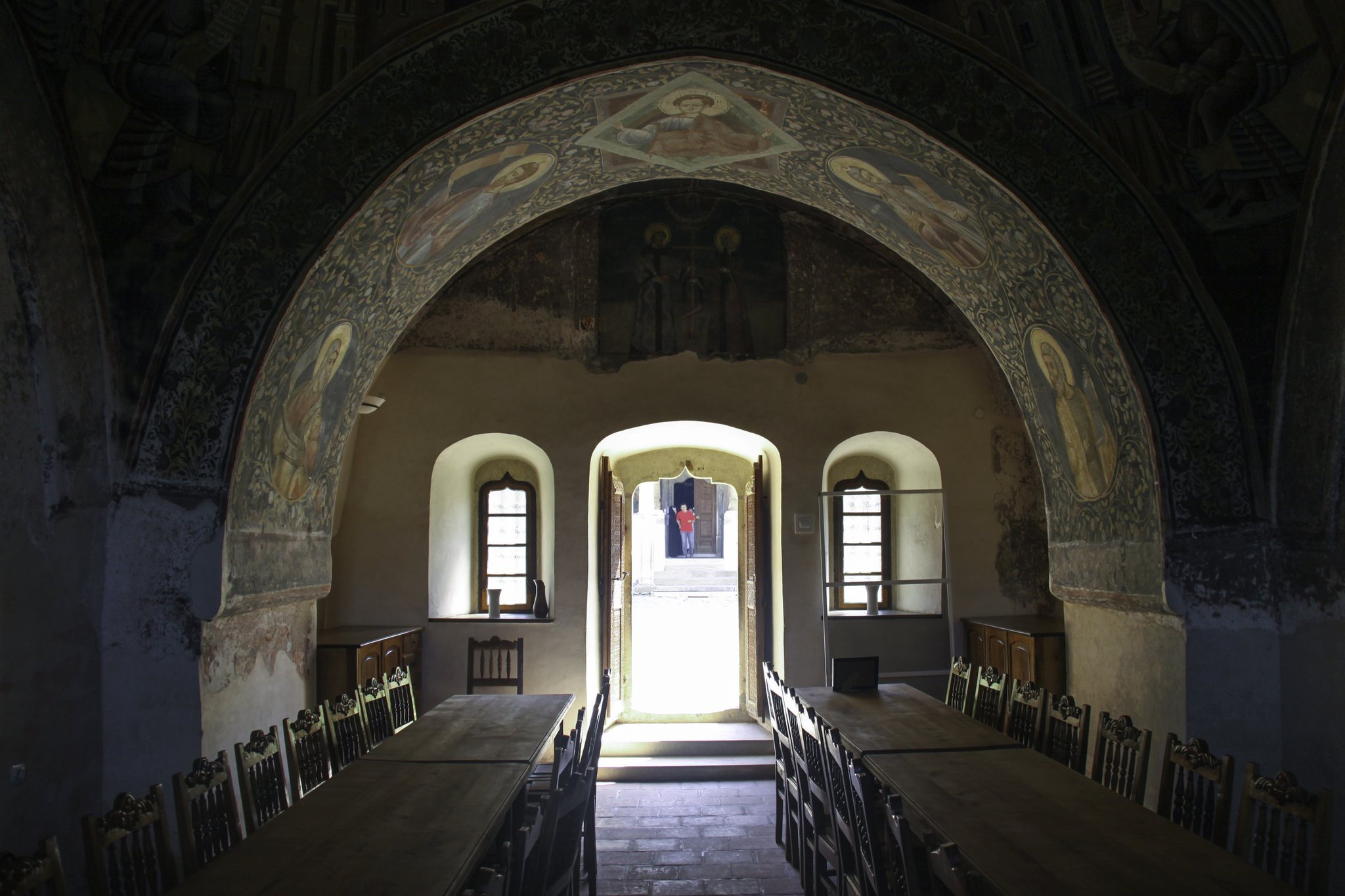
Horezu is a large, unified complex organized along an east–west axis. Four religious buildings occupy this arrangement: the central church, the infirmary church, the Saints Apostles Skete, and the Saint Stephen Skete. The principal enclosure has a rectangular plan. Two-storey monastic cells line its northern side, their facade arranged with a regular arcade. The southern side contains the princely residence, the bell tower, and a large council hall, while the western side is occupied by the refectory, with a chapel above it.
The first entrance stood in the western wall. After the refectory was built, access was moved to the southern wall beneath the bell tower. The tower contains four bells, three of which bear Brâncoveanu’s name. The arrangement preserves the relationship between the enclosure’s residential, communal, and religious buildings.
Main church
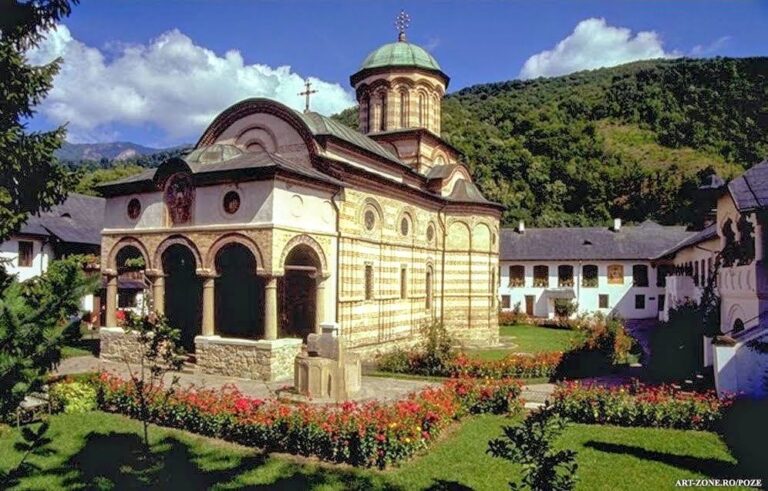
Dedicated to the Holy Emperors Constantine and his mother Helen, the main church follows a trefoil plan and develops the model of the episcopal church at Curtea de Argeș through more elongated proportions and the addition of a Brâncovenesc porch. It is approximately 32 metres long and reaches about 14 metres at its greatest height. The porch consists of an arcade supported by ten carved stone columns decorated with late-Renaissance ornament. Rectangular panels and ornamental niches with circular designs articulate the facade.
A carved marble frame surrounds the entrance doorway. Above it, an inscription displays the arms of Wallachia and the Cantacuzino family. Inside, three aisles terminate in three apses, which are projecting rounded ends of the church. Two many-sided towers rise above the building, each provided with windows, a dome, and a cross.
The large narthex, or entrance vestibule of an Orthodox church, has a nine-opening arcade carried by ten Renaissance-style columns. Three arches provide entrances on three sides, while the remaining openings contain windows. The principal entrance projects outward as a domed portico. On the eastern wall, a large Last Judgment mural faces donor portraits of Constantin Brâncoveanu, Maria, and their eleven children. Other portraits represent the Brâncoveanu, Basarab, and Cantacuzino families, beginning with the early-sixteenth-century nobleman Datco of Brâncoveni and including Basarab III the Elder and Constantin Cantacuzino.
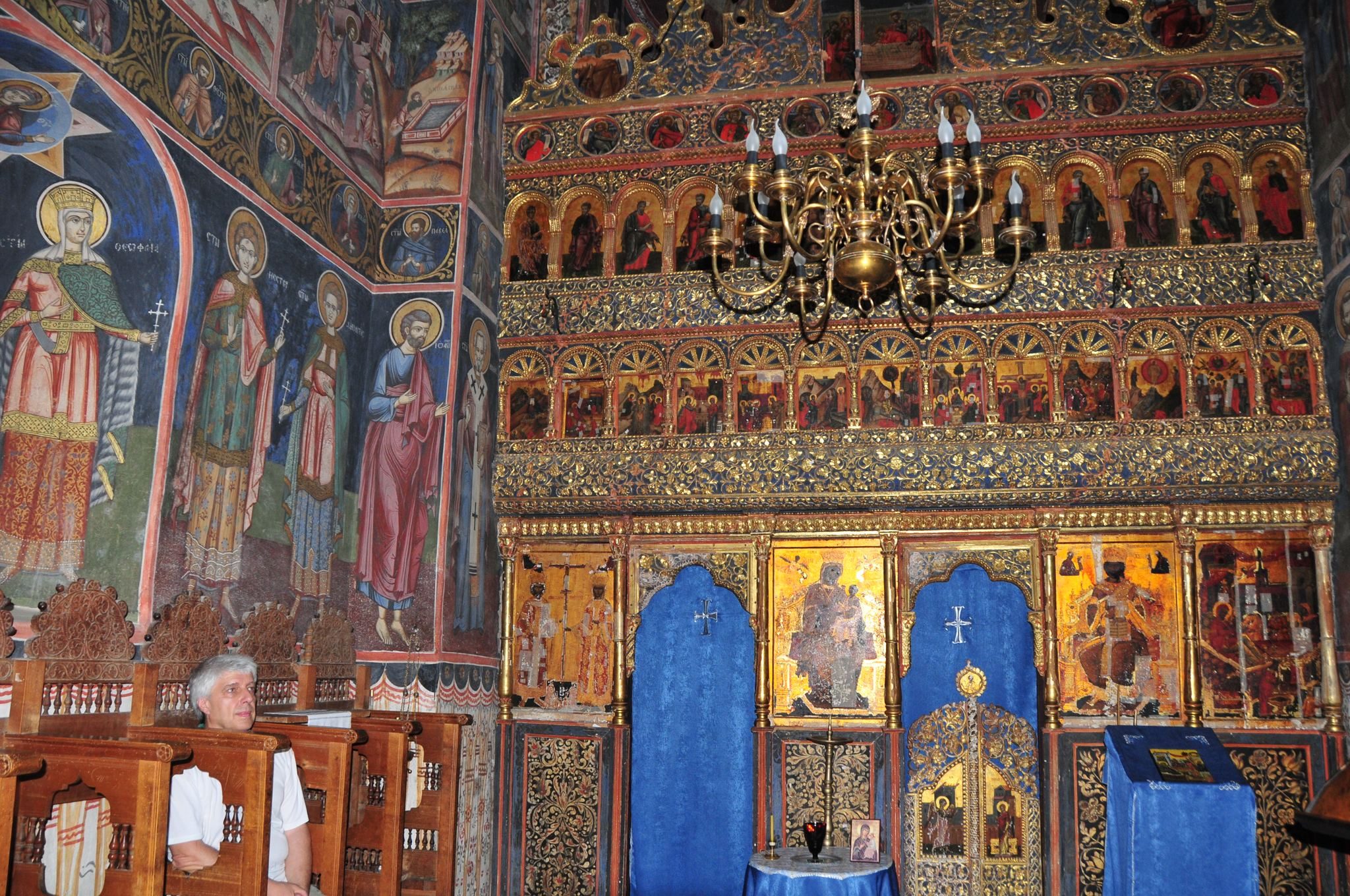
The church’s mural decoration was produced between 1692 and 1694. Constantinos and Ioan, identified as Greek masters, worked alongside the Romanian painters Andrei, Stan, Neagoe, and Ioachim. The painting was completed on 30 September 1694 and combines religious scenes with votive portraits and representations of aristocratic families. A monumental limewood iconostasis, the decorated screen separating the sanctuary from the main body of the church, is carved and gilded. Maria Brâncoveanu donated silver lamps, and the church preserves other religious objects, including paintings and stone and wood sculpture.
The church contains the tomb of Ioan the Archimandrite and a prepared but unused tomb intended for Constantin Brâncoveanu. The prince’s actual burial place is Saint George’s Church in Bucharest.
Associated churches and sketes
Infirmary church
The infirmary church stands near the main church and is dedicated to the Dormition of the Mother of God. Founded by Maria Brâncoveanu in 1696 and completed in 1699, it contains paintings by the Romanian painters Preda, Nicolae, and Ianache.
Saints Apostles Skete
The Saints Apostles Skete was built in 1698 and painted in 1700 by the hierodeacon Iosif and Ion. Its presence forms part of the east–west sequence of religious buildings that defines the ensemble.
Saint Stephen Skete
The Saint Stephen Skete was established in 1703 and named after Brâncoveanu’s eldest son. Its paintings are associated with Ianache, Istrate, and Hranite.
Library of Constantin Brâncoveanu
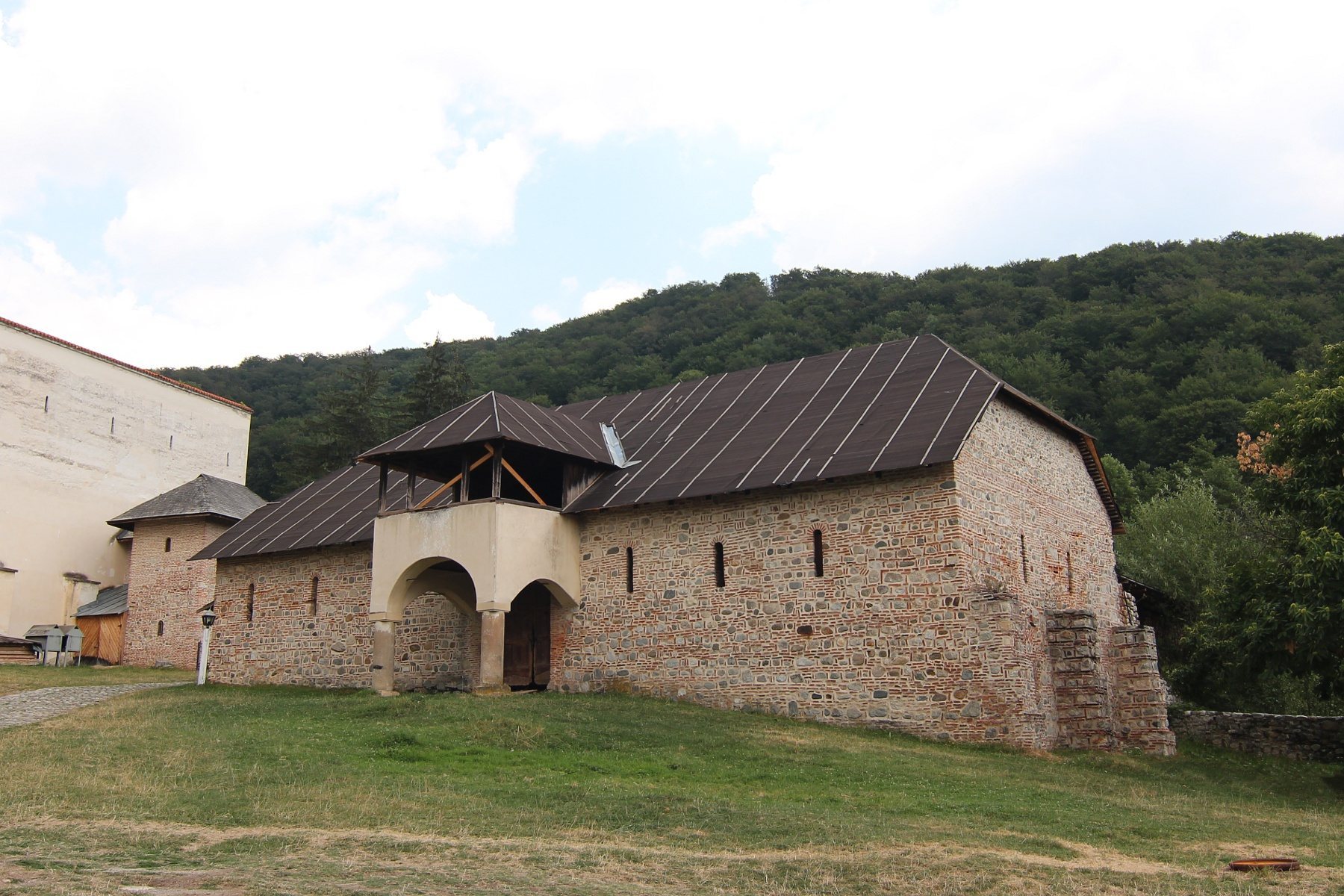
The Library of Constantin Brâncoveanu occupies a distinct building within the monastery. An inscription dated 1708 stands above its doorway and describes the library as a house that offers spiritual nourishment through books. Its surviving record of printed works and manuscripts reflects the intellectual activity that accompanied Horezu’s religious role.