Varlaam Monastery: A Greek Orthodox Monastery in Meteora
Site at a Glance
- Rating
- 4.8
- Popularity
- Medium
- Country
- Greece
- Primary era
- Early Modern
- Eras represented
- Early Modern
- Civilizations
- Ottoman
- Site type
- Religious
- Remains
- Fortified Monastery
On this page10 sections
History
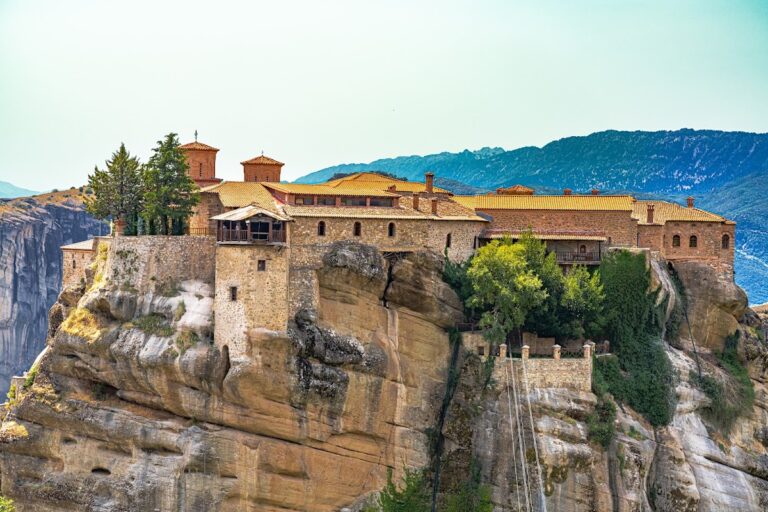
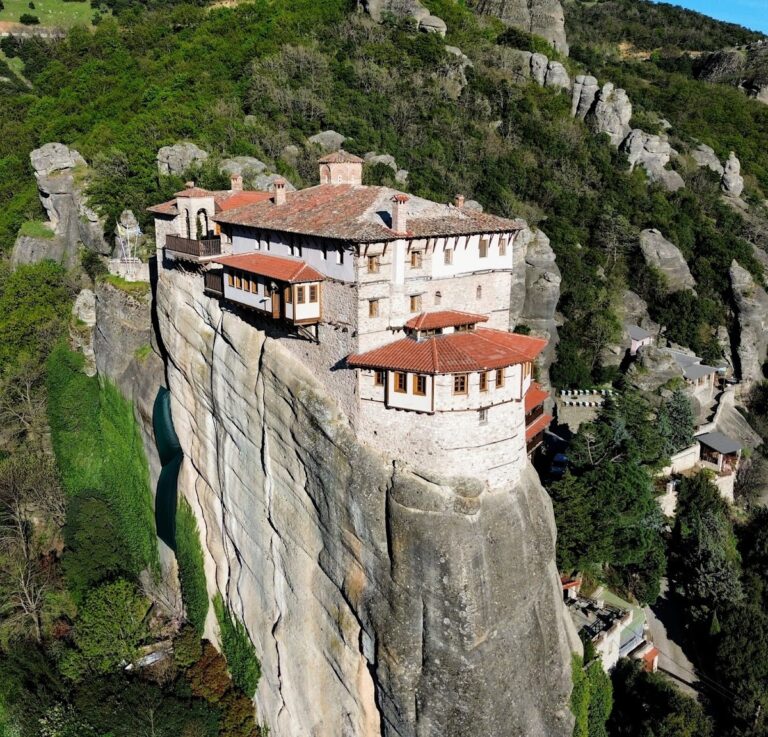
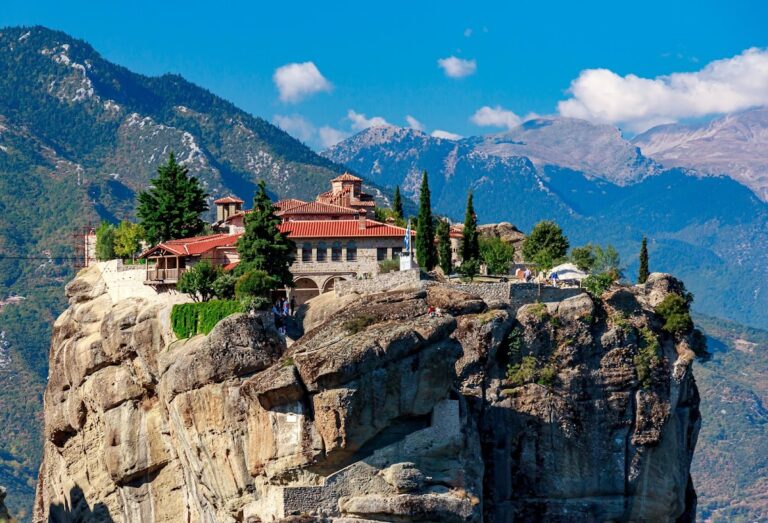
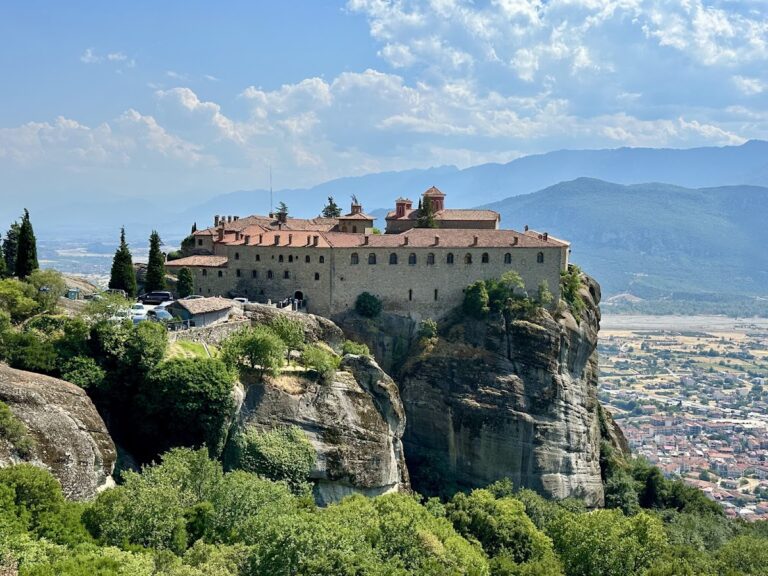
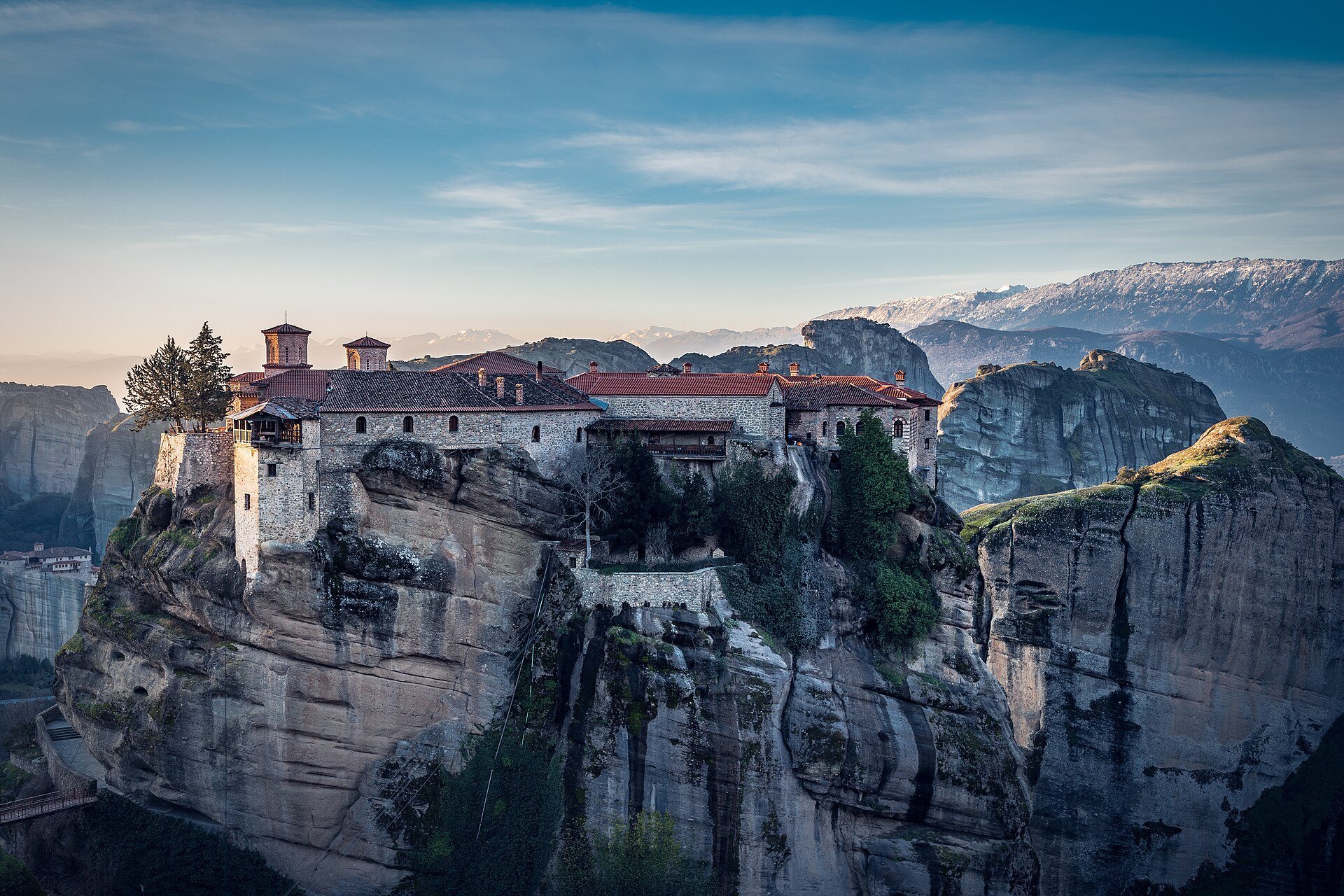
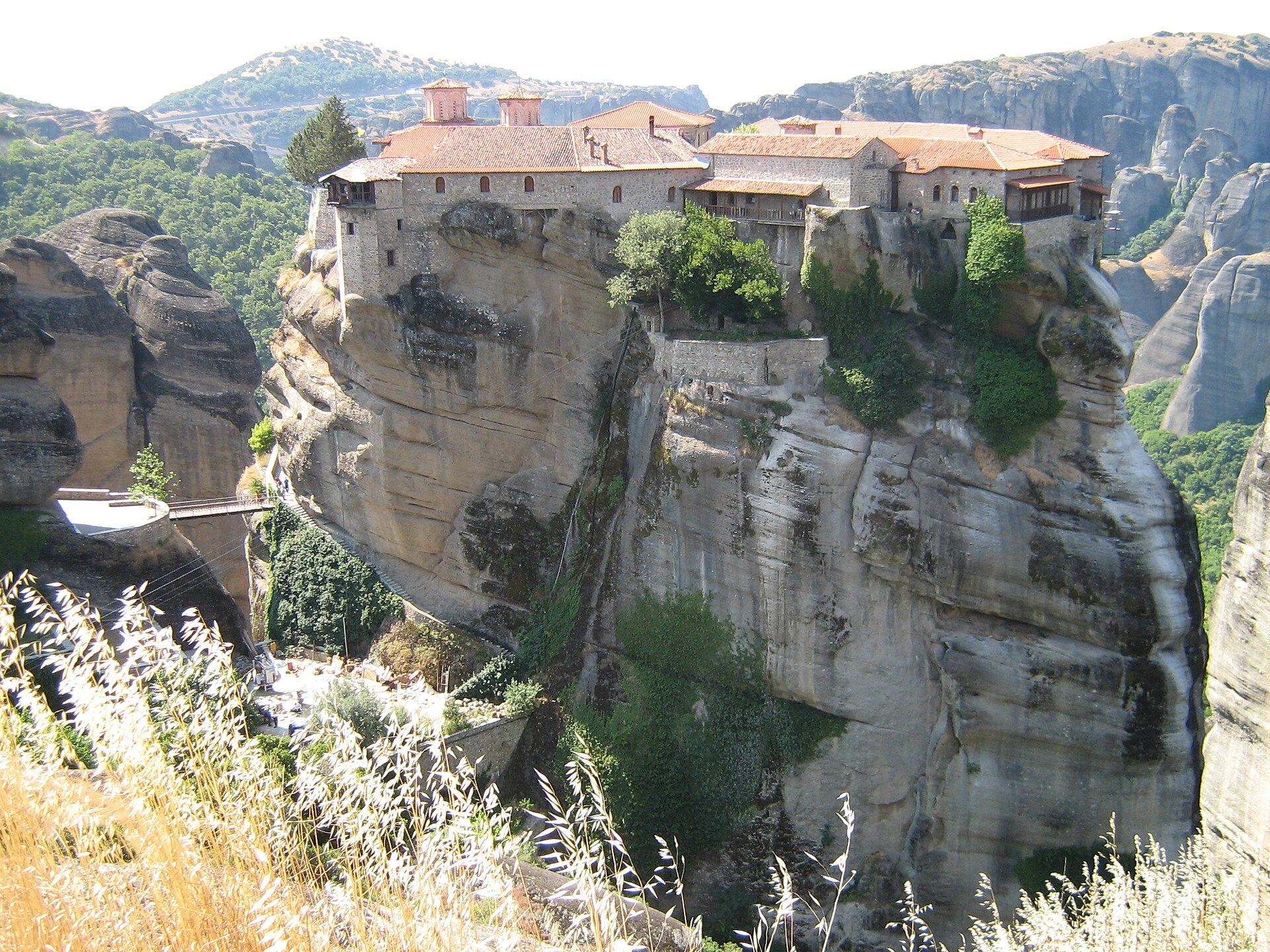
Varlaam Monastery, also called the Monastery of All Saints, is a sixteenth-century Greek Orthodox monastery in the Meteora complex near Kalambaka, Greece. Built on a precipitous rock within a landscape of elevated monastic foundations, it belongs to the Stagonian and Meteora Metropolis and remains an active religious community.
Early Hermitage and the Apsaras Foundation
Tradition connects the site’s first settlement with the monk Varlaam, who climbed the rock during the first half of the fourteenth century. He built a small chapel dedicated to the Three Hierarchs, Basil the Great, Gregory the Theologian, and John Chrysostom, three major bishops and theologians venerated in Eastern Christianity. Varlaam was a contemporary of Saint Athanasius of Meteora, the founder of the Great Meteoron monastery.
The monastery’s principal founders were the brothers Nektarios and Theophanes Apsaras, members of a wealthy and prominent family from Ioannina. Both entered monastic life in the late fifteenth century. They first settled on the island of Ioannina and later lived at Dionysiou Monastery on Mount Athos, an autonomous Orthodox monastic community in Greece.
In 1510, the brothers settled on Varlaam Rock, where the remains of an earlier hermitage survived. With the help of two other monks, they began rebuilding the foundation. The monastery belongs to the sixteenth century, and its completion is also dated to 1517. The Apsaras brothers rebuilt the ruined Three Hierarchs Chapel in 1518, while the main Church of All Saints was begun in 1541 and identified by an inscription as completed in 1542.
The Apsaras Monastery
Theophanes Apsaras died in 1544 and Nektarios in 1550. They were buried beneath the southeastern cross-arm of the Church of All Saints, and a model of the church was placed above their tombs. The monastery continued to develop after their deaths. Its identity as a Greek Orthodox foundation and its connection with Ioannina are expressed in part through the image of Saint John of Ioannina in the Church of All Saints. He was martyred in Constantinople in 1526 at the age of eighteen, and his representation has been interpreted as reflecting the opposition between Orthodoxy and Islam as well as the close relationship between Meteora and Ioannina.
The Three Hierarchs Chapel was rebuilt for a second time in 1627, and its wall paintings were added in 1637. The skull of Saint Nicholas of Metsovo, who was martyred at Trikala in 1617, has been kept at the monastery since that year. His image was added to the chapel approximately two decades after his death.
Archive and Heritage
During the eighteenth century, the monk Christopher spent decades organizing the monastery archive and preparing a complete description of its written relics. Some of these materials are displayed in the monastery museum. Varlaam is one of the six surviving Meteora monasteries included in the UNESCO World Heritage Site inscribed in 1988. UNESCO World Heritage status identifies places judged to have outstanding universal value under the World Heritage Convention.
Remains
Rock Setting and Monastic Layout
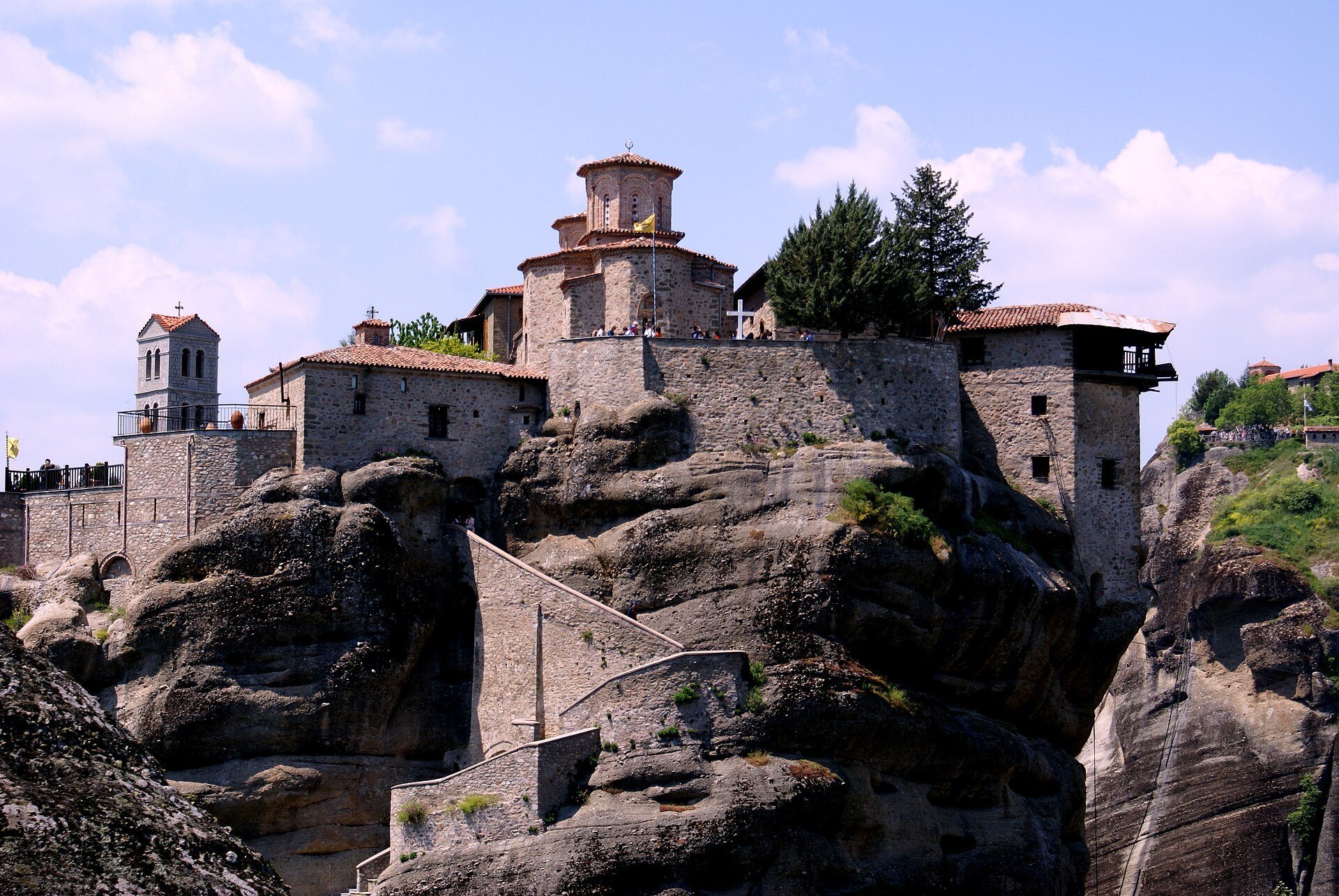
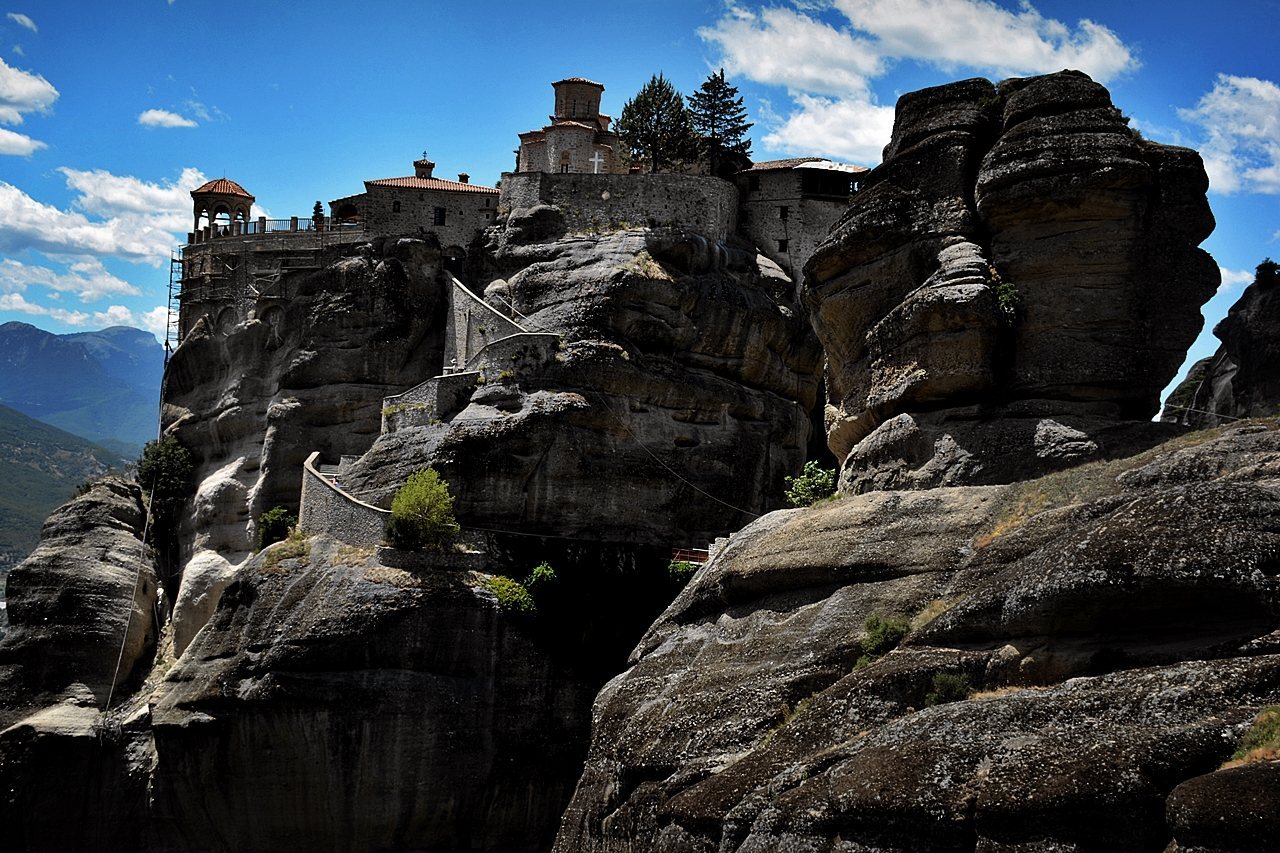
Varlaam Monastery occupies the summit of a rocky precipice about 373 metres above the valley floor and approximately 595 metres above sea level. The rock belongs to the Meteora formations, sandstone and conglomerate cliffs shaped by fluvial erosion and geological uplift within the forested Pineios Valley landscape. After a flight of 117 steps, the hospital is encountered first, followed by the Chapel of the Holy Anargyroi, the Church of All Saints, and a castle-like structure. The altar, the Three Hierarchs Chapel, monks’ cells, and guest rooms lie to the left.
Church of All Saints
The Church of All Saints has a cross-shaped nave built rapidly with tuff as its principal material. The founders’ tomb occupies the southeastern part of the church. An inscription above a window identifies Nektarios and Theophanes as hieromonks, monks ordained as priests, and founders from Ioannina, while giving the creation date as 1542.
The church’s wall paintings were produced in two stages, in 1548 and 1566. Their decoration is arranged in four horizontal zones. Scenes from the Christian cycle occupy the niches and upper walls, prophets appear in the central parts of the niches, and saints fill the lower zone. The dome contains Christ Pantokrator, the image of Christ as Almighty or Ruler of All, surrounded by angels, the Virgin Mary, and John the Baptist. The sanctuary arch contains the Platytera, an image of the Virgin associated with the sanctuary.
The painted cycle includes the Heavenly Liturgy, the Ascension, the Annunciation, the Nativity, the Transfiguration, the Last Supper, the Agony in Gethsemane, the Betrayal of Judas, the Crucifixion, the Dormition of the Virgin, the raising of Lazarus, Christ’s entry into Jerusalem, and the Carrying of the Cross. Other scenes show Herod’s massacre of the infants, Christ before the Sanhedrin, Judas’s repentance and suicide, Joseph of Arimathea receiving permission to bury Christ, Peter’s denial, Pilate’s judgment and scourging, the healing of the blind man, Christ’s meeting with the Samaritan woman, the Exaltation of the Holy Cross, and Christ’s appearance to the apostles.
Figures in the church include Constantine, Helena, Eustathius, the Archangel Michael, Theodore Stratelates, Menas, James the Persian, Mercury of Caesarea, John Damascene, and Cosmas of Maiuma. Nektarios Apsaras appears on the southeastern column and Theophanes Apsaras on the northwestern column, beside Saint John of Ioannina. The columns also depict Cyriacus the Anchorite, Saint Pimen, Saint Theophanes, Christ as the Inspirer of All, John the Calybite, Saint Alexius, Euphrosynos the Cook, Saint Chariton, Saint Macarius of Egypt, Saint Varlaam, Saint Onuphrius, Saint Paul of Latros, Saint Barbara, Saint Joasaph, Theotokos Paraklesis, and Saint Moses the Ethiopian.
The eastern wall carries a depiction of the Second Coming, including a fiery stream that carries sinners into the mouth of a whale-like monster. On the western wall, the monk Sisoes mourns before the tomb of Alexander the Great, the fourth-century BC Macedonian king and military conqueror. An accompanying inscription states that Alexander’s body remained glorious for many years but that death spares no great person.
The paintings are attributed to the Theban painter Frangos Katelanos and to the brothers Kondaris. An inscription states that the nave’s decoration began in June and ended in October 1566 through the work of the priest Georgios of Thebes and Brother Frangos. The paintings are regarded as major examples of the School of Northwestern Greece, a post-Byzantine Orthodox tradition of monumental fresco decoration. Katelanos’s work combines features of the Cretan manner with emerging Baroque movement and plasticity, while the Kondaris paintings are more static, with rhythmic compositions and strong contrasts of light and shadow.
Hospital and Castle
The hospital is a square building in the southeastern part of the rock. Four columns support its roof externally, creating nine rooms. Eight rooms have cross-vaults, while the ninth has a dome that changes into a chimney. A small Chapel of the Holy Anargyroi is attached to the northern side for the sick and elderly.
The monastery’s balcony castle rises 40 metres high. An inscription identifies Nektarios and Theophanes as its creators and dates its construction to 1536.
Three Hierarchs Chapel
The Three Hierarchs Chapel stands in the southeastern part of the rock. It is a single-room structure with a wooden roof that continues into a semicircular vault. Its paintings include themes of blessing, Saint John Chrysostom, veneration of the Virgin, the Heavenly Liturgy, anointing, and the Crucifixion. Instead of a dome showing Christ Pantokrator, the upper zones of the northern, southern, and western walls contain 57 figures of the forefathers.
On the northern wall, Nektarios and Theophanes hold a model of the chapel beside Saint Nicholas of Metsovo, Saint Catherine, Saint Barbara, and Saint Thecla. The paintings follow the early Cretan manner, a disciplined post-Byzantine Orthodox style, and are attributed to an iconographer named John.
Former Altar and Museum
The former altar is an elongated building that ends externally in a three-sided dome. Inside, a low colonnade of five pillars divides the space into two niches. The building has been converted into a museum of the monastery’s treasures, including portable icons, gold-embroidered epitaphioi, vestments, and liturgical objects. Among the icons is a Virgin and Child attributed to Emmanuel Tzanes, a seventeenth-century Greek painter associated with post-Byzantine Orthodox icon painting.