Bistrița Monastery: An Orthodox Monastic and Cultural Center in Romania


Site at a Glance
- Rating
- 4.8
- Popularity
- Medium
- Country
- Romania
- Primary era
- Medieval
- External website
- Open
- Eras represented
- Medieval, Modern
- Civilizations
- Ottoman, Principality of Wallachia
- Site type
- Religious
- Remains
- Monastery
On this page8 sections
History
Bistrița Monastery is an Orthodox monastery in Romania, in the village of Bistrița, on the valley of the Bistrița River. Founded by the Craiovești boyar family, it was built between 1492 and 1494 and first appears in a document issued by Vlad the Monk on 16 March 1494. The founders included Barbu Craiovescu, Ban of Craiova, and his brothers Pârvu the vornic, Danciu the armaș, and Radu the postelnic. The Craiovești were a powerful Wallachian family whose members held senior offices and supported religious foundations.
Foundation and rebuilding
The monastery was completely destroyed in 1509 by Mihnea Vodă, also known as Mihnea I, who was engaged in conflict with the Craiovești. The family rebuilt Bistrița between 1515 and 1519, during the reign of Neagoe Basarab. This second foundation established the monastery as a durable religious center under Craiovești patronage.
Neagoe Basarab, a nephew of the Craiovești, was reportedly brought to Bistrița in his youth to study language and literature. The monastery therefore had an educational role from an early period, alongside its function as a place of Orthodox worship and monastic life.
The relics of Saint Gregory
Barbu Craiovescu brought the relics of Saint Gregory the Decapolite, a Byzantine Christian monk and saint, from Constantinople. The relics became the monastery’s principal sacred possession and helped make Bistrița a major pilgrimage destination. They were associated with healing and with bringing rain during drought.
One tradition says that Barbu obtained the relics from a Turk for a small quantity of gold after the weighing scale unexpectedly balanced. Another tradition connects them with the plague of 1763, when the relics were taken to Bucharest and the epidemic subsequently receded. In 1656, Constantin Voievod donated the silver reliquary in which the relics are kept.
Bistrița also received important gifts from later patrons. In autumn 1600, Mihai the Fugitive purchased the freeholder village of Costești and donated it to the monastery. Constantin Brâncoveanu, a Wallachian ruler associated with extensive ecclesiastical patronage, later gave Bistrița a bell and an icon of Saint Anne reputed to work miracles.
A center of writing and learning
By the seventeenth century, a school operated at Bistrița. Monks and writers copied and translated religious and historical works in Romanian and Church Slavonic, the liturgical and literary Slavic language traditionally used in Orthodox communities in the region. A Romanian document from 1573 associated with the monastery has been described as the second-oldest Romanian document after Neacșu’s letter from Câmpulung.
A charter attributed to Mihnea Vodă states that the Liturghierul, described as the first book printed in Romanian, was produced at Bistrița on 10 November 1508. Another tradition identifies the monastery as the site of the first printing press in Wallachia, operated by Macarie. These claims place Bistrița within the early history of Romanian religious printing and literacy.
In 1620, Mihail Moxa wrote the Chronograph of Wallachia at Bistrița. The work has been described as the first universal history produced in the region. Its manuscript was found at the monastery in 1845 by the Russian philologist V. Grigorovici, published at Kazan in 1859, and is now preserved in Moscow.
Matei al Mirelor took refuge at Bistrița during the winter of 1610 to 1611 and wrote a life of Saint Gregory the Decapolite there. Its historical preface contains a short account of the wars of Radu Șerban. Later, at the invitation of Ilarion, bishop of Râmnic, Alexandru Dascălul worked at the monastery from 1694 to 1704. He was associated with Otocenic or Patetic, Cheia înțelesului, an ode for readers, and the Gogiomanii of Saint Nicholas Church in Șcheii Brașovului.
Other writers and scribes connected with Bistrița included Teofil, associated with Evanghelie învățătoare of 1644; Teofan, associated with a Church Slavonic Psalter from 1619; Ilarion, associated with an annotated Psalter; Ștefan the Hieromonk, associated with a Cazania from 1724; and Ioachim of Bărbătești, associated with The History of Troy from 1766. Ștefan later became metropolitan of Wallachia, after serving as a scribe, monk, and abbot at Tismana.
Reconstruction and modern transformations
A nineteenth-century earthquake seriously damaged the monastery. Bistrița was rebuilt between 1846 and 1855 during the reigns of Gheorghe Bibescu and Barbu Știrbei. The final stages were carried out under the supervision of Carol Benesch. The rebuilt church received its interior paintings from Gheorghe Tattarescu in 1855, while portraits of Barbu Craiovescu, Constantin Brâncoveanu, Maria Doamna, Despina Doamna, and Barbu Știrbei became part of the painted decoration.
During the Romanian War of Independence, from 1877 to 1888, the monastery housed a military hospital. A military school operated there from 1883 to 1898. After 1917, the Saint Catherine Children’s Home was transferred from Bucharest to Bistrița, where it continued for forty years. The complex also accommodated a kindergarten, a four-grade elementary school, a monastic seminary for nuns, and later a girls’ secondary school with workshops. Together, these institutions formed the philanthropic Association of the Protection of the Mother of God.
During the interwar period, Bistrița was one of the monastery-prisons of the Kingdom of Romania. Vartolomeu Stănescu, a former bishop of Râmnic, was imprisoned there because of his sympathies for the Legionary Movement, a Romanian ultranationalist and fascist political movement.
The monastery’s educational work was abolished in 1948 after the communist regime was established. On 10 September that year, about 200 Greek-Catholic nuns from the monasteries of Obreja and Jucu were confined at Bistrița and pressured to abandon the Romanian Church United with Rome, an Eastern Catholic church that retains Byzantine worship while recognizing communion with the Roman Catholic Church. Contact with the Orthodox nuns was later prohibited. The Greek-Catholic nuns were dispersed, while their superiors were arrested by the Securitate, the secret police and principal internal security service of communist Romania.
Bistrița was dissolved as a monastery in 1959, and its nuns were sent away. The buildings later housed a special school for children with intellectual disabilities, where pupils received theoretical and practical training, including the production of carved solid-wood furniture. A dispensary for the inhabitants of Costești and forest workers also operated there under the direction of a nun who was a physician.
In 1984, Bishop Gherasim of the Diocese of Vâlcea, Argeș, and Olt re-established monastic life at Bistrița. He restored the buildings and used a proposed printing museum as a pretext for gradually repopulating the monastery. Monastic life gained renewed importance after 1989. Since 1999, the abbacy of Bistrița has also administered Arnota Monastery, which was converted from a male monastery into a female one. Bistrița is included in Romania’s Register of Historical Monuments under classification code VL-II-a-A-09666, remains a functioning monastery, and belongs to the Râmnic Archdiocese. It is also identified as the place where Chrysea died.
Remains
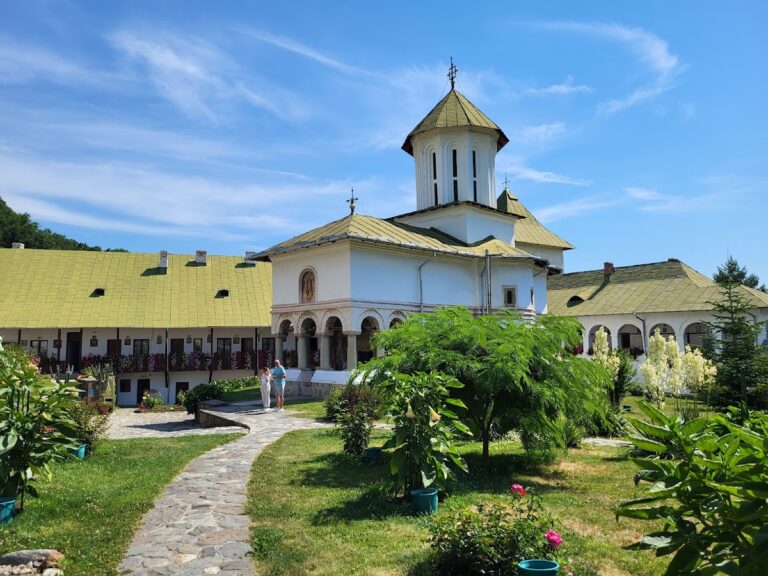
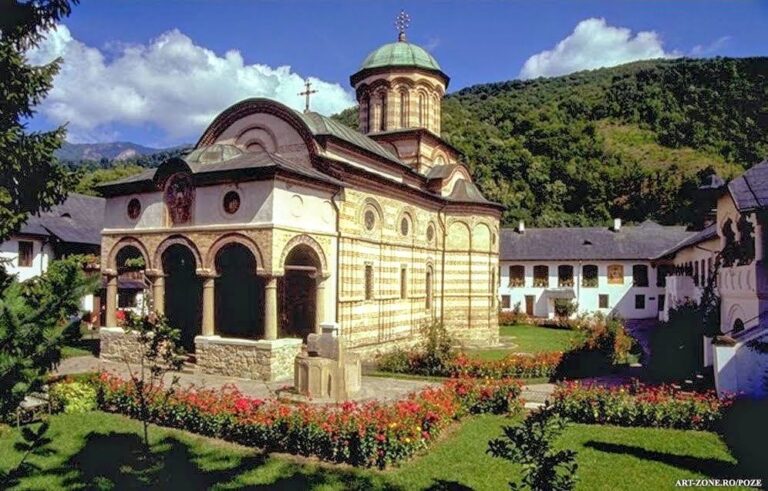
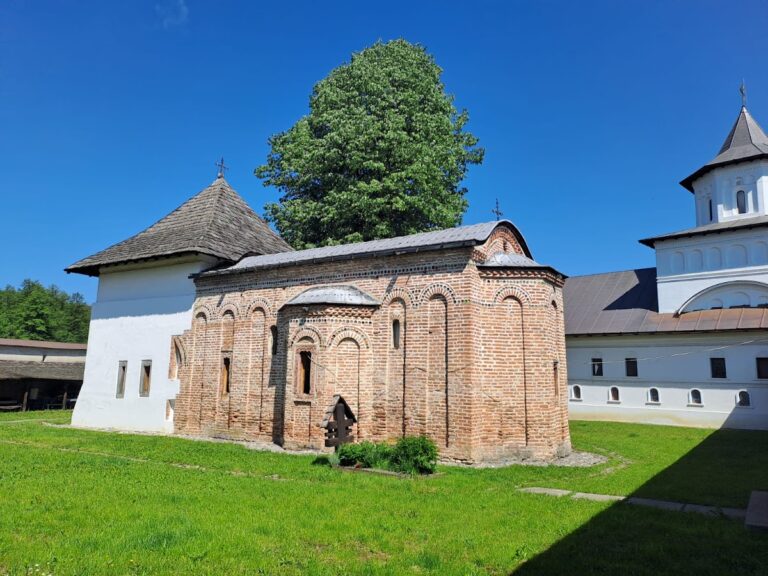
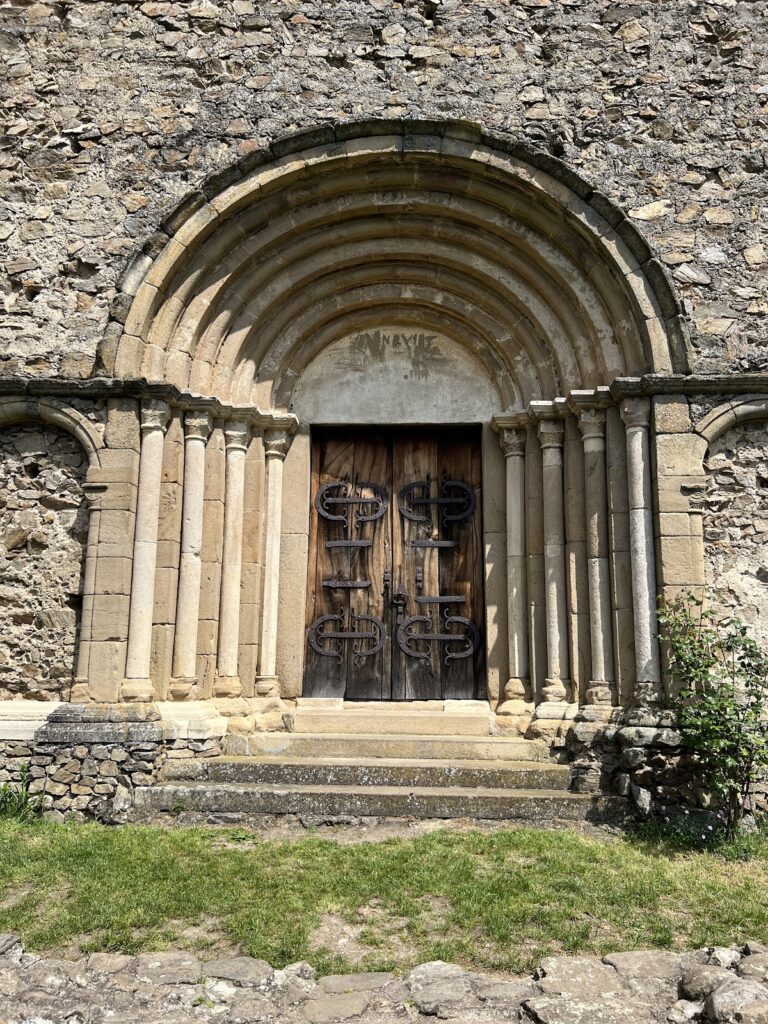
The surviving complex includes the Church of the Dormition of the Mother of God, a bell tower, monastic cells, and courtyards. Its present form reflects the original foundation, the rebuilding of the early sixteenth century, the nineteenth-century reconstruction, and the later adaptation of its buildings for educational, medical, and charitable uses.
Church and sacred furnishings
The monastery church is associated with painters and fresco artists connected with Dealu Monastery, a historic Romanian Orthodox foundation known for its church and painted decoration. After the nineteenth-century rebuilding, Gheorghe Tattarescu painted the interior in 1855. The decoration includes portraits of Barbu Craiovescu, Constantin Brâncoveanu, Maria Doamna, Despina Doamna, and Barbu Știrbei. A painting by Apcar Baltazar, dated between 1901 and 1909, is also associated with Bistrița.
The silver reliquary donated by Constantin Voievod in 1656 holds the relics of Saint Gregory the Decapolite. The monastery’s historically associated sacred objects also include Brâncoveanu’s bell and the icon of Saint Anne. Together, these furnishings preserve the material connection between the church, its patrons, and the devotional traditions surrounding the monastery.
Cells, courtyards, and later-use spaces
Monastic cells and courtyards form part of the complex around the church. Other spaces were adapted during later periods for a military hospital, a military school, the Saint Catherine Children’s Home, schools, workshops, a dispensary, and a special school. These changes gave the buildings functions beyond worship while retaining the monastery’s physical complex.
Bistrița’s literary holdings included manuscripts and printed books in Romanian and Church Slavonic. The Chronograph of Wallachia, written by Mihail Moxa in 1620, was found at the monastery in 1845, although the manuscript is now preserved in Moscow. These written works form an important part of the monastery’s cultural remains and explain its long association with copying, translating, and teaching.