Abbotsbury Abbey: A Benedictine Monastery in the United Kingdom
Site at a Glance
- Rating
- 4.2
- Popularity
- Very Low
- Country
- United Kingdom
- Primary era
- Medieval
- External website
- Open
- Eras represented
- Medieval
- Civilizations
- English
- Site type
- Religious
- Remains
- Monastery
On this page14 sections
History
Foundation and early development
Abbotsbury Abbey was a Benedictine monastery in the United Kingdom, founded in the early eleventh century by the Scandinavian thegn Orc, also known as Urk or Urki, and his wife Tola. A thegn was a high-status landholder and royal retainer in Anglo-Saxon England. Dedicated to Saint Peter, the monastery was established on the site of an earlier small church during the early reign of Edward the Confessor.
Orc and Tola had no children and endowed the monastery with extensive lands, including holdings at Tolpuddle, Portesham, Hilton, and Anstic. Tola later left the abbey her entire estate. Around 1050, Orc also founded a guild at Abbotsbury. Its surviving statutes state that the association protected the monastery’s interests and had its hall there. A guild was an organized association whose members supported shared religious, economic, or social interests.
A charter of King Edmund I, who reigned from 939 to 946, may be the earliest historical reference connected with Abbotsbury. It records the grant of five hides at Abbedesburi to the thegn Sigewulf. A hide was an Anglo-Saxon unit of land assessment related to the resources needed to support a household, although its area varied. The place-name may indicate that the land had previously belonged to an abbot.
A later foundation tradition, preserved in the monastery’s lost cartulary, attributed the earlier church to a priest named Bertufus. He was said to have dedicated it to Saint Peter and called it Abodesbyry. The cartulary was destroyed in a fire during the English Civil War. Edward the Confessor granted Orc land at Wootton, while another charter made Edward the abbey’s protector in relation to Bishop Hermann.
Landholding and royal privilege
The monastery was already within the Benedictine order before 1066, when monks from Cerne Abbey were sent to Abbotsbury. William the Conqueror confirmed its existing rights. From 1075 until its dissolution, the abbey belonged to the Diocese of Salisbury. Benedictines followed the Order of Saint Benedict, a Western Christian monastic tradition based on communal worship, work, and disciplined religious life.
By the time of the Domesday survey, Abbotsbury held more than 65 hides of land. The survey, commissioned by William the Conqueror in 1086, recorded landholding, resources, and rights for taxation and administration. The abbey exercised feudal rights over eight manors and villages: Abbotsbury, Tolpuddle, Hilton, Portesham, Shilvinghampton, Wootton Abbas, Bourton, and Stoke Atram. It became a local centre of power and received further privileges and land grants after disputes over parts of its Abbotsbury estate with the sheriff Hugh Fitz Grip and his widow.
The abbey’s royal privileges expanded during the medieval period. Henry III confirmed its earlier liberties in 1269 and granted it the right to hold a weekly market and an annual fair at Hilton in 1271. Edward I granted market rights at Abbotsbury, while Edward III confirmed the monks’ right to hunt game across substantial parts of their lands, which were noted for their livestock.
Royal control and religious responsibilities
During the early thirteenth century, King John repeatedly kept the abbacy vacant so that its revenues could be used by the Crown or granted to royal supporters. An abbacy was the office or tenure of an abbot, the head of a monastery. A vacancy is recorded in 1212 and 1213, and in July 1213 the prior was ordered to send clergy to the king so that a new abbot could be chosen.
As a religious house under royal protection, the abbey was required to provide hospitality and support. It was ordered to maintain Henry Lombard from 1244 and Norman Beaufiz from 1309. During the Scottish wars, it received requests to shelter war veterans, and in 1339 it was made responsible for two hostages from Berwick-upon-Tweed. The monastery also paid pensions for members of the royal household after the appointments of Abbots Peter of Sherborne in 1321 and William le Fauconer in 1324.
The abbey served as a burial place and received endowments for masses for the dead. In 1323, Robert le Bret transferred land at Holwell to support a daily mass for his father Richard le Bret and their ancestors. Other benefactors made substantial gifts in return for prayers for themselves and their families.
Financial crisis and reform
The Black Death affected Abbotsbury in the mid-fourteenth century and probably killed Abbot Walter de Saunford in 1348. The abbey also suffered financially because of its exposed coastal position, repeated attacks by seaborne invaders, and the cost of supporting coastal-defence forces. Mismanagement by Abbot Walter de Stokes, who served from 1348 to 1354, increased its debts.
Bishops’ investigations in 1353 and 1354 found serious administrative abuses. Walter de Stokes was removed from effective control, and the king placed the abbey’s estates under the supervision of Prior Robert de Faryngdon and three other administrators. The investigation concluded that Stokes had misused lands and revenues, maintained excessive household staff and hunting dogs, and caused losses said to total £855. He died in 1354.
In 1386, the abbey petitioned Pope Urban VI for assistance, stating that invasions by Spanish, Norman, and Breton forces, together with the costs of coastal defence, had reduced it to such poverty that it could no longer conduct services. The pope directed the Bishop of Salisbury to provide the monks with the church at Tolpuddle. In 1390, Pope Boniface IX incorporated the parish churches of Abbotsbury, Portesham, Winterborne St Martin, Toller Porcorum, and Tolpuddle into the abbey’s holdings.
Late medieval renewal and dissolution
After a bishop’s inspection in 1426, visitation ordinances prohibited careless grants, restricted the abbot’s purchase of wine to what was necessary for consumption, and generally prohibited women from visiting the monastery. Further visitations took place in 1488 and 1503. Henry VII made numerous gifts to the abbey during a period of renewed prosperity.
In 1505, Thomas Strangeways endowed the Strangeways Chapel through a three-sided agreement involving the abbots of Abbotsbury and nearby Milton. He transferred a parish and various revenues to support specified masses for the dead.
Dr Thomas Legh, acting in Henry VIII’s campaign to dissolve England’s monasteries and other religious houses, probably visited Abbotsbury in March 1539. The abbey was apparently in good order and had annual revenues of more than £400. On 12 March 1539, the last abbot, Roger Roddon, surrendered the monastery with Prior Thomas Bradford and eight monks. They received pensions, including £80 for Roddon and £9 for Bradford.
The abbey was dissolved under Henry VIII and demolished under the terms of its sale so that its stone could be reused. Sir Giles Strangways acquired the abbey buildings, manors, water mills, lands, and Abbotsbury Swannery for £1,906 10 shillings. Henry VIII formally granted him the abbey site, and much of the former estate later remained with Strangways’s descendants, the Earls of Ilchester. The surviving abbey remains and St Catherine’s Chapel are under English Heritage guardianship. Principal surviving and associated structures include Grade I listed and scheduled monuments, while other buildings have Grade II* or Grade II status.
Remains
Abbey complex
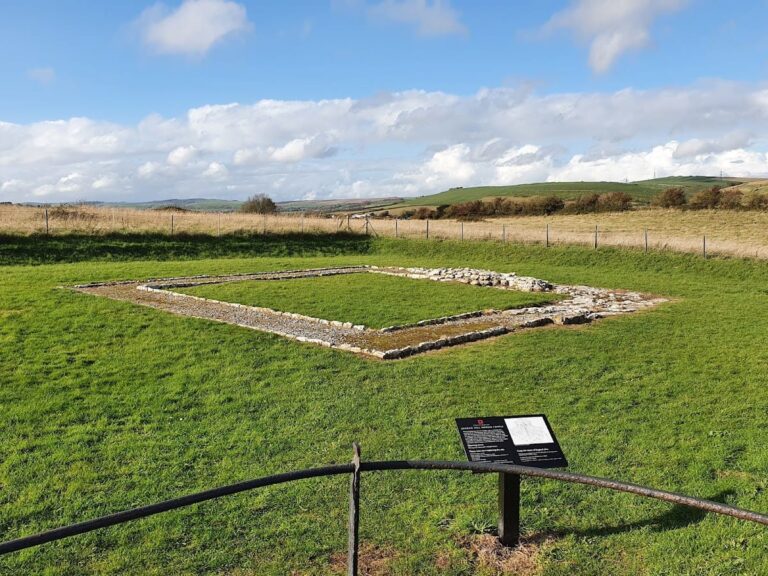
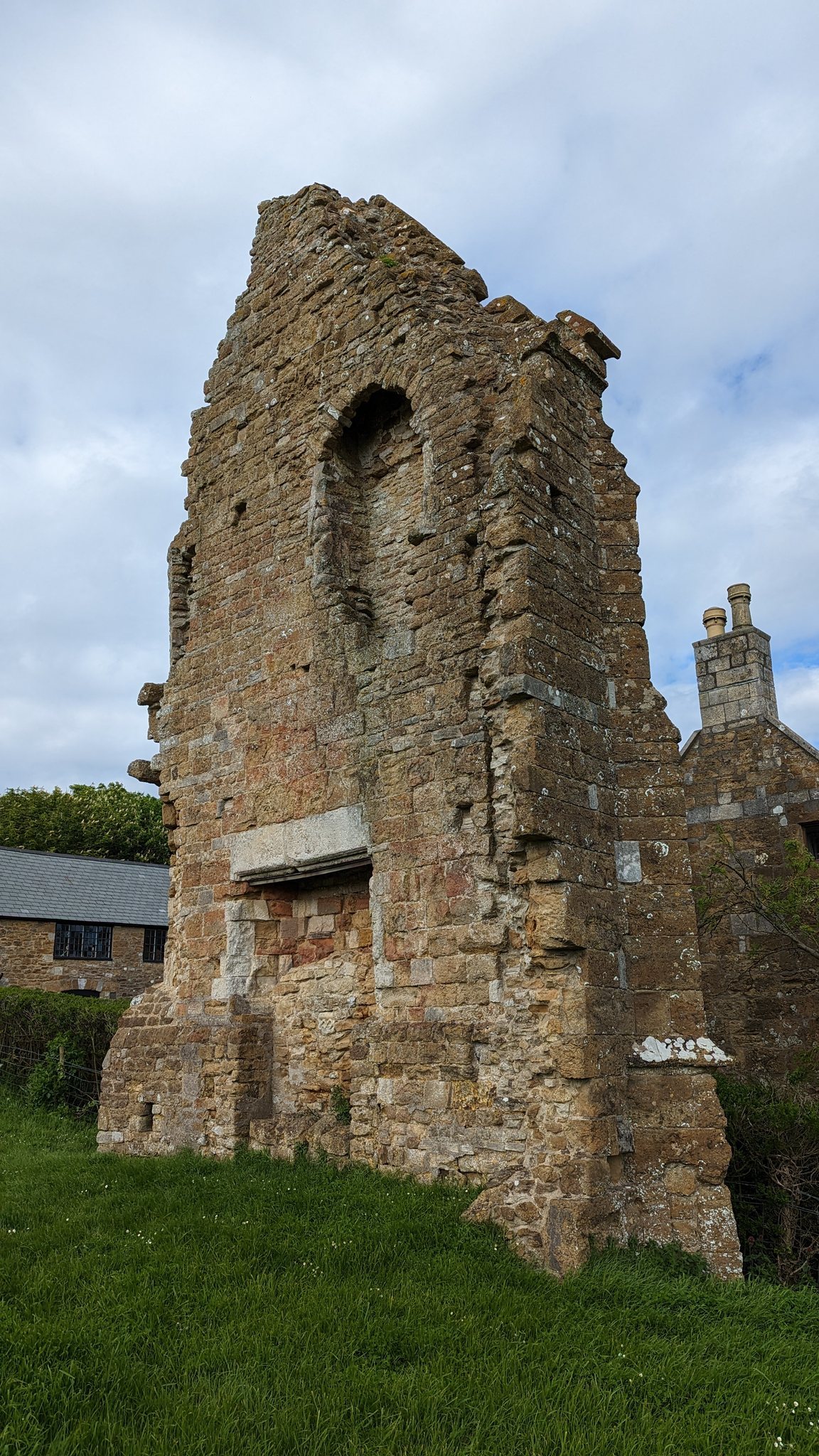
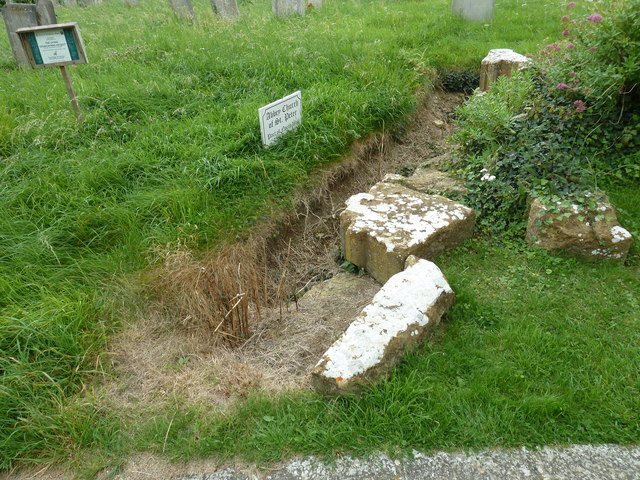
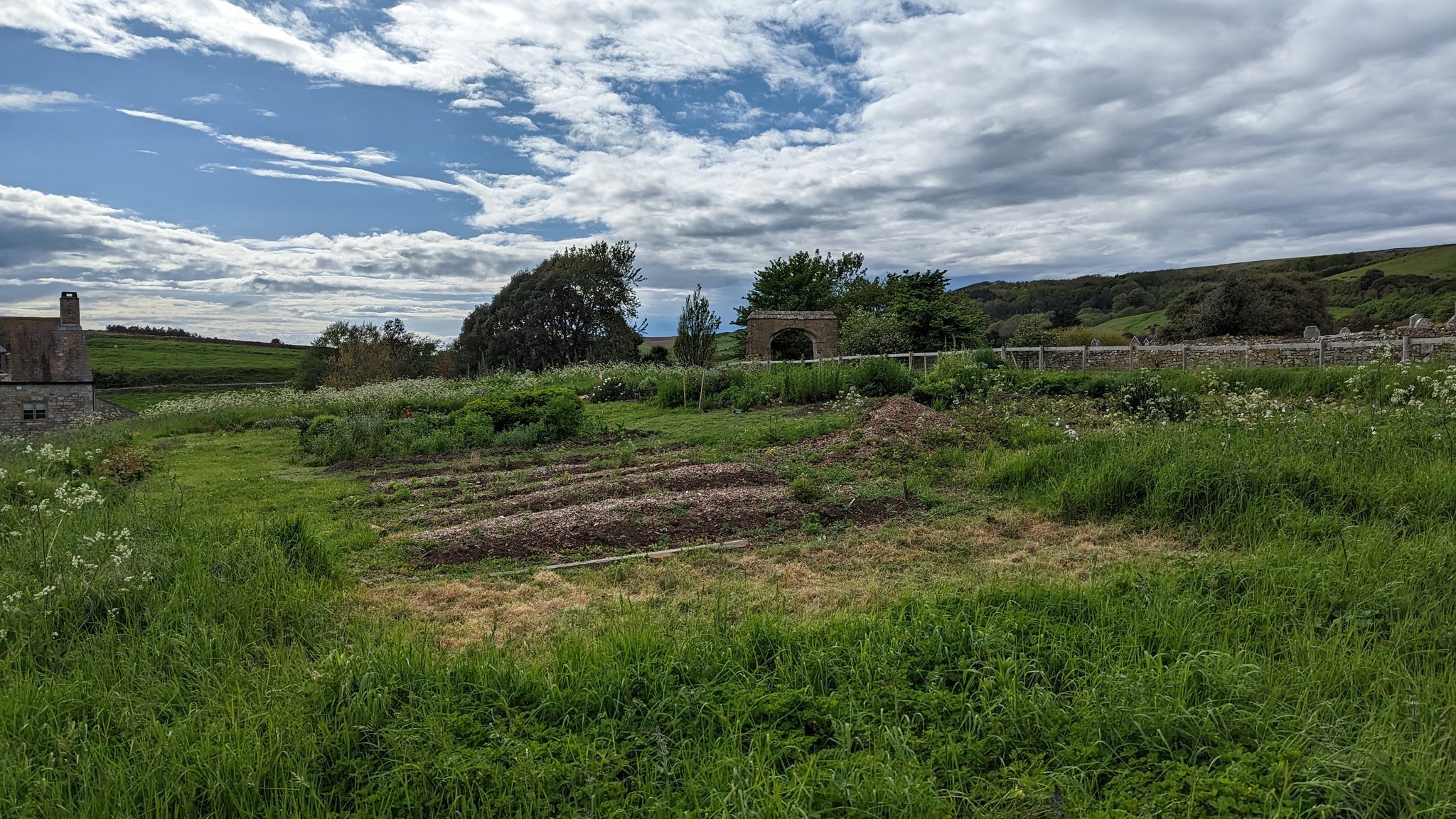
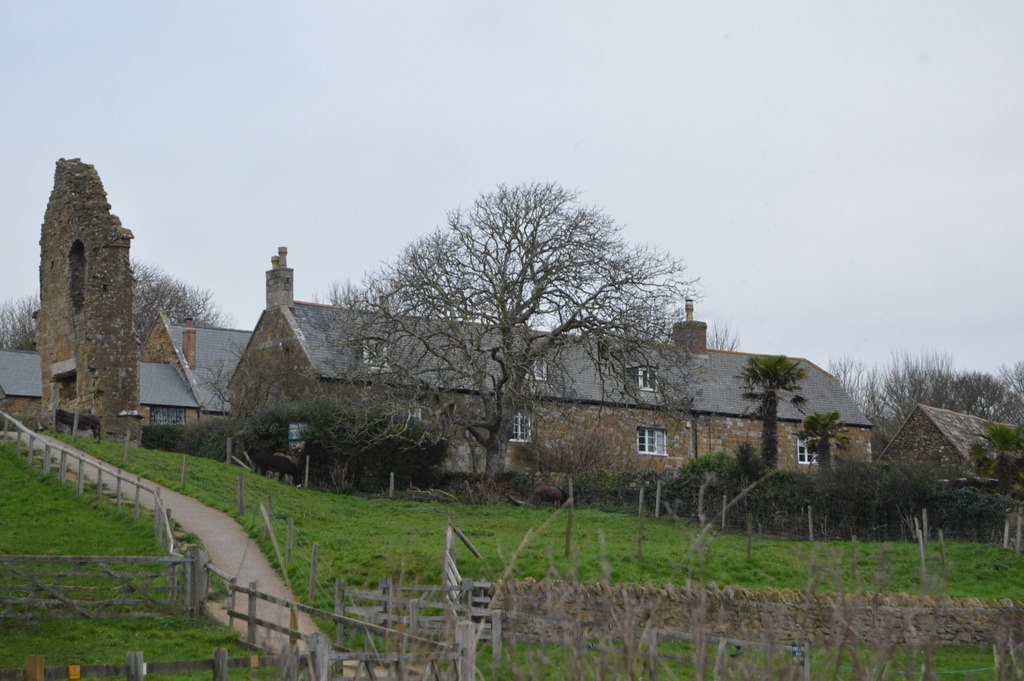
The former abbey complex survives in partial form rather than as a complete monastery. Traces of the north wall can be seen in the churchyard south of the present parish church. Parts of a building possibly identified as the abbot’s house also survive.
Associated buildings
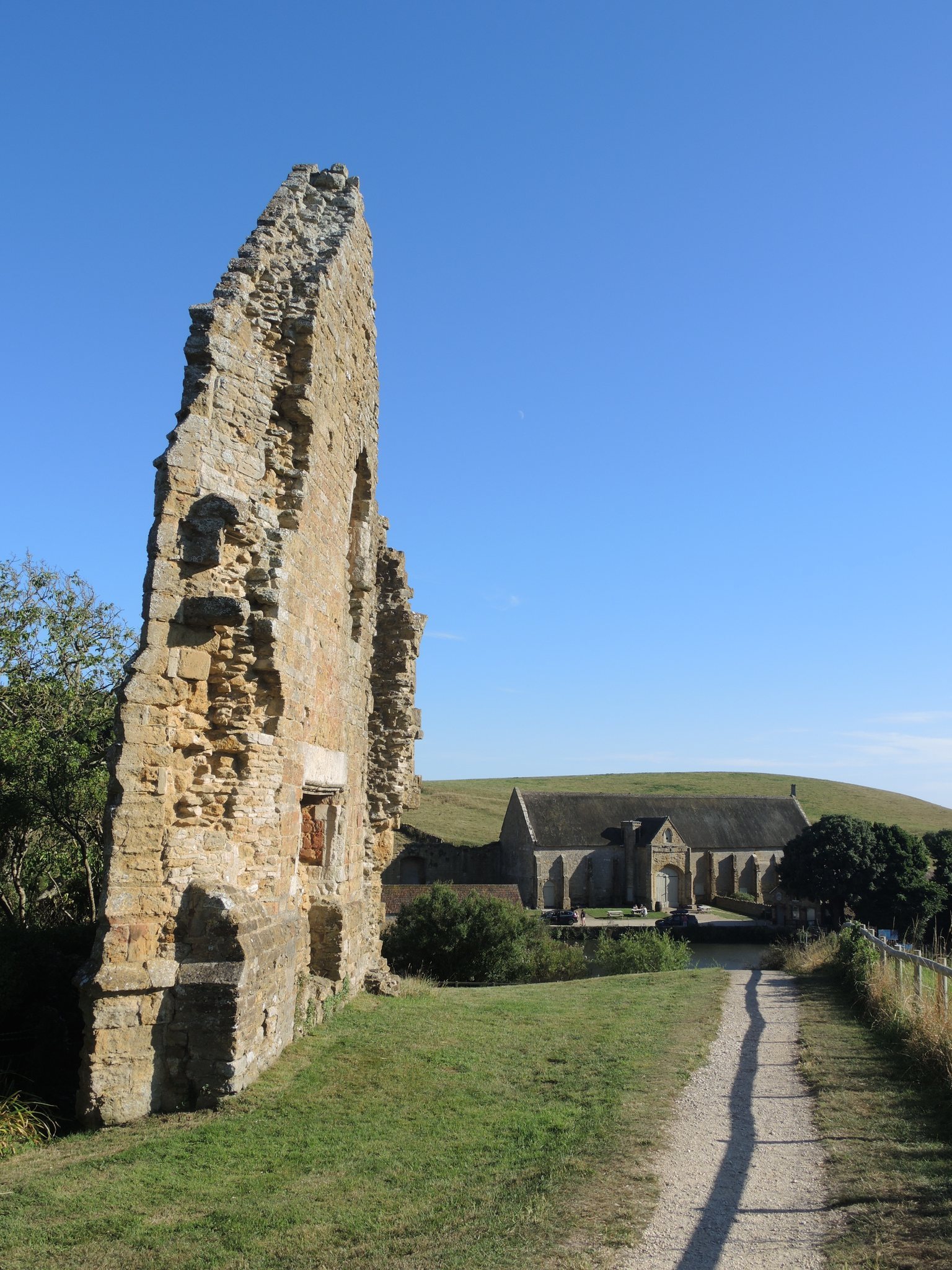
Other surviving or associated features include the Malthouse, Dairy House, Pigeon House, and a gable-ended wall section called Pynion’s End. The complex also retains a gatehouse, a gateway, a run of cottages known as the Abbott’s Walk, Abbey House, and a Granary.
Agricultural and coastal structures
Tithe barn
The fourteenth-century tithe barn is approximately 80 metres long and 9.5 metres wide. A tithe barn was a large agricultural building used to store crops, especially grain, including produce owed to a church or religious institution. The barn is reputedly the world’s largest thatched tithe barn. Only part of its roof remains, and two porches survive, each topped by a watching chamber.
St Catherine’s Chapel
St Catherine’s Chapel stands near the abbey remains. It was used at one time as a lookout over the sea and also served as a landmark for mariners.
Swannery
The former abbey swannery is now known as Abbotsbury Swannery and is described as an internationally famous nature reserve.
Burials
The abbey was associated with the burials of Humphrey Stafford, who died in 1413, and his wife Elizabeth d’Aumale Mautravers Stafford. Sir John Mautravers and another Humphrey Stafford, who died in 1442, were also buried there.