Mikawa Kokubun-niji: The Former Provincial Buddhist Nunnery in Japan
Site at a Glance
- Rating
- 3.8
- Popularity
- Low
- Country
- Japan
- Primary era
- Medieval
- External website
- Open
- Eras represented
- Medieval
- Civilizations
- Yamato
- Site type
- Religious
- Remains
- Monastery
On this page12 sections
History
Foundation and Development
Mikawa Kokubun-niji is the former provincial Buddhist nunnery in Toyokawa, Japan, established within the Nara-period network of state-supported monasteries and nunneries promoted by Emperor Shōmu. Its exact foundation date is unknown, but tradition connects it with the emperor’s decree of 741, which ordered provincial Buddhist institutions to promote Buddhism and reinforce imperial administration. Archaeological evidence indicates that construction followed the neighboring Mikawa Kokubunji.
The nunnery may have been completed as late as the Jingo-Keiun era, from 767 to 770. This possibility is based on the techniques used to produce its roof tiles and on its plan, which followed the arrangement associated with Sai-ryū-ji, a Buddhist temple whose layout served as a model for the complex. The similar plan of Sagami Kokubun-niji has also led to the proposal that both nunneries were established under the administration of Dōkyō, a Buddhist monk and influential court figure during the reign of Empress Shōtoku.
Construction took place in stages. The Kondō, or principal worship hall, the Lecture Hall, and the nuns’ quarters were built before the Middle Gate, the covered corridors, the Belfry, and the Sutra Repository. The formal character of the excavated roof tiles suggests that the two Mikawa provincial institutions were built relatively late in comparison with other provincial temples.
A bronze bell preserved by Kokufushōzan Kokubunji provides a further possibility concerning the complex’s chronology. Although tradition regards it as a Nara-period object, its style places it at the beginning of the Heian period. This has led to the proposal that the Belfry of either the provincial monastery or the nunnery may have been constructed as late as the early Heian period.
Decline and Rediscovery
The later history of Mikawa Kokubun-niji remains unclear. The nunnery is thought to have declined around the end of the Heian period and disappeared from historical records before that period ended. Its precinct lay about 500 meters northeast of the Mikawa Kokubunji ruins, within an area that also contained the Mikawa provincial government site and Funayama Tomb No. 1. Together, these sites indicate that the vicinity had long served as a political center.
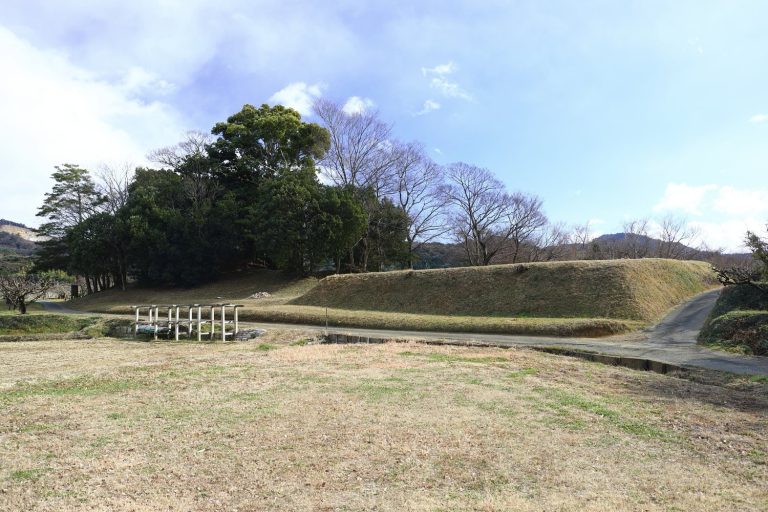
The ruins were discovered by Shibata Tsunee in 1920 and designated a National Historic Site on October 12, 1922. The protected area was expanded on April 22, 1972, after excavations beginning in 1967 identified foundations beyond the original boundary. Further investigations took place in 1990, 1992, and from 1996 to 1999.
Toyokawa City carried out preservation and improvement work from 1999 to 2005. The site opened as the Mikawa Kokubun-niji Historic Site Park on November 13, 2005. A later Soto Zen temple, Seikoji, traditionally said to have been founded in 1595, had occupied the center of the former precinct. It was moved west during the historic-site improvements, leaving the excavated nunnery layout available for preservation and interpretation.
Remains
Precinct Layout
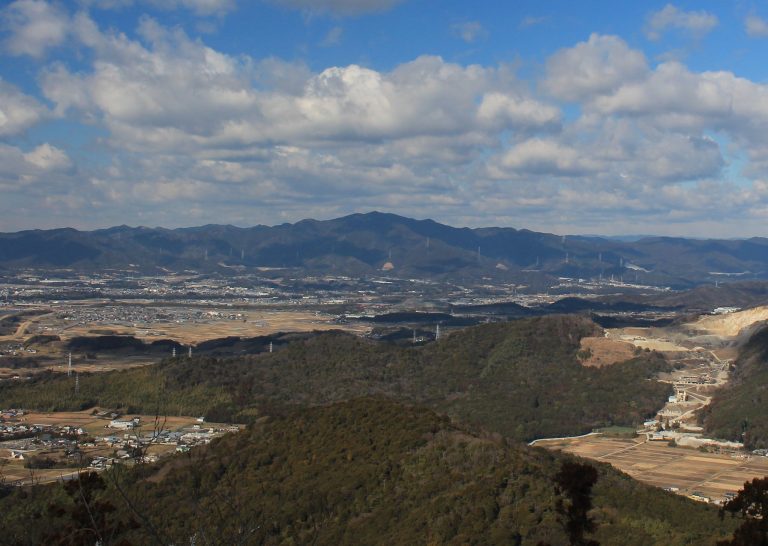
The ruins occupy a roughly 150-meter-square precinct, equivalent to 500 ancient shaku, on the Yahata Plateau. The plateau is a diluvial terrace between the Otowa and Shirakawa rivers, with a south-facing slope backed by Odoriyama to the north. The buildings were arranged along a north-south axis, extending from the South Gate through the Middle Gate, Kondō, Lecture Hall, nuns’ quarters, and a northern building.
Gates and Cloisters
Corridors extended from both sides of the Lecture Hall toward the Middle Gate and enclosed the Kondō. This arrangement formed a double cloister, a covered corridor system made from two parallel ranges around the central buildings. The layout followed the Sai-ryū-ji model and gave the nunnery a formal organization comparable in general form to a provincial monastery.
Worship Hall and Associated Buildings
The Kondō measured approximately seven bays by four bays. A bay is a structural interval between supporting posts. This made the hall nearly the same size as the Kondō at the neighboring Mikawa Kokubunji and unusually large for a nunnery, where comparable halls commonly measured five bays by four. The precinct itself was smaller than the monastery’s, which measured 600 ancient shaku square, and it had no pagoda. The double cloister and the scale of the Kondō nevertheless gave the complex a substantial form. One interpretation is that the monastery’s design was adapted for the nunnery to make construction more efficient.
Materials and Reconstructed Features
Roof Tiles and Kilns
The original kiln that produced the foundation-period roof tiles has not been identified. The tiles resemble those from the Mikawa Kokubunji ruins and from the Etchū Kokubunji ruins in Takaoka, Toyama. This similarity may reflect the movement of tile workers after construction at Etchū Kokubunji. Kilns used for ninth- and tenth-century repairs or rebuilding at the provincial government site, monastery, and nunnery have been identified at the Akatsukayama ancient kiln site in Toyokawa.
Excavated Objects
Excavations have yielded roof tiles, bricks, pottery, and clay miniature pagodas. Some pottery bears ink markings meaning “east” and “monastery.” These inscriptions suggest that the nunnery, positioned east of the monastery, may have been known as the Eastern Temple and that the two institutions maintained contact.
Reconstructed Middle Gate
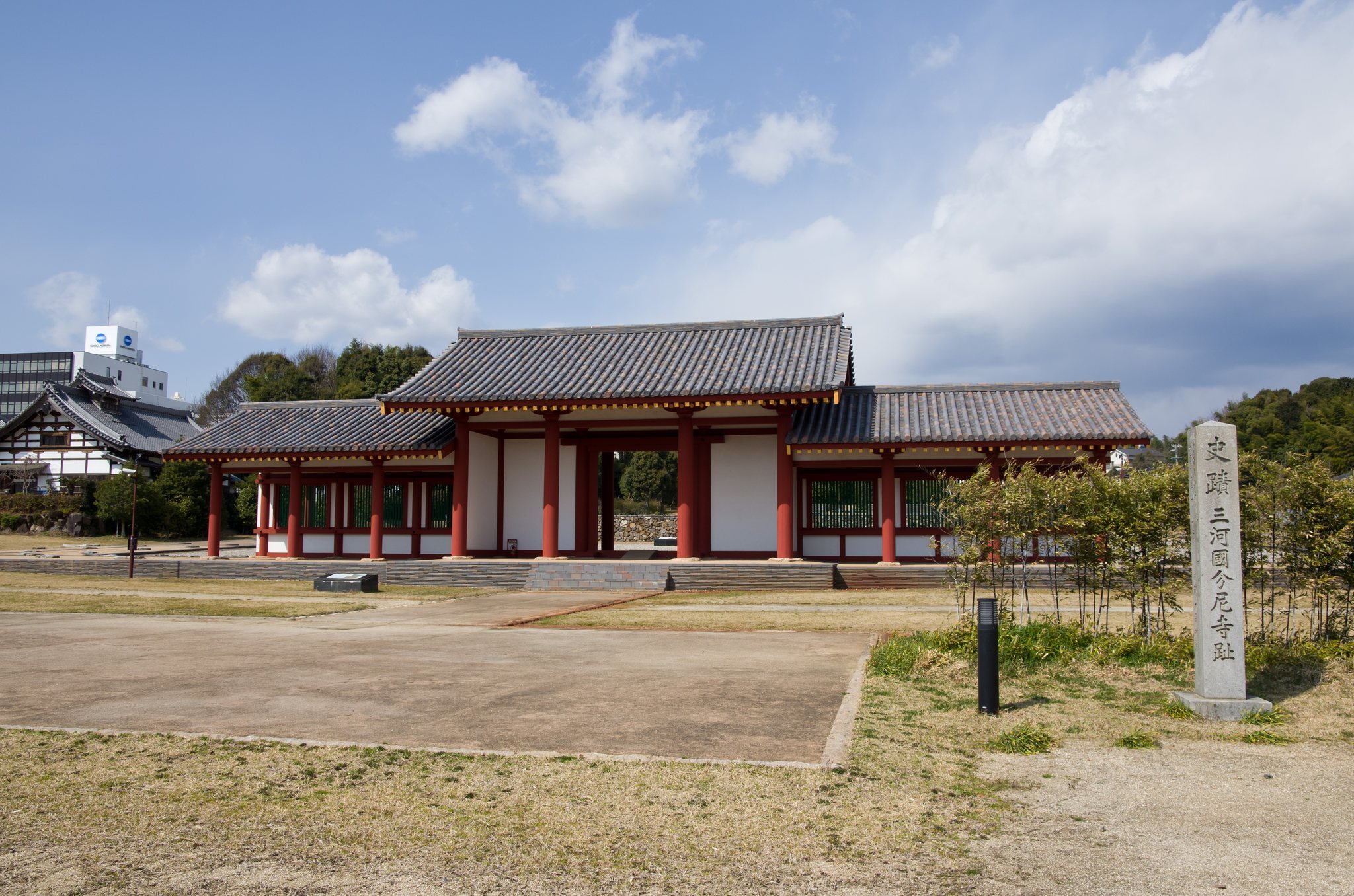
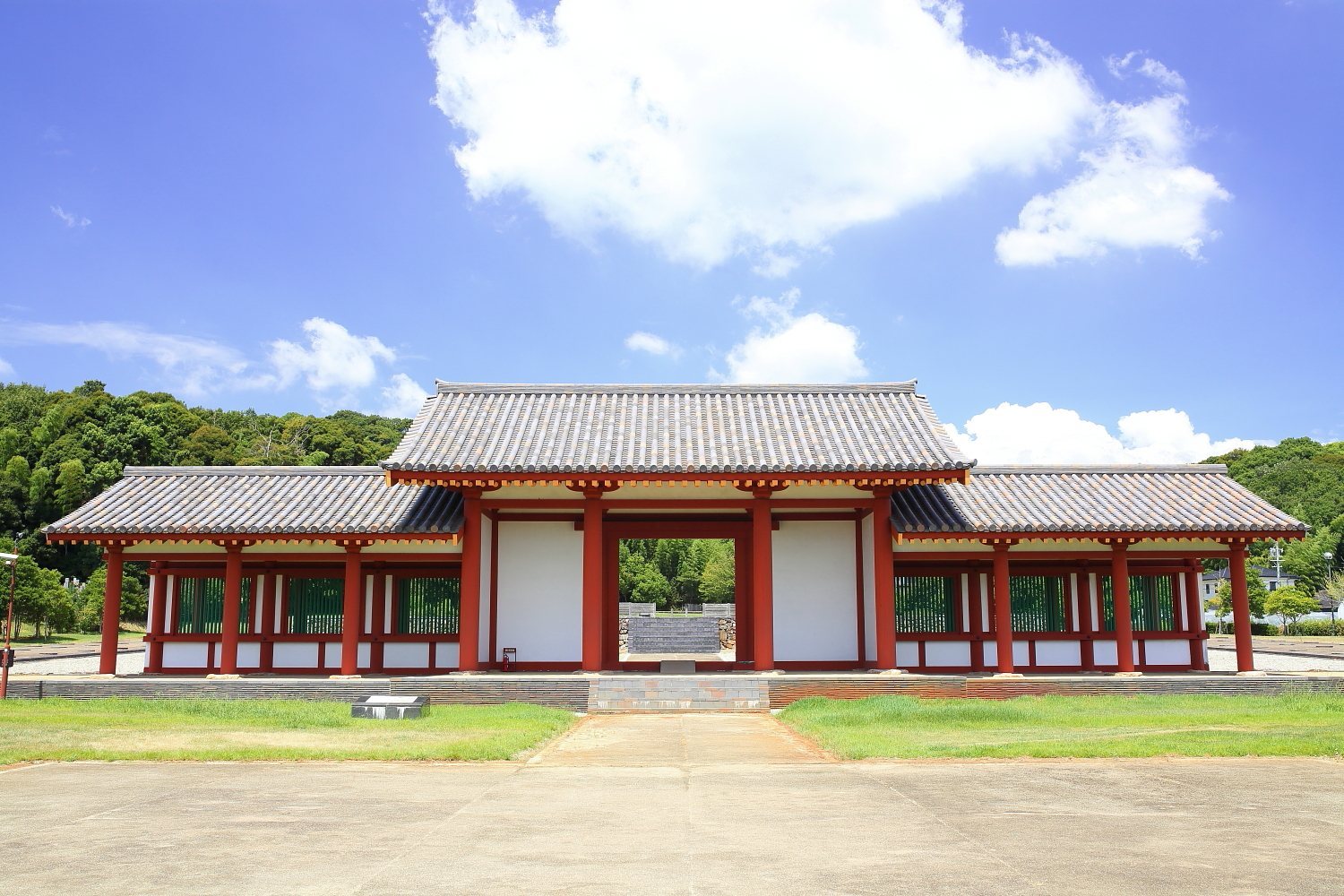
The Middle Gate and part of the Cloister have been reconstructed at full scale and painted red. Their rebuilt forms are maintained within the Mikawa Kokubun-niji Historic Site Park, where they convey the scale and arrangement of the excavated precinct.
Associated Bell
The bronze bell associated with the ancient provincial temple complex is preserved by Kokufushōzan Kokubunji rather than surviving among the excavated ruins. It is regarded as a possible relic of the ancient monastery or nunnery. Its style dates it to the early Heian period, despite its traditional identification as a Nara-period object, and it was designated an Important Cultural Property in 1922.