Santa Maria de Lavaix: A Former Monastery in Catalonia
Site at a Glance
- Rating
- 4.3
- Popularity
- Low
- Country
- Spain
- Primary era
- Medieval
- Eras represented
- Medieval, Early Modern
- Civilizations
- Crown of Aragon, Spanish
- Site type
- Religious
- Remains
- Monastery
On this page10 sections
History
Santa Maria de Lavaix is a former monastery in Spain, near El Pont de Suert in Catalonia, whose institutional history began in 848. Founded as the monastery of Saint Julian of Sentís by Abbot Trasoad, it was soon transferred to Lavagiu or Vilanova, probably at or near the present site. The monastery occupied a frontier position in the valley of the Noguera Ribagorzana and later developed into an important religious and landed institution.
Foundation and Benedictine rule
In 848, Fredelo, Count of Toulouse, granted the early monastery jurisdictional immunity during conflicts among the counts of the Spanish March. In 939, the community was placed under Bishop Atón of Ribagorza. About twelve members lived there under Abbot Adroer, and the monastery was connected with the bishopric of Roda.
In 947, the community adopted the Rule of Saint Benedict, which governed communal religious life through prayer, discipline, and obedience. Raymond II, Count of Ribagorza, granted a further immunity probably between 955 and 970. From 947 to 1092, the monastery followed Benedictine observance while its frontier location gave it strategic importance.
The counts of Pallars and Ribagorza supported Lavaix with extensive donations. These included San Vicente de Soperún, Rins, Serraduy, Aramunt, Hortoneda, Saint John of Espluga de Serra, Saint Mary of Lacera, as well as mills, houses, cellars, lands, vineyards, and other property. Such endowments helped the monastery establish control over the valley of Adons.
In 1015, Bishop Eimerico of Ribagorza consecrated two new altars. During the Benedictine period, the church and monastic buildings were enlarged, and several altars were dedicated to Saint Mary, Saint Peter, Saint John, and Saint Lawrence. Each altar was served by a monk-priest.
Canonical and Cistercian transformation
In 1092, Ramón Ramón, a canon of Roda and Urgel, imposed a canonical rule to exercise closer control over the monastery. A canonical community was governed by clerics living under a common rule rather than by a monastic order. Pope Paschal II later placed Lavaix under the bishopric of Roda, whose see was subsequently transferred to Lérida. In 1112, the monastery of Saint Genís of Bellera was attached to Lavaix.
From 1140, the barons of Erill protected and financed the monastery. Their support included the construction of a major new church and its cloister. In 1223, Bishop Berenguer de Erill restored monastic life and affiliated Lavaix with the Cistercian order, a reform branch of Western monasticism that sought stricter observance of Benedictine principles. The change took effect by 1224, when Lavaix became a daughter house of Bonnefont Abbey within the filiation of Morimond.
The Cistercian period brought further growth. In 1230, monks from Lavaix founded the daughter monastery or priory of Santa Maria de Fontclara in the Bajo Cinca. Lavaix continued to receive endowments, including the parish church of Arén and its property in 1408. Its prosperity also supported an abbatial palace and a separate residence for the Erill family, probably the building associated with Lavaix Castle on the hill north of the monastery.
Decline, dispersal, and submergence
During the early modern period, Lavaix became more stable before gradually declining. The church underwent a major Baroque restoration in the seventeenth century. Its economic power and property were reduced by the ecclesiastical confiscations of 1821, part of the nineteenth-century Spanish measures that dissolved religious houses and appropriated or sold much of their property.
The monastery was affected by the Carlist Wars and suffered repeated plundering. Revolutionaries burned its library in 1833. Definitive exclaustration, the formal removal or departure of members from a monastic community, took place in 1835, and the last monks left in 1855. Remaining nominal privileges were abolished in 1874. Santa Maria de Lavaix then became a sanctuary belonging to the parish of El Pont de Suert.
The monastery’s documentary record was repeatedly damaged or destroyed, with major losses beginning during the War of the Spanish Succession. A faithful 1782 copy of the twelfth- and thirteenth-century Cartoral de Lavaix survives in the library of the Royal Academy of History in Madrid, while a smaller group of documents is held in the chapter archive of Lleida.
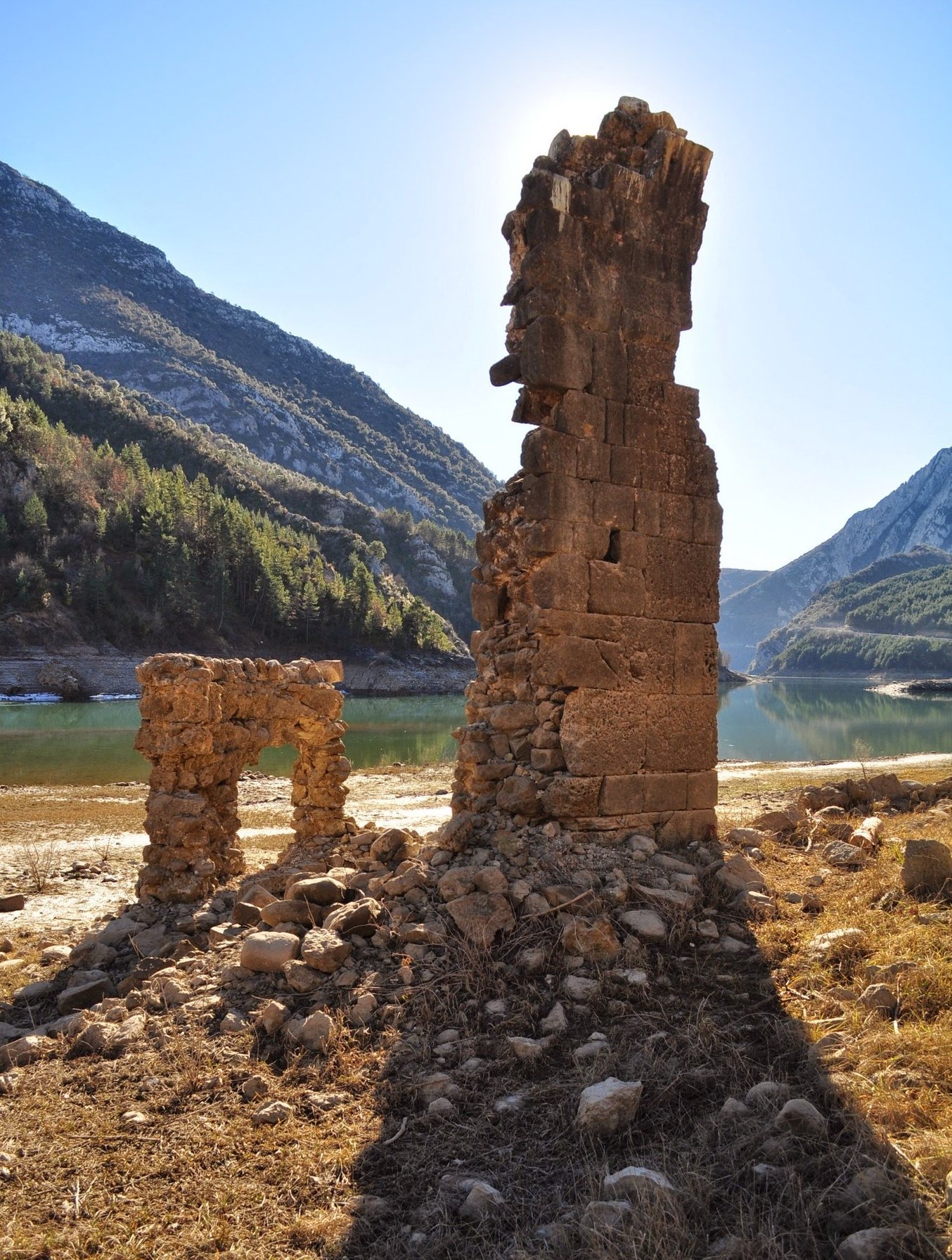
Construction of the Escales reservoir flooded the remains during the 1950s. The ruins deteriorated afterward, although parts emerge when the water level falls. Recent excavations have brought additional information about the monastic complex, though their results remain incompletely published. The former monastery is recognized as a Local Cultural Interest Property, and its territory remains associated with the Diocese of Lleida.
Remains
Santa Maria de Lavaix stood beside a mountain slope in the Noguera Ribagorzana valley. The church formed the northern side of the complex, with the cloister immediately south of it. Other monastic buildings were arranged around the cloister and extended farther south. Much of the complex is submerged beneath the Escales reservoir for much of the year, while lower water levels reveal the church and other remains.
The Romanesque church
The twelfth-century church was a Romanesque, single-nave building with a Latin-cross plan, in which a long central axis is crossed by a shorter transept. Its semicircular barrel vault, a continuous rounded ceiling, covered a nave divided into three bays by transverse arches. The transept was lower than the nave, and the eastern end originally terminated in three semicircular apses. The central apse was slightly larger than the two lateral apses.
Seventeenth-century Baroque alterations replaced the central apse with a much deeper presbytery ending in a rectangle. Surviving structural fragments include the northeast angle of the nave, the southeast pier of the crossing where the nave and transept meet, the springing of the presbytery arch at the southern apsidiole, or smaller subsidiary apse, and lower sections of other walls.
The western entrance had a round arch with two recessed archivolts, the bands of molding that follow the curve of an arch, supported by columns. Three windows opened in the west facade, including a central window probably belonging to the original construction. The facade ended in a five-opening bell gable arranged across three levels.
Monastic buildings
Cloister
The cloister stood south of the church and contained sixteen capitals, the sculpted upper parts of columns or attached shafts. It also incorporated the family burial place of the barons of Erill. The surrounding buildings accommodated the monastic community.
Palaces and Erill residence
The complex included an abbatial palace and a separate residence for the Erill family. The Erill residence was probably situated on the hill north of the monastery and associated with the remains known as Lavaix Castle.
Surviving decoration and condition
Much of the church’s exterior sculptural decoration has disappeared. Some surviving fragments were reused in houses at El Pont de Suert and elsewhere, including Casa Junyent in Esplugues de Llobregat. Capitals held by the Frederic Marès Museum and the National Art Museum of Catalonia may also have come from Lavaix, although their provenance is not securely identified.
The Escales reservoir covers the ruins for much of the year. At high water, only small portions project above the surface. During periods of low water, the remains of the church and other parts of the former monastic complex become visible.