Abbey of Santa María de Alaón: A Lombard Romanesque Benedictine Monastery in Spain


Site at a Glance
- Rating
- 4.7
- Popularity
- Very Low
- Country
- Spain
- Primary era
- Medieval
- External website
- Open
- Eras represented
- Medieval
- Civilizations
- Crown of Aragon, Visigothic
- Site type
- Religious
- Remains
- Monastery
On this page11 sections
History
The Abbey of Santa María de Alaón is a former Benedictine monastery in Sopeira, Spain, whose present Lombard Romanesque church was built in the late eleventh or early twelfth century over a Visigothic foundation. Also known as Nuestra Señora de Alaón and the Abbey of Nuestra Señora de la O, it became an important religious institution in Ribagorza and later continues as the parish church of Sopeira.
Visigothic origins and early records
The monastery may have originated in the sixth or seventh century, during the Visigothic period. Its existence is recorded from 806, when Begon, Count of Toulouse, commissioned Abbot Chrysogonus to reorganize the monastery of Santa María. At that time, it served as the head of the pagus ripacurciense, a territorial district associated with the medieval County of Ribagorza, under the authority of the Bishop of Urgell.
Muslim forces destroyed the monastery in 1006. During the subsequent Cluniac period, a medieval reform movement within Benedictine monasticism, Alaón lost its independent monastic character. By the end of the eleventh century, it had become dependent on the cathedral of Roda de Isábena.
Restoration and medieval influence
Bishop Ramon Dalmau strengthened the institution by appointing Bernardo Adelm, a monk of San Victorián, as abbot. With renewed Benedictine support, the monastery was restored and acquired the appearance associated with the surviving church. Saint Ramon, Bishop of Roda, consecrated it on 8 November 1123.
A period of prosperity followed. The abbey exercised influence over other religious buildings in the surrounding area, several of which adopted a similar architectural style. Its abbot held powers described as almost episcopal and represented the Kingdom of Aragon as a deputy, attending the Cortes in the ninth place on the right.
Later monastic history
In the seventeenth century, Abbot Benito Latras died while attending the Cortes on 11 June 1682. His body was transferred to the crypt and became associated with the legend of Cosán, or Cos Sant. According to the tradition, travelers could obtain a safe journey by tossing a coin.
Monastic life ended after the Ecclesiastical Confiscations of Mendizábal in 1836, when church properties in Spain were seized and transferred out of ecclesiastical ownership. The former monastery then became Sopeira’s parish church. During the Spanish Civil War, a fire destroyed part of the monastery and its remaining possessions. Benito Latras’s remains, a Romanesque sculpture, and other valuable objects were burned at the beginning of the conflict.
Records, archaeology, and protection
The abbey’s cartulary, a manuscript collection of copied charters and institutional records, contains up to 327 documents concerning the monastery and its dependencies between 806 and 1245. The material includes foundation records, privileges, ecclesiastical rights, genealogies, and accounts of medieval events. The collection was probably compiled in the second half of the twelfth century, largely from an earlier cartulary of the tenth or eleventh century. Its latest document dates to 1121, although documents from the thirteenth century were added later.
Around the fifteenth century, an anonymous writer, probably a monk of the abbey, is believed to have added entries about events connected with the County of Ribagorza during the eleventh and twelfth centuries. The cartulary also states that Bernard Unifred, Count of Ribagorza, and his wife were buried at Alaón. Archaeological excavations later found a tombstone set into the northern wall of the church commemorating the “Venerable Count Unifred.”
The abbey was protected as a Historic-Artistic Monument and included in Spain’s National Artistic Treasure by the government of the Second Republic in 1931. In 2004, the Government of Aragon declared it an Asset of Cultural Interest. The church and surviving monastic structures have since been restored and remain in good condition.
Remains
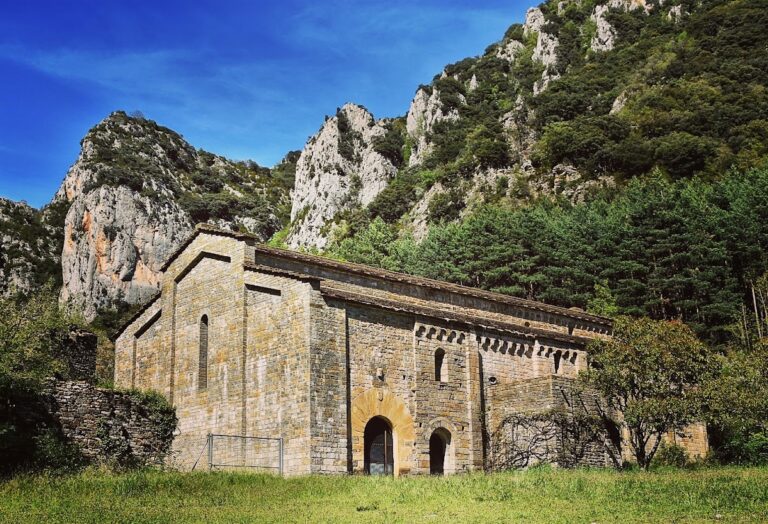
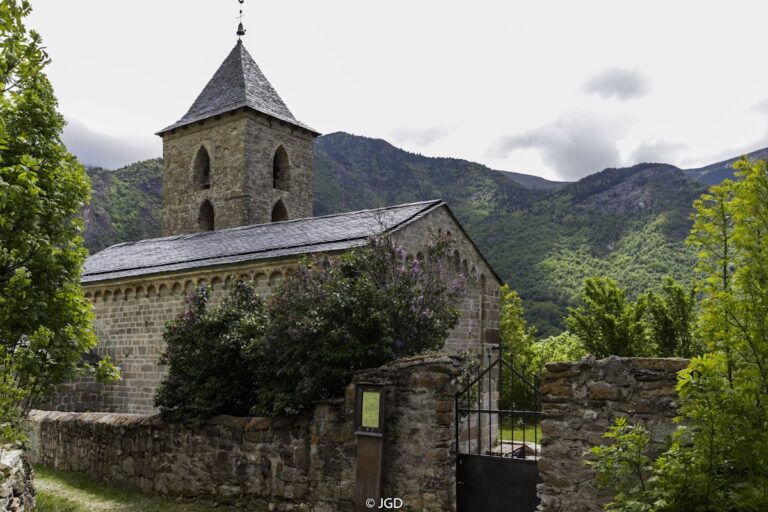
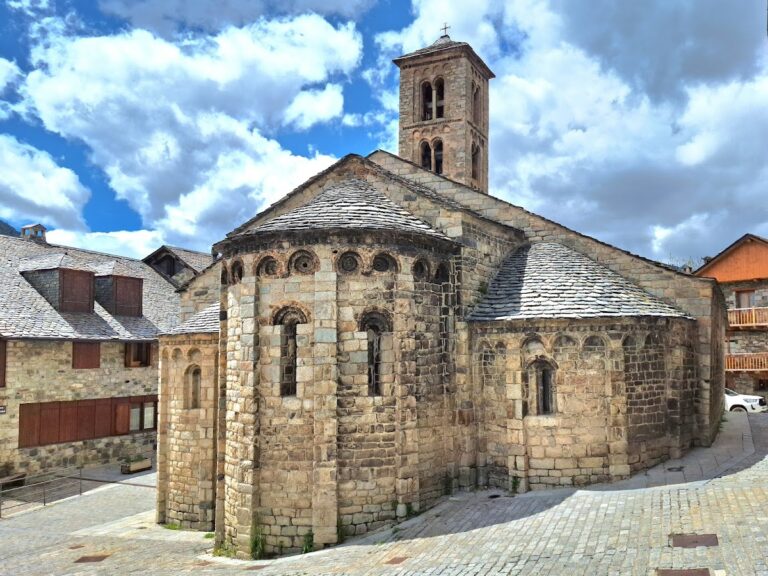
The surviving complex is centered on a Lombard Romanesque basilica with three aisles, semi-cylindrical apses, and a square bell tower rising through four storeys. The church stands above an earlier Visigothic sanctuary, while the remaining monastic fabric includes fragments of the former cloister and other restored structures.
Church and underground sanctuary
Romanesque basilica
The church has three aisles and semi-cylindrical apses decorated with blind arcades, a series of shallow arches applied to the wall surface. Its main doorway is formed by voussoirs, wedge-shaped arch stones, beneath a semicircular arch and archivolts, which are successive ornamental bands around an arch. A Trinitarian chrismon, a Christian monogram representing the Trinity, is placed above the entrance. The square bell tower has four storeys and forms part of the surviving church structure.
Visigothic crypt
Two stairways beneath the main sanctuary descend to a crypt. Archaeological examination established that this underground space was originally a small Visigothic temple, over which the later abbey was built. The crypt therefore preserves the physical relationship between the early sanctuary and the Romanesque church above it.
Inscriptions and count’s tombstone
Partial removal of modern stucco in the vaulted passage leading to the crypt revealed two groups of inscriptions. One dedicates the church to Saints Peter and Paul, principal apostles of early Christianity. The other, written in red Visigothic characters, dedicates the small sanctuary to Saints Nereus and Achilleus, early Christian martyrs.
The tombstone commemorating Bernard Unifred is set into the church’s northern wall. It bears the Latin inscription “Venerabilis Unifredus Comes,” meaning “Venerable Count Unifred,” and preserves the memory of the Ribagorza count associated with the abbey’s burial tradition.
Former cloister and monastic remains
The monastery formerly had a cloister, but only a few bases of its original columns survive. Other remaining monastic structures, together with the church, have been restored, preserving the principal physical elements of the former abbey complex.
Nearby sites