Hardehausen Abbey: A Cistercian Monastery and Educational Centre in Germany
Site at a Glance
- Rating
- 4.4
- Popularity
- Very Low
- Country
- Germany
- Primary era
- Medieval
- Eras represented
- Medieval, Early Modern, Modern
- Civilizations
- Holy Roman Empire
- Site type
- Religious
- Remains
- Monastery
On this page17 sections
History
Hardehausen Abbey is a former Cistercian monastery in Germany, near Warburg in North Rhine-Westphalia. Bishop Bernhard I of Oesede founded it on 28 May 1140 as the first Cistercian foundation in Westphalia, and its initial buildings were completed in the wooded valley by 1155. The abbey belonged to the Diocese of Paderborn, was founded from Kamp Abbey, and ultimately formed part of the wider Cistercian network descending from Morimond Abbey. Its church was dedicated in 1165, when Hardehausen was also raised to abbey status.
Before and during the foundation
The settlement had earlier connections with the ecclesiastical administration of Paderborn. In 1009, Bishop Meinwerk established an episcopal estate at Herswithehusen, and a document from 1036 recorded three farmsteads and associated lands at Hiriswithuson, a name identified with Hardehausen. By the foundation of the monastery, the settlement was known as Hardenhusium.
The first abbot, Daniel, came from Kamp with twelve monks. The monastery was placed in a wooded valley surrounded by marshland, a setting associated with many Cistercian foundations. Before the foundation charter was signed on 15 May 1155, disputes and transactions involving Corvey Abbey, Duke Henry the Lion, and the Counts of Everstein and Schoneburg had been settled. The land had been cultivated and the first buildings were already in use.
After the church dedication in 1165, Hardehausen’s abbots received a seat and vote on the prelates’ bench of the Holy Roman Empire, the political framework in which ecclesiastical rulers and prelates held formal territorial rights. The abbey soon became a source of new foundations. It supplied monks for Marienfeld Abbey in 1185, Bredelar Abbey near Marsberg in 1196, and Scharnebeck Abbey near Lüneburg in 1243.
Religious, social, and economic development
Hardehausen acquired the women’s monastery of Walshausen in 1293 and replaced its emptied community with a male Cistercian convent in 1320. It exercised spiritual supervision over the women’s monasteries at Brenkhausen and Wormeln, provided provosts for neighboring women’s communities, served churches in its monastic villages, and held the right to present clergy to the parish of Scherfede.
The convent consisted mainly of sons of non-noble families from the Paderborn region and neighboring dioceses. The monks served as clergy in surrounding monastic villages, while the abbey supported regional religious life through processions, pilgrimages, and confraternities. A large procession took place in the Warburg region on the second Rogation Day before Ascension, a traditional day of prayer and procession associated with agricultural protection. Pilgrims also traveled from the monastic villages to Kleinenberg and to the major Vincent pilgrimage at Scherfede. In 1734, Abbot Vinzenz Spancken entered a prayer confraternity with Abdinghof Abbey in Paderborn and Marienmünster Abbey.
Agriculture was central to the monastery from the beginning. Hardehausen initially relied on direct labor and the processing of farm products, but from the fourteenth century some lands were leased because the community no longer had enough workers to cultivate them all. The abbey expanded its possessions through purchases, gifts, loans secured against land, and parts of the inheritance of the Counts of Everstein after their male line ended.
About two centuries after its foundation, Hardehausen had become the largest ecclesiastical landowner in the Principality of Paderborn, an ecclesiastical territory ruled by the prince-bishop of Paderborn. Its holdings comprised approximately 16,000 morgens, a historical land measure whose size varied by region, including about 7,500 morgens of woodland. The abbey held manorial authority and patrimonial jurisdiction, meaning lower judicial and administrative powers, over several settlements. Its lands reached roughly from Salzkotten to Kassel and from Brakel to Fritzlar.
The monastery operated agricultural granges, mills, workshops, urban residences, and administrative properties. Its enterprises included fishponds, fishing rights on the Diemel, fruit and vegetable cultivation, pig and sheep husbandry, beekeeping, grain and oil milling, shoemaking, and weaving. The Hardehausen monastery apple was cultivated on the estate. At its height, the community comprised about 450 monks and lay brothers, members of the religious community who generally undertook agricultural, craft, and administrative work under a distinct form of monastic discipline. Hardehausen was consequently one of the major economic powers of the Paderborn region.
The abbey was exempt from secular guardianship from its foundation and extended that privilege to many acquired lands. It maintained a hospital and distributed bread to people in need. Its scriptorium was active in 1180–1182, and the calendar-computation manuscript Computus emendatus, written by the Paderborn master Reihner, remained in the monastic library in 1715. The monastery educated priest-monks in theology and philosophy and supported advanced study at universities including Erfurt and Paderborn.
Reformation, war, and rebuilding
The Reformation divided the convent between Catholic and Protestant factions. Martin Thonemann, a declared Catholic, became the forty-first abbot after defeating the Protestant candidate. Hardehausen was then commissioned to oppose reforming tendencies in affiliated monasteries. It conducted a visitation at Scharnebeck and mediated disputes involving Loccum and Amelungsborn. Scharnebeck was dissolved in 1531 after its abbot resigned, while Loccum temporarily returned to Catholic observance between 1630 and 1634 during mediation involving Hardehausen.
During the Thirty Years’ War, the European conflict of 1618–1648, Hardehausen was looted and partly destroyed. Abbots Stephan Overgaer and Laurentius Kremper directed rebuilding between 1680 and 1750, creating much of the complex’s later appearance.
Hardehausen was secularized on 29 January 1803. Abbot Petrus von Gruben and twenty-five monks were expelled, while the abbot and conventuals received pensions. The French general François-Étienne Kellermann received the former abbey as a gift. After the church was demolished in 1812, its furnishings were sold or auctioned, and the lands were leased as a state domain. When the territory became Prussian in 1815, the forest passed to the state.
From estate to educational centre
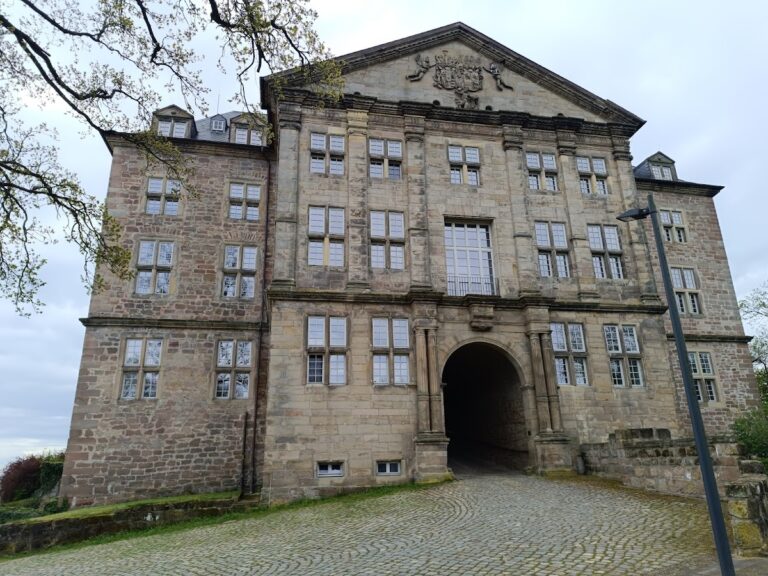
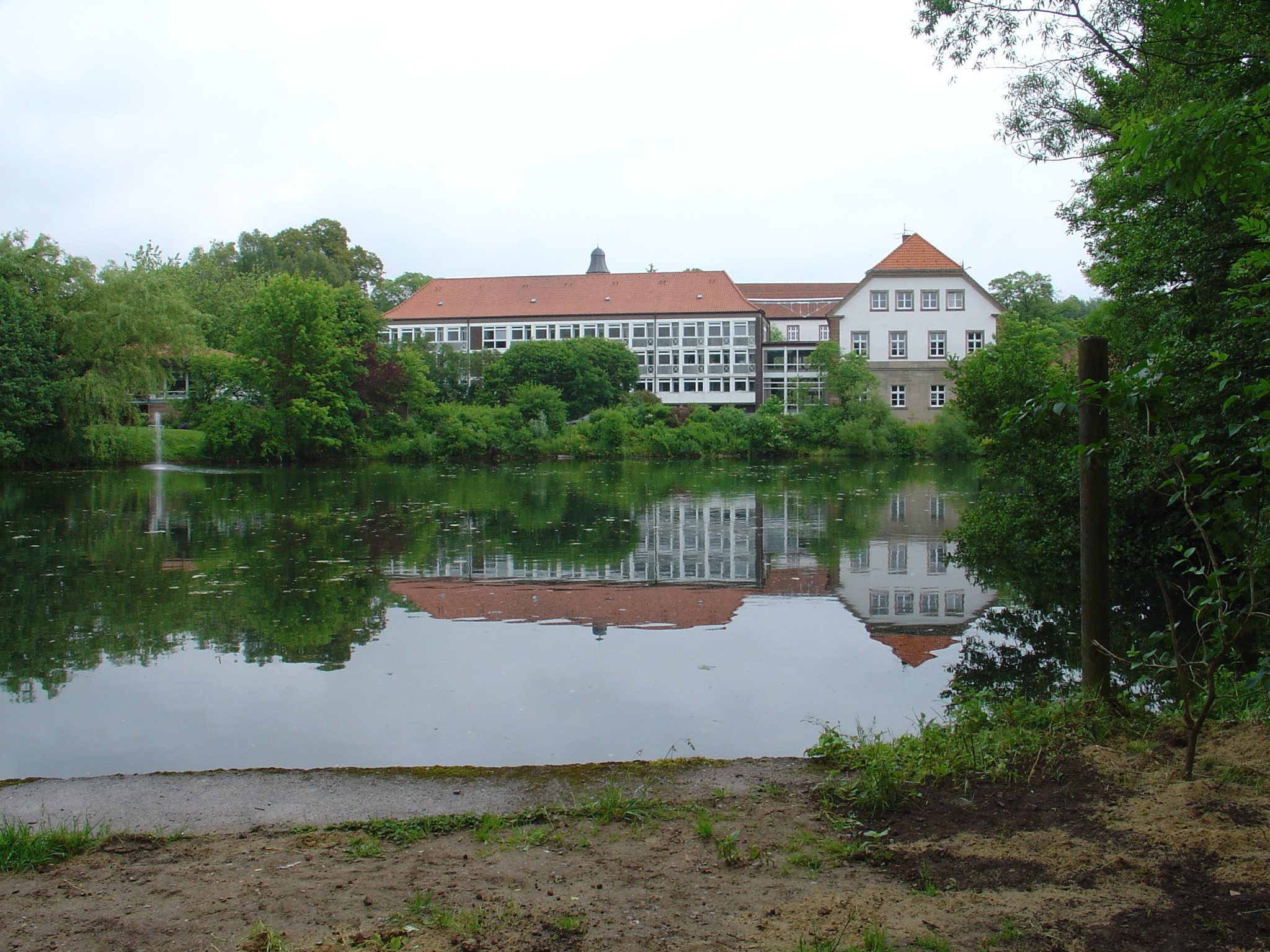
Count Franz von Merfeld acquired the neglected buildings and converted them into a substantial château. After his death, the estate administrator Bang bought the complex from the Merfeld heirs in 1852, and it later passed to the Counts Wydenbruck. From 1902, the buildings housed the Royal Prussian Educational Institution, known throughout Germany for applying educational ideas regarded at the time as revolutionary.
Cistercians returned in 1927, when Prior Alfons Heun and monks from Marienstatt Abbey reoccupied part of the former monastery. Pope Pius XI restored Hardehausen’s abbey status in 1931, and Heun became abbot in 1933. The National Socialist regime dissolved the community in 1938, amid political pressure and economic difficulties. The monks moved to Magdeburg-Neustadt for parish work. Heun went to Brazil in 1939, and the remaining community followed in 1941 to Itatinga, where they founded Hardehausen-Itatinga. Hardehausen’s canonical rights were transferred to the Brazilian monastery, which was consequently regarded in ecclesiastical law as Brazil’s oldest monastery.
In 1938 the complex was sold to the Kassel company Henschel and later acquired by the Association of Catholic Workers’ Colonies, which established an institution for treating alcoholism. In 1944, the National Political Educational Institution at Bensberg moved to Hardehausen. Approximately thirty prisoners from a Buchenwald concentration-camp external work detachment were forced to work there. American forces seized the complex in May 1945, but Archbishop Lorenz Jaeger prevented its destruction or looting.
Diocesan youth chaplain Augustinus Reineke established an archdiocesan youth centre at Hardehausen in 1945, with its first courses held that summer. The Federation of German Catholic Youth was founded there in 1947. In 1949, the Anton Heinen Catholic rural adult-education college was established alongside the youth centre. The former monastery buildings have since served the Archdiocese of Paderborn as educational, conference, and recreational facilities.
A documentation centre for the history of Catholic youth work in Germany has occupied part of Hardehausen since 1977. Since 1991, the youth farm has taught children and young people about ecological practices. Vincentian sisters, whose tradition emphasizes charitable service and care for the poor, lived at Hardehausen until 2008. A small Franciscan community was established there in 2009 to offer shared religious life and spiritual guidance.
The abbey archive includes charters from 1130 to 1796 and administrative records from 1399 to 1802, now held in the Münster State Archives. Much of the library was lost after secularization, although parts had already been sold in 1718 to the Duke of Wolfenbüttel and are now preserved in the Herzog August Library. The complex’s present institutional role grew from the post-1945 youth centre and the Anton Heinen college, which adapted the surviving buildings and the later church for educational use.
Remains
Monastic precinct and cloister
Conventual buildings
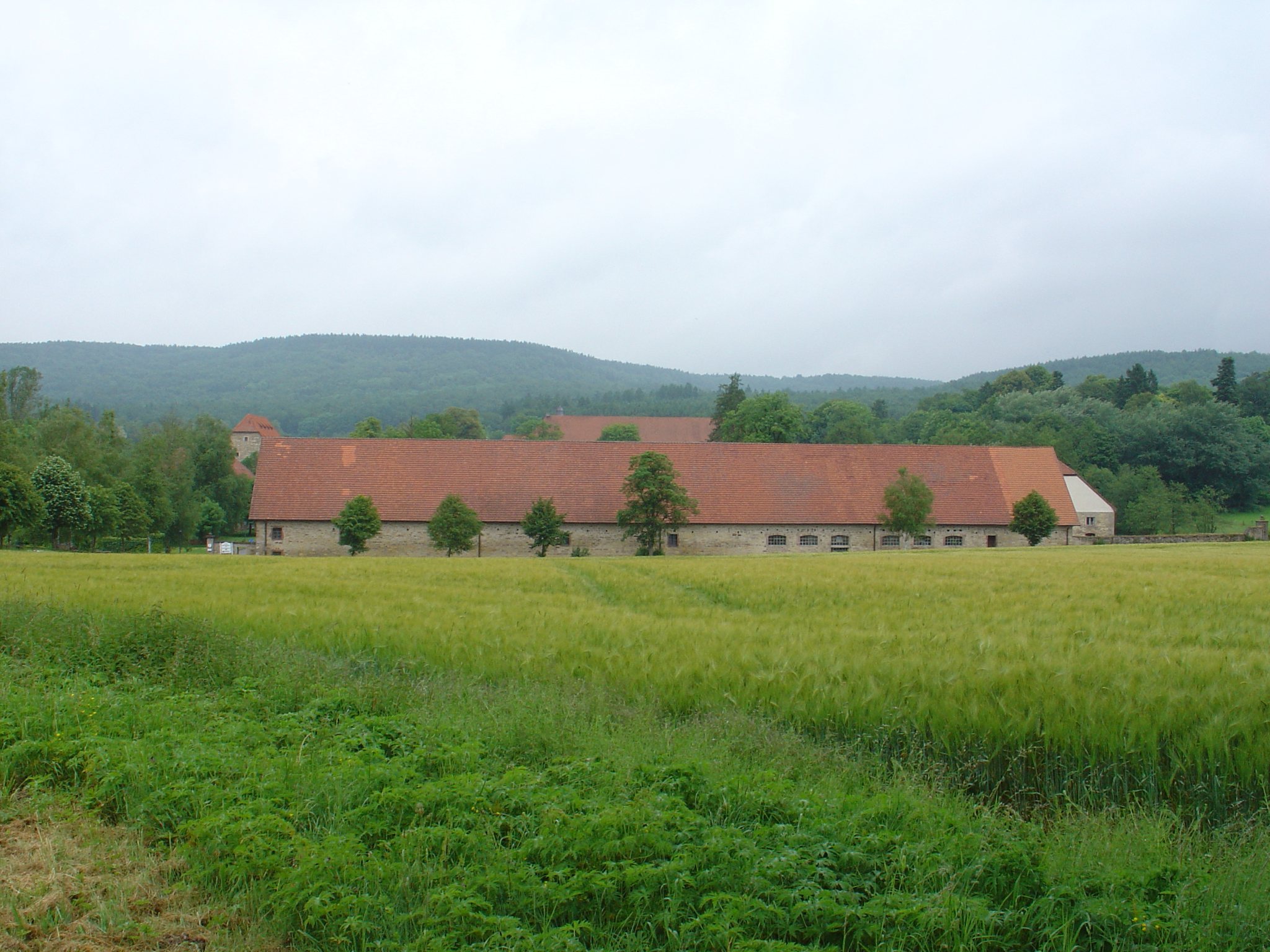
The former abbey occupied a precinct of approximately 72 morgens enclosed by a perimeter wall. The conventual buildings formed a two-storey quadrum, a roughly square arrangement of monastic ranges around a central cloister. The south wing extended eastward, and parts renewed by an abbot were given Gothic forms. The west wing contained the lay-brothers’ building, while the refectory was later demolished.
Cloister details
The partly two-aisled north cloister retains richly profiled column bases from the foundation period. A vault-closure stone in the east cloister carries the Three Hares, a medieval motif in which three animals form a circular composition and their ears create a triangular pattern.
Church and chapels
Abbey church
The former abbey church was a cruciform column basilica with a triple apsidal ending and two subsidiary apses at the transept. Its central nave had a flat roof. The church represented a Hirsau plan, a Romanesque layout associated with the reforming monastic tradition of Hirsau, and was regarded as a major monument of Weser Romanesque architecture. Four Attic-form column bases and a Corinthian capital survive from the former basilica. A fully preserved capital with a palmette-ring band was especially admired for its workmanship.
Altars and burials
The high altar was dedicated to Saint Mary, the Glorious Virgin, with the dates 1160 and 1650 associated with it. Other altars were dedicated to Saints Peter and Paul, Saint John the Baptist, Saint Nicholas, the Trinity, and Saints Agnes and Lucy. The eastern wing contained the Stephen Chapel, which served as the Spiegel family crypt. The northern choir held the burials of Bishop Bernhard, the abbey’s co-founder, and Bishop Siegfried of Paderborn, who was associated with the Cistercians and requested burial there.
Surviving and later churches
The Chapel of Saint Catherine ante portas, meaning “before the gates,” was built in 1261 and demolished on the abbot’s orders in 1764. The oldest surviving monastery building is an octagonal funerary chapel, probably an ossuary, dating from the beginning of the thirteenth century. An ossuary is a chamber used to house human bones removed from graves. The monastery also had a Marian chapel associated with its hospital.
The abbey church was demolished in 1812. The western part of its nave survives within the present church, while four column bases and portions of the choir and transept outer walls were incorporated into the forecourt north-east of the cloister. A new church was built in 1965–1966 for the youth centre and adult-education college and was substantially remodelled between 2015 and 2017.
Agricultural and service buildings
Farm courtyard and garden
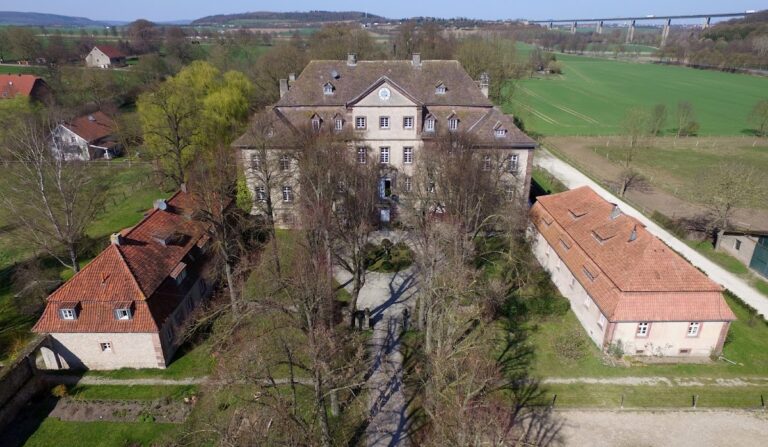
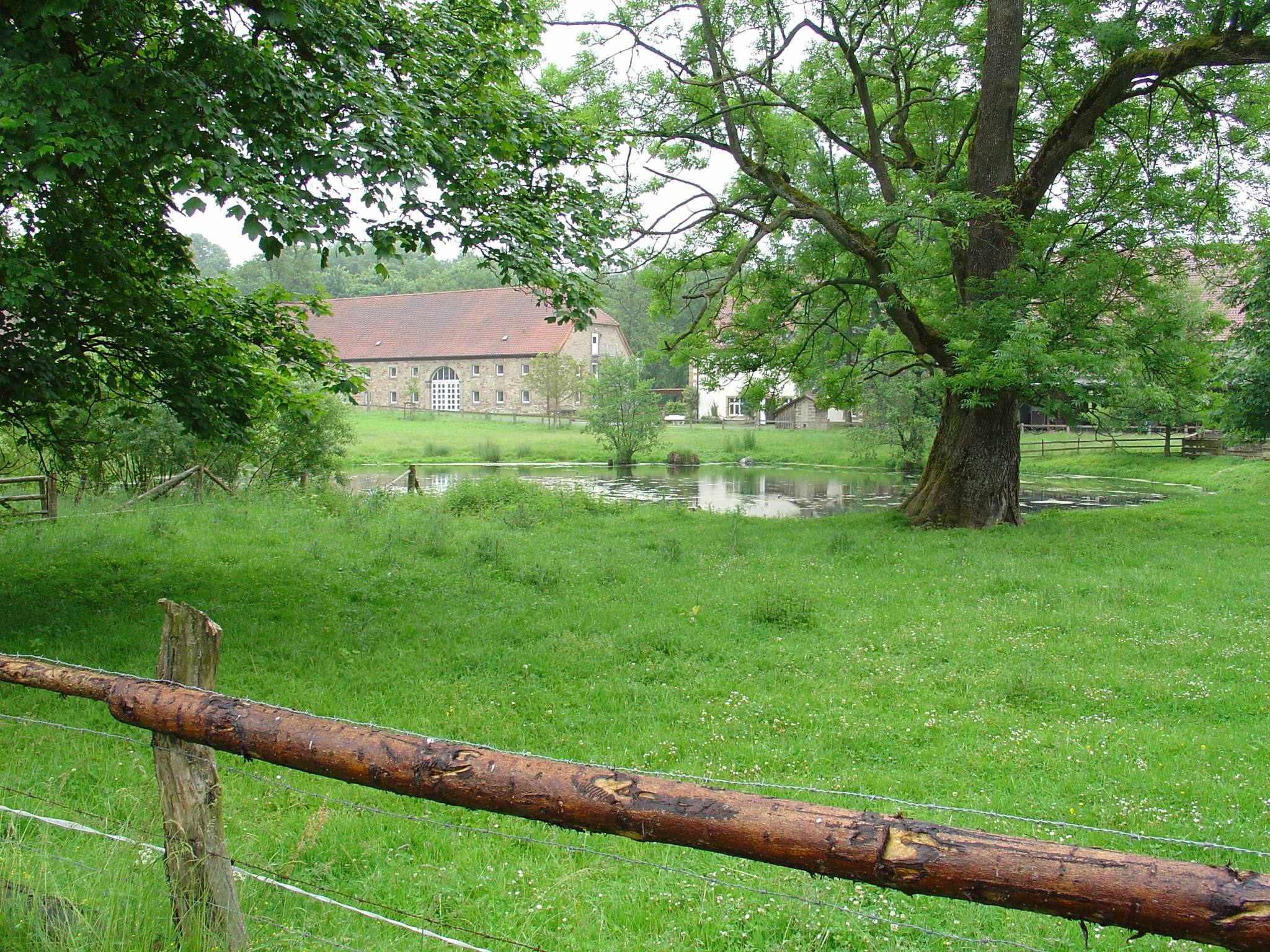
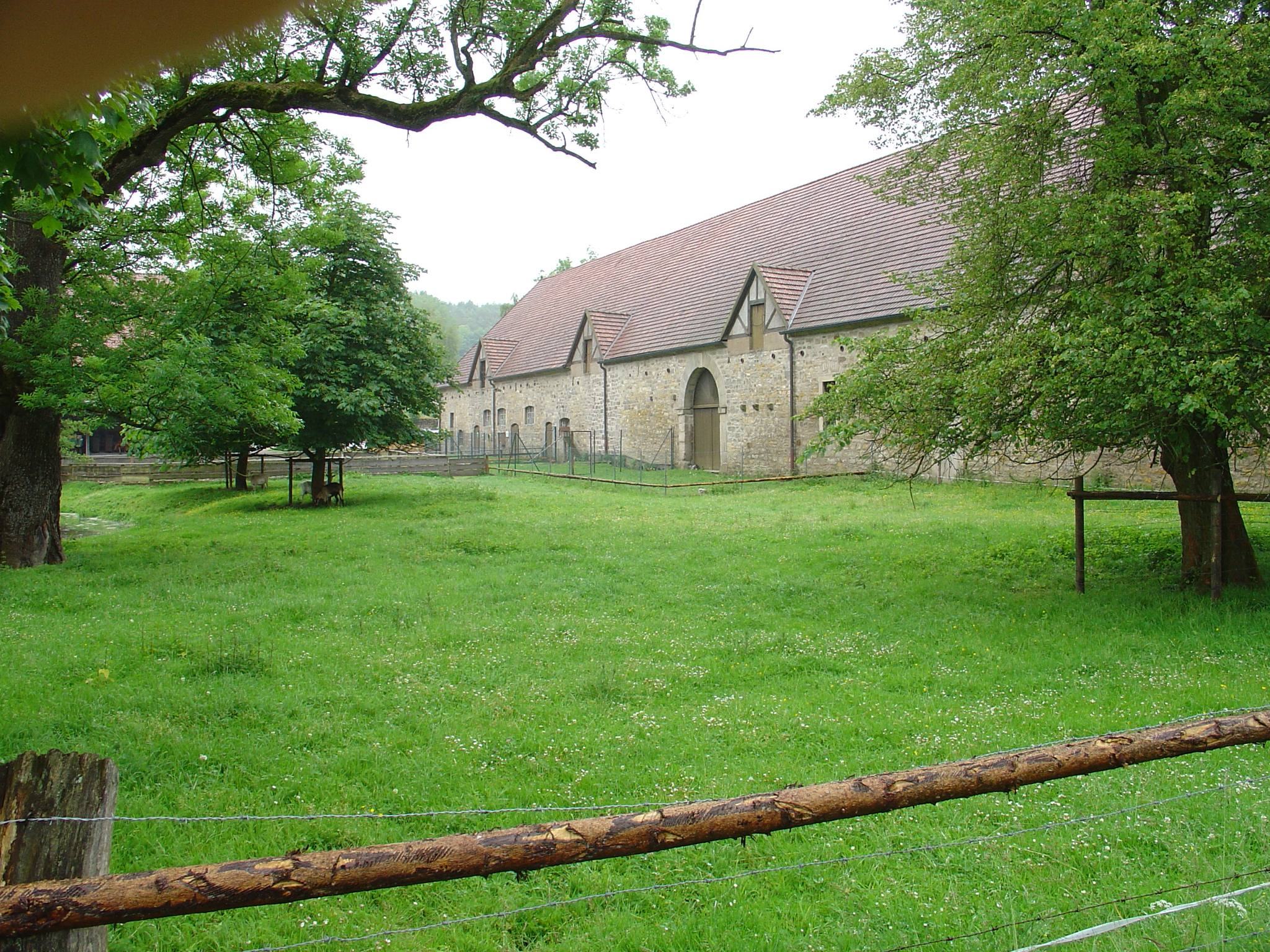
The agricultural buildings were arranged around a courtyard on a south-east to north-west axis. They included a granary dated 1723, a barn from 1740, an eighteenth-century monastery tavern, and additional barns. The Baroque prelate’s garden included an orangery and is now known as the Prelate’s House or Garden House.
Industrial installations
Hardehausen’s wider economic complex included nine fishponds, fishing facilities on the Diemel, and a grange at Rozedehusen. Other granges stood at Marienrode and Mönchehof near Kassel. The monastery operated a grain mill, an oil mill, several other mills along the Diemel, and mills at Fritzlar and Borgentreich. Its workshops included shoemaking and weaving, while agricultural production supplied fruit, vegetables, pigs, sheep, wool, honey, and fish.
Residences and later adaptations
The monastery maintained urban residences or town houses at Paderborn, Salzkotten, Fritzlar, Warburg, Wolfhagen, Hofgeismar, Volkmarsen, Brakel, Kassel, Blankenrode, Marsberg, Nieheim, Hamelin, Höxter, Grebenstein, Borgentreich, Peckelsheim, and possibly Cologne. Their recorded dates range from 1160 to 1408 and generally refer to foundation or acquisition.
The former mill, later used as the rector’s residence, now contains a youth meeting place and café. A bookshop and a fair-trade shop were incorporated into the complex. These uses coexist with medieval fabric, the nineteenth-century château conversion, twentieth-century institutional adaptations, and the modern church, preserving the physical evidence of Hardehausen’s changing religious and educational roles.