Blankenrode: A Medieval Frontier Town in Germany
Site at a Glance
- Rating
- 4.3
- Popularity
- Medium
- Country
- Germany
- Primary era
- Medieval
- External website
- Open
- Eras represented
- Medieval
- Civilizations
- Holy Roman Empire
- Site type
- City
On this page7 sections
History
Foundation and rebuilding
The abandoned medieval town of Blankenrode lies east of the present-day village of the same name in Lichtenau, North Rhine-Westphalia, Germany. Simon I, Prince-Bishop of Paderborn, an office combining religious leadership with secular territorial authority, and the abbot of Corvey, a medieval monastery, founded it in the mid-13th century as a frontier fortress. They intended it to secure their territories against the expanding Counts of Waldeck.
In 1267, a feud between Paderborn and Corvey on one side and Waldeck and Osnabrück on the other led to the town’s destruction. Blankenrode was rebuilt. A 1298 document confirms that both the castle and town existed, and a church is mentioned in 1302.
Municipal growth and frontier conflict
Blankenrode had municipal self-government by about 1307. Town councillors, a town seal, and a town judge are first recorded in 1321. The settlement became prosperous, with a mayor and a town hall among its civic institutions. Chroniclers claimed it had 4,000 inhabitants, a figure considered much too high; the built-up area instead suggests a population above 1,000.
The frontier settlement was repeatedly contested, damaged, rebuilt, and strengthened. During the 14th century it became less important to the Prince-Bishop of Paderborn. The castle and town were pledged as security several times, and the von Brobeke and Rabe von Pappenheim families shared them.
Destruction and abandonment
In 1390, during a feud between Bishop Ruprecht von Berg of Paderborn and the Bengelern, a regional faction, Count Heinrich VI of Waldeck took advantage of the castle garrison’s absence. He entered Blankenrode and destroyed it completely. The town was never rebuilt.
The von Brobeke family sold its last property at Blankenrode to the city of Warburg in 1449. The Rabe von Pappenheim family’s claims passed to Hardehausen Monastery in 1451.
Remains
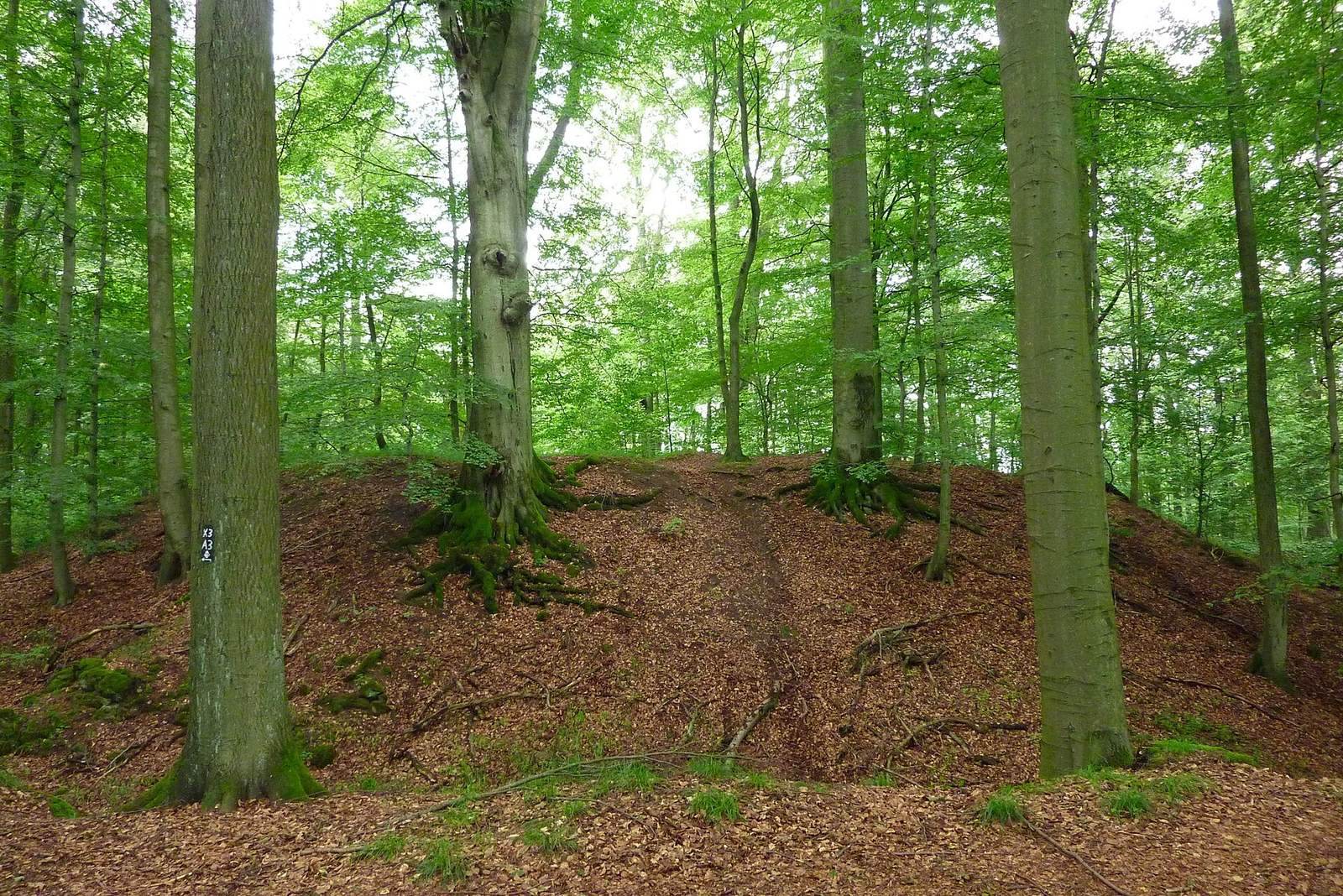
The former town occupies a projecting ridge of the southern Egge hills, east of the present-day village of Blankenrode. Its settlement area is now covered by trees. A double central rampart divided the town into eastern and western parts and separated it from the King’s Road, an important route.
Castle precinct
A circular castle, 25 metres in diameter, stood on a hill within the castle precinct. The eastern part of the town was inhabited by castle retainers and knights. The western part, probably added after 1267, housed townspeople engaged in farming and crafts.
Civic and religious features
The town included a town hall and a church. A cemetery lay on its eastern side.