Burg Peckelsheim: A Medieval Castle Complex in Germany


Site at a Glance
- Rating
- 4
- Popularity
- Very Low
- Country
- Germany
- Primary era
- Medieval
- Eras represented
- Medieval, Early Modern, Modern
- Civilizations
- German, Holy Roman Empire, Kingdom of Prussia
- Site type
- Military
- Remains
- Castle
On this page8 sections
History
Burg Peckelsheim is a partially preserved medieval castle complex in Peckelsheim, Germany, established in 1294 around which the settlement developed. The site later became associated with the Spiegel family and retains buildings from the medieval castle and its later agricultural estate.
Early references and the castle settlement
A fortified farm called “Pykulessun” appears in the records of Corvey Abbey as early as the tenth century. Corvey was a major medieval Benedictine monastery whose records preserve early references to settlements and fortified estates in the region. A castle was established at Peckelsheim in 1294, and the settlement received town rights in 1318.
Noble castle-holders, known as burgmen, were associated with Peckelsheim and Borgholz. A burgman held land or rights in return for duties connected with a castle, including its defense and administration. The families von Niehausen and von Spiegel belonged to this group. Johann von Brobeck acquired one quarter of the castle and town after the Paderborn bishop Heinrich von Spiegel zum Desenberg had pledged it to him.
The Spiegel family and later estate
From 1378, Burg Peckelsheim belonged to the Spiegel zum Desenberg line. The branch of the family that had formerly lived at the castle later became known as Spiegel von und zu Peckelsheim and continued to own the neighboring Helmern estate. Members of the family also held the hereditary marshal’s office of the Paderborn prince-bishops. These rulers combined ecclesiastical leadership with territorial government, while an hereditary marshal was a high-ranking court official whose office passed within a family.
Under the Spiegel family, the surviving residential tower was built in the fourteenth century. Simon von Spiegel zu Peckelsheim constructed a new residence beside it in 1510 and made further alterations in 1535. The castle was abandoned in the eighteenth century, although the estate continued as an agricultural holding. A barn was added in 1856.
In 1906, the property belonged to Albert Legge and his wife, Therese, née Lücking. Burg Peckelsheim was entered on the register of architectural monuments in Willebadessen on 13 February 1985.
Remains
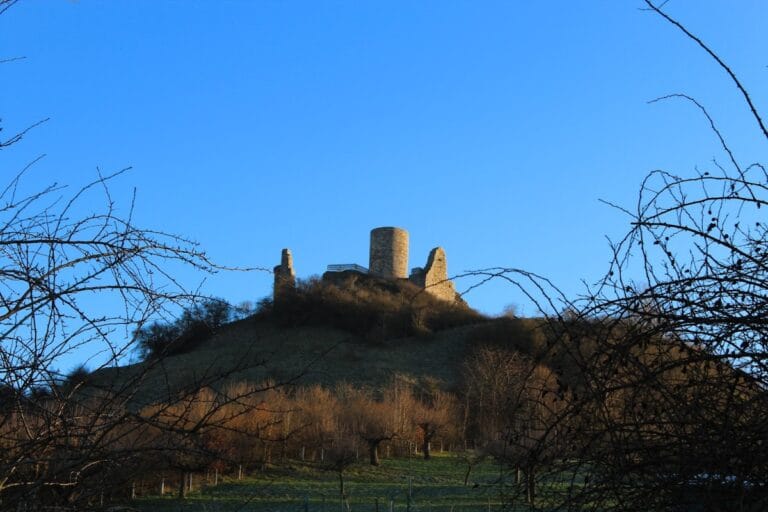
The surviving complex at Burgstraße 5–7 includes a three-storey residential tower, a residence beside it, and a barn. Together, these buildings represent the medieval castle, its sixteenth-century domestic enlargement, and the later agricultural use of the estate.
Castle buildings
Residential tower
The residential tower dates from the fourteenth century. Such a tower was designed for habitation as well as defense. It survives as a three-storey structure, with a coat-of-arms panel dated 1535 attached to the tower house. The medieval tower is currently in poorly maintained conservation condition.
Residence
A residence was built beside the tower in 1510. Its Late Gothic window lintel, the horizontal stone spanning a window opening, bears the von Spiegel coat of arms and the date 1510. Later alterations included the insertion of Neoclassical arched windows. A gate arch dated 1856 also bears the von Spiegel arms, while a door lintel dated 1906 records Albert Legge and Therese Lücking.
Barn
The barn was added to the estate in 1856, after the castle itself had ceased to be used as a residence. It forms part of the surviving group of buildings that reflects the property’s continued agricultural function.
Nearby sites