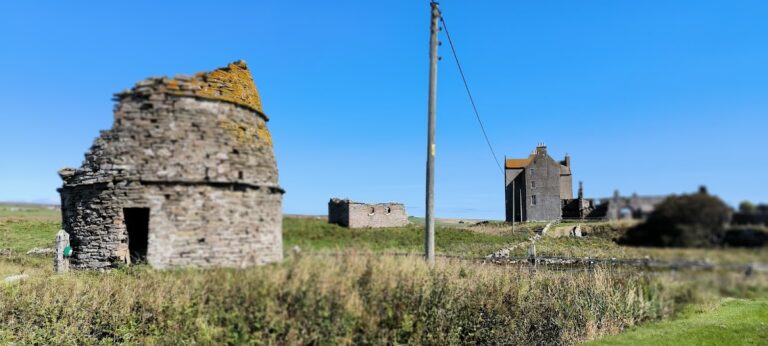
Castle Sinclair Girnigoe: A Clan Sinclair Fortress near Wick
Site at a Glance
- Rating
- 4.7
- Popularity
- Medium
- Country
- United Kingdom
- Primary era
- Medieval
- External website
- Open
- Eras represented
- Medieval, Early Modern
- Civilizations
- Kingdom of Scotland
- Site type
- Military
- Remains
- Castle
On this page10 sections
History
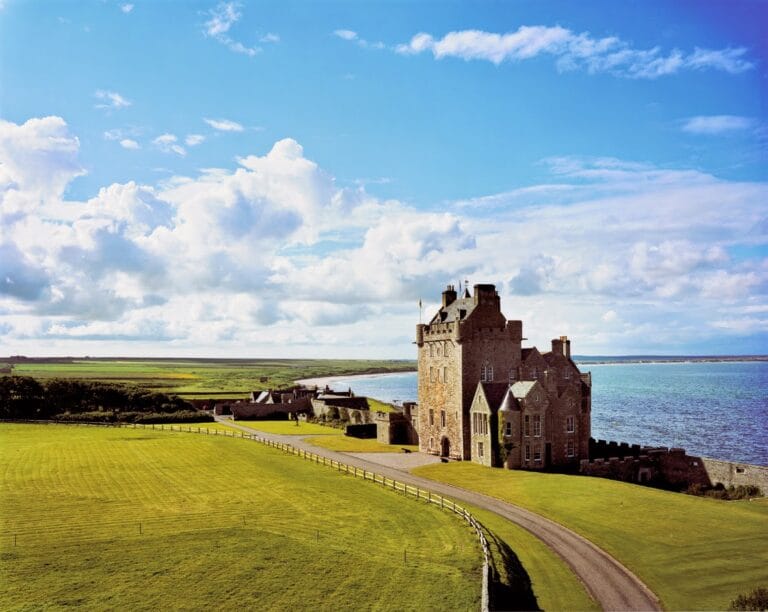
Castle Sinclair Girnigoe is a ruined Scottish stronghold near Wick in the United Kingdom, developed from a fifteenth-century fortified residence on the east coast of Caithness. It was one of the principal seats of Clan Sinclair, the aristocratic family whose members held the earldoms of Orkney and Caithness and controlled several castles in northern Scotland.
Foundation and Sinclair rule
Castle Girnigoe was built for William Sinclair, 2nd Earl of Caithness, probably between 1476 and 1496 and certainly before his death at the Battle of Flodden in 1513. That battle ended in the defeat of the Scottish army by the English. Archaeological evidence suggests that the castle may have incorporated the foundations of a fourteenth-century fortified residence. Another tradition attributes an earlier foundation, after 1379, to Henry Sinclair, Earl of Orkney.
William Sinclair’s son, John Sinclair, 3rd Earl of Caithness, completed work after his father’s death. The site was later enlarged with defensive walls and residential buildings. The 4th Earl of Caithness made Girnigoe his principal residence and rebuilt the central tower, strengthening the castle’s role as the main seat of the Caithness branch of the family.
Sixteenth-century occupation and conflict
The castle underwent extensive changes during the sixteenth and seventeenth centuries, particularly under George Sinclair, 5th Earl of Caithness. In the late sixteenth century, it reportedly resisted a twelve-day siege by the Earl of Sutherland. The attacking forces had previously burned Wick.
Girnigoe also served as a place of confinement and refuge. Olave Sinclair, the foud, or local administrative official, of Shetland, was brought there in May 1573 after suffering paralysis from a stroke. In 1577, George Sinclair, 4th Earl of Caithness, imprisoned his son John Sinclair, Master of Caithness, the customary title of the heir to the earldom, on suspicion of rebellion. John remained imprisoned for seven years and was then given salted beef without anything to drink. He eventually died insane from thirst. The rebel Earl of Bothwell, a Scottish nobleman involved in opposition to the crown, was also at Girnigoe in December 1594.
The names Sinclair and Girnigoe
In 1606, George Sinclair, 5th Earl of Caithness, obtained parliamentary authorization to change the castle’s name from Girnigoe to Sinclair. Both Castle Sinclair and Castle Girnigoe were recorded in 1700, and both names remained in use.
The relationship between the two names and the supposed two castles has long been uncertain. The western addition was traditionally treated as a separate Castle Sinclair, but archaeological investigations begun in the late twentieth and early twenty-first centuries indicate that the complex may instead have developed as one castle. The later section may have been built on earlier foundations.
Occupation, seizure, and ruin
Parliamentary troops associated with Oliver Cromwell occupied the castle in 1651 and used it as a military base for approximately nine years. In 1672, George Sinclair, 6th Earl of Caithness, transferred the castle to his creditor John Campbell of Glenorchy to settle heavy debts.
After Sinclair died without an heir in 1676, Campbell claimed the earldom. George Sinclair of Keiss challenged him, but Campbell defeated him at the Battle of Altimarlach in 1680, a conflict over the succession to the Earldom of Caithness. Sinclair of Keiss then besieged and captured the castle with firearms and artillery.
Following the capture, the roofs, doors, floors, furniture, and other usable elements were stripped from the buildings so that the castle could not serve the Campbell faction. George Sinclair of Keiss later secured recognition as the 7th Earl of Caithness, and the Sinclair lands, including the castle, were restored in 1681. The castle nevertheless remained uninhabited and declined into ruin.
Archaeology and preservation
The Clan Sinclair Trust has managed the castle and carried out archaeological research and preservation work since 1998. Malcolm Ian Sinclair, 20th Earl of Caithness, transferred the castle to the Trust in 2000. Excavation and restoration in the early twenty-first century, including investigations begun in 2003 and continuing at least into 2009, produced further evidence for interpreting the complex as a single developing building rather than two wholly separate castles.
Castle Sinclair Girnigoe has been a scheduled monument, a nationally protected archaeological or historic site, since 1935. In 2002, the World Monuments Fund, an international organization concerned with endangered cultural heritage, included it among the world’s 100 most endangered castles. It was the only Scottish castle on that list.
Remains
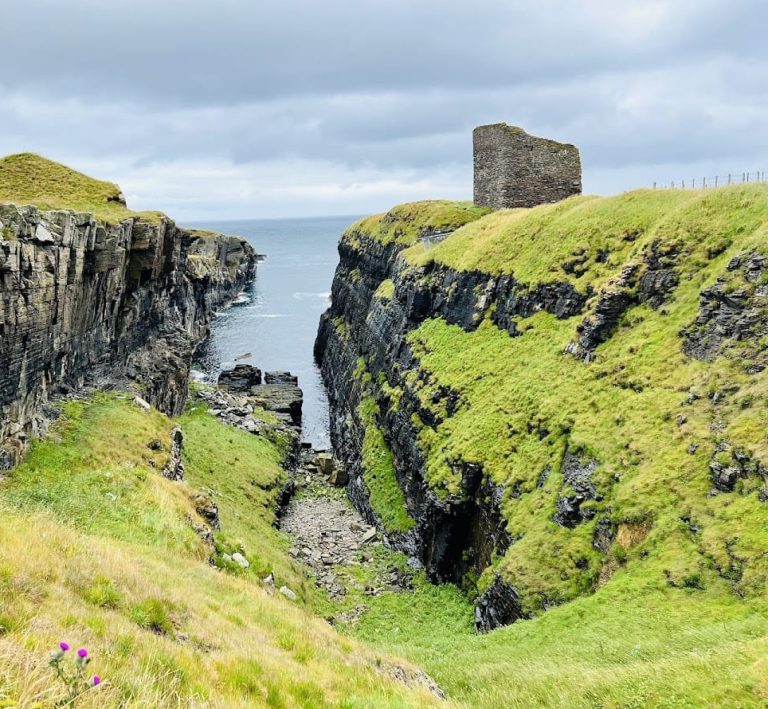
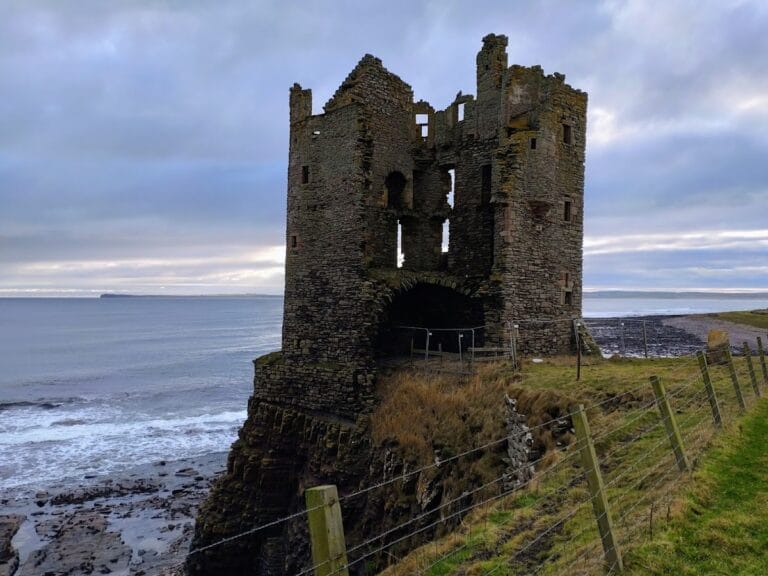
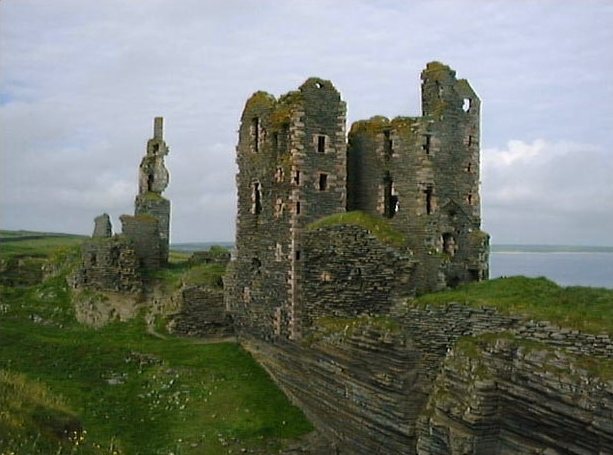
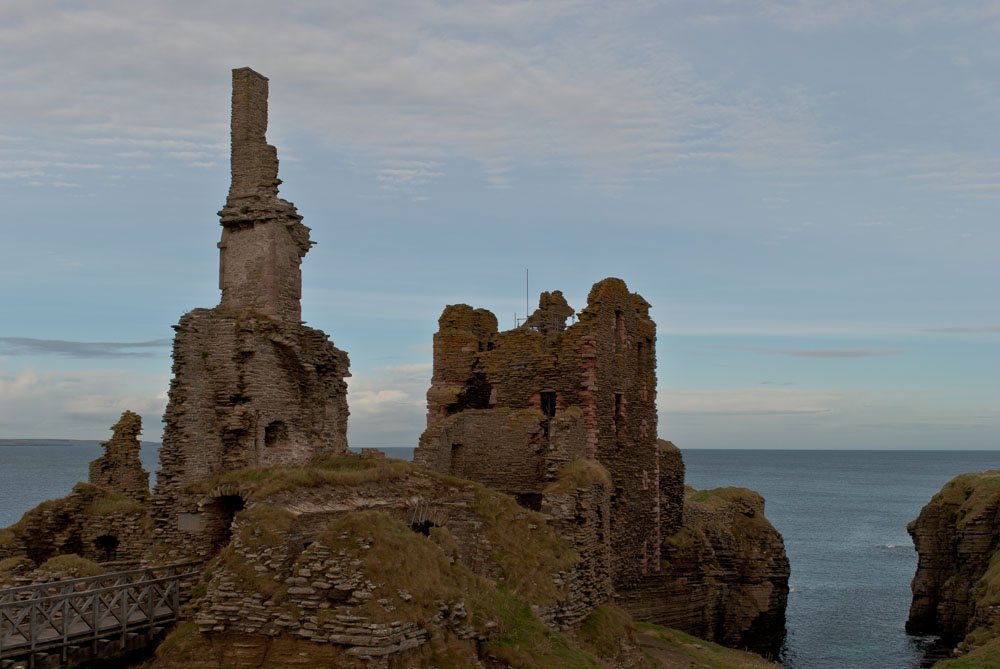
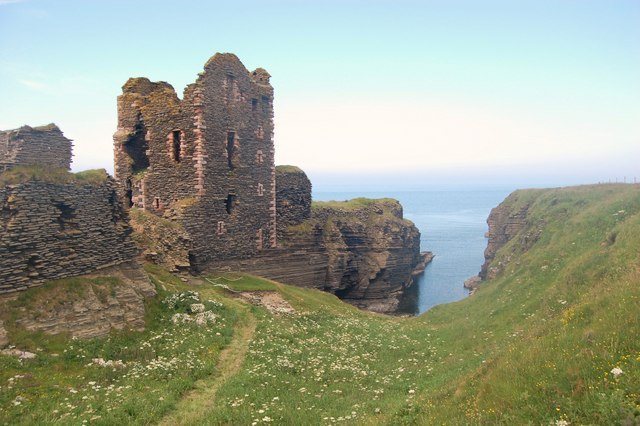
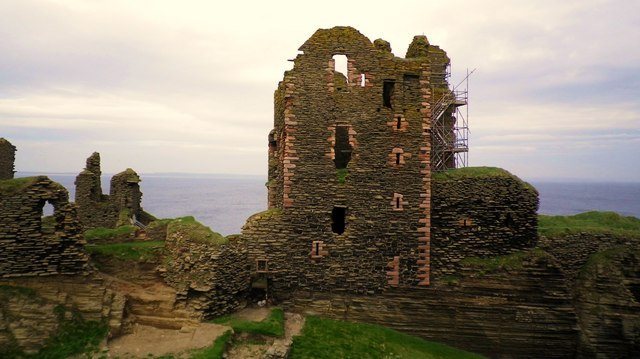
The ruins occupy a steep rocky promontory overlooking Sinclair Bay and the North Sea, about three miles north of Wick. The coast runs approximately east to west at this point. A deep ravine separates the rock from the mainland except on the western side, while the eastern end has very steep sides and is surrounded by the sea on three sides. The complex is built principally of stone and now survives in a ruined state.
Castle Girnigoe
Girnigoe is described as an adapted five-storey L-plan tower house, a fortified residence arranged around a tall defensive tower. Its two principal wings meet at a right angle, and its crow-stepped gables have stepped rather than straight sloping edges. Another description identifies its western residential tower as U-shaped, with the open side facing east, so the surviving plan reflects differing interpretations of the principal sections. A secret chamber lies within the vaulted ceiling of the kitchen.
Castle Sinclair enclosure
The section known as Castle Sinclair was added in 1606 as a gatehouse and associated buildings enclosed by a curtain wall, a defensive enclosing wall. It has three wings arranged around a courtyard on three sides, while the eastern side facing Girnigoe was left without a building along the courtyard edge. A drawbridge connected the two sections across the ravine.
Defensive ditches were cut along the western and southern sides of the Castle Sinclair section. The southern entrance stood where the two sections meet and led into the ditch between them, allowing Girnigoe to remain defensible even if Castle Sinclair were captured. The complex also had an entrance in the western wall of Castle Sinclair and another on the southern side at the junction of the two sections.
Surviving setting and records
Many stone structures that once stood along the edges of the promontory have been lost. A bridge constructed in 2008 now links the castle to the surrounding mainland. The ruins are also represented by a painting made in 1815 by William Daniell, an English landscape painter and printmaker. The painting is held by the Tate Gallery in London.