Basilica di Santa Tecla: Milan’s Early Christian Cathedral Basilica
Site at a Glance
- Rating
- 4.6
- Popularity
- Very Low
- Country
- Italy
- Primary era
- Classical
- External website
- Open
- Eras represented
- Classical
- Civilizations
- Roman
- Site type
- Religious
- Remains
- Basilica
On this page8 sections
History
Basilica di Santa Tecla was an ancient early Christian basilica in Milan, Italy, built during the late Roman imperial period and probably founded around 350. Construction was probably ordered by Constans I, a fourth-century Roman emperor, in 345. The church belonged to the Roman Christian building tradition and was dedicated to Saint Thecla of Iconium, an early Christian holy woman traditionally associated with the apostle Paul. Its earlier names, Basilica Maior and Basilica Nova, referred respectively to its greater size and later foundation than the nearby Basilica Vetus.
The episcopal complex of Roman Milan
The basilica developed when Mediolanum, the Roman name for Milan, served as the capital of the Western Roman Empire from 286 to 402. It formed part of an episcopal complex that included the Basilica Vetus, later enlarged as the cathedral of Santa Maria Maggiore, the baptisteries of San Giovanni alle Fonti and Santo Stefano alle Fonti, the archbishop’s palace, residences and offices for the clergy, and a hospice for elderly people. Ambrose of Milan, the bishop whose episcopate shaped Milan’s opposition to Arian Christianity, mentioned the complex in 386.
Before the Christian complex was established, a Roman temple dedicated to Minerva occupied the site. That sanctuary had itself been built over an earlier Celtic temple dedicated to Belisama, a deity associated with arts connected with fire and later equated with Minerva in a Latin inscription from Aquitania. Remains of both earlier places of worship were found in excavations before the inauguration of Expo 2015.
The former pagan sanctuary was converted into a Christian church during Ambrose’s campaign against pagan worship and Arian Christianity. Arians and Trinitarians held opposing positions in fourth-century disputes over the nature of God and Christ. In Milan, the conflict affected church ownership, episcopal appointments, and public worship.
The Arian controversy
The Basilica Maior hosted the Council of Milan in 355. Constantius II, the brother and successor of Constans I, supported Arian Christianity and attempted to obtain the council’s acceptance of that position. Dionysius, bishop of Milan, and Athanasius of Alexandria rejected it. Constantius then exiled both bishops and installed the Arian Auxentius in the Basilica Nova.
The basilica remained a focus of conflict between Milan’s predominantly Trinitarian population and its Arian elite. Repeated clashes required intervention by imperial guards. Pope Damasus I excommunicated Auxentius in 369, but imperial backing allowed him to retain the Milanese see until his death in 374.
In 386, the Arian bishop Mercurino Auxentius, supported by Empress Justina, challenged Ambrose and demanded the Basilica Portiana, a Milanese church whose use was contested during the controversy. Ambrose refused to surrender it and gathered a large following around the church. Fearing unrest, Justina returned the basilica to Catholic worship.
Destruction, rebuilding, and medieval use
Attila destroyed the basilica in 452, but Eusebius repaired it in 454. Archbishop Lawrence I of Milan then carried out an extensive restoration between 490 and 512. The Goths destroyed the building again in 539, after which it remained in ruins during the Lombard period, the era of Lombard rule in Italy.
Archbishop Angilbert II rebuilt the basilica in 836 and dedicated it to Jesus the Savior. A great fire in Milan destroyed it in 1075, after which it was rebuilt with early Romanesque forms. It became known as Santa Tecla of Iconium. The church survived the destruction of Milan ordered by Frederick Barbarossa in 1162.
Basilica di Santa Tecla and the Basilica Vetus formed a double-basilica cathedral system. Santa Tecla served as the summer cathedral of the Milanese archdiocese, while the Basilica Vetus served as the winter cathedral. Liturgical activity moved between them in the transmigratio, a formal ceremony held especially on the third Sunday of October and on the eve of Easter. The cathedral chapter could elect Milan’s bishop only in Santa Maria Maggiore.
The episcopal complex was the religious center of late Roman Milan, while the imperial palace served as the city’s civil center. Its development also reduced the importance of the former cardo maximus, the principal north-south street of a Roman city, in favor of the road connecting the episcopal complex with the imperial palace.
Demolition and archaeological recovery
When construction of the new cathedral began in 1386, Santa Tecla remained open but no longer held its former central position. In November 1387, part of the basilica was partitioned to receive reused marble from the choir of the adjacent Santa Maria Maggiore. During the late fourteenth and early fifteenth centuries, sections of the church became storage areas. Antonio da Corbetta’s chapel held bricks, the chapel of Santa Medicina held marble and sarizzo, a grey granite used as building stone, and a new doorway for moving materials required the altar of the chapel of San Bassiano to be relocated. Much of the building was still being used as a warehouse in 1400.
The church remained in use until demolition connected with construction of the Duomo began in 1458. The work ended in 1461. That year, Archbishop Carlo Nardini da Forlì arranged the solemn transfer to the new cathedral of the Holy Nail, a relic of Christ’s crucifixion that had been kept in Santa Tecla.
The basilica’s north side wall and an adjoining row of columns survived and were incorporated by the architect Solari into the Coperto dei Figini, a commercial arcade and meeting place. The arcade was demolished in 1864 during the creation of Piazza del Duomo. Later investigations during construction of the Milan Metro and beneath the Duomo area brought further remains of Santa Tecla and its earlier religious buildings to light. Some of the basilica’s remains were subsequently preserved in the mezzanine of the Duomo station on Milan’s M1 metro line.
Remains
Layout and surviving architectural elements
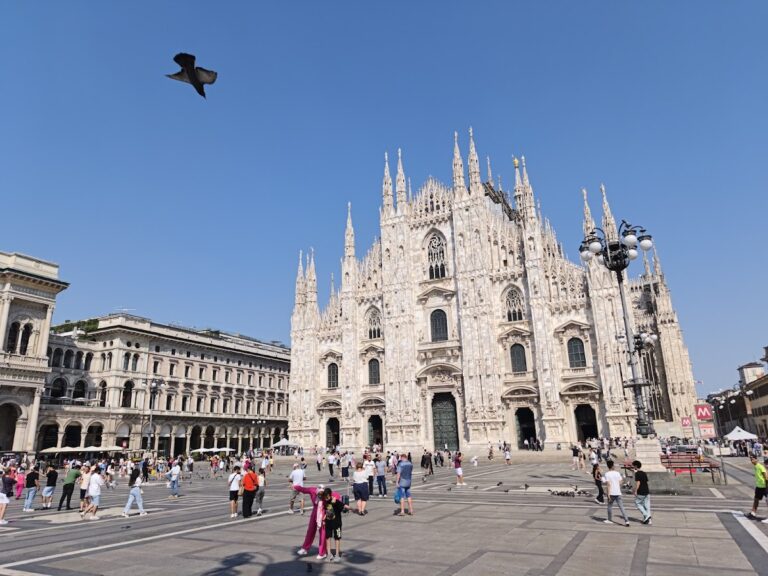
Santa Tecla was a five-aisled early Christian basilica with an estimated length of 67.60 metres and width of 45.30 metres. It stood in what is now Piazza del Duomo, opposite the present Milan Cathedral. Within the episcopal complex, the baptistery of San Giovanni alle Fonti lay between Santa Tecla and Santa Maria Maggiore, while the smaller baptistery of Santo Stefano alle Fonti stood north of Santa Maria Maggiore.
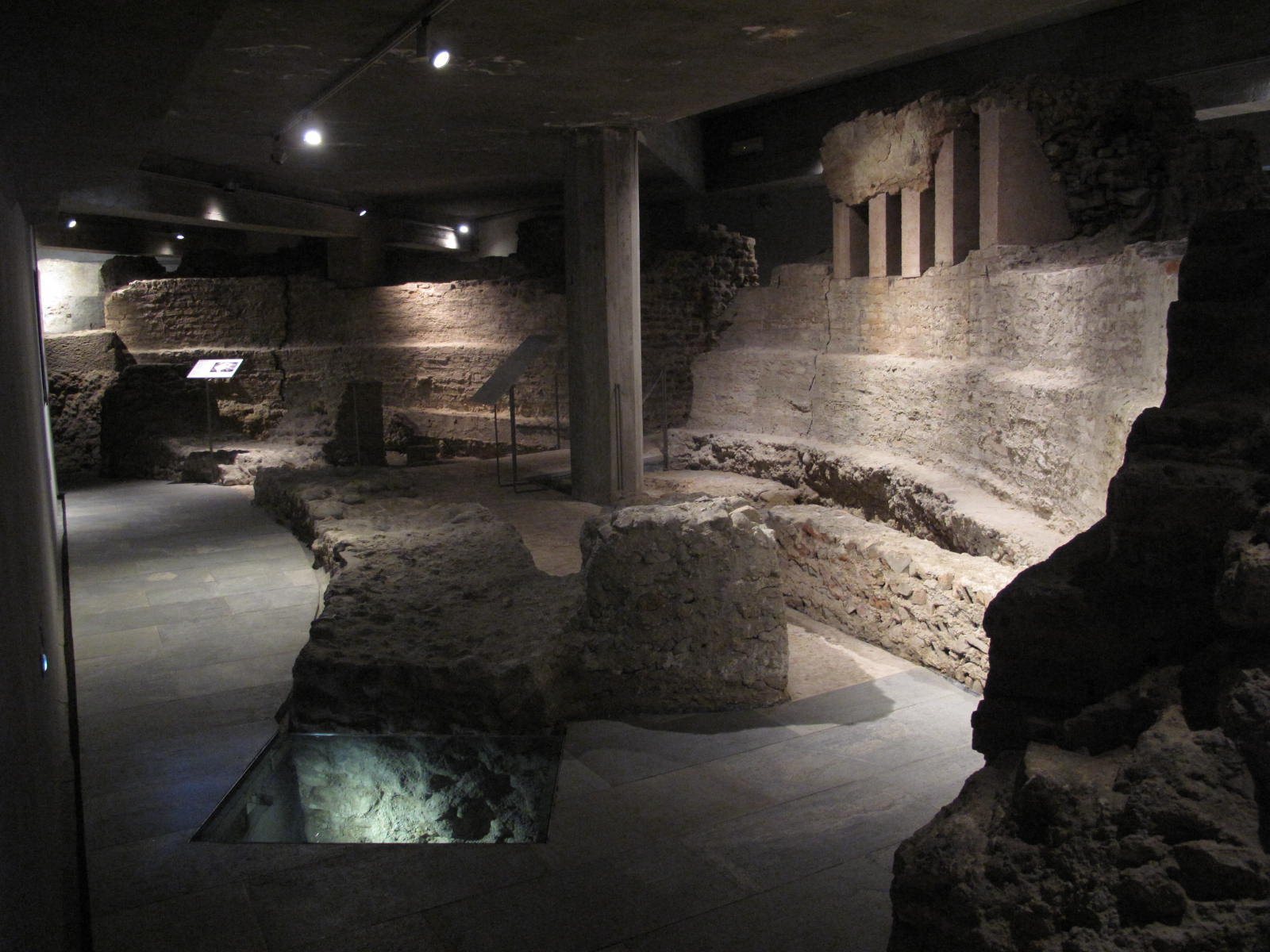
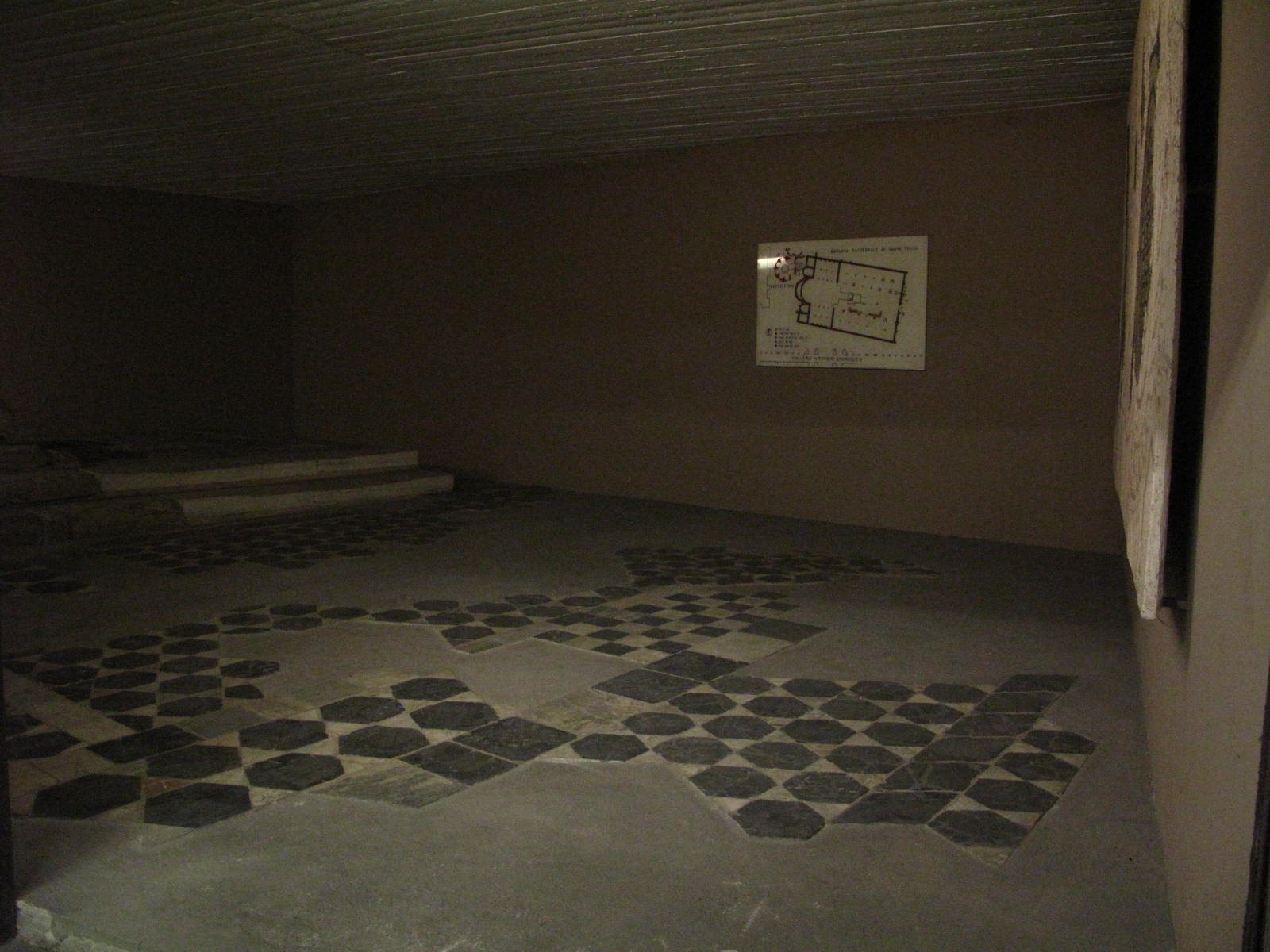
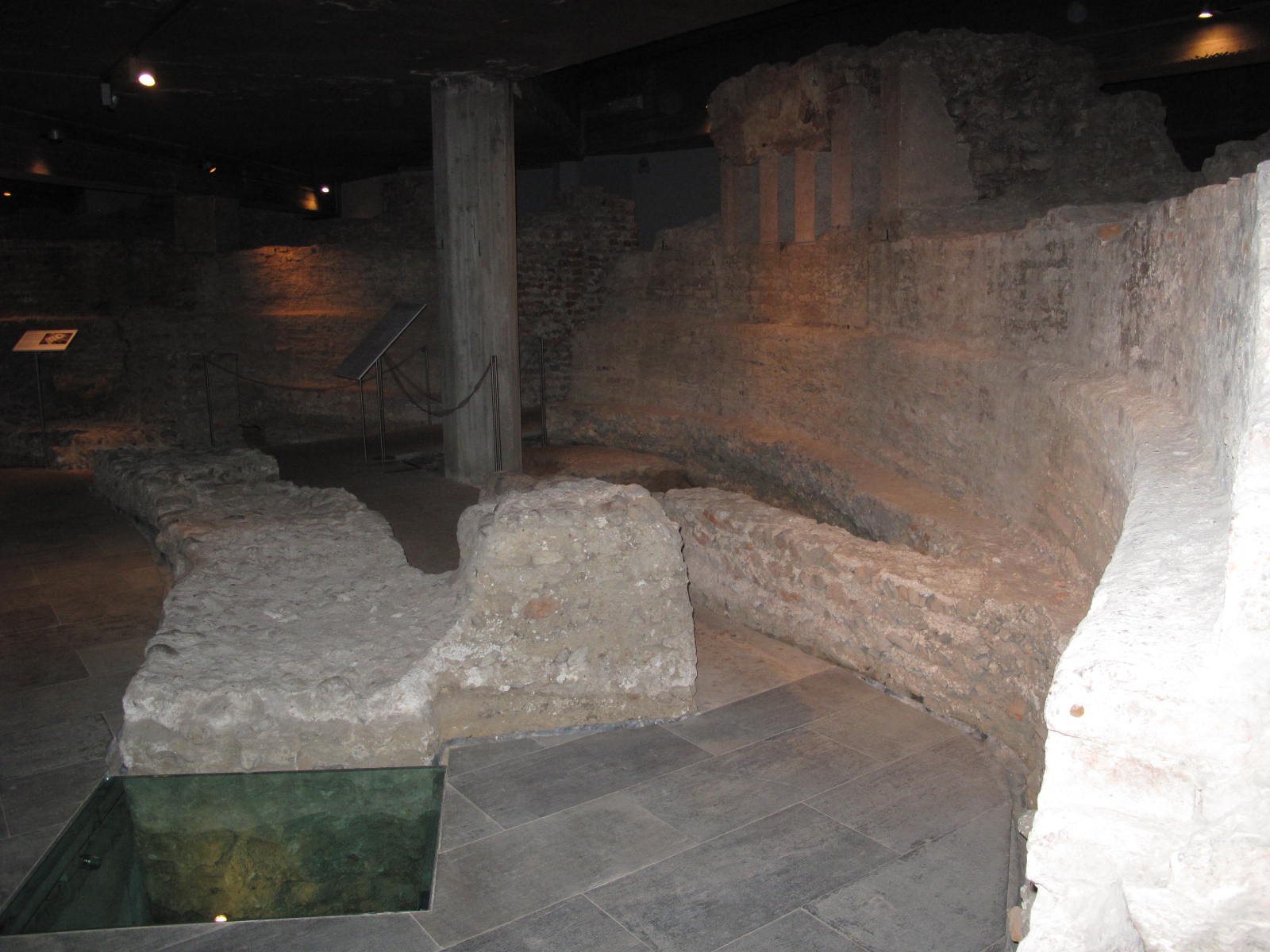
The remains displayed in the mezzanine of Duomo station include a well used by the early Christian basilica, part of the apse with its pilasters, sections of the central nave, and part of a solea, a raised or specially arranged liturgical walkway. The solea and surviving pavement belong to the early Christian period. The pavement dates to the middle of the fifth century and uses the opus sectile technique, in which cut pieces of stone or other hard material are fitted together to create geometric or pictorial designs.
Associated archaeological remains
A base from one of the basilica’s columns is preserved in the museums of the Sforza Castle. Excavations in the area also uncovered painted tombs dating to the ninth or tenth century.