Rievaulx Abbey: A Cistercian Monastery in North Yorkshire
Site at a Glance
- Rating
- 4.8
- Popularity
- Medium
- Country
- United Kingdom
- Primary era
- Medieval
- External website
- Open
- Eras represented
- Medieval, Early Modern
- Civilizations
- English
- Site type
- Religious
- Remains
- Monastery
On this page17 sections
History
Rievaulx Abbey is a former Cistercian monastery in the United Kingdom, near Helmsley in North Yorkshire, founded on 5 March 1132 in the valley of the River Rye. The Cistercians were a reforming Catholic order that emphasized communal prayer, austerity, manual work, and economic self-sufficiency. Established by monks from Clairvaux Abbey, Rievaulx became the first Cistercian abbey in northern England and was dedicated to Saint Mary.
Foundation and early expansion
Bernard of Clairvaux, a leading Cistercian abbot and promoter of new foundations, sought to establish a monastery in northern England. He wrote to Henry I, king of England, in 1131, and the king directed him to Thurstan, Archbishop of York. Thurstan introduced Bernard to Walter Espec, who donated the site. William, Bernard’s secretary, led the monks who arrived to create the new community.
The first buildings were temporary wooden structures. Permanent construction began in 1135 under Geoffrey of Ainay, who later became abbot of Fountains Abbey. Rievaulx was a direct foundation of Clairvaux and belonged to the Cistercian Order. Although it lay within the Diocese of York, it was exempt from episcopal control and subject directly to its order and the pope.
Rievaulx quickly became a center for further expansion. It founded Warden in 1135, Melrose in 1136, Dundrennan in 1142, Revesby in 1143, and Rufford in 1147. Melrose and Dundrennan were in Scotland, while the other daughter houses were in northern England. Apart from Rufford, these communities later established daughter houses of their own.
In 1154, the abbots of Rievaulx and nearby Byland Abbey agreed to mutual prayer and assistance and set out their respective rights and obligations. Their monasteries were close enough for their bells to be heard by one another. Rievaulx also received papal protection during disputes involving the archbishops of York and the bishop of Durham. Pope Innocent IV renewed that support in 1243, while threats of excommunication were directed at people accused of despoiling the abbey, including some of its benefactors.
Growth under Aelred
The abbey’s major period of growth came under Aelred of Rievaulx, its second abbot from 1146 until his death in 1166. Aelred was a theologian and spiritual writer whose works made him one of the best-known religious figures associated with medieval England. During his rule, donations increased, and Walter Espec gave much of his fortune to religious foundations before becoming a monk at Rievaulx. He was later buried at the abbey.
The monks drained wet ground, improved the land, and cleared woodland. By about 1160, the community included approximately 140 monks and 500 lay brothers, who carried out agricultural, craft, and other practical work while taking part in the religious life of the house. The total population was about 650 people. At its height, Rievaulx controlled nearly 6,000 hectares, much of it used for sheep pasture, and possessed at least fifty ploughlands, medieval land units broadly based on the area cultivated by a plough team.
Sheep raising and wool sales formed part of the abbey’s prosperity. The community also developed lead and iron mining and other technologies. Its school educated many young people, while its scriptorium, the monastery’s writing and book-production area, produced Bibles and liturgical books. The abbey’s economic activity also supported charitable work and benefited people in the surrounding region.
Rebuilding and decline
A major rebuilding campaign began around 1230. The abbey church was enlarged and raised, especially in the choir, but the cost of the work placed the community under severe financial pressure. Abbot Roger resigned in 1239 when the planned construction could not be completed. During the thirteenth century, epidemics among the abbey’s sheep further reduced its income.
Scottish raiders damaged the abbey’s finances in the early fourteenth century. Population loss during the Black Death made it difficult to recruit lay brothers, and the community responded by leasing much of its land. In October 1322, the Battle of Old Byland took place outside the abbey during the Despenser War, a conflict involving political opposition to King Edward II and the Despenser family. The English king took refuge at Rievaulx, learned there that his army had been defeated, and fled to York. Scottish forces then plundered possessions abandoned at the abbey.
The community had fallen to seventeen people by 1380, consisting of Abbot John de Layton, thirteen monks, and three lay brothers. In 1406, Pope Innocent VII reminded the monks to sing Mass solemnly and audibly. One monk, Thomas Beverley, refused because he did not know Latin. By the fifteenth century, strict Cistercian observance had weakened. The monks were permitted to eat meat and occupy more private accommodation, while the abbot maintained a substantial household in the former infirmary.
During the sixteenth century, the number of lay brothers declined sharply, requiring changes to the organization of work and accommodation. An iron-smelting furnace called the Yron Smith was built within the precinct in the early sixteenth century. It used charcoal to heat ore and make iron for the monastery’s needs.
Dissolution and later ownership
Rievaulx Abbey was dissolved on 3 December 1538 during the Dissolution of the Monasteries, Henry VIII’s programme of suppressing English monasteries and transferring their property to the Crown or its grantees. At closure, the community comprised roughly twenty monks and lay employees. An inventory listed 72 occupied buildings, 21 monks, 102 lay employees, and an annual income of £351.
The Crown granted the abbey to Thomas Manners, Earl of Rutland. The buildings were dismantled, their roofs were stripped of lead, and the bells were given to the king. The ironworks continued under Manners, with four furnaces operating by 1545. A blast furnace, a tall furnace using a continuous air blast to smelt iron ore, was added in 1577, and a new forge was built between 1600 and 1612. Production ended around 1640 because of fuel shortages.
George Villiers, first Duke of Buckingham, later acquired the abbey through marriage, and the valley passed to his son, also named George Villiers. In 1687, the younger Villiers sold the valley to Charles Duncombe. Duncombe’s family developed Duncombe Park and later extended the estate toward the former monastery. Thomas Duncombe created Rievaulx Terrace on the plateau above the abbey, with neoclassical temples overlooking the ruins. From the 1770s and 1780s, the remains attracted increasing interest from Romantic artists and writers.
Excavation and preservation
The Yorkshire Archaeological and Topographical Association began excavation campaigns in 1881 and 1893. Structural consolidation started in 1907 after the ruins became dangerous. The Office of Works, the British government body responsible for public buildings and historic monuments before the creation of later heritage institutions, took the site into state care in 1917 and carried out emergency repairs. These included reinforced-concrete beams inserted into the upper parts of walls, while later excavations exposed areas concealed by earlier deposits.
The wider site received Scheduled Ancient Monument status in 1915, and the abbey became a Grade I listed monument in 1955. A Scheduled Ancient Monument is a nationally protected archaeological or historic site, while Grade I is the highest category of protection for buildings of exceptional historical or architectural interest in England. The ruins are now maintained by English Heritage.
In the 1920s, stored lead removed from the abbey’s windows after the Dissolution was donated to restore the Five Sisters window at York Minster, a group of five tall lancet windows. Archaeological investigation in 2015 used low-level aerial photography to create a digital surface model and earthwork plan of the precinct. A ground survey followed in 2018, and the results published in 2019 clarified the landscape surrounding the abbey.
Remains
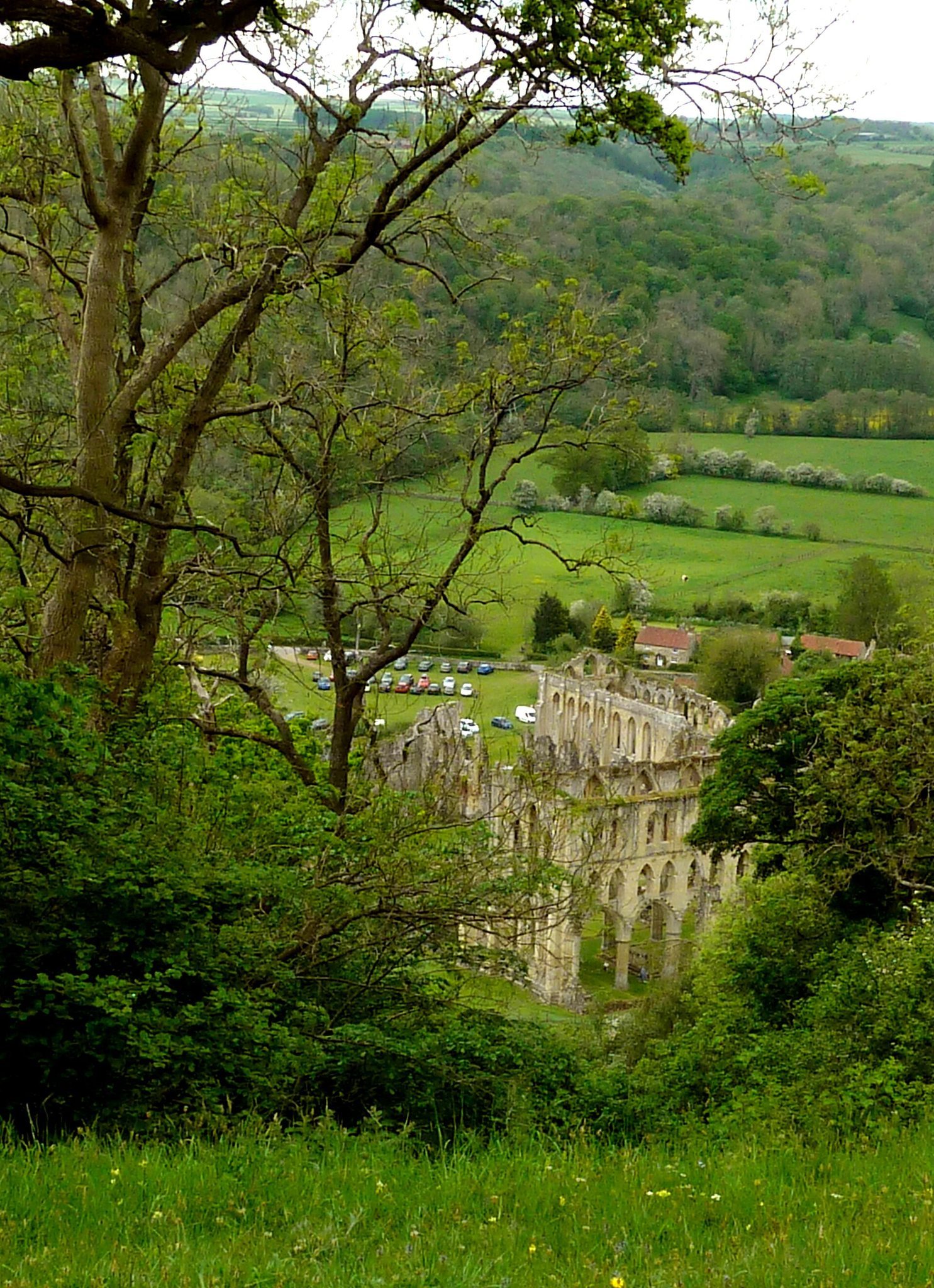
Rievaulx Abbey occupies a narrow enclosed valley on the eastern bank of the River Rye, surrounded by steep hills and wooded slopes. The complex covers approximately 15 acres. The river was diverted to create level ground for construction, and its course was altered twice more during the twelfth century. The former river channel remains visible in the grounds. Because of the confined site, the church is aligned toward the north rather than following the usual eastward orientation, while the wider complex extends from north to south.
The abbey church
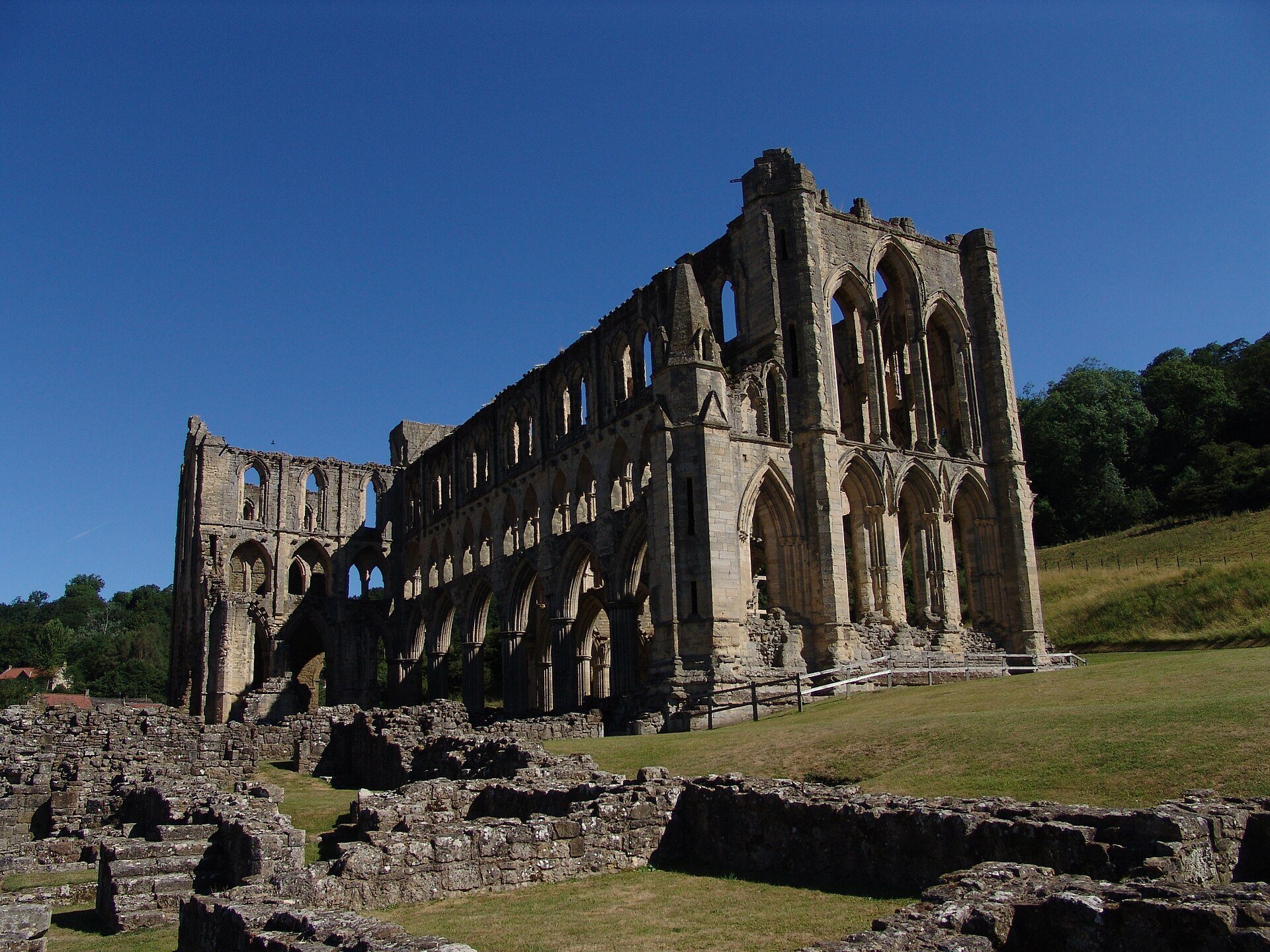
The first church was begun in 1135 in the restrained Romanesque manner associated with early Cistercian architecture. It had a cruciform plan, a square-ended east end, and a nine-bay nave with little or no decoration. The first level of the nave and transept survives from this phase.
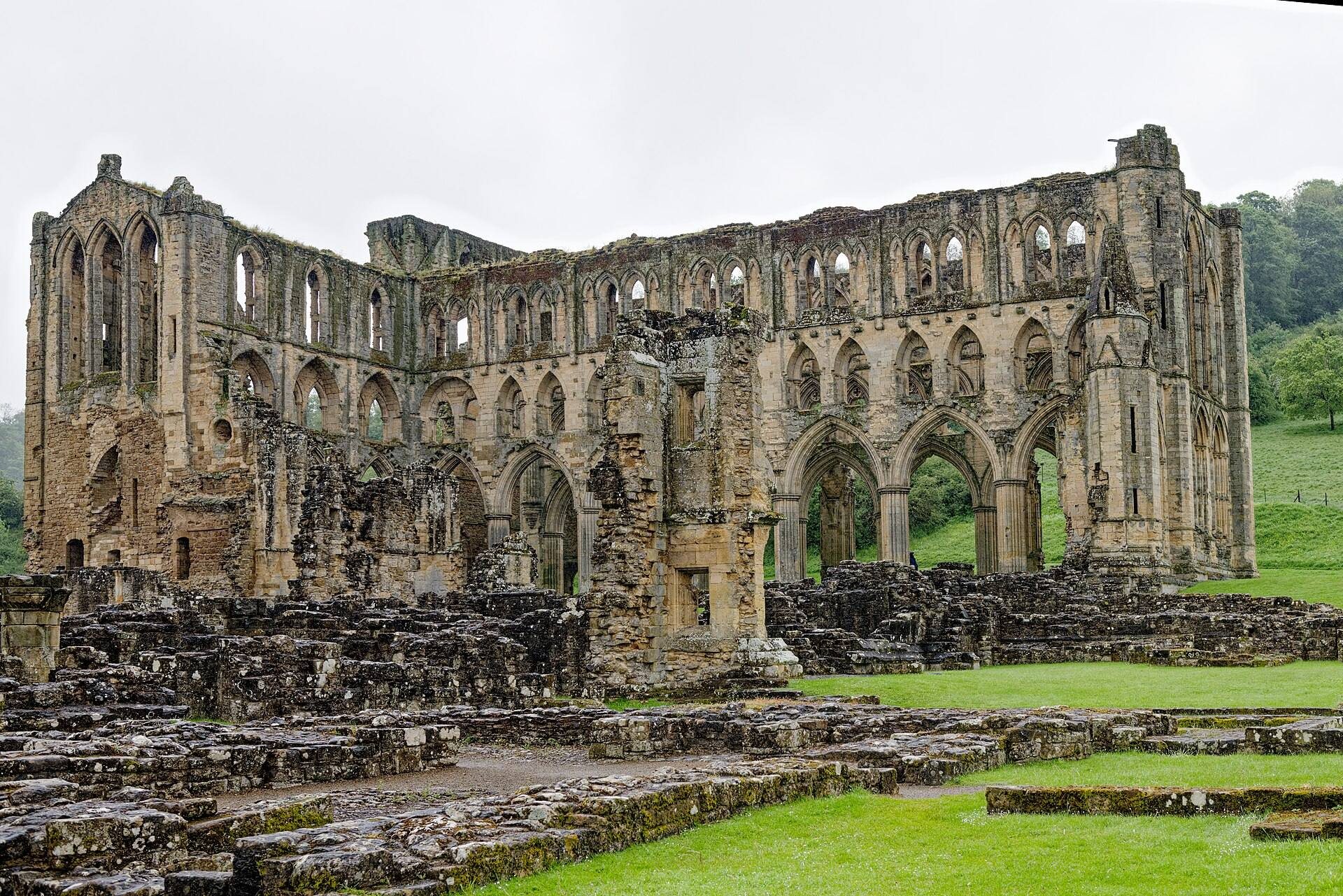
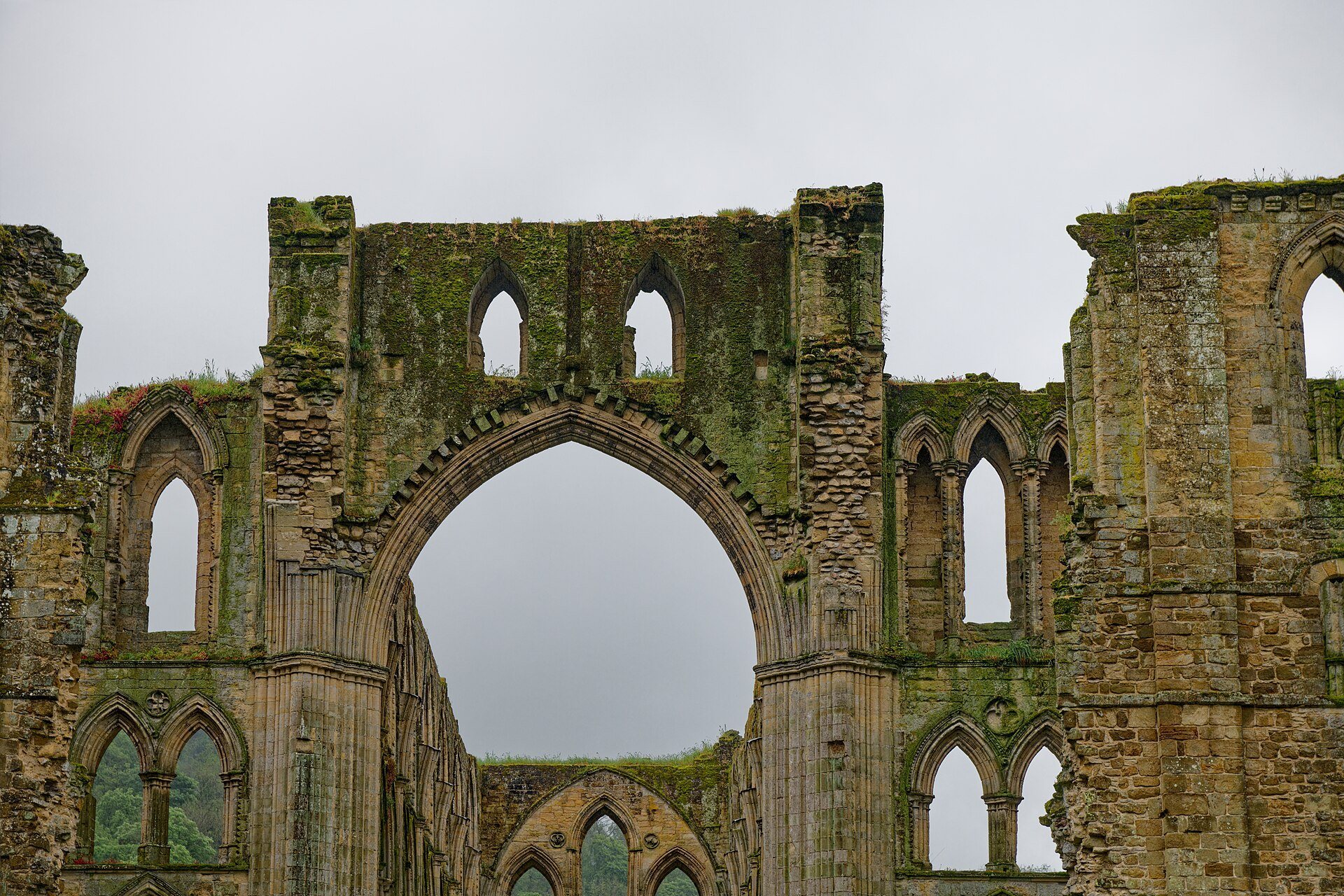
Around 1230, the church was enlarged and raised in the Gothic style. The completed design was approximately 107 metres long and included a new six-bay choir substantially higher than the earlier building. The choir retained a flat-ended termination and was surrounded by an unusual rectangular ambulatory, a passage allowing movement around the eastern end of a church. The nave was not lengthened, but it was raised to three levels, with pointed arcades and two tiers of windows. Financial problems prevented the intended remodelling of the transept.
The surviving church ruins include the choir, transept, nave walls, lancet windows, and remains of stained-glass openings. The church is the best-preserved major building in the complex.
Monastic buildings
Cloister
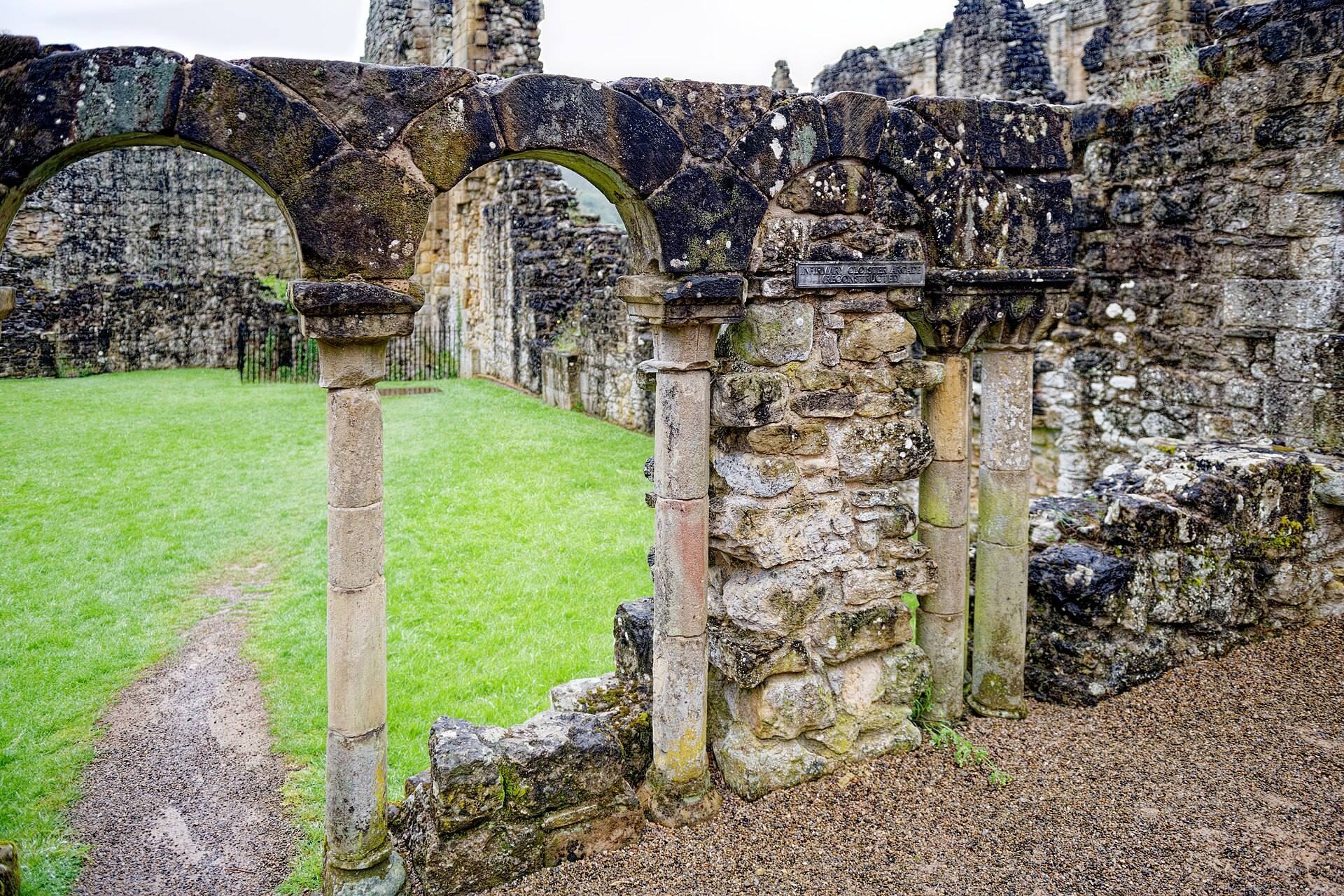
The cloister, a covered walkway surrounding an open court, measured approximately 42 metres on each side, making it one of the largest in the British Isles. Its surviving Romanesque arcades include five arches carried on small columns with alternating circular and hexagonal bases. The cloister area is now largely grassed over, while the surviving arcades preserve part of the monastery’s central circulation space.
Chapter house
Foundations of the chapter house survive beside the cloister. This room was where the monks met for readings, discipline, and administrative business. It was unusually large and ended to the east in a semicircular apse enclosed by an ambulatory. That arrangement allowed lay brothers to hear readings, including the Rule of Saint Benedict, more easily.
Infirmary
The infirmary stood northeast of the main complex and accommodated older monks. It included a small cloister, an architectural feature found mainly in the largest and wealthiest Cistercian abbeys. The building later became associated with the abbot’s substantial household during the period when monastic observance had become less strict.
Refectory, chapel, and kitchen
The refectory is partly ruined but retains substantial remains. Its large foundations were adapted to compensate for the natural slope of the ground, and the structure is approximately 37 metres long and 15 metres high. Remains of the abbey’s chapel and kitchen are also visible within the complex.
Industrial and landscape remains
The Yron Smith and later ironworks
The Yron Smith was an iron-smelting furnace within the abbey precinct, built in the early sixteenth century to use charcoal for heating ore and producing iron for the monastery. Industrial activity continued after the Dissolution under the Manners family. Four furnaces were operating by 1545, a blast furnace was added in 1577, and a forge was constructed between 1600 and 1612. These later works form part of the industrial history associated with the former monastic estate.
Rievaulx Terrace
Rievaulx Terrace occupies elevated ground above the abbey. Created by Thomas Duncombe, it contains neoclassical temples positioned to overlook the ruins and the surrounding valley. The terrace belongs to the later estate landscape that developed after the monastery had passed into private ownership.
Burials and surviving evidence
Aelred of Rievaulx was buried at the abbey, as were Thomas de Ros, 4th Baron de Ros, and John de Ros, 5th Baron de Ros. Their burials form part of the surviving historical associations of the monastery, alongside the church ruins, monastic foundations, river works, and industrial remains that reveal the site’s development from a twelfth-century religious foundation into a later estate landscape.