Zavala Monastery: A Serbian Orthodox Monastic Complex in Bosnia and Herzegovina
Site at a Glance
- Rating
- 5
- Popularity
- Very Low
- Country
- Bosnia and Herzegovina
- Primary era
- Modern
- Eras represented
- Early Modern, Modern
- Civilizations
- Austria-Hungary, Habsburg, Ottoman, Serbian
- Site type
- Religious
- Remains
- Monastery
On this page19 sections
History
Zavala Monastery is a Serbian Orthodox monastery in Bosnia and Herzegovina, dedicated to the Presentation of the Virgin Mary and associated with the Eparchy of Zahumlje, Herzegovina, and the Littoral, an administrative diocese covering Orthodox communities in the Herzegovinian and coastal region. Its origins are uncertain, although the church’s foundations were laid in the late sixteenth century and again in 1819, and the building was completed in 1886. The monastery belongs to the religious and cultural history of the Eastern Orthodox rite in Herzegovina.
Origins and Ottoman-era development
Local tradition attributes the foundation of the church to Constantine, the Roman emperor associated with the legalization and patronage of Christianity in the Roman Empire. A seal dated 1271 has been interpreted as evidence that a church existed here during the thirteenth century. The earliest surviving written record dates from 1514, when Abbot Serafim purchased a vineyard at Orahov Do for the monastery.
After the Ottoman conquest of Herzegovina, orders issued in 1516 called for the destruction of Catholic churches built before the conquest. In the wider Popovo Polje region, the conversion of many Catholics to Eastern Orthodoxy became associated with Zavala’s proximity. In 1587, an Ottoman decree allowed the church to be rebuilt on its original dimensions. Members of the Hrabren-Miloradović family, a noble house associated with Herzegovina, are considered possible patrons of this rebuilding because their names appear in the monastery’s commemorative book.
Zavala was subordinate to Hilandar, the Serbian Orthodox monastery on Mount Athos and a major centre of Orthodox monasticism and manuscript culture. Its connections with Hilandar continued during the seventeenth century. In 1622, Maksim copied a typikon, a monastic rulebook governing worship and community life, while the hieromonk Joanikije copied a prologue, a devotional manuscript containing saints’ lives and related readings, in 1627. Maksim copied another prologue in 1628.
Destruction, restoration, and nineteenth-century events
The monastery suffered damage in 1663 and was destroyed in 1722 during the Ottoman-Venetian wars. It was completely restored between 1816 and 1876, and the monastic residence was built in 1876. In 1841, Zavala was described as one of the wealthier Orthodox monasteries in Herzegovina.
On 11 July 1875, Ivan Musić, a nineteenth-century Herzegovinian insurgent leader, took his insurgent and voivode oath at the monastery before his followers. Blažo Petrović, a Montenegrin, conferred on him the title of voivode, a military and regional leadership rank used in the Balkans. Monks returned after the Austro-Hungarian occupation of Bosnia and Herzegovina, and the monastery became active again in 1878.
Basil of Ostrog, a seventeenth-century Serbian Orthodox bishop and ascetic venerated as a saint, entered monastic life at Zavala. During the Second World War, the monastery suffered major damage and its entire collection was destroyed. Further damage and abandonment followed during the 1992–1995 war. The church survived without major damage, while the residence and ancillary buildings were burned.
Conservation and protected status
Conservation and restoration work in 2002 involved heritage-protection institutions from Bosnia and Herzegovina and Republika Srpska. The church and monastic residence were renovated, the frescoes were restored, and the brotherhood returned. The monastery, the old architecture and stonework of Zavala village, and Vjetrenica Cave together form a protected cultural-historical, architectural, and natural ensemble.
In 2003, the architectural ensemble, including the church, was designated a Category I national monument of Bosnia and Herzegovina. It has also been placed on Bosnia and Herzegovina’s UNESCO Tentative List.
Remains
Church and monastic buildings
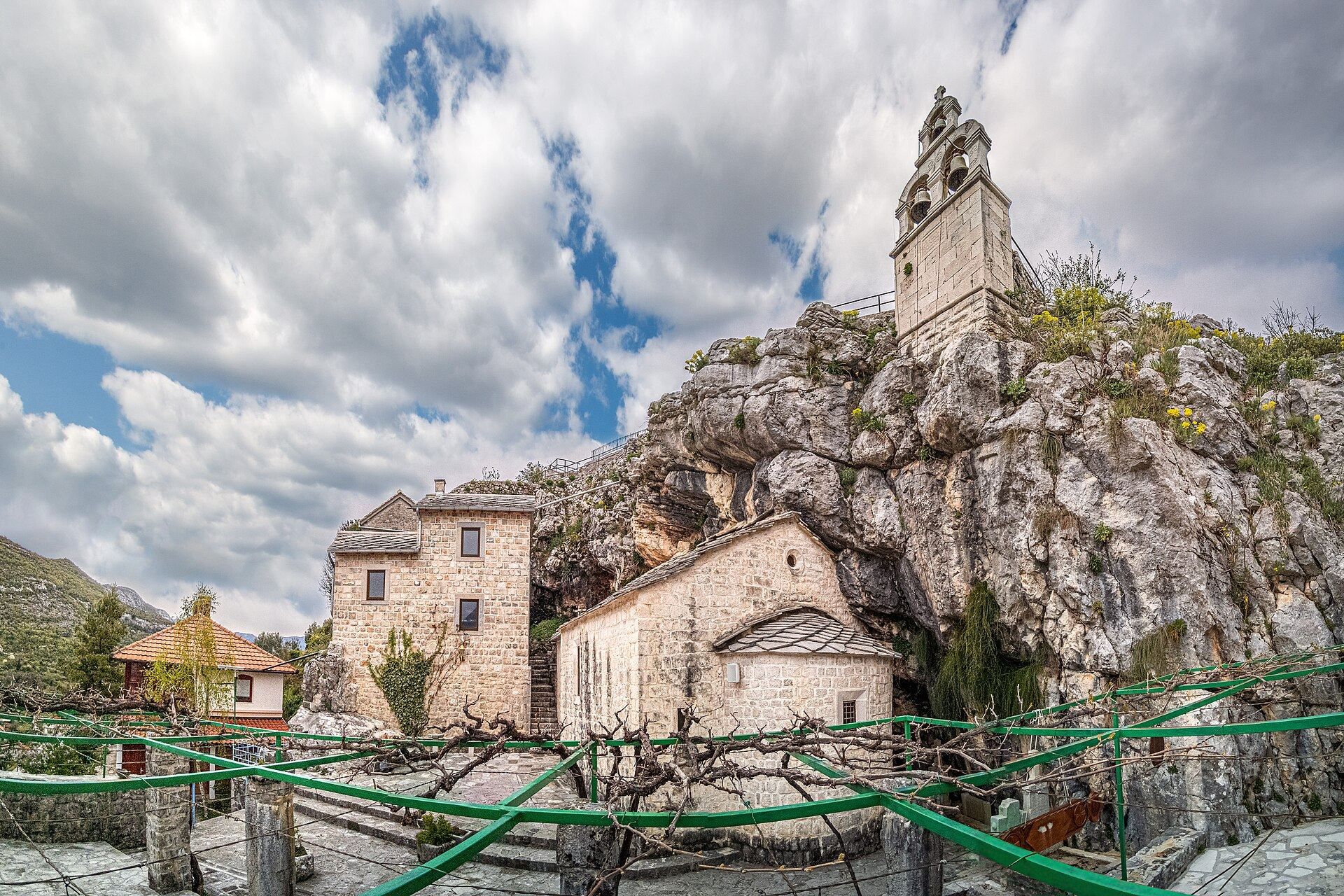
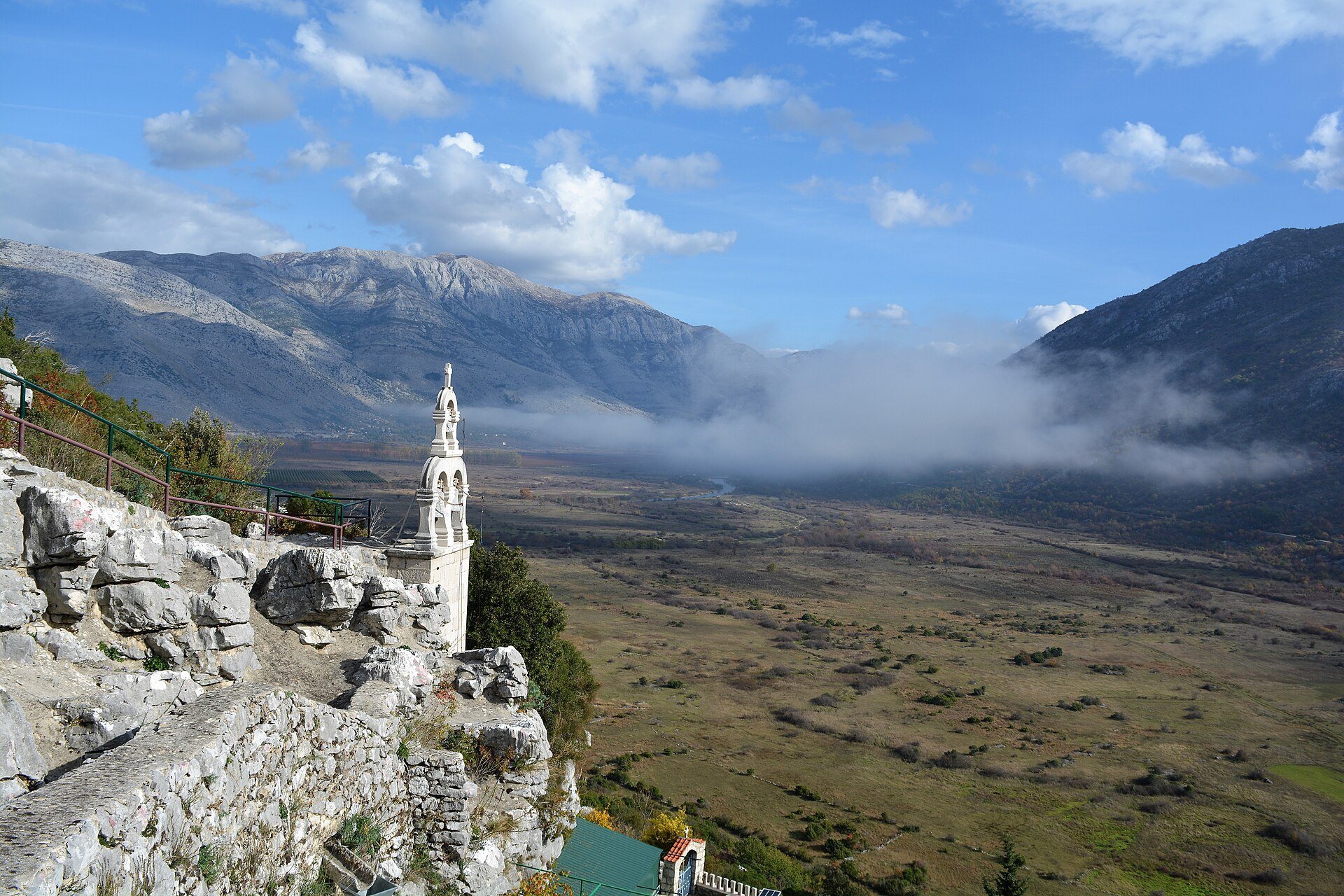
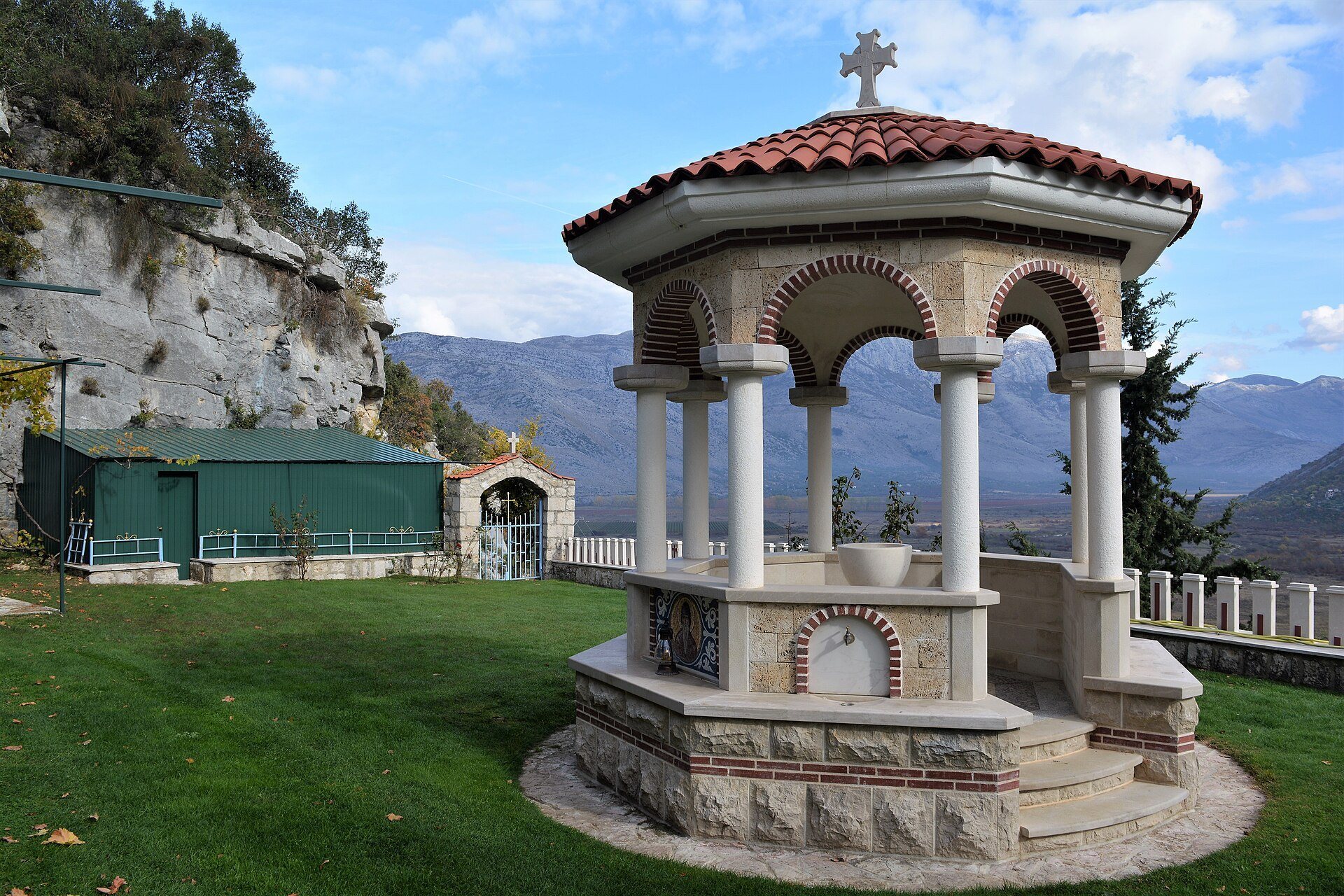
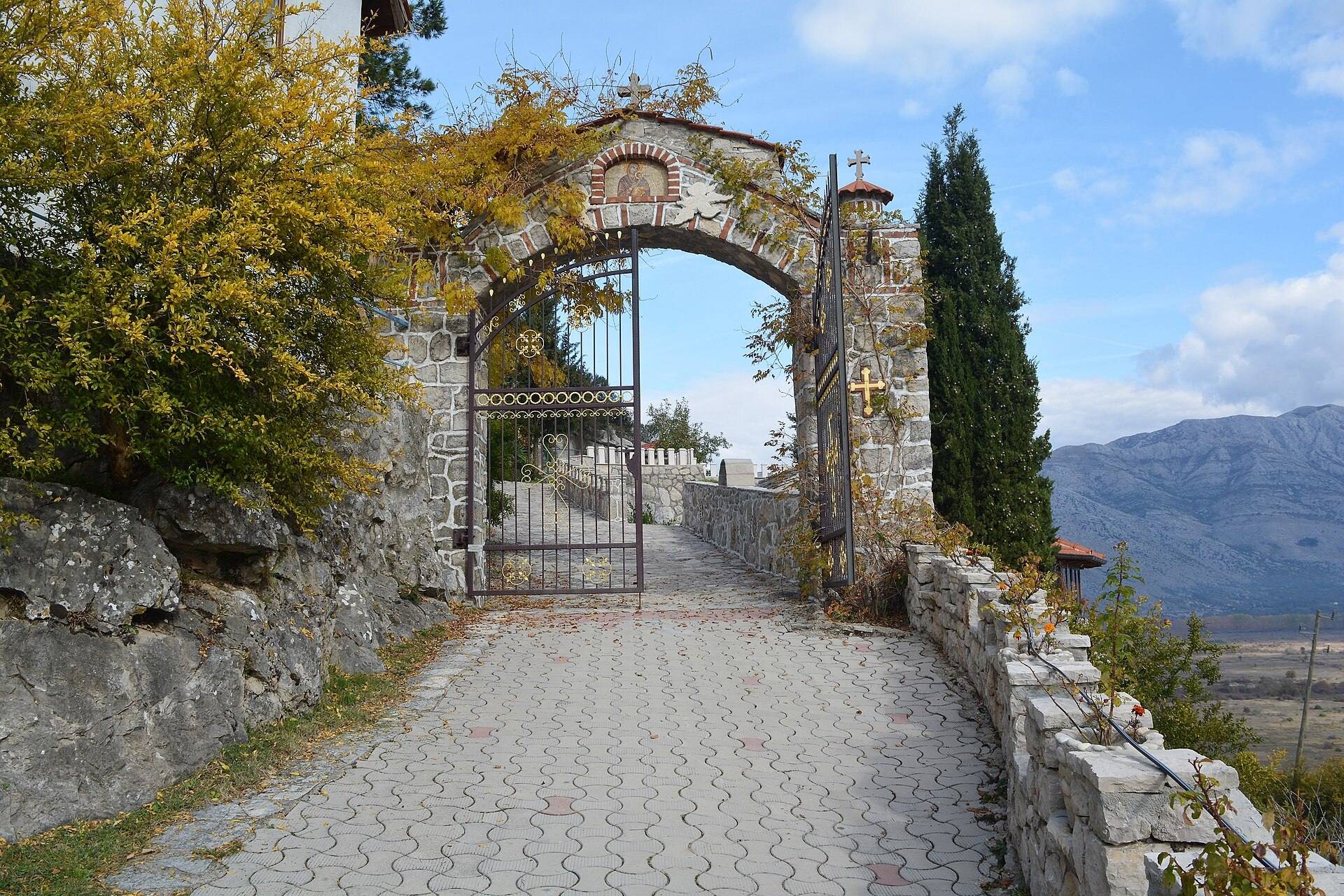
The monastery stands in Zavala village on the western edge of Popovo Polje, below Mount Ostrog. Its buildings are closely integrated with the landscape, and a natural rock face forms the northern wall of the church. The complex includes the Church of the Presentation of the Virgin, a bell-gable, a limestone retaining wall with an access tunnel and terrace, a newer monastic residence, a cistern, an old school, and cave hermitages.
Church of the Presentation of the Virgin
The church belongs to the group of Herzegovinian vaulted churches with lateral attached arches. It has a rectangular plan, is built of stone, and measures approximately 11.95 metres long. Its width varies from about 3.40 to 6.40 metres. The foundations were laid in the late sixteenth century and again in 1819, while the completed building dates to 1886.
Abbot Serafim was responsible for the church’s painted decoration. In 1619, the Hilandar monk Georgije Mitrofanović, a Serbian Orthodox painter known for major seventeenth-century fresco cycles, painted the interior. These frescoes are regarded as among the highest-quality wall paintings produced in Bosnia and Herzegovina under Ottoman rule.
Bell-gable
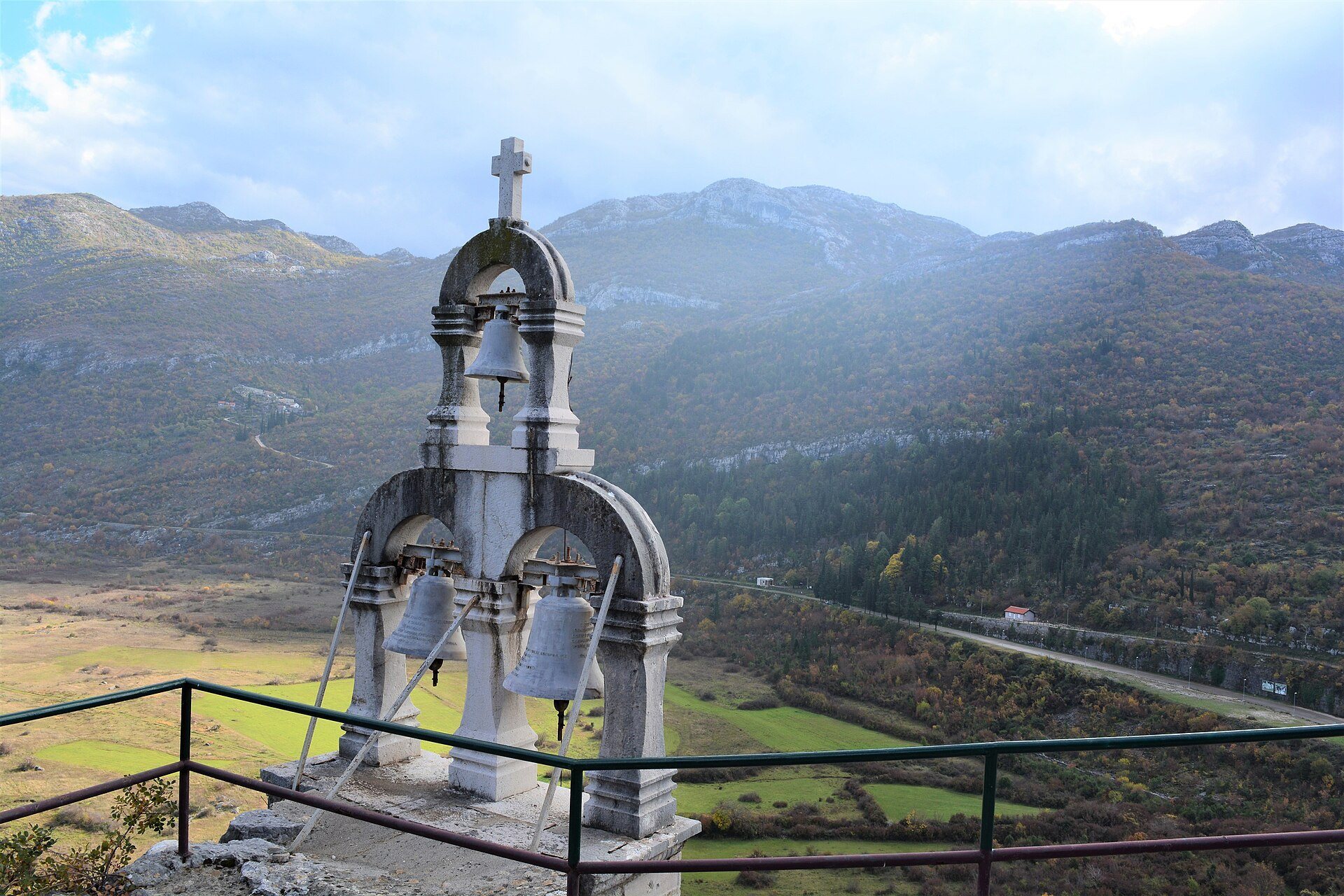
A stone bell-gable, a wall-like structure designed to hold church bells, stands against the rock beside the church. Built in 1899, it contains three bells.
Retaining wall and access tunnel
The limestone retaining wall and access tunnel once provided the route to the church before stairs were built. The structures are made entirely of limestone bonded with lime mortar. The eastern side of the retaining wall rises more than 5 metres, while the tunnel is approximately 15 metres long, 1.70 metres wide, and 1.80 metres high.
Monastic residence
The rectangular monastic residence measures approximately 11 by 7.50 metres. Built in 1876, it was burned during the 1992–1995 war. The residence forms part of the restored monastic complex.
School, hermitages, and nearby cave
Old school and cave hermitages
The old school lies below the access road, about 30 metres from the church. It is a rectangular stone building measuring approximately 5.80 by 3.80 metres and is now in ruins. Cave hermitages, secluded places used by monks or religious recluses for solitary or semi-solitary devotion, lie about 10 metres from the monastery.
Vjetrenica Cave
Vjetrenica Cave lies about 300 metres east of Zavala village. Strong air currents pass through its entrance and interior, giving the cave its name. Medieval drawings are carved into the rock at the entrance.
Crkvina necropolis
Church of Saint Petka
Crkvina, also called Petkovica, is a medieval necropolis southeast of the monastery. It contains the remains of the Church of Saint Petka, the Church of Saint Peter, stećak tombstones, and a continuing village cemetery on its eastern side. A stećak is a monumental medieval stone tombstone characteristic of Bosnia and Herzegovina and neighbouring parts of the western Balkans.
The remains of Saint Petka’s Church have been conserved to a height of 0.60 metres. The building is a single-nave church with a semicircular eastern apse. It was built against an earlier structure, cutting through that structure’s walls on the north and west. Two stećak tombstones are incorporated into its northern wall, and the church is generally dated to the late medieval period.
Church of Saint Peter
Saint Peter’s Church is a single-nave building with a rectangular eastern apse. It measures 13.64 by 6.22 metres and has walls approximately 0.50 metres thick, constructed from regularly coursed dressed stone. The church was first mentioned in 1525.
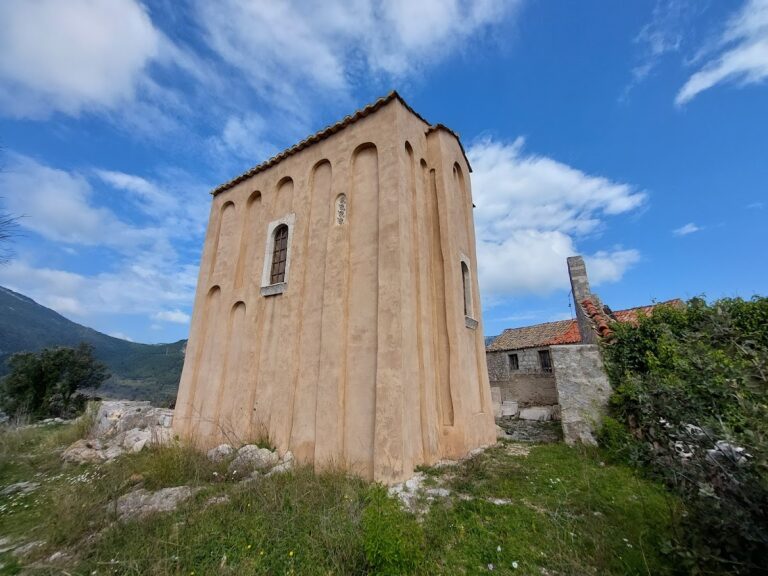
Its date remains uncertain, with proposed datings ranging from the ninth to the twelfth century, including the second half of the twelfth century. Stone architectural decoration and construction technique support the later dating within that range. Architectural stone fragments found during investigation in 1957 are now held in the Trebinje Museum, together with stonework discovered at Zavala Monastery and nearby.
Fortified structures
Grad tower
A fortified tower known as Grad stands on steep rock above Zavala in the direction of Belenići. Its walls are built of dressed stone. A large pit below the tower is known as Tamnica or Zmajevica. Local tradition attributes the tower’s construction to Herceg Stefan, the fifteenth-century Bosnian nobleman and ruler Stefan Vukčić Kosača, who held the title of herceg. According to the tradition, he built it while fleeing Blagaj with his treasure.
Village tower
A separate stone-built tower also stands within Zavala village.