Nomoto Shōgunzuka Kofun: A Keyhole-Shaped Burial Mound in Japan
Site at a Glance
- Rating
- 3.8
- Popularity
- Very Low
- Country
- Japan
- Primary era
- Classical
- External website
- Open
- Eras represented
- Classical
- Civilizations
- Yamato
- Site type
- Burial
- Remains
- Burial Mound
On this page4 sections
History
Nomoto Shōgunzuka Kofun is a monumental Japanese burial mound in Higashimatsuyama, Japan, probably built in the latter half of the fourth century during the Kofun period, the era from approximately the third to the sixth centuries when large burial mounds were constructed. Also known as Nomoto No. 1 Kofun, it belongs to the Nomoto Kofun Group and was likely the largest kofun in Saitama Prefecture when it was built.
Debates over the construction date
The mound’s date was disputed for more than a century, with proposed dates ranging from the early to the late Kofun period. Archaeologist Ryoichi Kanaizuka placed it in the late fifth or early sixth century after examining pottery collected from the mound. Archaeologist Ken Amakasu instead proposed the fourth century, basing his argument on the mound’s form and the lack of confirmed haniwa installations, meaning clay figures or cylinders associated with some burial mounds.
Settlement remains at the nearby Goryo and Sorumachi archaeological sites provided further context. Sorumachi included a workshop for producing crystal beads, and the quantity and quality of its finds led to its interpretation as a community connected with the background of Nomoto Shōgunzuka Kofun. This evidence strengthened the view that the mound belonged to the early Kofun period.
Modern investigations
In 2017, the Higashimatsuyama City Board of Education and the Waseda University Archaeological Research Laboratory carried out three-dimensional surveying of the mound and ground-penetrating-radar investigations. Their results indicated that the kofun was probably constructed in the latter half of the fourth century. Since the Sakitama Kofun Group at Gyoda is generally dated to the latter half of the fifth century, Nomoto Shōgunzuka Kofun was probably the largest kofun in Saitama Prefecture at the time of its construction.
Remains
Nomoto Shōgunzuka Kofun is a south-facing, keyhole-shaped mound, a burial mound formed from a circular rear section and a projecting rectangular front section. It stands at the tip of the Matsuyama Upland, where the upland extends into the broad alluvial plain formed by the Toki River. Measuring about 115 metres in surviving length, it is the largest keyhole-shaped mound in the Nomoto Kofun Group. The rear circular section rises approximately 13 metres, while the front section is about 8 metres high. A surrounding moat has not been confirmed.
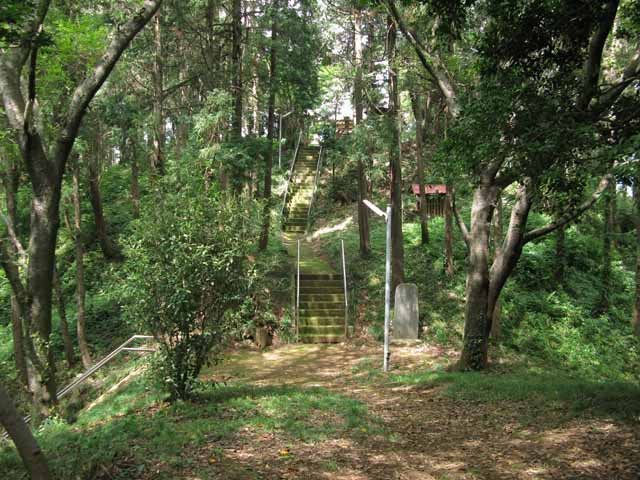
The mound has not been excavated archaeologically. A boring survey conducted at the summit in 1978 identified a feature 1.2 metres below the surface, interpreted as a possible gravel burial chamber. Pottery has also been recovered from the kofun. Rijin Shrine now stands on the summit of the rear circular section, while a memorial monument to those who died in the Russo-Japanese War occupies the front section.