Dubrovnik Synagogue: A Historic Sephardic Synagogue in Croatia


Site at a Glance
- Rating
- 4.1
- Popularity
- Low
- Country
- Croatia
- Primary era
- Early Modern
- External website
- Open
- Eras represented
- Early Modern, Modern
- Civilizations
- Republic of Ragusa
- Site type
- Religious
- Remains
- Synagogue
On this page10 sections
History
Dubrovnik Synagogue, also known as the Old Synagogue, is an Orthodox Sephardic synagogue in Dubrovnik, Croatia, opened in 1548 with a principally Baroque design. It is owned by the city’s Jewish community and is described as the world’s oldest Sephardic synagogue still in use, as well as one of Europe’s oldest synagogues.
Medieval Origins and Sephardic Development
A Jewish community probably existed in Dubrovnik by 1352, when the synagogue was likely established. The city authorities granted the community official legal recognition in 1408. After the expulsion of Jews from Spain in 1492, Sephardic Jews, meaning Jews of Iberian origin and their descendants, joined the community. Conversos, Jews who had been forcibly converted to Christianity or whose descendants sometimes continued Jewish practices secretly, also arrived from Spain and Portugal.
A ship carrying Portuguese Jewish refugees reached Dubrovnik in May 1544. The newcomers joined a small established community whose members worked in trade, crafts, banking, and medicine. They dealt in spices, silk, textiles, and other goods connected with Dubrovnik’s port. The synagogue’s formal inauguration as a Sephardic institution probably took place in 1548.
The Jewish Quarter
In 1546, Dubrovnik’s authorities assigned the Jewish community a designated quarter centered on Žudioska Street. This area became known as the Dubrovnik Ghetto, a legally or socially segregated urban district in which Jews were required or permitted to live. Gates at both ends of the lane were locked at night. The ghetto was partly destroyed in 1587.
The community’s position was periodically affected by restrictions and persecution connected with the adoption of Venetian laws and local Roman Catholic policies. Several blood-libel accusations, which falsely accused Jews of murdering Christians for ritual purposes, formed part of this history. During Dubrovnik’s economic and political decline in the mid-eighteenth century, Jews were prohibited from engaging directly in commerce, and in 1755 their residence was again restricted to the ghetto.
Changing Political Rights
French occupation under Napoleon brought legal equality to Dubrovnik’s Jews for the first time between 1808 and 1815. The annexation of the Dalmatian coast to the Austrian Empire in 1814 removed those rights. They were restored in the mid-nineteenth century under new laws applying to the Kingdom of Dalmatia, an Austrian crown land until 1918.
War, Destruction, and Survival
Before the Holocaust, approximately 250 Jews lived in Dubrovnik. During the Second World War, the German- and Italian-sponsored Croatian regime imposed racial laws, and some Dubrovnik Jews were deported to the Jasenovac camp in June 1941. After Dubrovnik came under Mussolini’s Italian administration, Jews were initially not deported. In November 1942, however, Italian authorities, under Nazi pressure, transferred them to Gruž and the nearby island of Lopud, where about 750 Jews from Dubrovnik and elsewhere were gathered.
In June 1943, the internees were transferred to a concentration camp on Rab Island. Following Italy’s surrender on 8 September 1943, Tito’s partisans moved some Jews to territories under their control. Approximately 180 to 200 people remained at Rab and were sent to extermination camps after German forces occupied the area. Dubrovnik was liberated by Tito’s Yugoslav partisan army in October 1944. Some Holocaust survivors from the city later emigrated to Israel.
During the communist period under Tito, the synagogue reopened in 1956. It served only as a museum during the 1980s, and a memorial plaque commemorating Dubrovnik’s Jewish Holocaust victims was installed in 1980. Damage from the 1667 earthquake, the Second World War, and the Croatian War of Independence was repaired as closely as possible to the original design. The synagogue reopened in 1997.
During the Croatian War of Independence, Dubrovnik was besieged by Serbian and Montenegrin paramilitary forces. About two-thirds of the city sustained some degree of damage. Shells and grenades damaged buildings beside the synagogue in autumn 1991, and a shell penetrated its roof in 1992. More than 80 valuable ritual objects were then transferred to the Yeshiva University Museum in New York for safekeeping. They included a thirteenth-century Torah scroll, silver ornaments, and textiles. A legal dispute involving former community president Michael Papo, community leader Dr Bruno Horowitz, and the Croatian state ended with a 1998 court ruling ordering the treasures’ return to Dubrovnik.
Contemporary Religious Role
The synagogue is formally affiliated with Orthodox Judaism and the Sephardic rite known as Nusach Edot HaMizrach, the Eastern Sephardic prayer tradition. It serves the community mainly during Jewish holy days and special occasions. Approximately 30 Jews currently live in Dubrovnik, and the small community has no permanent rabbi, so visiting rabbis conduct services on holy days. The building also houses a small museum of Dubrovnik’s Jewish history, with historical documents, ritual objects, and centuries-old artifacts. Israeli President Moshe Katsav visited the synagogue during his official visit to Croatia in 2003.
Remains
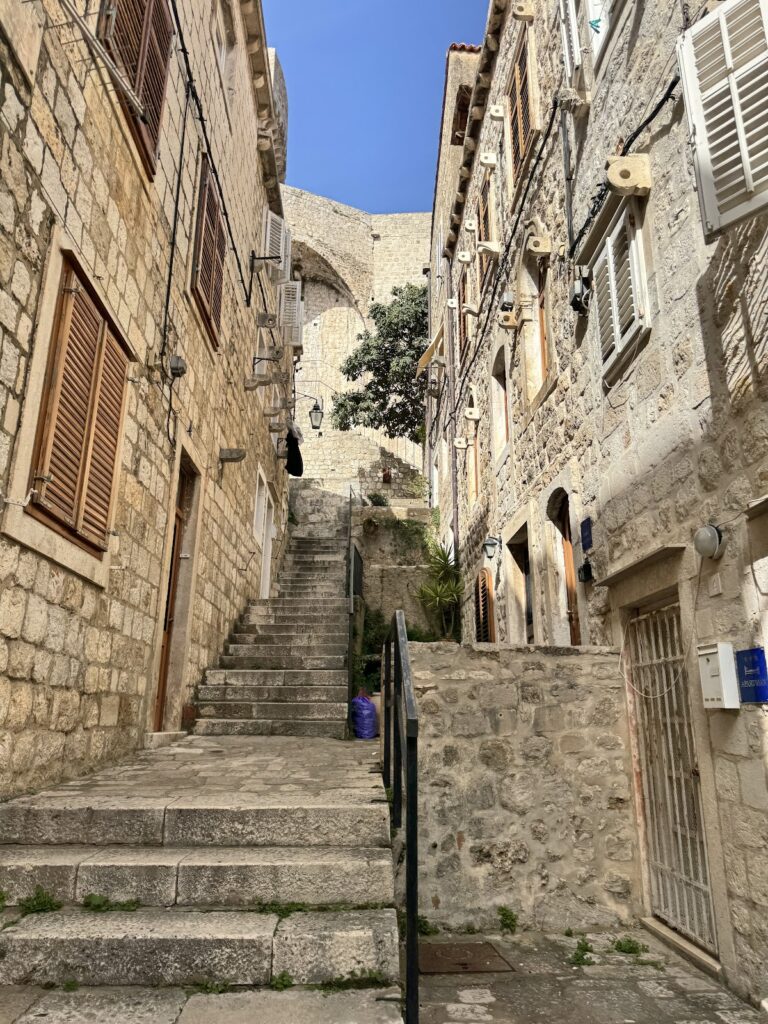
The synagogue occupies the third floor of a narrow rectangular house at 5 Žudioska Street in the northern part of Dubrovnik’s Old Town. The house is typical of fourteenth-century Dubrovnik buildings and is connected to a neighboring property formerly associated with the Tolentino family. Members of that family held the synagogue keys and cared for the building for centuries. Žudioska Street was historically the main lane of the Jewish quarter and leads toward the Stradun, Dubrovnik’s main pedestrian thoroughfare, near the town square and harbor.
Prayer Room and Baroque Interior
The present synagogue opened in 1548, while its interior was completed in 1652. Although the building includes elements from several periods and has undergone repeated refurbishment, its principal design is Baroque. The main prayer room is rectangular. A wooden bimah, the reading platform from which the Torah is read, stands at the center, while a wall with three arches divides the room into two sections.
On the eastern wall opposite the bimah stands an elaborate ark, probably made in the nineteenth century. The ark is the cabinet in which Torah scrolls are kept. It has gilded Corinthian columns, whose capitals are decorated with acanthus-leaf motifs, together with carved wooden ornament. Its inner doors are covered by a satin curtain, and it contains Torah scrolls, including one written before the expulsion of the Jews from Spain.
A thirteenth-century Moorish carpet with floral designs covers the steps leading to the ark. The ceiling is painted sky blue with gold stars and carries stucco reliefs. Nineteenth-century Florentine-style chandeliers hang from it. These features form part of an interior shaped by several historical periods rather than by a single rebuilding campaign.
Women’s Gallery and Community Spaces
An elevated women’s gallery was added along the southern wall in the eighteenth century. It occupies space taken from a room in the adjoining Tolentino building and has small openings and a partition. A women’s gallery is a separated or raised area traditionally provided for women’s participation in synagogue worship.
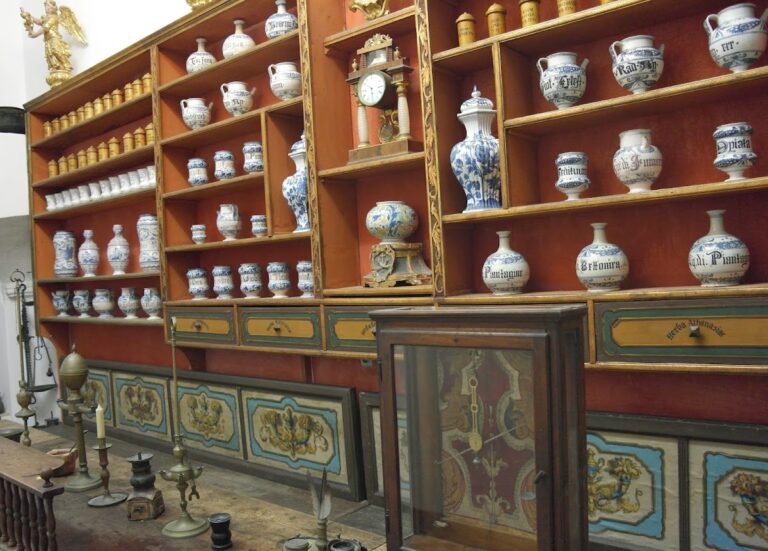
The synagogue’s internal arrangement differs from that of other European synagogues. The second floor contains the Jewish community’s offices, while the building also includes the small Jewish museum. Its holdings consist of historical documents and Jewish ritual and cultural objects, collectively known as Judaica.
Protection of the Interior and Wartime Repairs
During the Holocaust, after the Italian withdrawal and at the beginning of the German occupation, a community leader from the Tolentino family dismantled the ark and concealed it with the Torah scrolls and other Judaica in the homes of Christian Croatian friends. The objects were returned after the war, and the ark was reassembled.
The prayer space and the Jewish Community Headquarters sustained physical damage during the shelling of 1991, when their windows were shattered. Artillery penetrated the synagogue roof in 1992, prompting the temporary removal of more than 80 ritual objects. Following the 1998 court ruling, the treasures were returned to Dubrovnik. Repairs to the synagogue addressed damage from the 1667 earthquake, the Second World War, and the Croatian War of Independence while preserving the original design as closely as possible.