Medici Aqueduct (Acquedotto Mediceo): Pisa’s Historic Water Supply
Site at a Glance
- Rating
- 4.3
- Popularity
- Very Low
- Country
- Italy
- Primary era
- Early Modern
- Eras represented
- Early Modern, Modern
- Civilizations
- Grand Duchy of Tuscany, Italian
- Site type
- Infrastructure
- Remains
- Aqueduct
On this page20 sections
History
The Medici Aqueduct is a seventeenth-century water system in Pisa, Italy, built under the Medici grand dukes of Tuscany to carry spring water from Asciano Pisano into the city. Active from the seventeenth to the twentieth century, it addressed Pisa’s long dependence on wells, whose water was affected by the surrounding marshy ground and regarded as impure and unhealthy.
From Roman water supply to Medici planning
Pisa had once received water through a Roman aqueduct running from Caldaccoli, just outside San Giuliano Terme, to the city’s Roman baths. After that system fell out of use, the city depended on wells for at least a thousand years. Many residents suffered from cachexia, a wasting syndrome involving severe loss of weight and strength, and Michel de Montaigne noted the problem during his visit to Pisa in 1500.
Cosimo I de’ Medici, one of the grand dukes of Tuscany, initiated plans for an underground conduit that would collect the springs of Asciano Pisano and bring them within Pisa’s walls. The underground project failed, so an arched aqueduct was chosen as a more expensive but more functional solution.
Construction and early improvements
Grand Duke Ferdinando I de’ Medici began the new construction and entrusted its design to Raffaello Zanobi di Pagno between 1588 and 1592. In 1594, illness caused Andrea Sandrini to take over the work. He corrected a design error that had allowed water to stagnate instead of reaching Pisa. The aqueduct was completed in 1613 under Ferdinando’s successor, Cosimo II de’ Medici. Financing came from revenue raised by the salt tax and from the sale of timber from felled pine trees.
Repairs and improvements followed in 1632. Buttresses were added to stabilize the piers, channels were cleaned, collapsed sections were repaired, and some arches were rebuilt at greater height to improve the water gradient.
Damage, municipal management, and expansion
An earthquake centred in the Pisan Hills damaged the aqueduct on 14 August 1846. At the crossing of the Fosso della Vicinaia, visibly damaged and oblique arches were removed and rebuilt perpendicular to the road. The reconstruction also improved circulation through the crossing.
Management and ownership passed from the Office of Rivers and Ditches to the Municipality of Pisa in 1860. The municipality still owns the aqueduct and the Asciano cistern. In 1890, municipal works sought to increase the flow and improve water quality. Springs that became cloudy easily were excluded, while additional sources at Agnano and Ragnaia were brought into the system.
Decline and continuing water infrastructure
The Medici Aqueduct supplied Pisa for approximately three centuries, but its flow eventually became insufficient for a growing city. The Filettole Aqueduct opened in 1925 and supplied Pisa, neighbouring districts, and part of Livorno. The last known use of the Medici Aqueduct occurred during the Second World War, when it was the only functioning aqueduct in Pisa in 1943.
Water from the Valle delle Fonti still reaches Pisa through modern underground pipes laid beside the historic aqueduct and connected to the functioning Medici intake structures. The historic system also enabled the construction and operation of numerous urban fountains. Hydraulic chambers along the route distributed water for rural purposes, while underground conduits within Pisa supplied public fountains and private users. One branch, the Condotta della Religione, served the Order of the Knights of Saint Stephen, a military-religious order established by the Medici rulers of Tuscany.
Around 1619, the Kinzica district was connected through a conduit running from Piazza Cairoli across the former Ponte Vecchio, on the site of the present Ponte di Mezzo. This branch supplied fountains at the Logge di Banchi, near Santa Maria della Spina, and in Piazza San Martino.
Conservation
Conservation is uneven, and many sections have suffered from inadequate maintenance and structural instability. The Municipality of Pisa has restored the Cisternone in recent years. The hydraulic station on Via Battelli was restored by Pisa’s Leonardo da Vinci Industrial Technical Institute through the “The School Adopts a Monument” project. The route is especially vulnerable where it crosses heavily trafficked Via Puccini, where vehicles have repeatedly caused damage.
Remains
Spring collection and underground works
The aqueduct begins in the Valle delle Fonti at Asciano Pisano. Intake structures built in successive phases intercept springs feeding the Zambra stream. Small cisterns collected the water, which was filtered through layers of differently sized pebbles, sand, and activated carbon. Most of the purified water continued downstream, while a smaller quantity entered the Medici Cistern, or Cisternone Mediceo.
Cisternone Mediceo
The Cisternone held 366 cubic metres of water and provided approximately six to eight hours of autonomy when severe weather made the incoming supply cloudy. Its stone basin is fronted by a facade with a triangular pediment and lateral pilasters. A subterranean gallery carried water from the basin to the bottino of San Rocco. A bottino is a hydraulic chamber used to receive, regulate, settle, or distribute water. Restoration of the Cisternone included a large interior model showing the Pisan mountains and plain as they appeared when the hydraulic system was built.
House of the Fountain Keeper and bottini
Water from the Cisternone reached the House of the Fountain Keeper. The keeper controlled the intake system, regulated the quantity entering the aqueduct, and diverted cloudy water into the nearby Zambra stream while using water stored in the Cisternone.
Another underground section led to the bottino della Guglia, where the first fountain along the route is located. Branches added in the nineteenth century joined the system there and increased its flow. The underground section ended at the bottino of San Rocco, where water emerged and entered the slightly inclined arched aqueduct. An inscription remains at the San Rocco bottino.
Arched aqueduct
Structure and materials
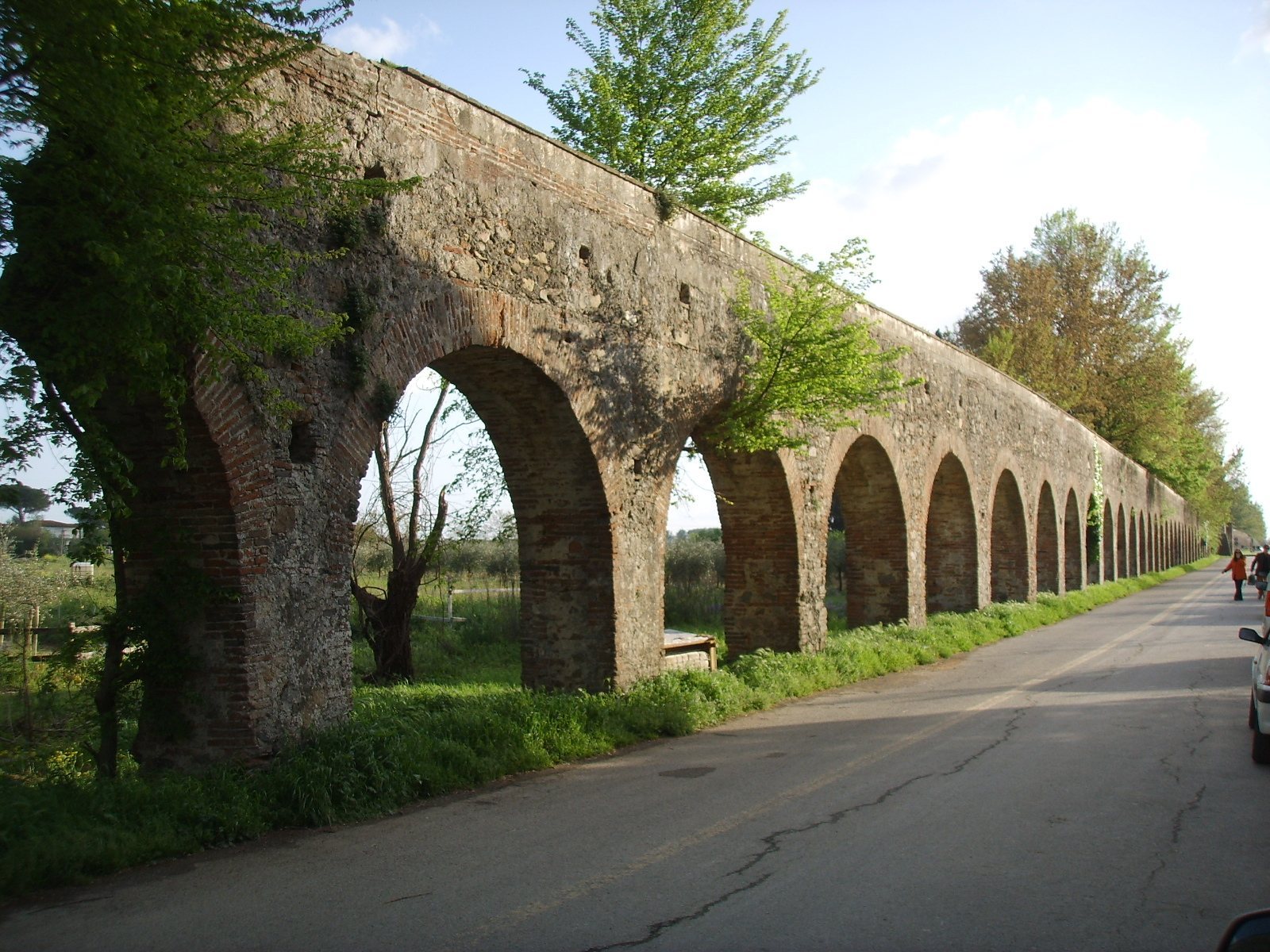
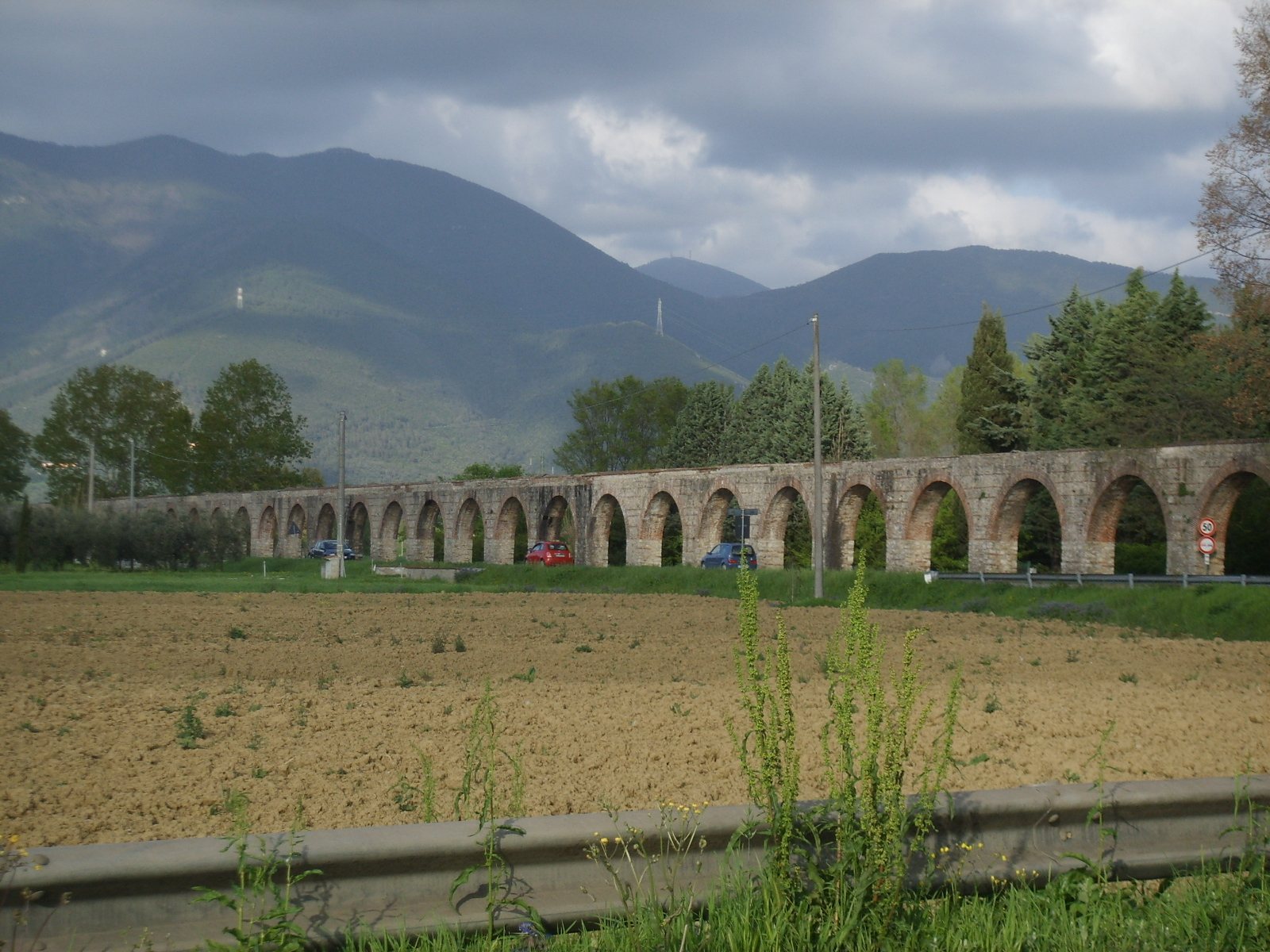
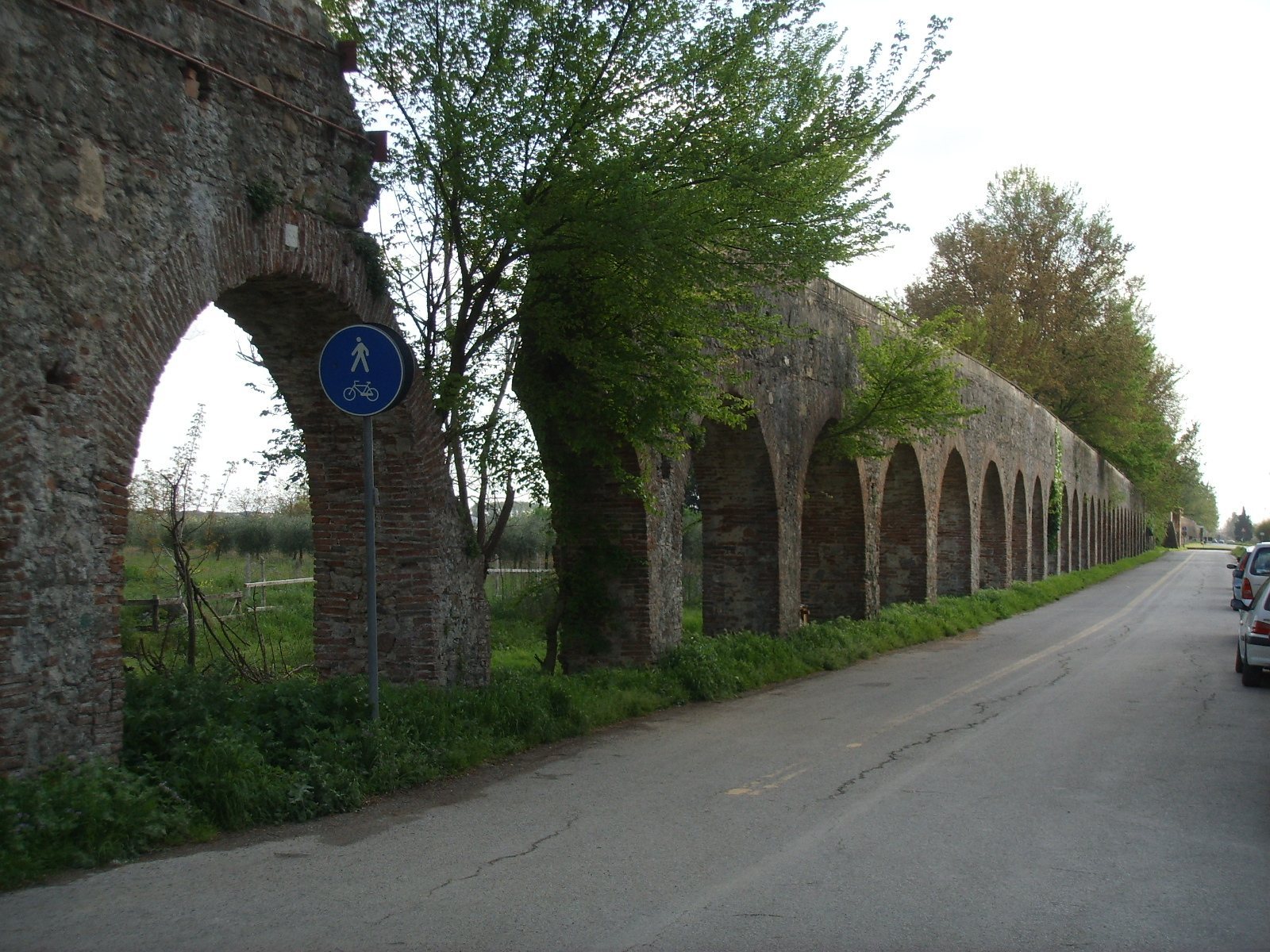
From Asciano to Pisa’s walls at Piazza delle Gondole, the aqueduct runs for approximately 6 kilometres in a substantially straight line. It originally comprised 954 evenly spaced arches whose height gradually decreased toward the city. Rubble stone and brick were laid in alternating courses to regularize the structure, while buried pine trunks supported the foundations.
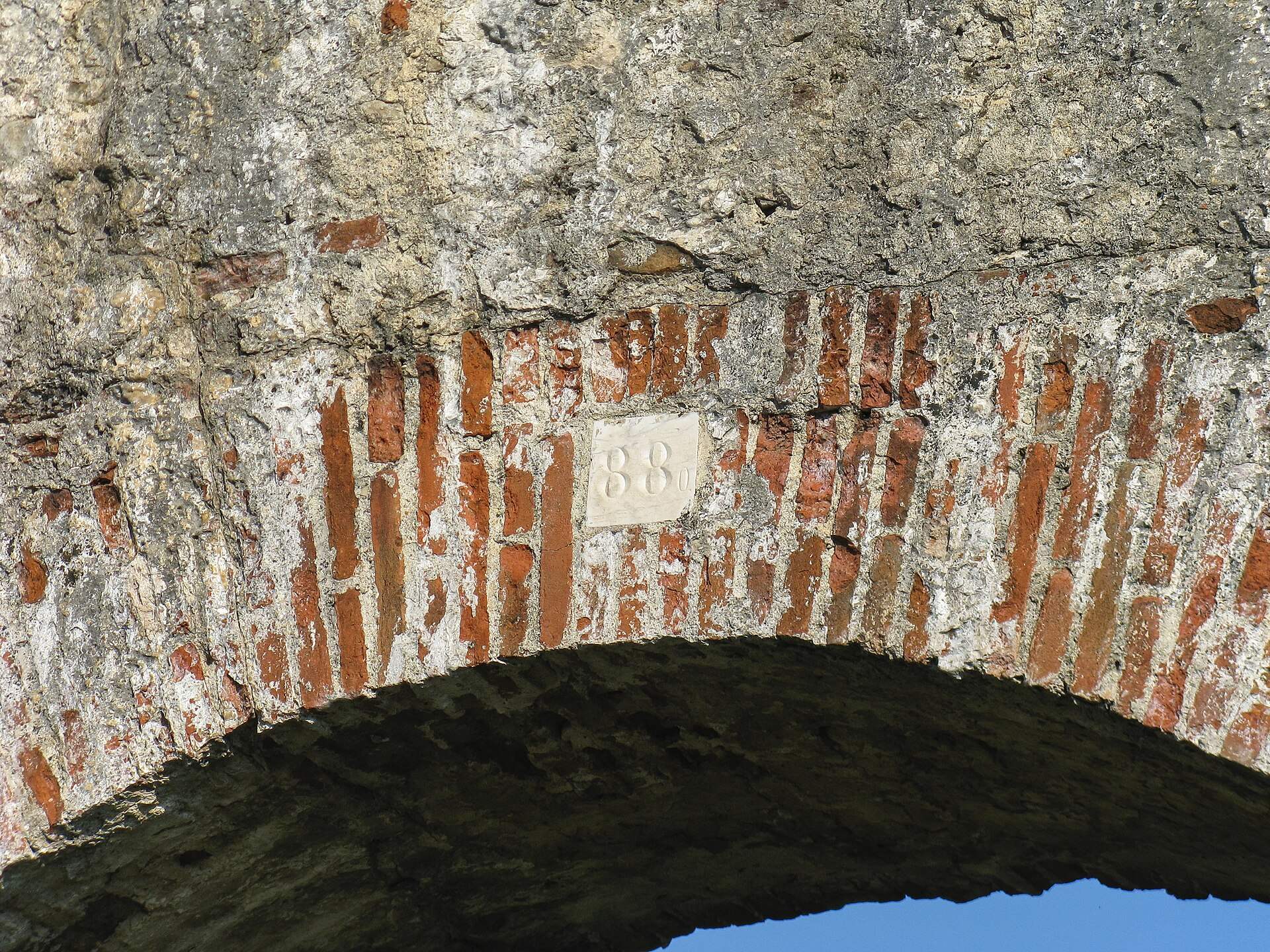
The water channel was made of terracotta and covered with stone slabs. This protected the water from solar heating and from dirt entering the channel. Marble plaques numbered the arches at intervals of ten, beginning at Pisa and proceeding toward Asciano.
Surviving condition
Many arches now lean by as much as 12 degrees and display conspicuous cracks. Natural collapses and deliberate demolitions for urban-planning works have interrupted the original sequence at 86 locations. In these areas, unstable stumps and broken brickwork remain. Masonry diaphragms added to improve stability have also separated from some arches by several centimetres.
Hydraulic stations and route fountains
Caselli idrici
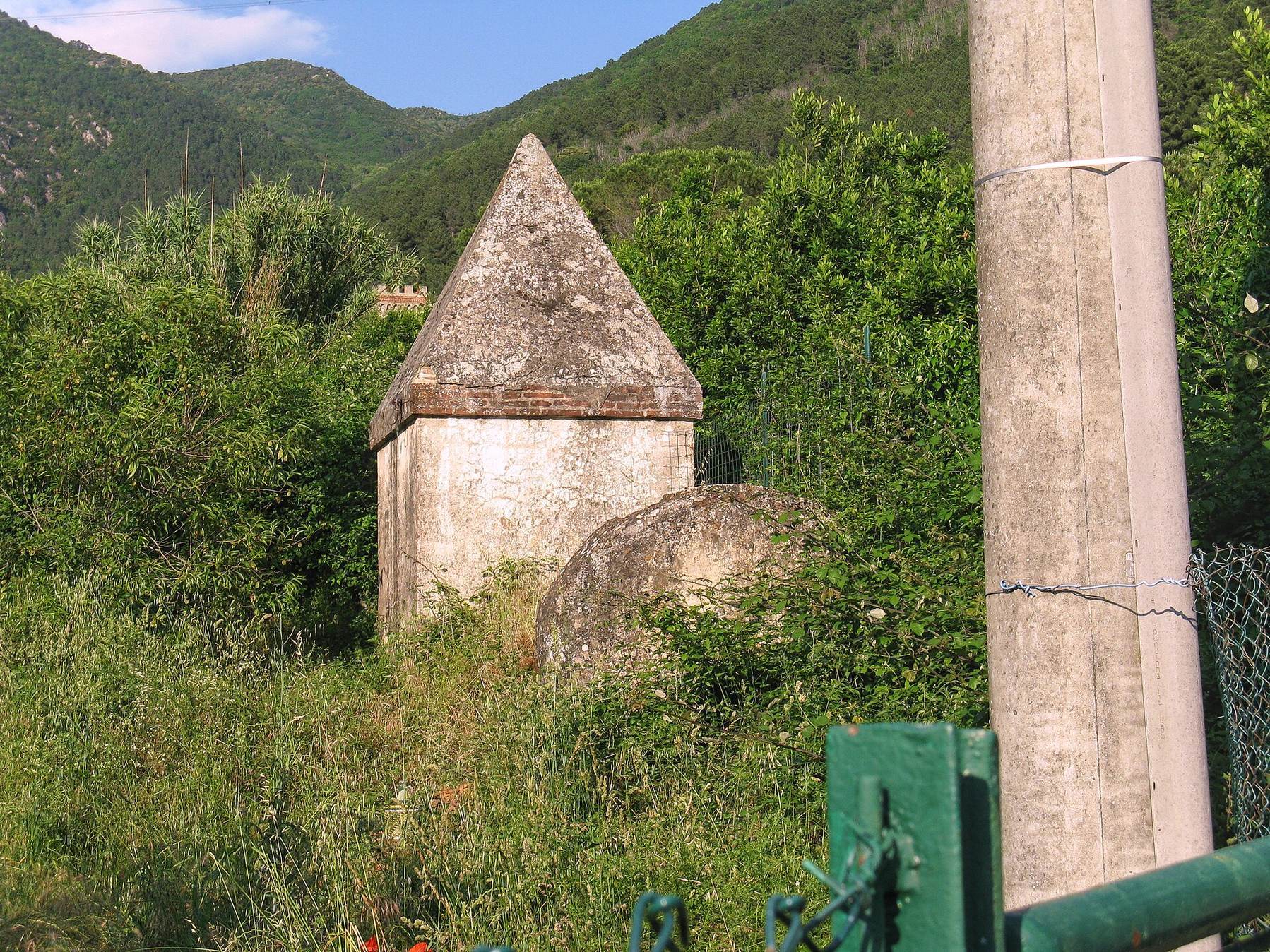
At least four hydraulic stations, or caselli idrici, remain identifiable. They stand at Asciano, at the corner of Via Possenti and Via dei Condotti; in open countryside near Via Vincenzo Bellini; near Via di Pratale; and at the corner of Via Angelo Battelli. These smaller stations settled water and distributed part of the supply to private users. The Via Angelo Battelli station was restored in 2007.
Fountains along the arches
Two fountains stand along the arched section, one at the intersection with Via Sant’Elena and the Fontana dei Cavallai on Via di Pratale. A cycle-and-pedestrian path accompanies parts of the aqueduct, following sections of the former Via dei Condotti, whose route was diverted in the 1980s.
Urban fountains
Fountain at Piazza delle Gondole
The first urban fountain stood in Piazza delle Gondole beside a cistern that was later demolished. Decorated in white San Giuliano marble in a neoclassical style, it bears the Medici-Lorraine arms. Two mascarons occupy its lower section. The upper one was ornamental and allowed water to overflow continuously onto a shelf, while the lower one supplied the public.
Fountains in central Pisa
Aqueduct-fed fountains served Piazza D’Ancona, Piazza San Luca, Via San Francesco, Piazza Cairoli, Piazza Martiri della Libertà, Piazzetta Tongiorgi, Piazza delle Vettovaglie, the courtyard of the archbishop’s palace, and the Lungarno in front of the Royal Palace. The fountain in Piazza Martiri della Libertà had originally served an earlier convent; the present fountain is a nineteenth-century work by Alessandro Gherardesca.
The Fontana dei Putti in Piazza dei Miracoli was made by Giuseppe Vaccà and Giovanni Antonio Cybei. The Fontana del Gobbo in Piazza dei Cavalieri stands before the pedestal of the statue of Cosimo I. Other surviving fountains include those in Piazzetta Tongiorgi, Piazza delle Vettovaglie, Piazza Cairoli, and the courtyard of the archbishop’s palace. The Via San Francesco fountain survives as a single frame, while the fountains on the Lungarno and in the former botanical garden known as the Giardino dei Semplici are represented by their former locations in the city’s water-supply history.
Kinzica connection
The former Kinzica branch supplied fountains at the Logge di Banchi, near the church of Santa Maria della Spina, and in Piazza San Martino. These urban features formed part of the network that carried spring water from the Medici Aqueduct into Pisa’s streets and public spaces.