Elchingen Abbey: A Former Benedictine and Imperial Abbey in Germany
Site at a Glance
- Rating
- 4.8
- Popularity
- Low
- Country
- Germany
- Primary era
- Early Modern
- External website
- Open
- Eras represented
- Medieval, Early Modern
- Civilizations
- Holy Roman Empire
- Site type
- Religious
- Remains
- Monastery
On this page14 sections
History
Elchingen Abbey is a former Benedictine abbey in Germany, founded before 1120 in the Danube valley by Count Adalbert of Ravenstein and his wife, Berta of Boll. Dedicated to the Virgin Mary and Saints Peter and Paul, it later moved to a hilltop medieval castle complex after a fire, where the present site developed. Its history includes monastic reform, territorial rule as a Free Imperial Abbey, repeated wartime destruction, and dissolution during secularization in 1802.
Foundation and relocation
The original monastery stood in a broad valley near the Danube. After the fire, Adalbert and Berta’s daughter Luitgard and her husband, Margrave Conrad of Meissen, refounded it on the hill at its present location. The date of this refoundation is given as either 1128 or 1142. On 26 February 1142, Conrad and Luitgard placed the monastery under papal protection, and Pope Innocent II confirmed that protection in 1147.
The first monks came from Hirsau and Lorch. Hirsau was the centre of a major medieval Benedictine reform movement that promoted stricter observance and influenced the ordered basilican design of the abbey church. Andreas of Aichheim served as the first abbot, approximately from 1128 to 1139. A document from 1150 records an exchange of properties involving Elchingen and St Blasien at Langenau, in the presence of King Conrad III, who acted as Elchingen’s advocate.
Growth and medieval religious life
Through substantial donations, Elchingen Abbey acquired extensive landed possessions and several villages. During the thirteenth and fourteenth centuries, the monastery appears to have cared for poor and seriously injured people. Burials west of the abbey church contain skeletons with unusually frequent evidence of severe trauma and disease, physical findings consistent with this charitable role.
The monastery was reformed before 1430 by monks from Wiblingen under the influence of the Melk reform, a late-medieval movement that sought stricter Benedictine observance and monastic renewal. In the fifteenth century, Elchingen became involved in a prolonged dispute with the Free Imperial City of Ulm over jurisdiction, precedence, and the monastic bailiwick, the authority responsible for protecting and administering the abbey’s secular interests.
Free Imperial Abbey and wartime destruction
In the late fifteenth century, Elchingen obtained imperial immediacy and became a Free Imperial Abbey. This status placed the monastic territory directly under the emperor rather than under a regional lord. Its elected abbot exercised territorial authority and held a seat in the Imperial Diet on the Swabian Prelates’ Bench. Ulm nevertheless retained supervisory rights over the monastery and jurisdiction in villages belonging to it.
Elchingen’s location near the routes between Ulm and Augsburg and between Ulm and Nuremberg brought economic advantages but also exposed the abbey to military campaigns. It was plundered several times and suffered major devastation during the Schmalkaldic War in 1546, the Second Margrave War in 1552, and the Thirty Years’ War. When Ulm adopted Protestantism, it largely left Elchingen and its possessions undisturbed, while the abbey resisted the effects of the Reformation. Abbot Andreas Dirrlin, who served from 1541 to 1547, was the first Elchingen abbot to receive pontifical insignia.
Territorial and religious prominence
By the early modern period, the abbey’s territory was divided among the Oberamt Elchingen and the administrative offices of Fahlheim, Stoffenried, and Tomerdingen. It included Oberelchingen, Thalfingen, Unterfahlheim, Oberfahlheim, Straß, Nersingen, part of Leibi, and the farm of Glassenhardt. At secularization in 1802, the territory covered about 112 square kilometres and included approximately 4,000 to 4,200 subjects.
A pilgrimage to an image of Mary of the Seven Sorrows began in 1644 and acquired importance beyond the local area during the seventeenth and eighteenth centuries. In the eighteenth century, the abbey also supported charitable work, pilgrimage, education, and scholarly activity. Its community had 42 members in 1715. In 1685, Elchingen joined the Benedictine Congregation of Swabia.
Secularization and later occupation
Secularization, the state dissolution or confiscation of ecclesiastical institutions and their property, ended Elchingen’s religious and territorial independence in 1802. Bavaria took over the territory, while most of the remaining 25 monks became priests in the surrounding region. The buildings were sold, and the territory was incorporated into the Electorate of Bavaria. In 1810, the part near Ulm passed to the Kingdom of Württemberg.
The abbey church became an ordinary parish church after the dissolution. Most of the monastic complex was gradually demolished, and by 1840 it had been almost entirely dismantled. Books and manuscripts from the library were transferred to Dillingen. On 14 October 1805, the fields immediately north of the monastery were the scene of the Battle of Elchingen, the largest engagement of the Battle of Ulm during the War of the Third Coalition. The battle decisively favoured Napoleon, who took quarters in the monastery buildings that evening. On 17 October, he also wrote from the abbey to Marshal Murat.
The Missionary Oblates of Mary Immaculate, a Catholic missionary congregation founded in the nineteenth century, settled on the site in 1921. Because of a shortage of German vocations, the community was transferred to the Polish Oblate province in 2006, and the Oblates remained associated with Elchingen until 2009.
Remains
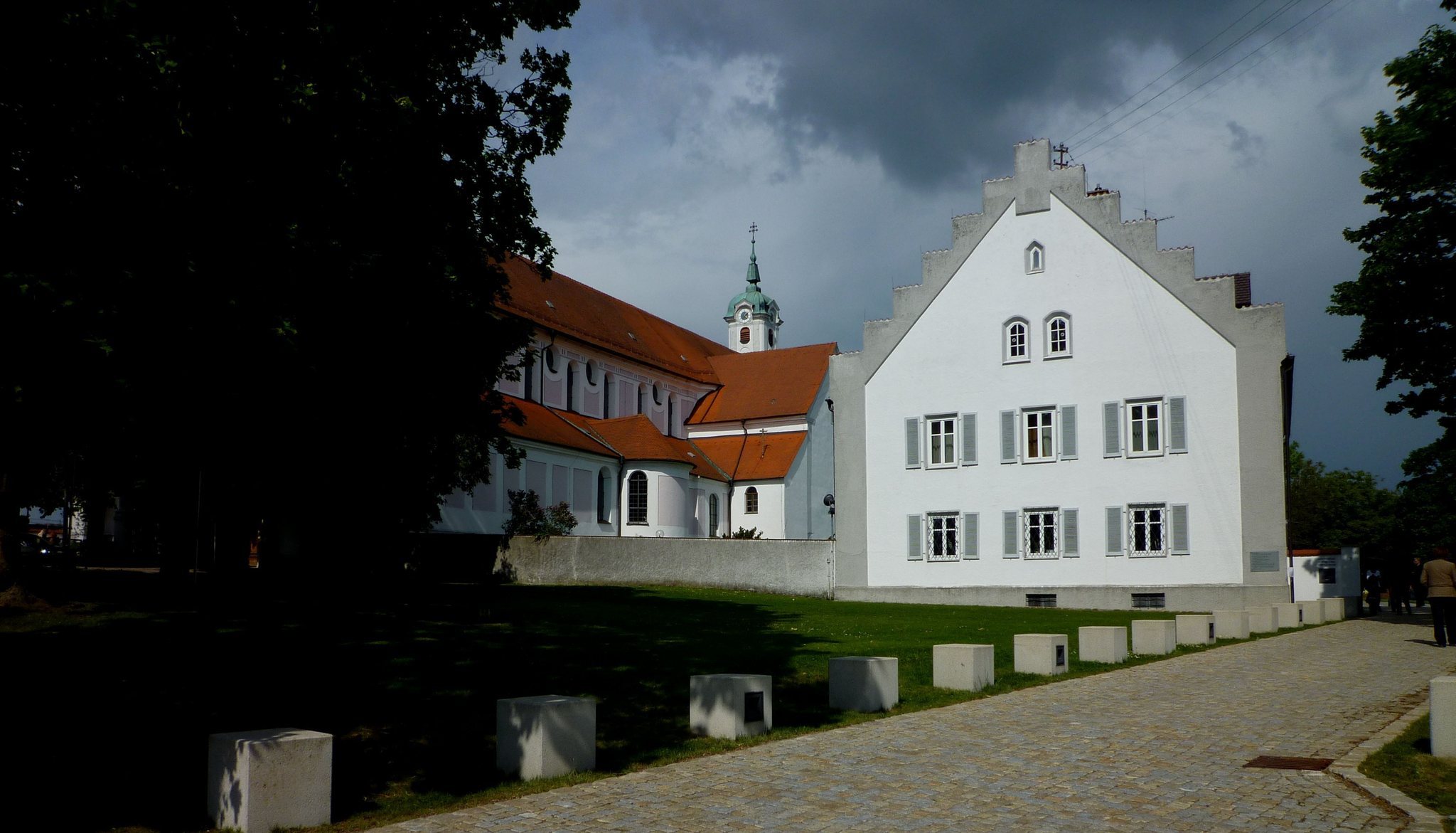
The surviving site is centred on the abbey church, together with portions of the monastic boundary and the western entrance known as Martins Gate. The present complex occupies the hilltop location to which the monastery was transferred after the fire, while almost all of the surrounding abbey buildings were demolished by 1840.
Abbey church
Romanesque foundation
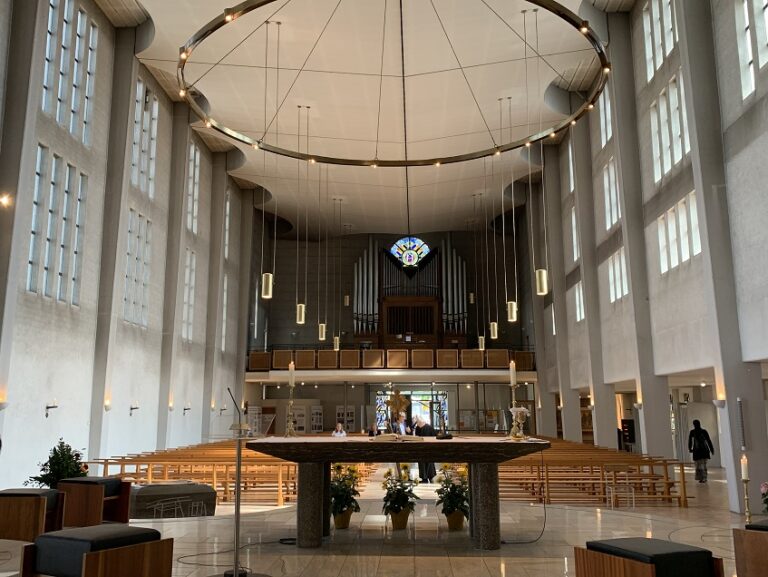
The church of Saints Peter and Paul began as a Romanesque, three-aisled pillar basilica measuring about 60 metres in length. Its plan followed the Hirsau building scheme, in which the crossing determined the dimensions of the transept arms, choir, nave bays, and aisles. Construction belongs to the twelfth century, with the date placed variously in 1142 or in the 1150s and 1160s. Although the building suffered a fire in 1146 and underwent later alterations, almost all of the masonry still standing before the eighteenth-century rebuilding came from this foundation period.
Eighteenth-century rebuilding
A fire destroyed the eastern part of the church in 1773 and caused its tower to collapse. Abbot Robert I Kolb directed the rebuilding, which continued from 1773 to 1784. The new choir was designed in the Rococo style, an eighteenth-century manner known for light, flowing ornament and elaborate decoration, while the nave received an early Neoclassical Louis XVI treatment with more restrained forms and revived classical motifs.
Joseph Dossenberger was the architect. Johann Michael Fischer designed the altars and sculptures, and Januarius Zick painted the altarpiece and ceiling frescoes, including scenes from the lives of Mary and Saint Benedict. Side chapels were added on both sides of the nave during the eighteenth-century remodelling, with one account dating them to 1746. The planned double towers were never completed because the abbey was dissolved in 1802.
Pilgrimage image
The image of Mary of the Seven Sorrows associated with Elchingen’s pilgrimage stood in the left side wing of the abbey church. Its position connected the surviving church interior with the devotional practice that had drawn pilgrims to the abbey since 1644.
Monastic remains and burials
Conventual buildings and boundary
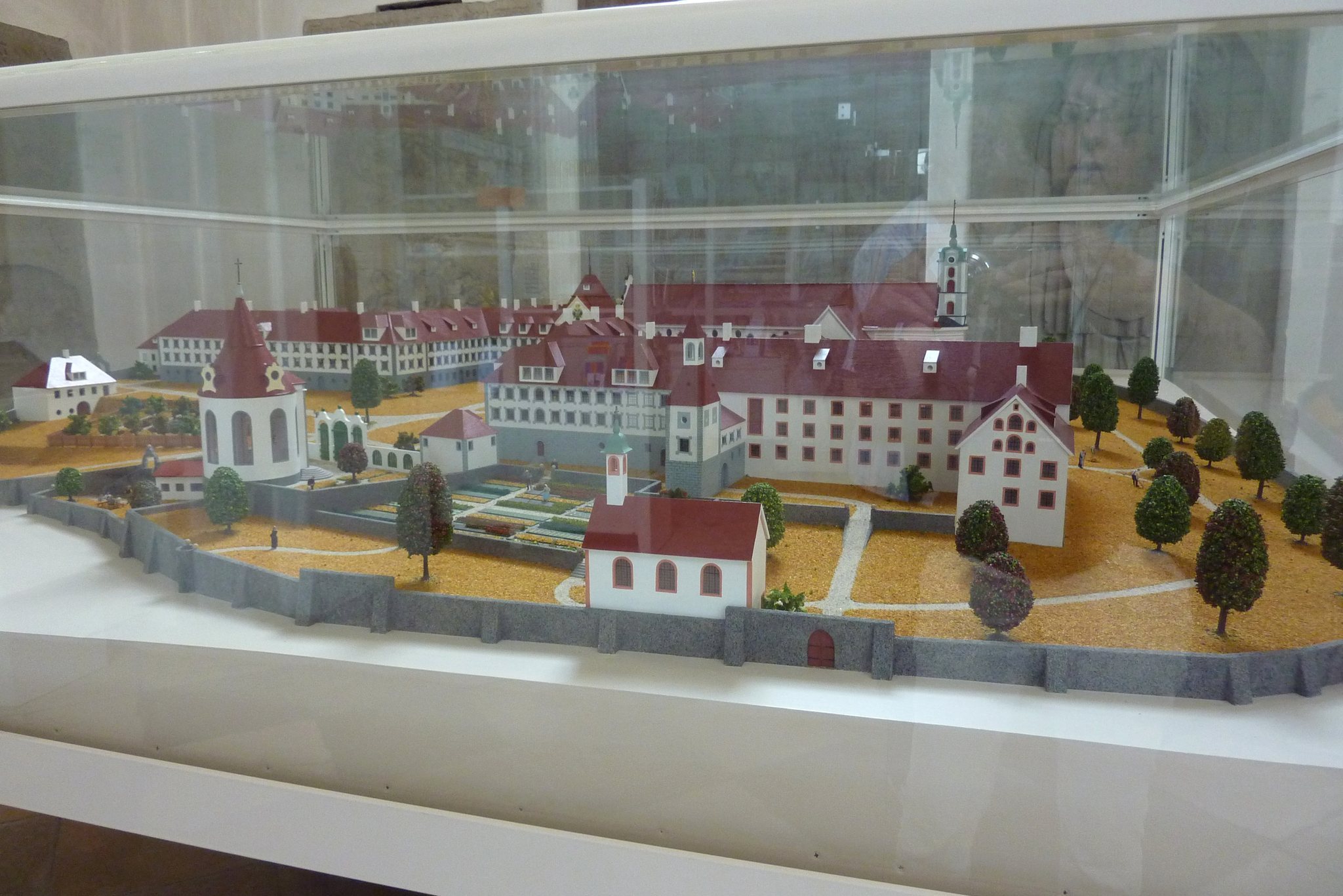
The conventual buildings were constructed by the master builder Christian Wiedemann, who also built the abbey buildings of Wiblingen. After the monastery was dismantled, the church, the monastic wall, and Martins Gate remained as the principal surviving elements of the former complex. These structures represent the surviving physical framework of a monastery whose other buildings had been gradually removed.
Burials west of the church
Burials west of the abbey church date from the thirteenth and fourteenth centuries. Examination of the skeletons identified frequent severe trauma and disease, providing physical evidence for the care of poor and injured people associated with the monastery during the medieval period.