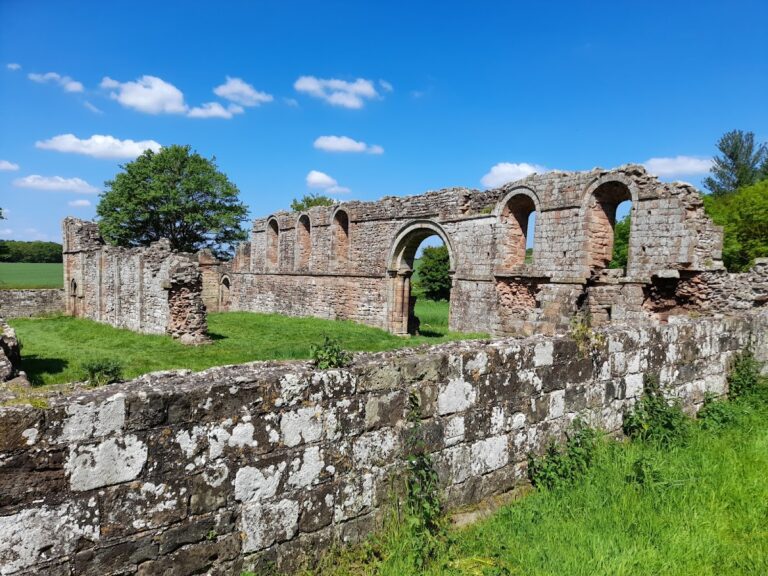
Wenlock Priory: An Anglo-Saxon Monastery and Cluniac Priory in England
Site at a Glance
- Rating
- 4.6
- Popularity
- Low
- Country
- United Kingdom
- Primary era
- Medieval
- External website
- Open
- Eras represented
- Medieval
- Civilizations
- Anglo-Saxon, English, Norman
- Site type
- Religious
- Remains
- Monastery
On this page16 sections
History
Wenlock Priory, also known as St Milburga’s Priory, is a former monastery in Much Wenlock, United Kingdom, whose origins lie in an Anglo-Saxon double monastery founded around 670–690 by Merewalh, king of the Magonsaete. A double monastery contained separate communities of monks and nuns. The foundation, then known as Wimnicas, became associated with Merewalh’s daughter Milburga, who served as its abbess and was later venerated as a saint.
The Anglo-Saxon monastery
Milburga’s relatives endowed the monastery with land, helping it develop as a religious centre. By 901 it had a male superior, and by the late eleventh century its community appears to have consisted of secular canons rather than monks following a clearly defined rule. In 901, Æthelflæd and Æthelred gave land and a gold chalice valued at thirty mancuses to the shrine of Saint Milburga. A mancus was an early medieval unit of account used for high-value payments. The monastery also received important endowments from Leofric, earl of Mercia, during the eleventh century.
Twentieth-century excavations identified a rectangular building that may belong to the seventh-century foundation. Much Wenlock itself developed gradually around the religious house, linking the later town to the site’s long history.
The Cluniac refoundation
Roger de Montgomery, earl of Shrewsbury, refounded Wenlock between 1079 and 1082, certainly by 1086, as a Cluniac priory. Cluniac houses followed the reforming monastic tradition centred on Cluny and its network of dependent priories. Monks probably arrived from La Charité-sur-Loire, the major Cluniac mother house in central France, and the new foundation was initially dedicated to the Holy Trinity. It retained much of the earlier monastery’s land and was listed in the Domesday Book by 1086, the survey of English landholding and resources commissioned by William the Conqueror.
In 1101, while the Holy Trinity church was being repaired, bones believed to belong to Saint Milburga were found beneath its floor. They were ceremonially transferred to the main monastery church. Goscelin of St Bertin subsequently wrote a life of Milburga, and reports of miracles at her shrine strengthened her cult. The shrine helped increase Wenlock’s religious importance and wealth.
During the twelfth century, Wenlock established or supported dependent houses at Dudley, Paisley, Prin, St Helen’s, and Church Preen. Around 1170, it was able to send a prior and twelve monks to establish Paisley Abbey in Scotland. For much of its history, Wenlock remained subordinate to La Charité and, indirectly, to Cluny. La Charité appointed most of its priors, who were usually Frenchmen, received an annual payment of 100 shillings, and required the prior to attend its chapters. Wenlock priors were also expected to attend Cluniac general chapters at Cluny until 1301, although attendance was irregular.
Prosperity and political influence
The thirteenth century was Wenlock’s most prosperous period, although the priory had accumulated debts of up to 1,750 marks by 1272. Prior Humbert, also called Imbert, held office from about 1221 to 1260. He expanded the priory’s estates and undertook diplomatic missions. King Henry III visited Wenlock several times in the 1230s, made numerous gifts to the priory, and employed Humbert as an envoy to Wales.
Prior John de Tycford, who served from 1272 to 1285, took part in commercial ventures and political activity. A monk who fled Wenlock later gathered an armed group and intended to ambush and kill him. Henry de Bonvillars, prior from 1285 to 1320, used his connections at the royal court to lessen the difficulties caused by the priory’s foreign status. He also participated in public affairs and served at least four times as a visitor for the Cluniac congregation.
The priory controlled extensive estates, chiefly around Wenlock. From the reign of Richard I, these lands benefited from the broadest ecclesiastical immunity in Shropshire. Most property was leased, although livestock farming was also important. In 1291 the priory owned 976 sheep, and its lands supported the growth of Much Wenlock and Madeley.
Foreign status and independence
Wenlock’s connection with France increasingly troubled the English Crown from the late thirteenth century. During the Hundred Years’ War, the prolonged series of conflicts between England and France from the fourteenth to the fifteenth century, the prior was required to pay the Crown £170 each year. The amount was later reduced to £50.
The Western Schism, a division in the Western Church between rival papal claimants during the late fourteenth and early fifteenth centuries, created a further break with Cluny. Cluny supported an antipope, a claimant regarded as illegitimate by the opposing papal line, while England did not. English Cluniac houses consequently gained practical autonomy, and English priors began to be appointed.
Wenlock was naturalised in 1395 after a payment of £400 and was recognised as fully independent of La Charité in 1494. Thereafter it was directly subject to the pope. Rival claims to the priory continued during the fifteenth century, producing repeated conflicts between royal nominees and candidates supported by La Charité.
Estates, industry, and dissolution
A coal mine first appears among Wenlock’s possessions in 1390. By 1540 the estate included several coal and ore workings and two smelting furnaces, which together produced more than £23 in annual income. The priory’s recorded revenues rose from £143 19s 8d in 1291 to £327 11s 1d in 1390 from secular and spiritual property combined. In 1535, before deductions, its income exceeded £433, making Wenlock the second wealthiest monastery in Shropshire after Shrewsbury.
The community numbered about forty monks during the fourteenth century, but only thirteen remained by 1540. Rowland Gosnell, also called Bridgnorth, became the first freely elected prior in 1521. His strict disciplinary policy caused opposition from dependent priors and the sacristan William Corfill. A visitation in 1523 found weak monastic discipline and excessive expenditure on the prior’s household. Gosnell repaired monastery buildings, wrote a chronicle of the priors and a collection of Saint Milburga’s miracles, and obtained the personal right to wear a mitre, ring, and staff. He was refused the rank of titular bishop.
John Bayley, formerly prior of Sandwell after its dissolution in 1525, became Wenlock’s last prior in 1527. The priory was dissolved on 26 January 1540 during the Dissolution of the Monasteries, the process by which Henry VIII’s government suppressed England’s monasteries and confiscated their property in the 1530s and 1540s. Bayley received an annual pension of £80 and retired to Madeley. The other twelve monks received pensions ranging from £6 13s 4d to £5 6s 8d, and some later served as parish priests.
Proposals to convert Wenlock’s church into a cathedral for a new diocese were not implemented. Most monastic buildings were later destroyed, although part of the complex became a private residence known as Wenlock Abbey. Protestants burned the relics of Saint Milburga in 1547. The former residential portion was restored in the nineteenth century by Charles Milnes Gaskell, a Liberal Member of Parliament.
The ruins and associated grounds are now under the care of English Heritage. Wenlock Priory is a Grade I listed monument, first listed in 1915 and designated in 1950, while its gardens have Grade II status on the Register of Parks and Gardens. In 2026, three decorative tile fragments removed from the ruins in the late 1960s were returned to the priory. One of them carries a dragon motif not previously recorded at Wenlock.
Remains
The church
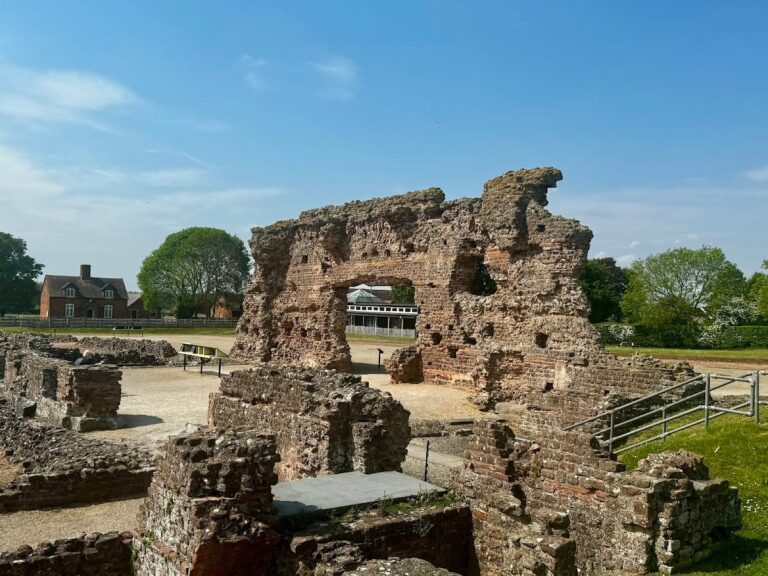
The final medieval priory church was built in the thirteenth century and measured at least 106 metres in length. Much of the visible church belongs to rebuilding carried out between the late twelfth and mid-thirteenth centuries, with a proposed completion date of about 1200–1240. Its surviving plan is a conventional cruciform church, with a nave, transepts, and a central crossing. A cloister stood south of the nave, with monastic buildings arranged around it.
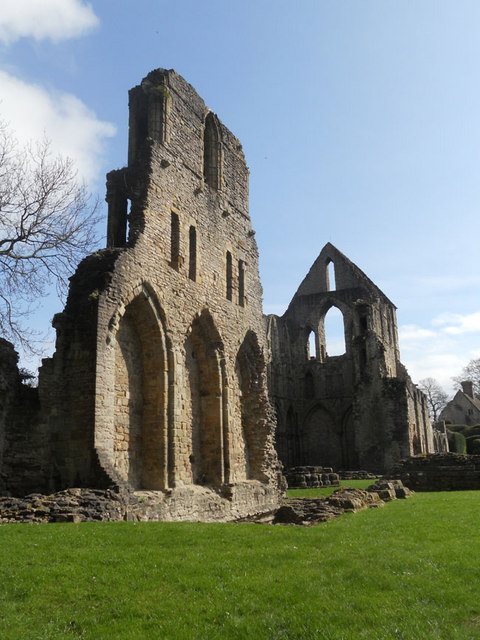
South transept
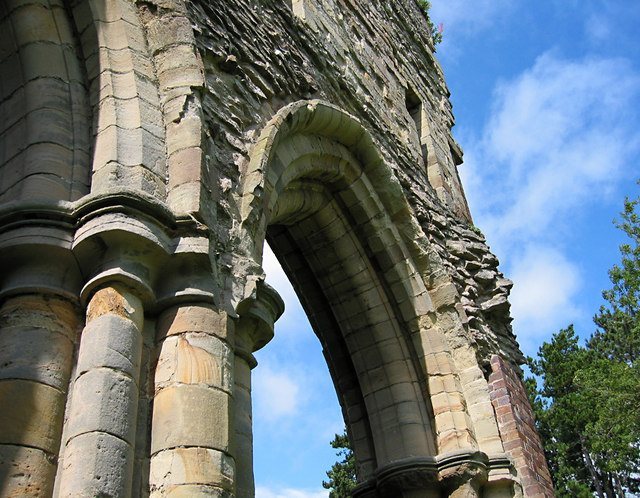
The south transept is the best-preserved part of the church. Its east wall contains a three-arched arcade opening into chapels. Above this is a triforium passage, an upper passage within the church wall, with paired lancets, or narrow pointed-arched windows. A clerestory, the upper windowed level, has one window in each bay.
The south wall has two blank arches, three blank lancets, three stepped lancet windows, and a single lancet in the upper gable. The lower part of the west wall is mostly blank, with a triforium and clerestory above. Near the crossing is a laver or water stoup with three blank arches, together with the remains of a pipe channel and drain. Surviving vaulting shafts show that the transepts were vaulted.
North transept and sacristy
The west wall of the north transept retains one complete bay with a design similar to that of the south transept. A blocked doorway leads west to the remains of the sacristy, the room used to store liturgical objects and prepare for worship. The sacristy contains three large arched recesses and a crypt.
Nave and upper vaulted room
Three bays survive at the south-west end of the nave. A room was built above the aisle vaults, so those vaults were made lower than elsewhere in the church. The purpose of this vaulted upper space remains uncertain. It has been proposed as a chapel of Saint Michael, although no altar has been identified.
Library and chapter house
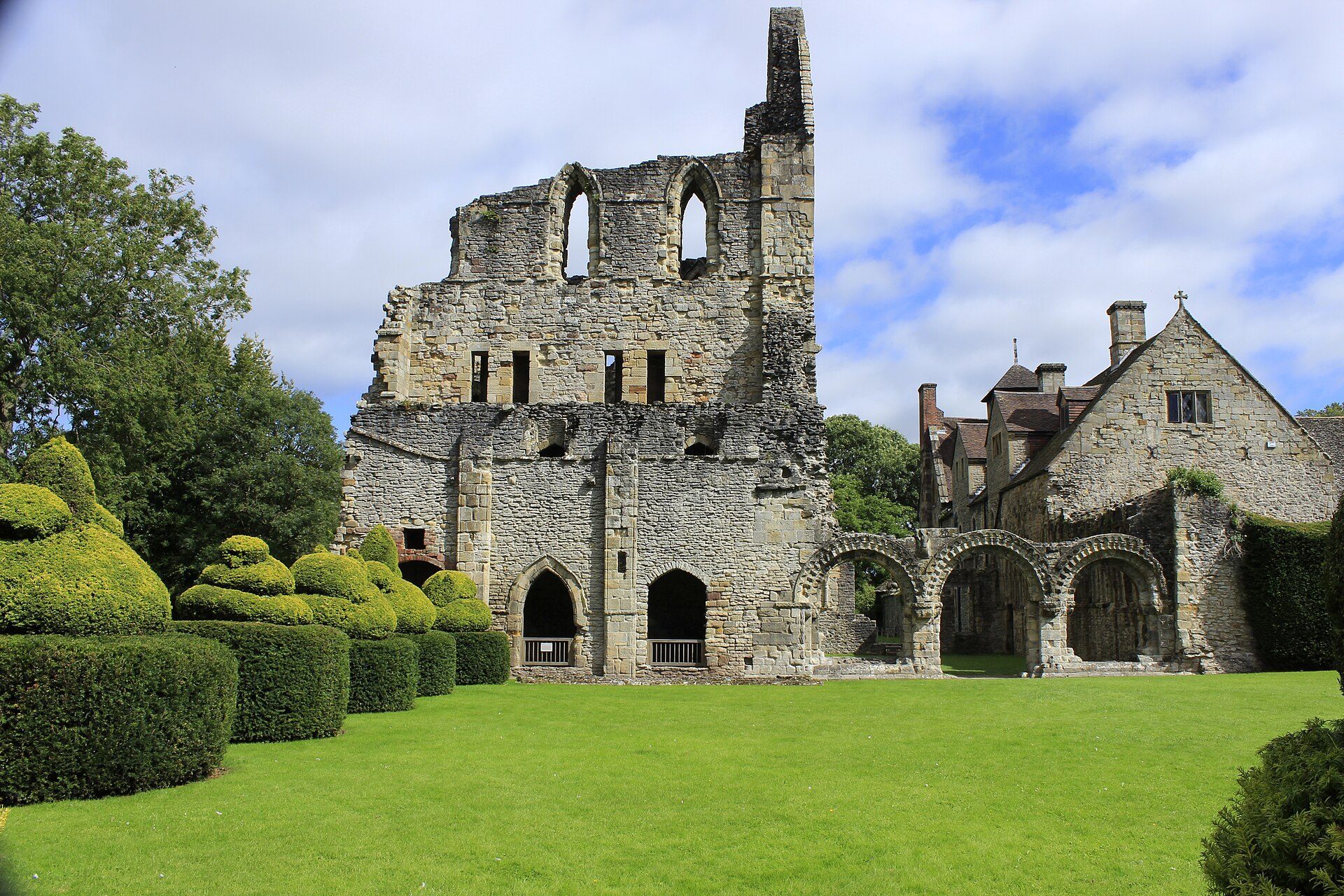
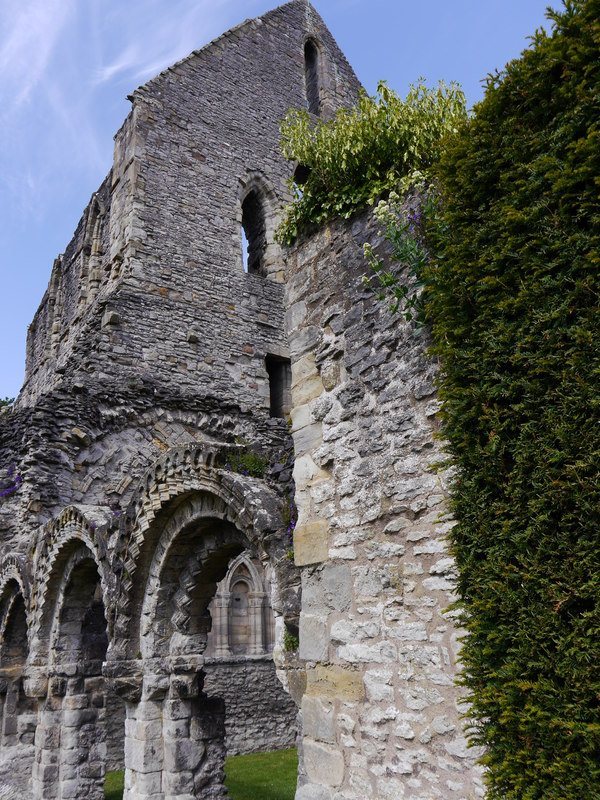
The library opens from the west wall of the south transept through one original arched opening flanked by two later arches. South of it, three round arches with zigzag ornament lead into the Norman chapter house, dated to about 1150–1180. The Norman period refers to the phase of English history following the Norman Conquest of 1066, especially the eleventh and twelfth centuries.
A chapter house was the room where a monastic community met for official business and readings. Wenlock’s chapter house has three levels of intersecting round arches and was vaulted in three bays, as shown by its surviving vaulting shafts.
Cloister, infirmary, and prior’s lodging
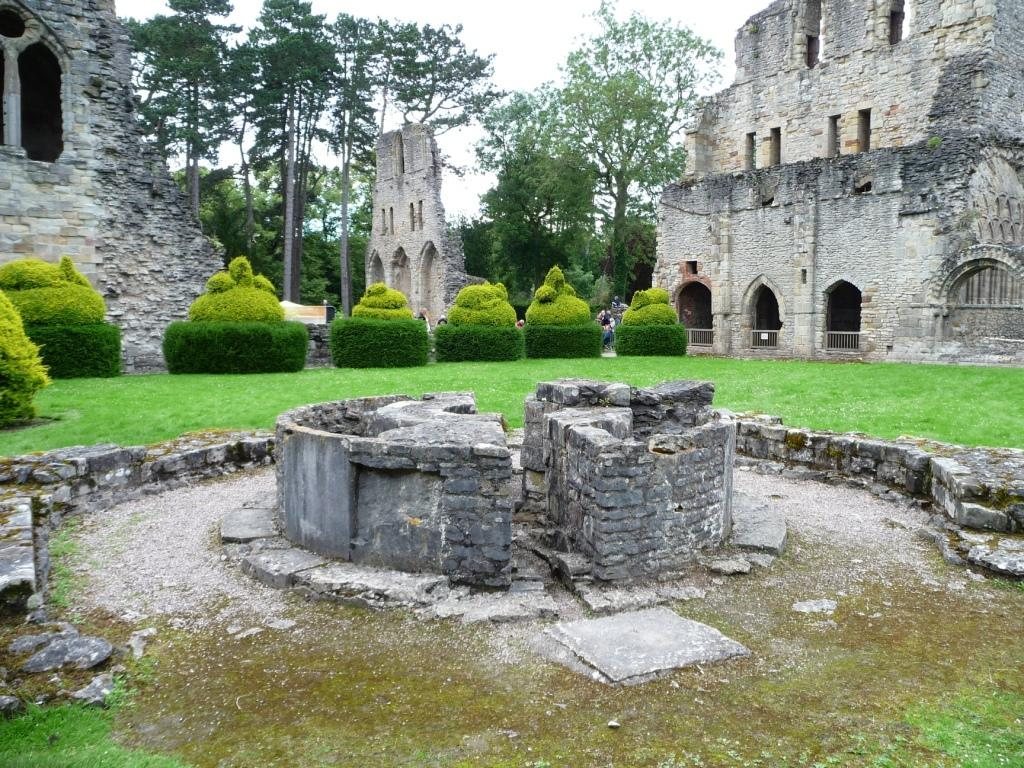
Cloister lavabo
Little of the cloister itself survives, but the cloister garth contains the remains of a lavabo, a monastic washing installation. Its base and the foundations of the surrounding pavilion remain in place. Two well-preserved carved stone panels from the late twelfth century depict scenes from the lives of the Apostles.
Infirmary and prior’s lodging
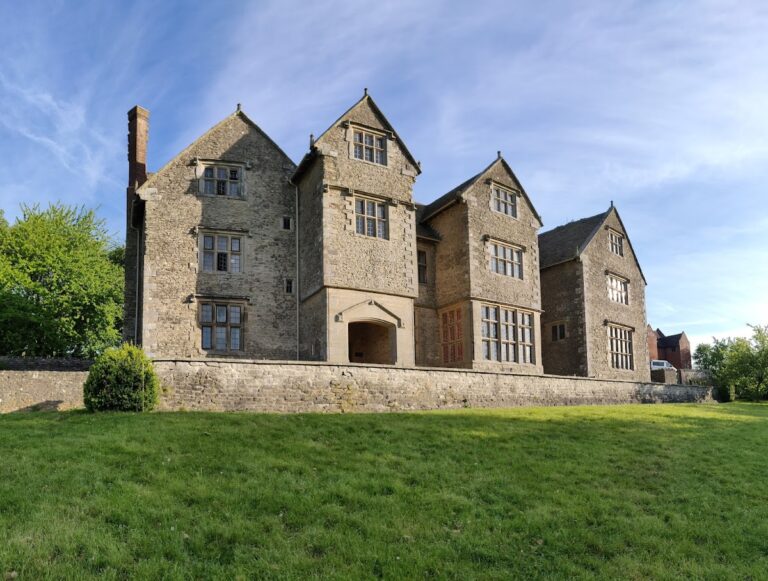
South of the chapter house, the infirmary and the prior’s lodging form an L-shaped private house. An infirmary was the monastic building used to care for sick or elderly members of the community, while the prior’s lodging was the residence of the priory’s head. The late fifteenth-century prior’s house and adjoining infirmary are substantially preserved as part of the residence, whose domestic architecture has been described as among the finest in England of about 1500.
Parts of the monastic buildings, including the later infirmary and prior’s lodging, were converted into a private residence that retains much of its external appearance. Most of the church and the other surviving priory buildings remain as ruins.
Grounds and recovered tiles
The grounds contain topiary and a well associated with Saint Milburga. Tradition held that the well could cure impaired eyesight and help Victorian women find a suitor.
Three decorative tile fragments returned to the priory in 2026 came from the ruins. Comparable tiles are known from only two other Shropshire sites, Bridgnorth Friary and Haughmond Abbey. One returned fragment bears a dragon motif that had not previously been recorded at Wenlock Priory.