Glambæk: A Medieval Lowland Castle on Fehmarn
Site at a Glance
- Rating
- 3.3
- Popularity
- Very Low
- Country
- Germany
- Primary era
- Medieval
- External website
- Open
- Eras represented
- Medieval
- Civilizations
- Danish
- Site type
- Military
- Remains
- Castle
On this page9 sections
History
Glambæk is a medieval lowland castle in Germany, located on the Burgtiefe peninsula of southern Fehmarn near Burg auf Fehmarn. Danish King Valdemar II ordered its construction in 1210 to protect the territory between the Baltic Sea and Burger Binnensee. Built as a brick fortress on level ground, it became the principal setting for Fehmarn’s political and military history until its destruction.
Royal stronghold and court
In 1248, during the reign of King Erik IV of Denmark, Glambæk hosted the wedding of Erik’s younger brother Christoph and Margarete Sambiria, the daughter of a Pomeranian duke. The castle passed through the reign of Erik V, from 1259 to 1286, without a recorded conflict.
King Erik VI of Denmark used Glambæk in 1307 to mediate a dispute between the counts of Holstein and the island’s lesser nobility. The resulting agreement became known as the Glambek Settlement. In 1320, King Christoph II issued Fehmarn’s oldest land law at the castle, which served as the island’s court. The territorial official, a member of the Reventlow family, lived at Glambæk and exercised judicial authority. In 1321, he ordered the hanging of many people who had supported Johann II of Holstein-Kiel, who died that year.
In 1326, Johann III of Holstein-Kiel received Fehmarn as a fief and issued a milder sworn land law. He abolished the Glambæk court, although the new law remained in force until 1558. The castle’s position again became contested during the rivalry between Denmark and the counts of Holstein. King Valdemar IV of Denmark attacked Fehmarn by fleet in 1358, captured Glambæk, and expelled the counts. Johann III’s son, Adolf VII of Holstein-Kiel, allied with the dukes of Schleswig and Mecklenburg and retook the island in 1359.
Wars and destruction
King Erik of Pomerania conquered Fehmarn again in 1416 and had Glambæk’s commander beheaded, but the counts of Holstein soon recovered the island. Erik returned in 1420 with 700 ships. After two failed landings, his forces succeeded on the third attempt, destroyed the castle, devastated Fehmarn, and killed about two-thirds of its population.
Adolf VIII of Holstein retook the island in 1424 and resettled it with farming families from Dithmarschen. After Glambæk was again lost to its opponents, he called on the Vitalienbrüder, a medieval association of armed sea raiders and privateers, to help capture the strongly fortified castle in 1426. They remained there until the castle was pledged to Lübeck under the Peace of Vordingborg in 1435. Glambæk also served as a base for sea raiders between approximately 1430 and 1460.
In 1558, while a new Fehmarn land law was being presented, Governor Heinrich Rantzau was physically attacked. That year, the castle’s official also complained about the deterioration of the complex. After 1558, Glambæk was uninhabited and used for storing timber and grain.
During the Thirty Years’ War, the major European conflict fought from 1618 to 1648 amid dynastic, political, and religious struggles, Fehmarn was captured in 1627 by 500 imperial soldiers under Jean de Merode. King Christian IV of Denmark attempted to reconquer the island in 1628, and Glambæk was finally destroyed during that campaign. Its bricks were removed for later building work, while drifting sand eventually covered the remaining ruins.
Rediscovery and interpretation
The Baltic storm surge of November 1872 exposed the buried remains. Systematic clearance and excavation began in 1908. Glambæk is regarded as one of the very few medieval brick or stone castles in Schleswig-Holstein to retain standing masonry, alongside Linau, while many of the region’s other medieval aristocratic castles were wooden motte constructions. The castle now lies within the Fehmarn town district of Burg auf Fehmarn. The town’s name comes not from Glambæk but from a much older castle that once stood within the present town area.
Remains
Layout and defenses
Glambæk formed a rectangular enclosure measuring approximately 36 by 53 metres. Its brick ring wall stood about four metres high, and the castle was protected by a water-filled moat and a low outer rampart. A drawbridge provided access across the defensive water barrier. The complex included two defensive towers, richly furnished rooms, stables, a barn, a bakery, a brewhouse, and five wells. An additional defensive tower formerly occupied the south-west corner.
Surviving masonry and earthworks
Square keep
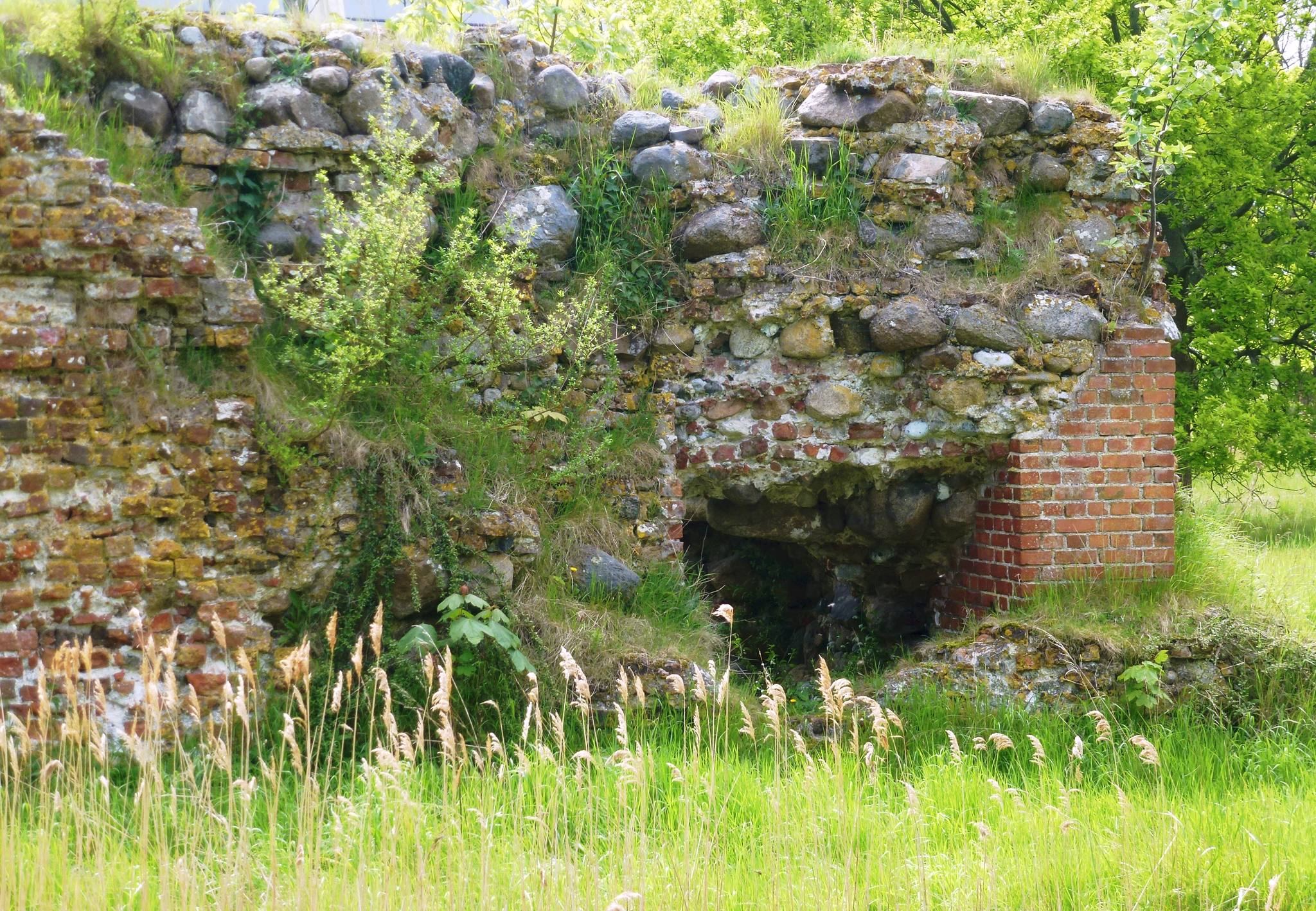
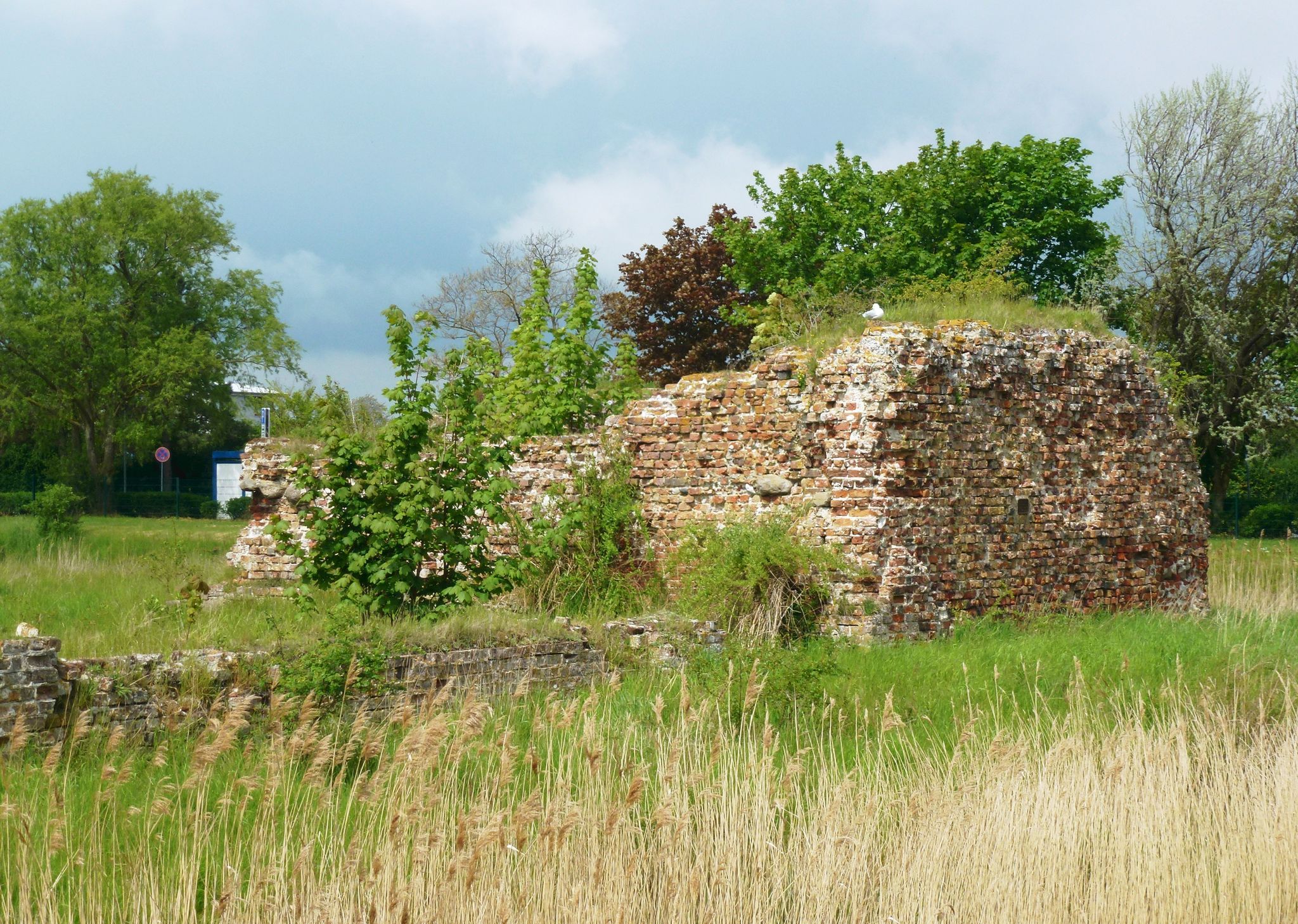
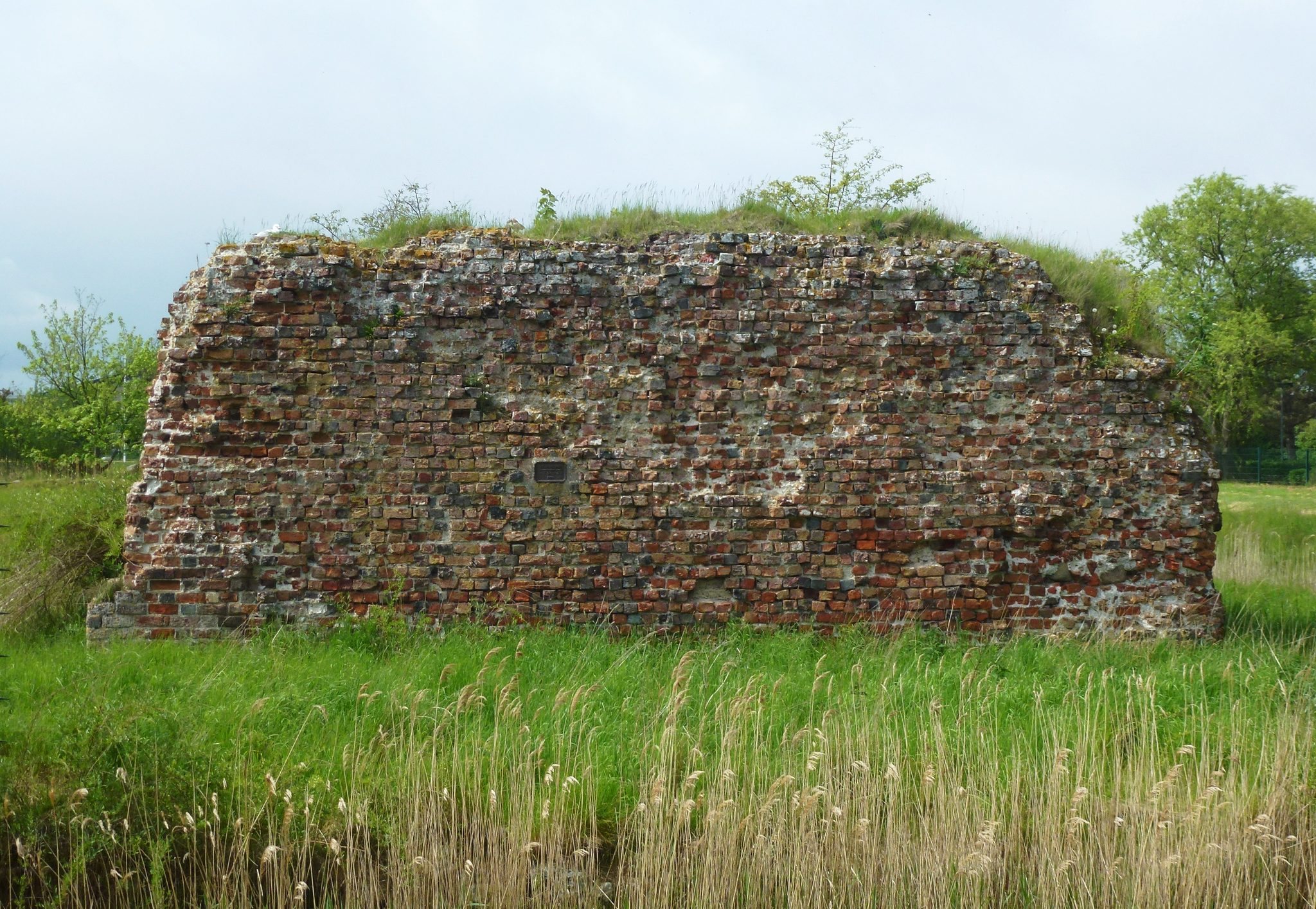
The lower part of the square keep survives in the north-east corner of the enclosure. It rests on a fieldstone foundation measuring approximately 11 by 11 metres. The remaining walls reach up to four metres in height and are approximately two metres thick.
Ring wall, moat, and rampart
Parts of the brick ring wall, the moat, and the outer rampart remain visible around the castle area. Much of the brickwork was removed after the destruction of 1628, and the surviving structures were later covered by sand before they were exposed and excavated. A high-water mark on the remaining masonry records the level reached by the November 1872 storm surge.