Co-Cathedral of Saint Mary of the Assumption and Saint Catellus of Castellamare: Principal Church of Castellammare di Stabia
Site at a Glance
- Rating
- 4.7
- Popularity
- Low
- Country
- Italy
- Primary era
- Early Modern
- External website
- Open
- Eras represented
- Early Modern, Modern
- Civilizations
- Italian, Kingdom of Naples, Spanish
- Site type
- Religious
- Remains
- Cathedral
On this page32 sections
History
The Co-Cathedral of Saint Mary of the Assumption and Saint Catellus of Castellamare is the principal church of Castellammare di Stabia, Italy, a parish church and co-cathedral of the Archdiocese of Sorrento-Castellammare di Stabia. A co-cathedral shares the seat or title of a bishop with another cathedral. The church is dedicated to the Assumption of Mary and Saint Catellus, the patron saint of Castellammare di Stabia, whose statue is venerated within the building.
Earlier Cathedrals and the New Foundation
The first cathedral of Castellammare di Stabia stood near Varano Hill. It was later moved to the vicinity of the castle and eventually transferred to the Quartuccio area. The Quartuccio cathedral suffered severe damage in the earthquake of 1436, prompting plans for a replacement. On 17 September 1517, a civic commission entrusted Giovanni Donadio with the design of a new church, but the project was never completed. A second initiative, promoted by Bishop Antonio Laureo in 1569, also failed.
After becoming bishop in 1581, Ludovico Maiorano sold the ruined cathedral to the castle and devoted the proceeds to a new building. In 1587 the city authorized construction on the remains of the former church at Quartuccio. The work was financed through a tax of one tornese on each kilogram of meat, oil, cheese, and other foodstuffs sold in the city or at the Royal Customs. The cornerstone was laid on 22 November 1587. Pietro Antonio De Sanctis supplied the architectural design, while Santoro Cortolano and Paolo Fasano carried out the construction.
Construction and Eighteenth-Century Completion
Financial shortages and repeated taxation slowed the building process. The church was partially opened for worship in 1643, when private chapels were granted to several noble families, although construction was still unfinished. An organ was installed in 1668 and definitively arranged in 1774. The atrium was built in 1713, while work on the main altar began in 1753 and ended in 1760. Bishop Giuseppe Coppola consecrated the altar on 12 April 1760.
The church still had no bell tower in 1774. A proposal to renovate an existing tower met opposition from the bishop because the project required the surrender of about two metres of his land. After royal intervention, a new bell tower was erected on municipal land in 1782. Its construction cost 7,323 ducats.
Nineteenth-Century Transformation
Between 1875 and 1893, Bishop Petagna ordered a comprehensive transformation of the church. The building received its present Latin-cross plan, with a transept and presbytery, and the Chapel of Saint Catellus was constructed. Architect Ignazio Rispoli designed the chapel under the direction of engineer Giovanni Rispoli. The cathedral was solemnly consecrated by Bishop Sarnelli in 1893 and dedicated to Mary of the Assumption.
Excavation for the Chapel of Saint Catellus uncovered remains of a Paleochristian necropolis, an early Christian burial ground, together with stretches of ancient streets and thresholds from Roman houses. The archaeological area was named the Area Christianorum. The excavation also brought to light a Paleochristian column and a third-century sarcophagus, which were incorporated into the church’s interior.
Restoration and Continuing Religious Use
The church was restored in 1930 and repaired again in 1980 after damage caused by the Irpinia earthquake. Further conservation included the complete restoration of the Chapel of the Blessed Sacrament in 1996. Three bronze entrance doors were donated in 1985 by the Banca Stabiese. The cathedral administers the churches of Jesus and Mary, Mary Most Holy of Caporivo, Saint Mary of the Garden, the Most Holy Crucifix at Rivo, and the Most Holy Crucifix and Souls in Purgatory.
The cathedral’s commemorative programme includes references to the 1906 eruption of Mount Vesuvius, the flood that affected the Stabian area in 1764, the First World War, and a wartime scene dated 1940. A marble memorial in the nave recalls Pope Pius IX’s visit to Castellammare di Stabia on 22 October 1849.
Remains
Plan, Facade, and Nave
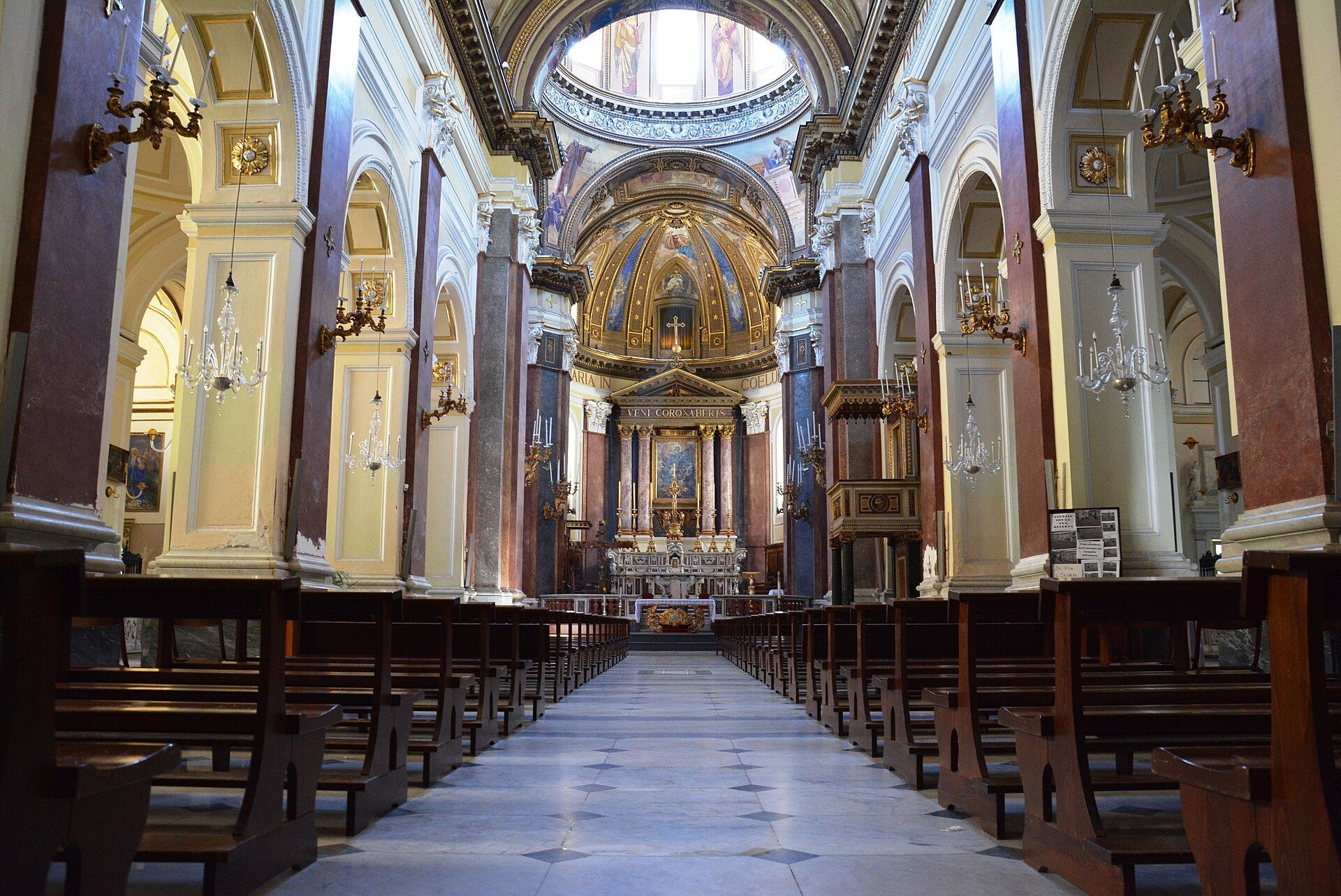
The cathedral has a basilica plan in the form of a Latin cross. A central nave is flanked by two smaller aisles, each opening onto five chapels. White and grey marble form square and octagonal patterns across the floor, where an ancient tomb of the Stabian priests lies at the centre of the main nave. The cross-arm of the church is the transept, while the presbytery forms the sanctuary area reserved for the altar and clergy.
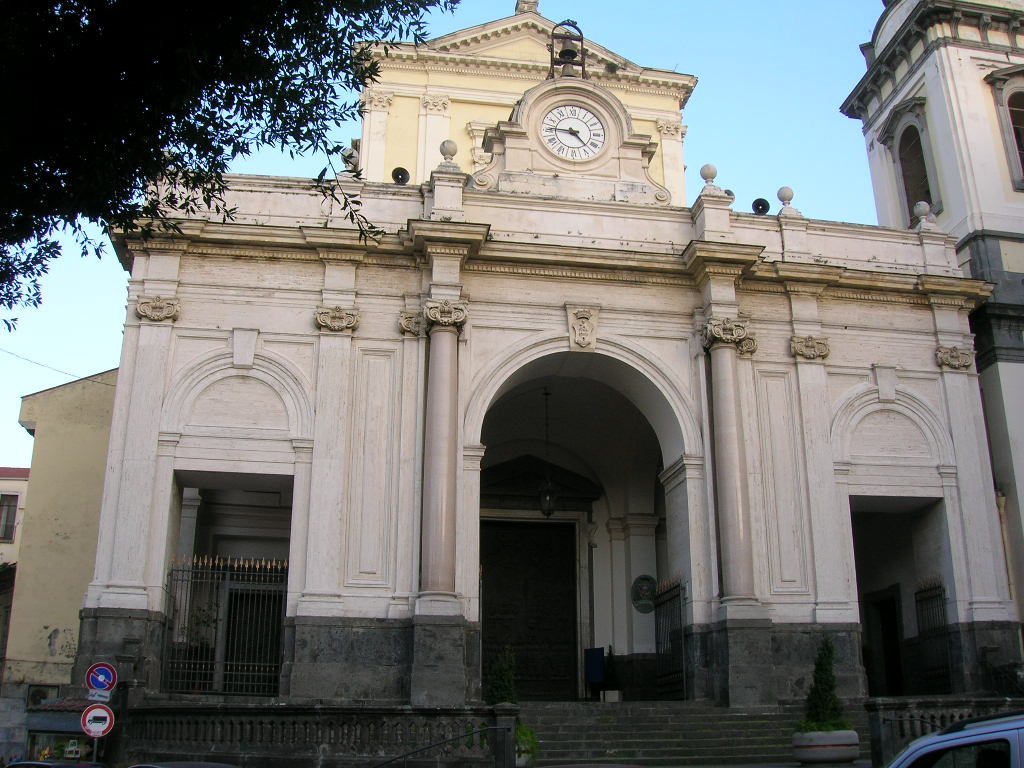
The marble facade has three arches resting on four pillars. Together they form a small internal atrium reached by a staircase made of Soccavo piperno, a dark volcanic stone widely used in Campania. The central arch is larger than the two lateral arches and is framed by columns with capitals. The city coat of arms appears above it, while a clock with two small bells is set into the parapet.
Entrance Doors and Rear Wall
The entrance is closed by three bronze doors made by the Florentine sculptor Antonio Berti. The central door is larger and more elaborately decorated than the two lateral doors. Inside, five arcades on each side separate the nave from the aisles. They rest on ten piperno columns decorated with stucco, medallions, and gilding.
The rear wall contains a funerary monument with a sculpted likeness of Tommaso Angelo d’Arco. Three marble plaques commemorate Pope Pius IX’s visit in 1849, Bishop Giuseppe Coppola’s renovation works of 1760, and the expansion carried out between 1887 and 1893. An organ stands on a gallery supported by four columns, with paintings of Noah and Abraham placed on either side.
Vault and Nave Decoration
The central vault contains three frescoes by Vincenzo Paliotti depicting episodes from the life of Saint Catellus. They show his imprisonment in Rome and the visit of Saint Gregory the Great, his release from prison, and his return to Stabia, which occupies the largest scene. Ten surrounding lunettes, semicircular or segmental areas of wall or ceiling, represent reliability, constancy, zeal, long-suffering, forgiveness, almsgiving, prayer, faith, charity, and hope.
Left Aisle Chapels
Baptistery Chapel
The Baptistery Chapel contains a marble baptismal font, an unfinished painting by Giuseppe Bonito of the Giving of the Keys to Saint Peter, and tempera paintings by Francesco De Nicola depicting the Baptism of Jesus and Jesus with the Children. A Paleochristian marble column with its capital stands in the chapel. It was found during excavation for the Chapel of Saint Catellus.
Chapel of Lourdes
The Chapel of Lourdes contains a stucco-and-cork reproduction of the grotto of Massabielle, with statues of the Virgin Mary and Bernadette at prayer. Francesco De Nicola’s tempera paintings of 1929 depict the apparition at Massabielle and a procession with the Blessed Sacrament. A former painting of the Madonna with Saints Thomas and Gaetano was transferred to the left arm of the transept.
Chapel of the Madonna del Carmine
The Chapel of the Madonna del Carmine contains Angelo Mozzillo’s 1793 painting of the Virgin freeing souls from Purgatory. Tempera paintings of Saint Teresa of the Child Jesus and Saint Louise de Marillac are also present, together with a marble plaque recording a restoration in 1853. The chapel was originally dedicated to Saint Michael the Archangel.
Chapel of Saint Francis de Sales
The Chapel of Saint Francis de Sales contains a wooden statue of the saint and two tempera paintings showing episodes from his life. Salvatore Franciosa painted the work on the right in 1932, while the other painting is by Francesco De Nicola.
Chapel of the Most Holy Crucifix
The Chapel of the Most Holy Crucifix contains a seventeenth-century wooden crucifix. Christ’s head turns slightly to the left, his feet are fixed to the cross by a single nail, and large wounds appear on his side and chest. Two nineteenth-century wooden statues stand in niches, representing Saint Blaise and the Addolorata.
The Addolorata was formerly kept in the Chapel of Ara Pacis. Made between the late eighteenth and early nineteenth centuries, the figure has a wooden head, hands, arms, feet, and legs, with the remaining form made from tow. It has crystal eyes and a black garment decorated with gold lace. A door in the chapel’s central wall leads to the former sacristy, the room used for storing liturgical furnishings and preparing for worship.
Right Aisle Chapels
Chapel of Saint Nicholas
The Chapel of Saint Nicholas was established in 1268 by the De Rogatis family, whose heraldic arms are placed beside the transept. Its central altarpiece by Giovanbattista Spinelli depicts Saint Nicholas of Myra. The side paintings, made by Salvatore Mollo in 1776, show Saint Barbara kneeling and Saint Anthony of Padua kneeling before the Child Jesus. A statue of the Deposed Christ stands at the foot of the altar.
Chapel of the Rosary
The Chapel of the Rosary contains a 1570 painting of the Madonna of the Rosary, attributed either to Ludovico De Maio or to an unknown sixteenth-century painter. Life-size figures represent the Virgin, Saints Catherine of Siena, Lucy of Syracuse, and Margaret of Antioch, together with Saints Dominic of Guzman, Francis of Paola, and Francis of Assisi. The painting has cracks corresponding to the joints of the wooden boards beneath it.
Two sixteenth-century paintings by Giovan Vincenzo D’Onofrio of Forli del Sannio hang on the side walls. They depict the Assumption, with the apostles beside the Virgin’s empty tomb, and the Nativity, with the Virgin, Saint Joseph, and shepherds. The chapel also contains the shrine of Bishop Agostino D’Arco. The chapel originally belonged to the Cacace family and passed to the Giordano family in 1825. Its principal painting had previously been in the De Caro family chapel at the Basilica of San Lorenzo Maggiore in Naples before Giovan Camillo Cacace brought it to Castellammare di Stabia.
Chapel of the Holy Family
The Chapel of the Holy Family contains an eighteenth-century group of Saint Anne, Saint Joachim, and the child Mary. The figures are made of papier-mache, apart from their wooden heads, hands, and feet, while their clothing is formed from plaster. A 1802 painting of the Visitation by Giacinto Diana hangs on the left wall. On the right is a painting of Saint Philip Neri inspired by Guido Reni’s work, commissioned by Bishop Giuseppe Coppola between 1750 and 1760.
Chapel of the Immaculate Conception
The Chapel of the Immaculate Conception contains a wooden statue of the Immaculate Conception. Its reliefs, made in 1838, depict the Presentation of the Virgin in the Temple and the Annunciation. The chapel also contains a nineteenth-century statuette of the Child Jesus, a papier-mache statue of Saint Antoninus, and further imagery from the life of Mary.
Chapel of Saint Catellus
The Chapel of Saint Catellus is larger than the other chapels in the right aisle. An ambulatory before the chapel contains the tombs of Bishops Agostino D’Arco and Francesco Saverino Petagna, together with bronze plaques commemorating the 1906 eruption of Mount Vesuvius and the flood of 1764. A short corridor leads to the canonry and sacristy, and medallions of Stabian bishops decorate its vaulted ceiling.
Altar, Archaeological Remains, and Frescoes
Paolo Amato frescoed the chapel. The dome shows the Glory of the Saint, while its coffers contain the twelve apostles. The triangular lunettes represent Prudence with a mirror and lamp, Justice with scales, Fortitude with a shield, and Temperance gathering a palm. The central altar is made of bronze and marble and is surmounted by the statue of Saint Catellus. Beneath the altar table is a third-century Paleochristian sarcophagus depicting the Good Shepherd, discovered during construction of the chapel.
Francesco Filosa made the representations of the 1906 Vesuvius eruption and the 1940 war scene in 1957. Vincenzo Paliotti painted the Madonna among angels on the altar vault and the apparition of the Archangel Michael to Saint Catellus and Saint Antoninus on Mount Faito on the entrance wall. The wooden statue of Saint Catellus was made by an anonymous artist in 1609. Two cross-shaped reliquaries were made in 1882 by Luigi Prezioso and Francesco Galante at the request of Father Brunone.
Statues and Windows
The chapel contains a recent statue of the Infant Jesus of Prague and a nineteenth-century wooden statue of Pope Saint Clement, transferred from the church of the Vergine della Saletta in Sant’Antonio Abate. Saint Clement is shown with long white hair and beard, crystal eyes, pontifical clothing, and a wooden quill. Two large stained-glass windows by Vincenzo Paliotti depict the city’s patron saints, Francis of Assisi, Dominic, Vincent Ferrer, and Francis Xavier.
The chapel’s nativity display is installed during the Christmas season and remains until shortly after the feast of Saint Catellus on 19 January. It now contains about 70 figures, dating from the seventeenth, eighteenth, and nineteenth centuries, and the figures have been restored. Many came from Bishop Francesco Petagna’s private collection, and some are attributed to Giuseppe Sammartino. They range from about 90 centimetres to 1.5 metres in height. Until several decades after the Second World War, the display was large enough for visitors to walk through and was assembled by shipyard workers.
Transept Chapels
Left Transept and Chapel of the Blessed Sacrament
The left arm of the transept is dedicated to the Sacred Heart of Jesus. It contains a late nineteenth-century wooden statue by Reccia of Naples, showing Christ with a youthful, bearded face, a blue robe, a pale blue cloak, and a flaming heart on his chest. Vincenzo Paliotti’s 1891 frescoes on the vault depict Jesus among suffering crowds and the apparition of the Sacred Heart to Saint Margaret. A fresco of Moses and Elijah appears near the window.
The Chapel of the Blessed Sacrament has an octagonal plan and was completely restored in 1996. Its main altar contains a painting of the Descent from the Cross, attributed either to Jusepe de Ribera or Andrea da Salerno, with the Trinity between Saints John the Baptist and John the Evangelist. An eighteenth-century altar supports a nineteenth-century tabernacle made from Sicilian agate, lapis lazuli, and diaspor. Other furnishings include a 1518 ciborium attributed to Andrea Ferrucci, a seventeenth-century repository for the holy oils, and a representation of the Fishing of Saint Peter. The dome frescoes show the Last Supper, the Manna in the Desert, the Sacrifice of Melchizedek, and the Angel Bringing Bread to Elijah on Mount Horeb.
Chapel of Ara Pacis
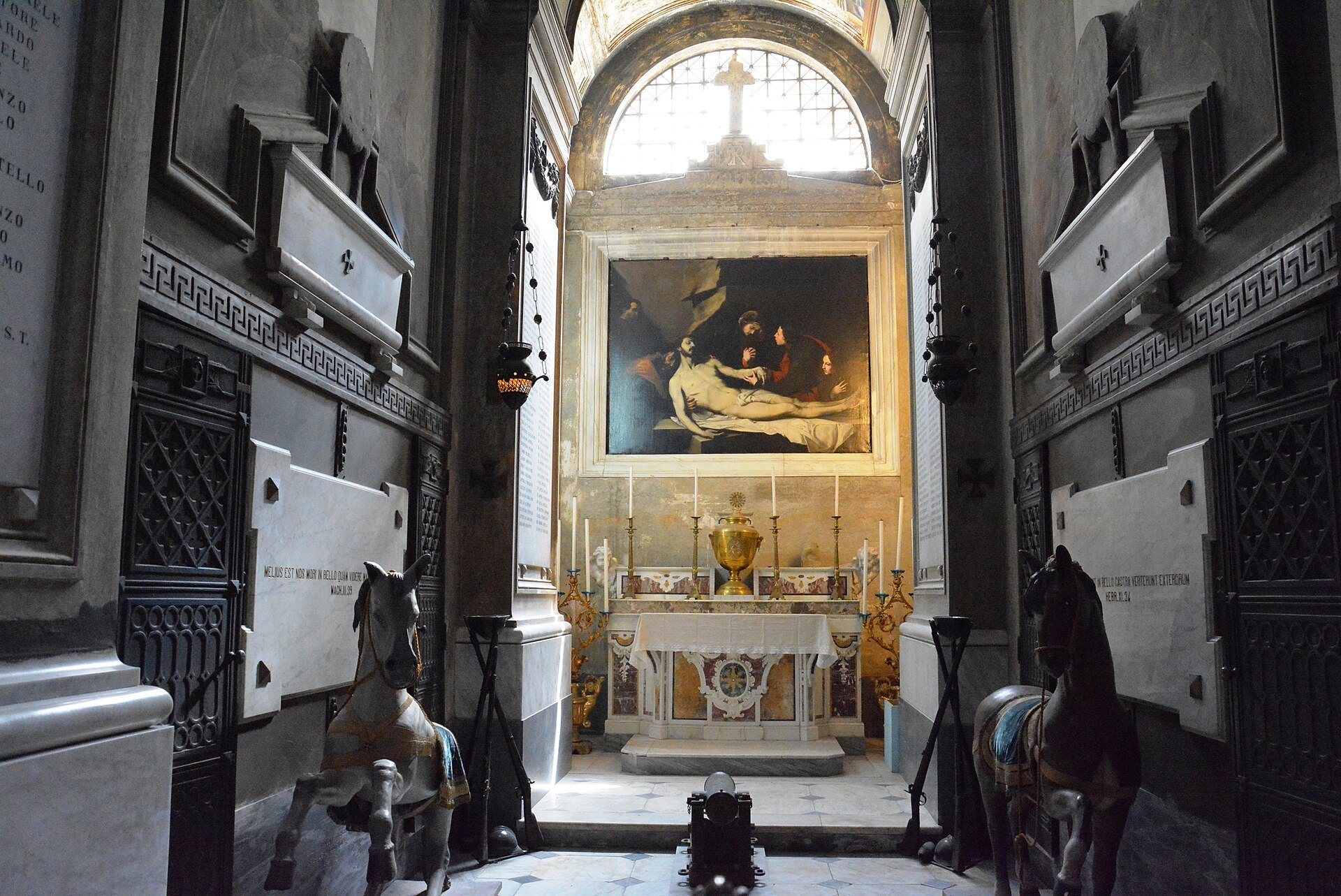
The Chapel of Ara Pacis, meaning Altar of Peace, was commissioned by the priest Raffaele Vanacore and built between 1924 and 1928 to a design by Giuseppe Pandolci. Originally dedicated to the Immaculate Conception, it became a memorial to the people of Stabia who died in the First World War. Six marble plaques list the names of Stabian soldiers who died in the conflict. Four helmets, six muskets, two shell casings, and a cannon stand near the altar.
The chapel contains a painting of the Descent from the Cross by Jusepe de Ribera, presented by a count to Bishop Sarnelli. Salvatore Franciosa painted its tempera frescoes in 1925. Other features include a votive lamp made by shipyard workers and an iron entrance gate bearing an inscription. The chapel was formerly the home of the Addolorata statue.
Right Transept and Chapel of Saint Joseph
The right arm of the transept is dedicated to Saint Joseph. A wooden statue by Reccia of Naples shows the aged saint in a purple robe and brown cloak, carrying the sleeping Jesus. Vincenzo Paliotti painted the 1890 frescoes of the Glory of Saint Joseph and the Patronage of the Saint. Another fresco shows the aged Joseph and King David.
Chapel of Saint Michael the Archangel
The Chapel of Saint Michael the Archangel has an octagonal plan and contains a marble statue of Saint Michael formerly located in the church of the same dedication on Mount Faito. The statue may be medieval. A tradition identifies it as a gift from Pope Gregory the Great to Saint Catellus in the sixth century, but that date remains traditional rather than established.
Temperas by Salvatore Cozzolino depict Saint Peter rescued from prison by the Archangel and Saint Michael expelling Satan from the tomb of Moses. The vault represents Jacob’s Ladder, the fall of the rebellious angels, angels summoning the dead to judgment, and the three angels appearing to Abraham. A wooden winter choir, made between 1904 and 1920 to Giovanni Rispoli’s design, was used by the Cathedral Chapter during the cold season.
Chapel of the Madonna dei Flagelli
The Chapel of the Madonna dei Flagelli contains a nineteenth-century statue of the Virgin and Child. Their faces, hands, and feet are wooden, while the rest of the figures is made from papier-mache. The chapel also contains a painting by Ribera of the Adoration of the Shepherds and a marble monument by Francesco Jerace commemorating Bishop Sarnelli. It was formerly known as the Chapel of the Nativity.
Sanctuary and Dome
Main Altar and Choir
The eighteenth-century main altar is decorated with coloured marble. Above it hangs Nunzio Rossi’s eighteenth-century painting of the Assumption. Seven half-length apostles appear in the scene, four looking into the empty tomb and three looking toward the Virgin on a cloud surrounded by putti and cherubs. Two anonymous eighteenth-century paintings on the sanctuary walls depict the Sacrifice of Isaac and Hagar seeing Ishmael dying in the desert of Beersheba.
A wooden choir from the church of La Pace in Castellammare di Stabia surrounds the main altar. It has two levels of seating, with the upper level for canons and the lower for abdomadaries. An iron ring for a candlestick appears in front of each stall. Five windows open in the vault above the altar, and their lunettes contain the Marian symbols Vas spirituale, Vas honorabile, Stella matutina, Rosa in Iericho, and Lilium convallium in a Byzantine style.
Sanctuary Frescoes and Dome
Three frescoes from 1888 depict Saint Joseph sleeping with Mary in contemplation, the Presentation of Mary in the Temple, and the Virgin crowned by Jesus. The central vault shows Mary rising from the tomb, while the four corners contain the Fathers of the ancient Church, Athanasius, Gregory Nazianzen, Basil, and John Chrysostom.
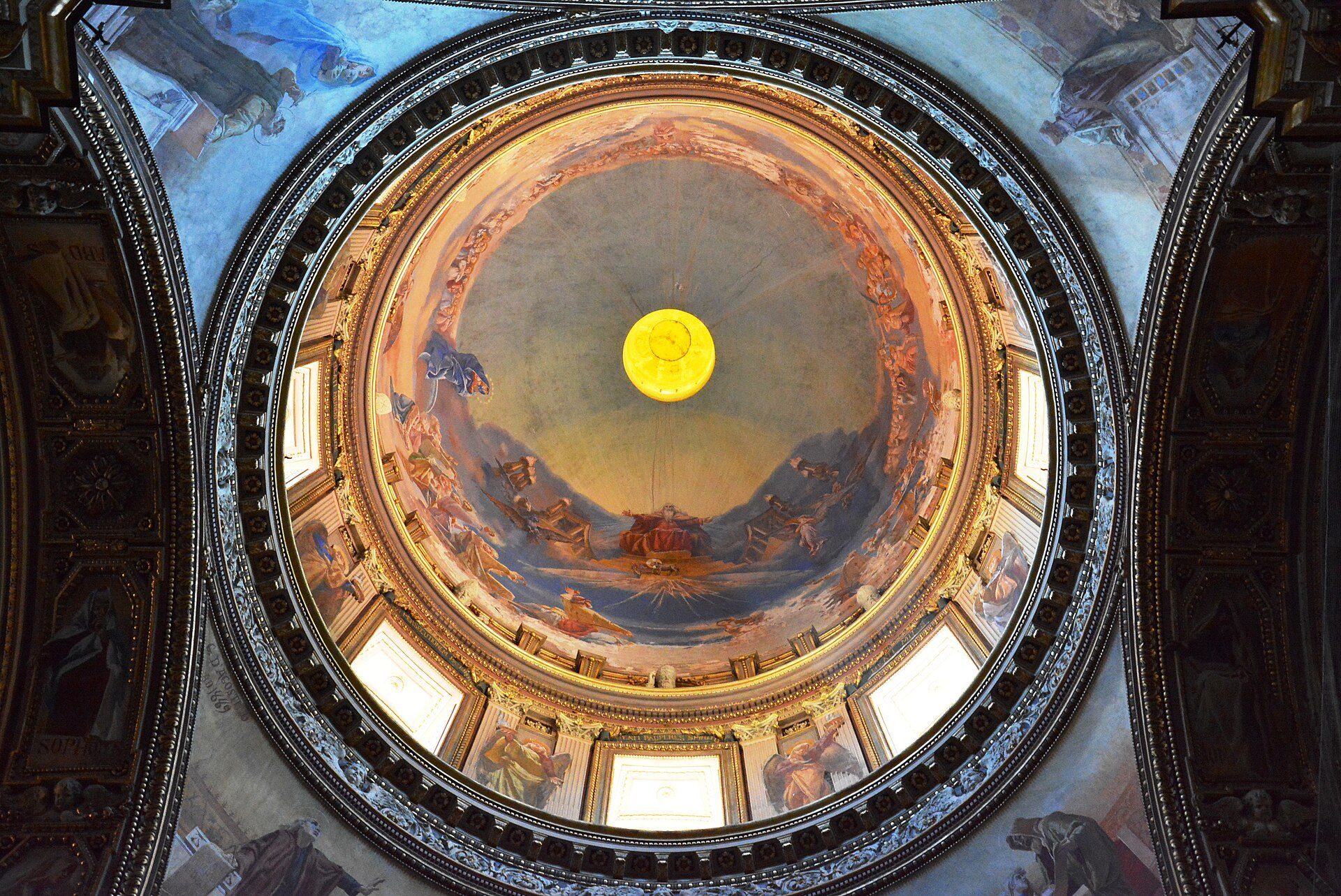
The dome rests on four pillars that form four large arches. Its coffers contain the sixteen major prophets. The interior depicts the Apocalypse and the four Evangelists, John with the eagle, Matthew with the angel, Luke with the ox, and Mark with the lion. Busts of eight bishops associated with the glorification of the Virgin Mary appear inside the dome: Pius V, Germanus, Peter Damian, Ildephonsus, Bonaventure, Anselm, Francis de Sales, and Alphonsus.