Kloster Falkenhagen: A Former Cistercian Nunnery in Germany
Site at a Glance
- Rating
- 4.2
- Popularity
- Very Low
- Country
- Germany
- Primary era
- Medieval
- Eras represented
- Medieval, Early Modern
- Civilizations
- Holy Roman Empire
- Site type
- Religious
- Remains
- Monastery
On this page14 sections
History
Kloster Falkenhagen is a former Cistercian nunnery in Germany, at the foot of the Köterberg in Falkenhagen, now a district of Lügde. Its history at Falkenhagen begins in 1246, and its Cistercian affiliation is recorded from 1247. The foundation emerged from a penance agreement between the counts of Schwalenberg and the Bishop of Paderborn after a conflict over rights to the monasteries of Gehrden and Willebadessen.
From Burghagen to Falkenhagen
Count Adolf I of Schwalenberg and Waldeck attacked Bishop Wilbrand of Paderborn, who responded by excommunicating him. During the feud, the Schwalenberg ancestral castle at Oldenburg was destroyed. On 14 April 1227, Adolf and his brother, Count Volkwin IV, promised to establish monasteries as penance and renounced several claims and rights connected with fortifications. Adolf fulfilled his part of the agreement by founding Marienthal at Netze in 1228.
Volkwin IV established an earlier monastery at Burghagen under the patronage of Saint John. Cistercian nuns from Eisenach joined the community, whose founding abbess was Kunigunde I of Schwalenberg. A church at Burghagen is mentioned in 1231, indicating that the monastery was founded between 1228 and that year. The location of Burghagen has been proposed at several places between Schwalenberg and Niese, including a field known as the deserted church, Berkenhagen northeast of Falkenhagen, and the Brink in what later became Rischenau’s Jewish cemetery. Ruins, oral tradition, the name of a nearby estate, and the later distribution of monastic property have supported some of these proposals, but the question remains unresolved.
Donations to the monastery and church at Burghagen were recorded in 1246. Between 1246 and 1249, the community moved to Falkenhagen for reasons that are not known. In 1249, Pope Innocent IV confirmed its rights under the name monasterium de Valleliliorum and recorded its new Marian patronage. The name Falkenhagen appears explicitly for the first time in 1251. A later tradition attributed the move to Volkwin IV, at the request of his daughter Abbess Kunigunde.
At Falkenhagen, the nuns called their monastery vallis liliorum, meaning “lily valley.” They followed the Cistercian interpretation of the Rule of Saint Benedict, which emphasized disciplined communal worship, prayer, and an austere religious life. Like many Cistercian women’s houses, however, the community was not formally incorporated into the Order of Cîteaux, which for a long period did not admit women’s monasteries. The church, dedicated to Saint Mary, Saint Alexander, and Companions, also served as the parish church. Kunigunde II of Schwalenberg, probably a daughter of Volkwin IV, is recorded as abbess in 1268 and 1298.
Destruction and the Order of the Holy Cross
The monastery began with modest endowments but strengthened its position through donations and indulgences, which in medieval Catholic practice were remissions of penalties associated with sin and were often connected with religious benefactions or pilgrimage. During the Everstein Feud, Falkenhagen was devastated around 1407, and the last nun living there fled to Brenkhausen.
In 1429, Wilhelmite brothers from Witzenhausen tried to settle in the ruined monastery at the request of Dietrich, Archbishop of Cologne and administrator of the Diocese of Paderborn. Their attempt failed. In 1432, Dietrich transferred Falkenhagen to the Order of the Holy Cross, a Catholic order whose communities combined communal religious life with pastoral and educational work. Because the former County of Schwalenberg was jointly administered by the noble lords of Lippe and the prince-bishops of Paderborn, the lords of Lippe confirmed the monastery’s old rights in 1446.
Reconstruction began in the fifteenth century but suffered repeated interruptions. The monastery was plundered during the Soest Feud in 1447, newly completed farm buildings burned in August 1479, and a plague outbreak in 1483 killed 29 monks within six months. Even during these setbacks, the choir of the new church was consecrated on 25 October 1483, followed by the consecration of the church on 21 October 1487.
Under Prior Heinrich of Bocholt, who led Falkenhagen from 1457 to 1495, the monastery became prosperous and was regarded as the largest and wealthiest house of the Order of the Holy Cross. In 1518, it housed 89 members, including 27 priests. From 1522, the community helped resettle deserted villages in the surrounding area. A new cloister, the covered walkway around a monastic courtyard, and a cemetery were consecrated in 1533.
Reformation, dissolution, and later Catholic use
The community remained Catholic during the Reformation. In 1542, it rejected the Lippe church ordinance and supplied a brother for Lutheran worship only under compulsion. Plague struck again in 1555, killing all but two lay brothers and leaving the monastery severely weakened. Protestant surroundings did not provide enough novices for renewal, so in 1596 Prince-Bishop Dietrich von Fürstenberg of Paderborn and Count Simon VI of Lippe agreed to dissolve the monastery. Six priests and three lay brothers remained at that time, and the property was divided between Paderborn and Lippe.
In 1604, Paderborn transferred its share, including all the farm buildings, to the Jesuits, members of the Society of Jesus, a Catholic order founded in the sixteenth century that became active in education and Counter-Reformation work. The church and conventual buildings went to Simon VI of Lippe, who installed a Lutheran preacher. He was forced to leave Falkenhagen during disturbances in the Thirty Years’ War, the seventeenth-century conflict that devastated much of Central Europe. The congregation has been Evangelical-Reformed since 1649.
After 1609, the Jesuits helped return parts of neighboring Protestant communities to Catholicism, in some cases reaching about half of their inhabitants. The converted Count Hermann of Lippe granted them a substantial bequest in 1620. During the Thirty Years’ War, the Jesuits occupied vacant monastery buildings but later left them. On their property, they consecrated a separate church in 1695.
Friedrich Spee of Langenfeld stayed at Falkenhagen for extended periods in 1629 and 1631. The German Jesuit priest and writer is traditionally associated with work there on Cautio Criminalis, his anonymously published 1631 criticism of witch persecution, torture, and coercive judicial methods. On the night of 9 February 1631, Spee and the coadjutor Henricus Mejer helped end a bandit attack on the monastery. A coadjutor was an assistant to priests or senior members of a religious community, often without full priestly status.
The monastery’s history ended with the suppression of the Jesuit order in 1773. A legal dispute over the former possessions between Paderborn and Lippe reached the Imperial Aulic Council, the supreme judicial body of the Holy Roman Empire, and was settled by compromise.
Remains
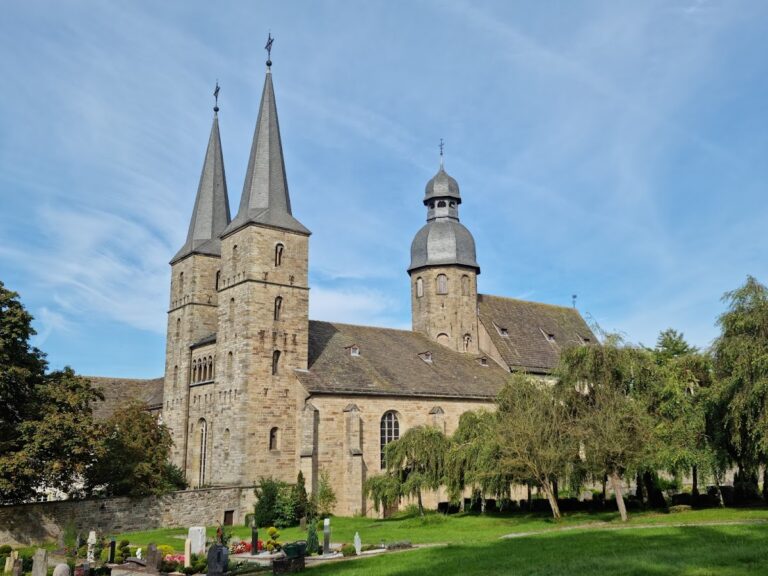
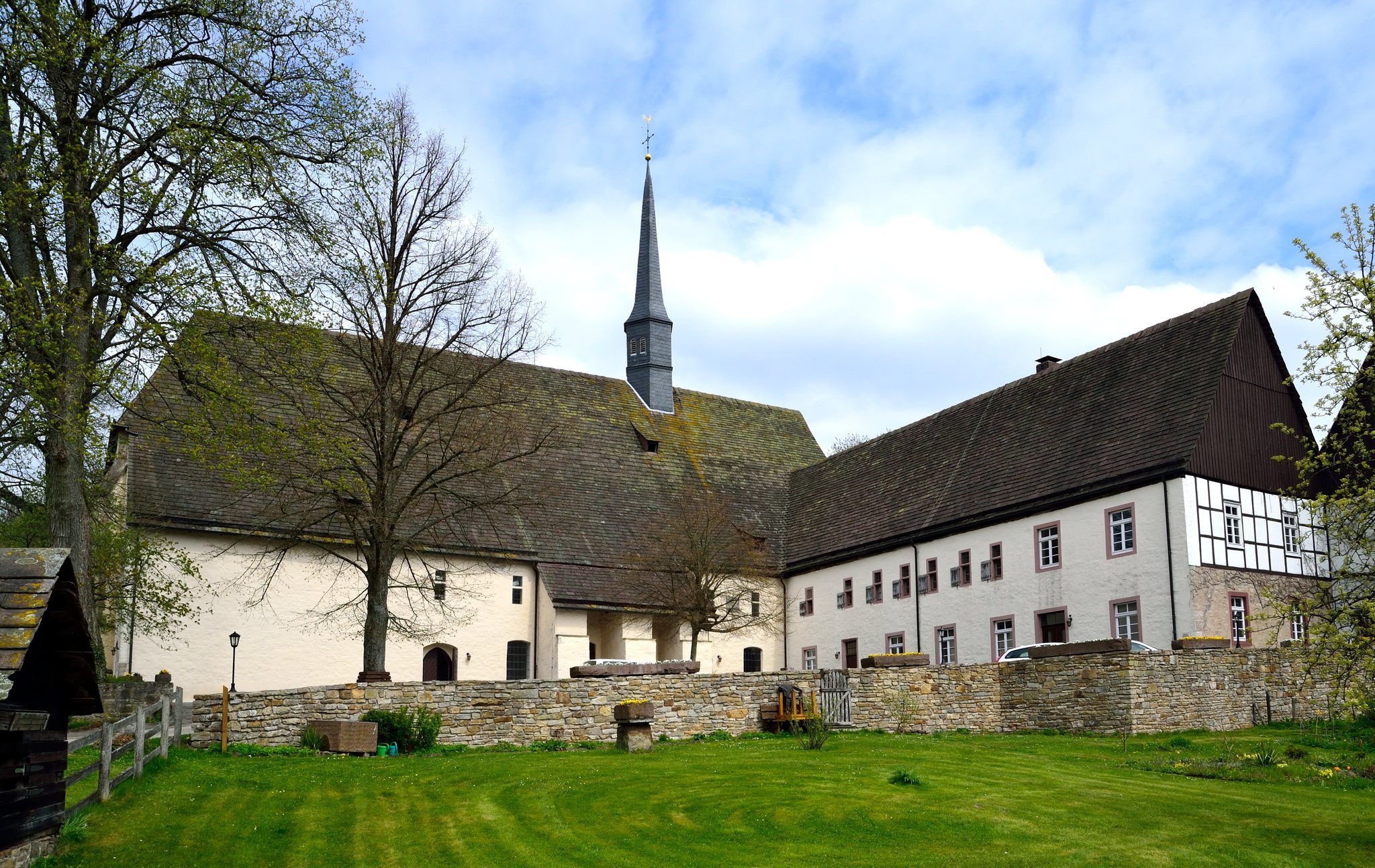
The surviving buildings form the remains of a monastery whose church was consecrated in 1487 and whose later structures reflect the changing division between Catholic and Evangelical-Reformed use. The complex includes the former monastery church, a surviving cloister wing, the dormitory, chapter house, priory building, and a later Catholic church created from a residential structure.
Church and cloister buildings
Former monastery church
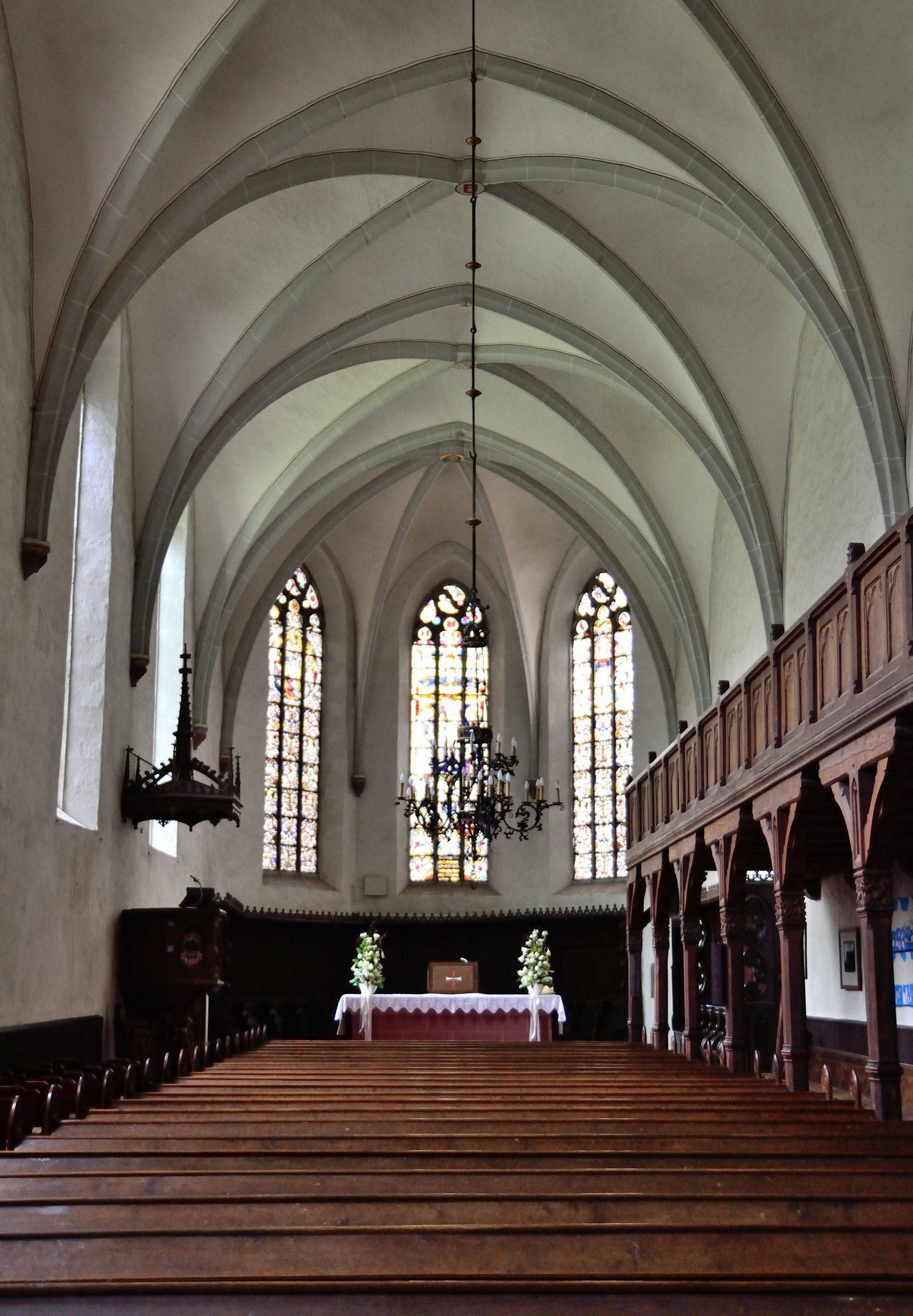
The former monastery church, consecrated in 1487, now serves as an Evangelical parish church. Three choir windows retain stained glass from about 1500, and choir stalls from the same period also survive. Their presence preserves elements of the late-medieval church interior associated with the Order of the Holy Cross.
Cloister wing and chapter house
A surviving wing of the cloister stands south of the church. The cloister was the covered walkway linking the principal monastic buildings around an enclosed courtyard. The chapter house has also survived. This was the room in which the community met for administrative decisions, discipline, and the reading of religious rules.
Residential and later religious buildings
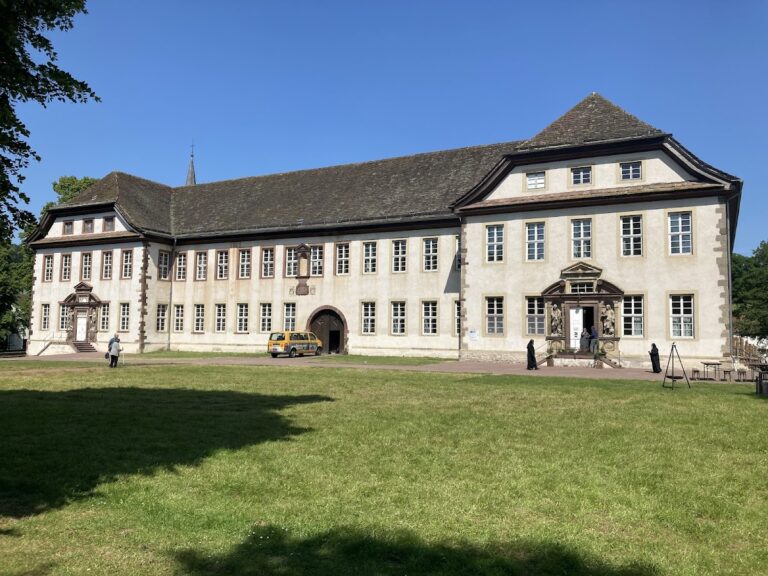
Dormitory and rectory
The two-storey dormitory was built in 1509 and survives as a rectory. Its late-medieval half-timber framework is characteristic, and the building is regarded as the oldest half-timbered building in Lippe.
Priory building
West of the church stands the half-timbered priory building, constructed in 1581. It now serves as the Catholic rectory, retaining the building’s connection with the later Catholic ownership of part of the former monastery complex.
Church of Saint Michael
A massive residential building was converted into the Church of Saint Michael in 1695 and serves as the Catholic parish church. An alteration in 1929 changed its character only slightly.
Memorial
Friedrich Spee memorial stone
A memorial stone at Falkenhagen commemorates Friedrich Spee’s association with the monastery and his opposition to witch persecution and torture.