Murbach Abbey: A Benedictine and Prince-Abbey in France
Site at a Glance
- Rating
- 4.6
- Popularity
- Low
- Country
- France
- Primary era
- Medieval
- Eras represented
- Medieval, Early Modern
- Civilizations
- French, Holy Roman Empire
- Site type
- Religious
- Remains
- Monastery
On this page15 sections
History
Murbach Abbey is a former Benedictine monastery in France, located in the Murbach valley of southern Alsace. Founded in 727 by Eberhard, Count of Alsace, of the Etichonid dynasty, it became a major religious, intellectual, and political institution of the Upper Rhine. Its community followed the Rule of Saint Benedict, a system of communal monastic discipline, and the abbey later became a prince-abbey whose abbot held the rank of a prince of the Holy Roman Empire.
Foundation and royal protection
Eberhard endowed the new monastery with property in about 40 settlements between the Burgundian Gate and Hagenau. He was probably buried at Murbach in 747. Saint Pirmin, a missionary bishop associated with the foundation and reform of monasteries in the southwestern German-speaking regions, organized the community with twelve monks from Reichenau and became its first abbot. The monastery was initially known as Vivarius Peregrinorum, meaning “the pilgrims’ pond” or “wandering monks.”
A later tradition placed Irish or Scottish missionary monks in the region before Murbach was founded, first near Bergholtzzell and later in the Murbach valley. This tradition appears in the fifteenth-century Annales Murbacenses, although the alleged activity is not documented. In 728, Bishop Widegern of Strasbourg confirmed Murbach’s inclusion in the Strasbourg diocese while granting it exemption from episcopal control. The monastery could elect its abbot from within the community and retain ownership of its endowments. Frankish royal privileges later confirmed its immunity and possessions.
Murbach was dedicated to Saint Leodegar of Autun, a seventh-century bishop and martyr, and was also placed under the protection of the Apostles, the Virgin Mary, Saint Michael, and Saint Peter. The lower jaw of Saint Leodegar reached Murbach as a relic in 760. It may have remained partly at the abbey or may have been transferred in 1785 to the collegiate church at Guebwiller.
Under the Carolingians, Murbach acquired a close relationship with royal power. Charlemagne confirmed its immunity in 775, made it a royal abbey, and held the secular title Pastor Murbacensis for about a year in 792–793. The office of advocate, which represented and protected the abbey, later became hereditary in the Habsburg family. After the division of the Carolingian realm, Murbach successively fell within the kingdom of Lothair I and the East Frankish kingdom, and later within the Holy Roman Empire, whose ruler became its direct protector.
Intellectual and territorial growth
Abbot Simbert, active around 786–792, introduced stricter Benedictine discipline and higher educational standards. By the mid-ninth century, Murbach had become an important intellectual and spiritual center of the Upper Rhine. Its school attracted clerics who later held important positions, while its library and scriptorium, the monastery’s writing and copying room, produced theological, grammatical, historical, and liturgical works. A library catalogue listed roughly 340 works, and a later copy of the catalogue survives in Colmar.
The abbey maintained a prayer association with Reichenau, Remiremont, Saint Gall, and San Salvatore in Brescia. Its workshops included goldsmiths and later textile workers who produced tapestries. Its possessions expanded to about 350 settlements, mainly in Alsace but also across the Rhine, in the Black Forest, the Palatinate, the Worms and Mainz regions, and around Lake Lucerne. The Benedictine house at Lucerne became a Murbach possession in the ninth century, and the settlement around it later developed into the city of Lucerne.
Hungarian forces attacked Murbach during raids in July 926. They plundered and burned the monastery and killed seven monks, who were venerated as martyrs. Regular communal life resumed only in 959, after 23 years without an abbot. Imperial donations and confirmations then supported renewed growth.
Murbach was associated with several important early German literary and historical works. The Murbach Hymns contain interlinear Old High German glosses, explanatory words written between the lines of Latin liturgical texts for monks and novices. The original manuscript was lost during the Thirty Years’ War, while a later copy survives in Oxford. The Wessobrunn Prayer may have been written at Murbach, and part of the Annales Alamannici was compiled there. In 1515, a manuscript of Velleius Paterculus’s historical work was discovered at the abbey. The original is lost, but a damaged copy made from it survives.
Prince-abbey and medieval power
During the eleventh century, Murbach developed connections with the reform movements of Cluny and Gorze. Abbot Samuel of Weißenburg governed both Murbach and the monastery of Saint Gregory at Munster. Abbot Erlolf of Bergholz advised Emperor Henry V and took part in negotiations that led to the Concordat of Worms in 1122.
During the twelfth and thirteenth centuries, Murbach reached a second peak of political and economic influence. It founded or acquired dependent religious houses, including Bergholtzzell in 1006, Goldbach in 1135, Saint-Amarin, and institutions connected with Lucerne. Around 1178, Abbot Conrad of Eschenbach granted urban rights to the settlement around the Lucerne priory.
The Habsburgs exercised formal advocacy over Murbach from 1135 through Werner II of Habsburg. In 1259, the abbey bought back the advocacy rights from the Habsburgs and their vassals, ending their direct legal control over this aspect of the monastery’s administration. In 1228, Emperor Frederick II designated Abbot Hugh of Rothenburg as princeps. Murbach thereby became a prince-abbey, and its abbots held a seat and vote on the imperial council of princes until the institution was dissolved.
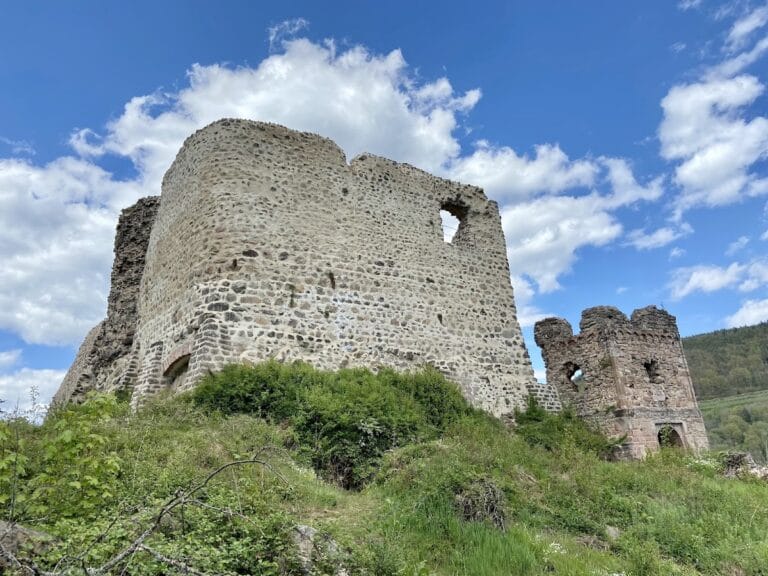
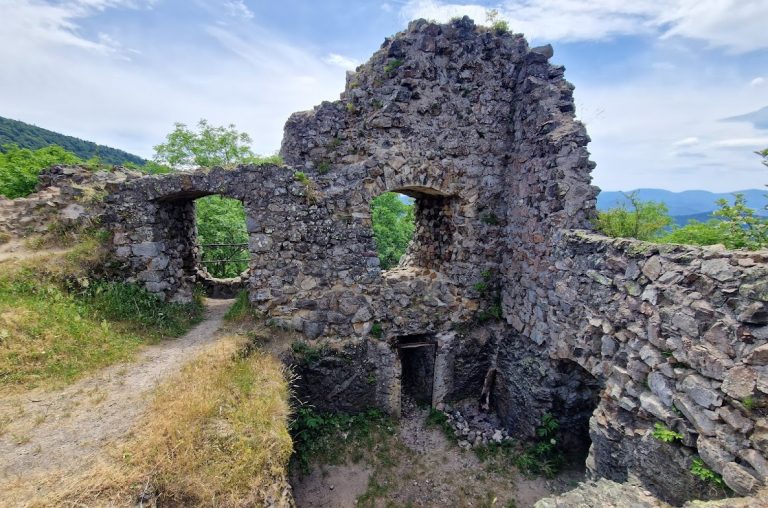
Murbach protected its medieval territory through a network of castles and urban fortifications. About 25 castles were built during the Middle Ages, including Hugstein near Guebwiller, Friedbourg near Saint-Amarin, Hohrupf in the Murbach valley, and Hirtzenstein near Wattwiller. The abbey also financed fortifications at Guebwiller, Wattwiller, and Saint-Amarin.
Decline, collegiate life, and early modern rule
After the decline of the Hohenstaufen dynasty in the late thirteenth century, Murbach’s political influence and finances deteriorated. It relinquished or sold distant possessions near Mainz, Delle, and eventually Lucerne. In 1291, it transferred Lucerne and other Swiss possessions to the Habsburgs in exchange for five Alsatian villages and 2,000 marks of silver.
In 1335, the abbot and the remaining thirteen monks formally ended communal monastic life. The abbey’s revenues were divided into prebends, endowments assigned to members of a collegiate institution, and its members adopted a canonical collegiate way of life. Murbach nevertheless retained its status as a small ecclesiastical principality. Abbot Bartholomeus von Andlau, who governed from 1447 to 1476, reorganized the administration, archive, and library and divided the territory into the offices of Guebwiller, Saint-Amarin, and Wattwiller. In 1448, he defeated a revolt by the citizens of Guebwiller and strengthened the abbey’s territorial authority.
Murbach’s interests included timber, metal mining, trade, tolls, markets, glass production, and silver mining. The permanent union with Lure, a Benedictine abbey west of the Vosges confirmed by papal action in 1544, gave Murbach control of the silver mines at Plancher-les-Mines. In the same year, Emperor Charles V granted the abbey the right to mint coins. The mint operated at Guebwiller until 1680, with a brief resumption after the Thirty Years’ War.
During the Reformation, Abbot Georg von Masmünster suppressed Protestant preaching in Murbach’s territory. In 1524, Lutheran citizens of Guebwiller were executed at Hugstein, and the territory remained Catholic. During the Peasants’ War of 1525, the abbot and monks fled to Lure. Murbach itself was not attacked, but Guebwiller was affected by the revolt. Georg von Masmünster negotiated a settlement that restored loyalty to the abbey while imposing relatively moderate penalties. Wattwiller and Uffholtz later defended themselves against rebel forces.
From 1587, emperors increasingly appointed commendatory abbots. These officeholders received the revenues and formal authority of an abbey without necessarily living there or directing its religious community. Cardinal Andreas of Austria became Murbach’s first such abbot, and the system continued for almost two centuries, contributing to disputes involving the community, the papacy, imperial authorities, and later France.
War, French control, and dissolution
The Thirty Years’ War brought occupation, military requisitions, plundering, fires, and the dispersal of the community. Monks fled to other monasteries, while archives, relics, and valuables were moved to Besançon and Breisach. The library was taken to Wildenstein Castle, where much of it was later plundered. Murbach remained deserted until about 1650, and only one of the resident Murbach monks is said to have survived the war.
The Peace of Westphalia in 1648 formally preserved Murbach’s status as a territory immediately subject to the Holy Roman Empire, meaning that it answered directly to the emperor rather than to a regional lord. France nevertheless acquired effective control in 1680 under Louis XIV’s reunification policy. The abbey retained considerable internal administrative and economic autonomy for a time, but its political independence progressively diminished.
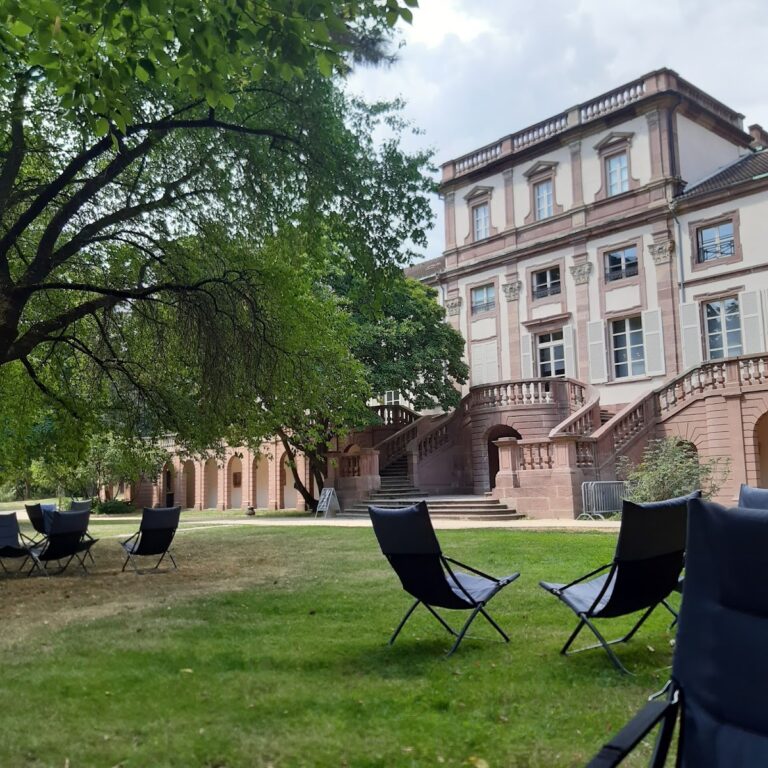
From the late seventeenth century, improved finances supported repairs, new construction, parish restoration, a water-control project on the Lauch, and a glassworks in the Saint-Amarin valley. Murbach also constructed the Neuenburg residence at Guebwiller and transformed a former summer residence into the Wesserling hunting palace.
The community attempted to move from the isolated Murbach valley to Guebwiller. The monks moved there in 1759, and a papal bull secularized Murbach and Lure in 1764 as a collegiate institution of twelve noble secular canons. The new collegiate church of Notre-Dame at Guebwiller was consecrated in 1785. The relic of Saint Leodegar may have been transferred there at that time.
The French Revolution abolished the principality’s feudal and judicial privileges, nationalized its property, and incorporated its territory into the department of Haut-Rhin. The collegiate chapter was dissolved, Murbach Abbey ceased to exist in 1790, and the last prince-abbot and most of the canons left France.
Remains
The former abbey lies in a side valley of the Murbach stream, which flows toward the Lauch in the Florival valley. The site stands at about 450 metres above sea level on the eastern side of the Vosges, below the Grand Ballon, whose summit reaches 1,424 metres. The original monastic buildings and first large abbey church cannot be securely located or reconstructed from the surviving evidence. Medieval images are unreliable for this purpose, and the earliest known depiction of the church, in a fourteenth-century psalter, is highly stylized.
Romanesque church
Saint Leodegar’s church
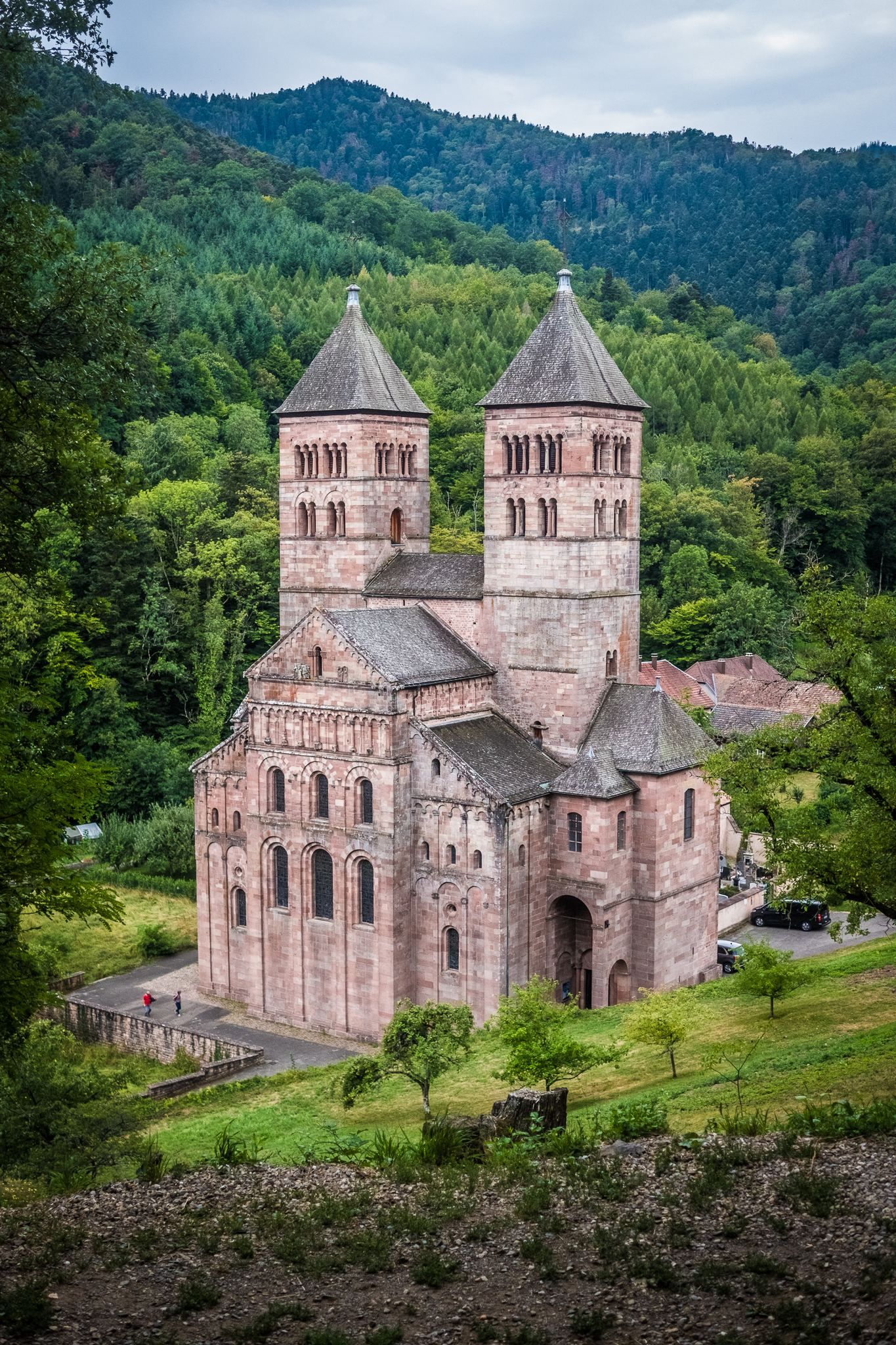
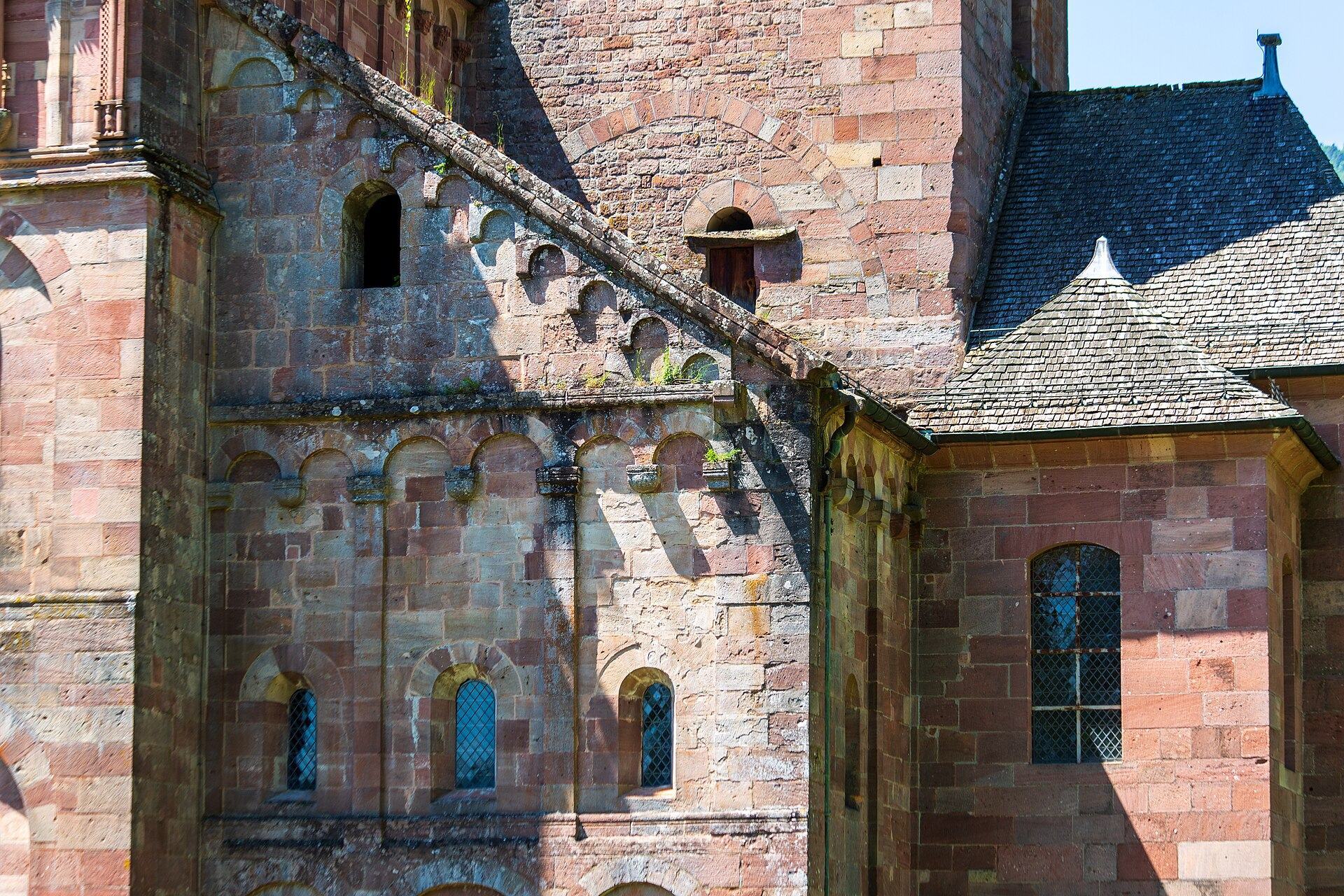
The surviving eastern section of the twelfth-century abbey church of Saint Leodegar is the principal architectural remnant of Murbach. The building was a major Romanesque work in the Upper Rhine and among the early vaulted Romanesque churches. Its construction is generally placed in the mid-twelfth century, although the precise date remains debated. An oratory was dedicated in 1134, the church was sufficiently advanced by the later twelfth century to influence other Romanesque buildings, and the completed church was consecrated in 1216.
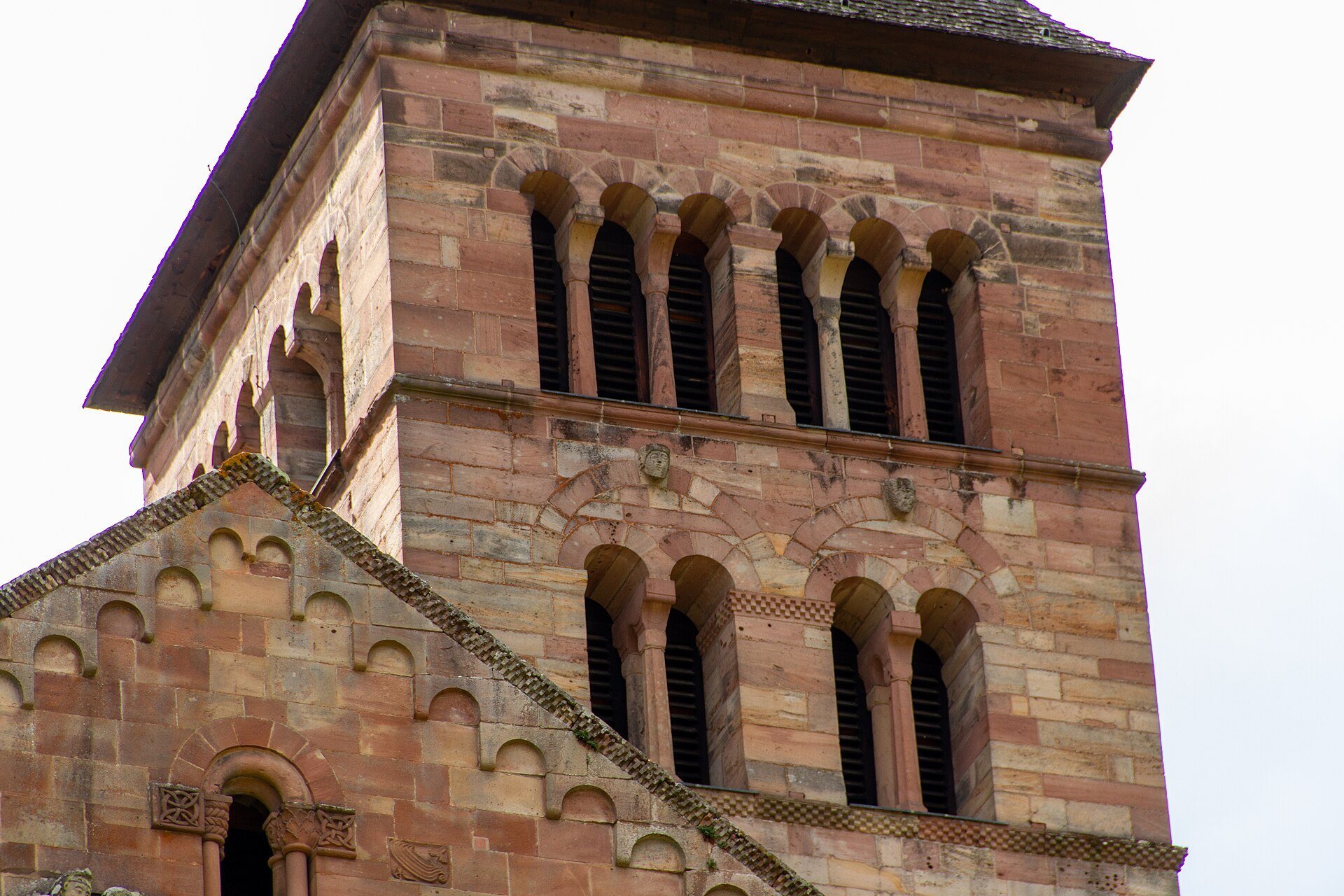
The church originally consisted of three naves, a transept, an eastern choir, and two tall sandstone towers rising above the transept. Its ribbed cross-vaults used intersecting arches whose ribs supported the vaulting surfaces, a technique associated with developments in Lombardy and other twelfth-century Upper Rhine buildings. The church was dedicated to the Holy Trinity, the Holy Cross, the Virgin Mary, and Saint Leodegar, while retaining the earlier altar dedications and patrons of the preceding church.
Surviving eastern section
From 1738 onward, the nave and much of the western part of the church were dismantled for a planned Baroque rebuilding that was never completed. By the mid-1760s, the nave walls had largely been demolished or had collapsed, and their stones were reused in the presbytery of the former collegiate church at Lautenbachzell. The former nave site is now a cemetery.
The choir and transept with their two towers were transferred to the municipality of Murbach in 1764 and became the parish church. The church was restored in 1868–1869, 1900–1905, 1964–1966, and 1981–1986. The last restoration added two bronze doors and three bells. A gallery organ made by Martin and Joseph Rinckenbach was installed in 1906.
Sarcophagus of the seven monks
By the northern side altar stands the sarcophagus associated with the seven monks killed during the Hungarian attack of 926. Its front slab dates from the twelfth century and its upper slab from the early eighteenth century. The present form of the sarcophagus is not original.
Gatehouse and associated buildings
Former entrance gate
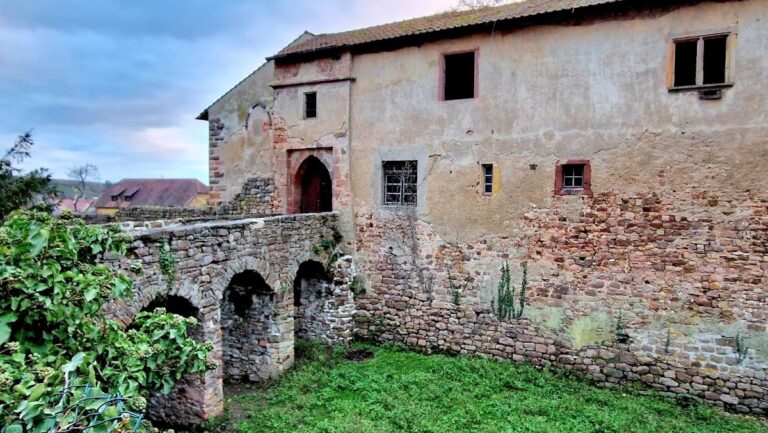
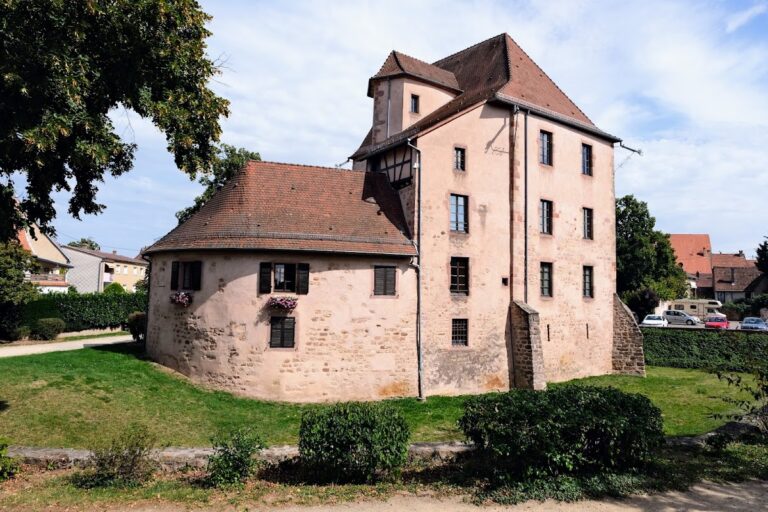
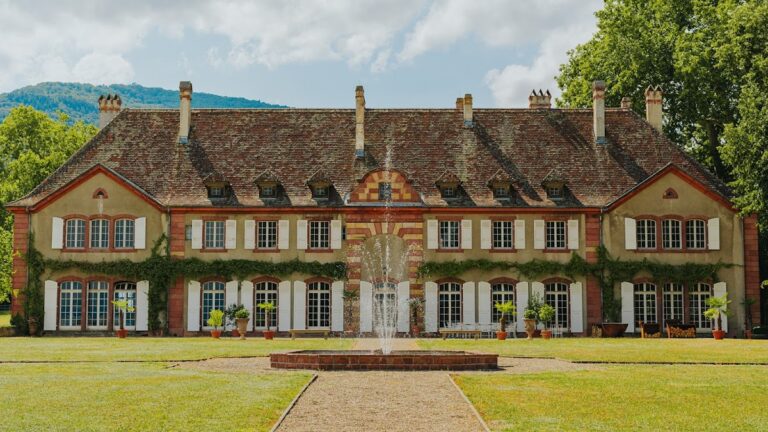
The remains of the abbey include the former entrance gate or gatehouse and associated buildings dating from the first half of the eighteenth century. The entrance porch bears the arms of the prince-abbot, a leaping black dog with a gold collar on a shield. Traditionally called the “dog of Murbach,” the emblem later became the coat of arms of the municipality and appears in the arms of several former Murbach possessions.
Loretto Chapel
The Loretto Chapel stands on the slope above the monastery and was built in the late seventeenth or early eighteenth century. It forms part of the surviving architectural remains associated with the former abbey.
Surviving manuscripts and protection
Objects and manuscripts associated with Murbach survive in other collections. The Murbach Hymns are preserved through a later copy in Oxford. An eighth-century manuscript of the letters of Saint Jerome from the Murbach scriptorium is held in the intercommunal library at Epinal. The lost manuscript of Velleius Paterculus survives only through a damaged copy made from it.
The former abbey’s physical remains and church are protected as historic monuments in France. The church was classified in 1841, while the former gatehouse, entrance portal, and associated buildings received additional protection in 1985.